1Introduction
A rate card tells you almost nothing about whether a wholesale VoIP termination provider can actually deliver your calls. Two providers quoting the same $0.006/min to a destination can produce wildly different outcomes on your traffic — one connects 75 out of 100 attempts, the other connects 45. The only way to tell them apart before you sign is to read the technical quality data: ASR, PDD, CLI delivery, and route tier documentation.
This guide skips the general "how to choose a provider" checklist and goes straight to the metrics that actually predict route performance. You will learn what ASR and PDD mean in practice, how route tiers like Premium CLI, Standard, and LCR trade quality for cost, how CLI delivery guarantees are verified rather than assumed, and exactly what to ask for — live dashboards, test call data, trial volume — before you move production traffic onto a new route.
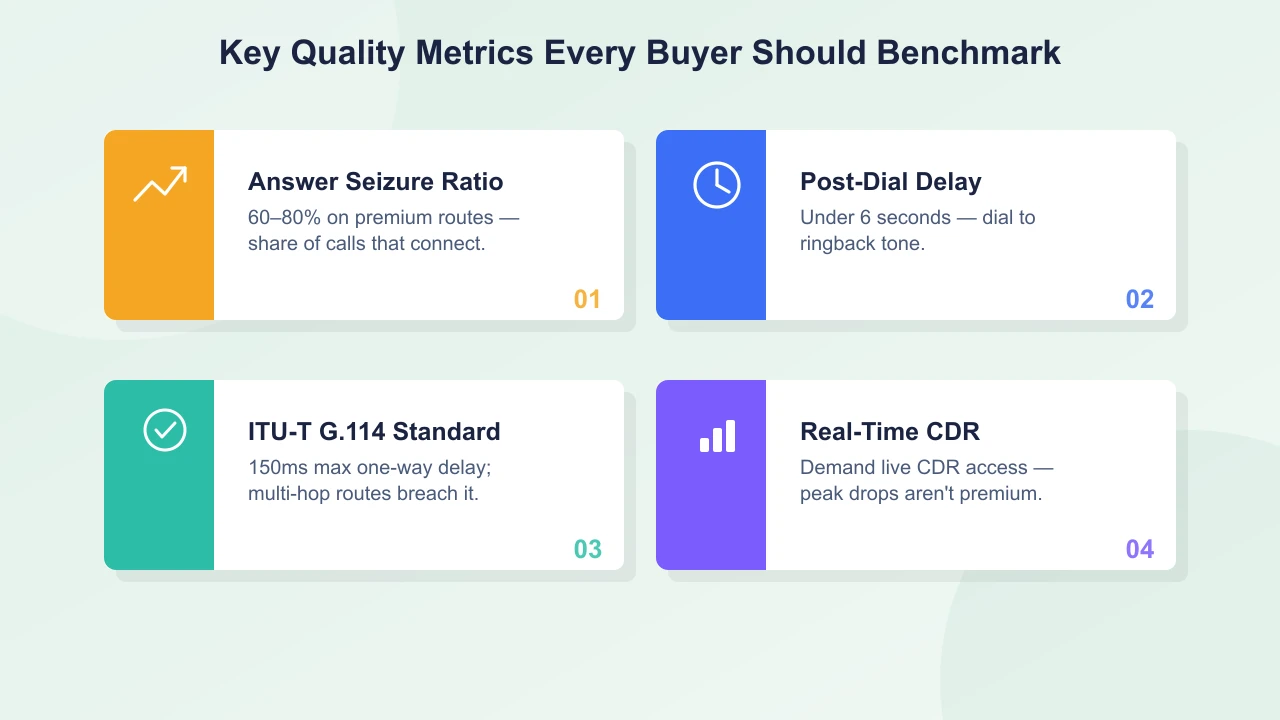
Judge route quality on measured data, not marketing: ASR of 60–80% and PDD under 6 seconds on Premium CLI routes, 45–65% ASR on Standard, and sub-45% ASR with variable PDD on LCR. Always request a live test window and real-time dashboard access — CDR-level data over rate-card promises — before committing volume to any route.
2Answer-Seizure Ratio (ASR): The First Number to Demand
ASR (Answer-Seizure Ratio) is the percentage of call attempts (seizures) that result in an actual answer at the destination. If a provider sends 1,000 call attempts to a route and 620 are answered, the ASR is 62%. This single number is the fastest signal of route health, but it only means something when you know what "normal" looks like for the destination and route tier you are buying.
ASR is destination-sensitive: mobile-heavy markets in parts of Africa or the Pacific naturally run lower ASR than fixed-line-dominant corridors like the US or Western Europe, simply because more attempts hit unreachable or switched-off handsets. Never compare ASR across two different destinations as if they were the same route class — compare a provider's ASR on your specific destination against another provider's ASR on that same destination.
Also separate ASR from NER (Network Effectiveness Ratio), which excludes user-side failures like "busy" or "no answer" and isolates network-caused failures — congestion, routing loops, and carrier-side rejects. A route with low ASR but high NER usually means your calling list has bad numbers; a route with low ASR and low NER means the carrier's network is the problem. Softtop's Voice Termination reporting breaks out both figures per destination so you can tell which one you are actually looking at.
3Post-Dial Delay (PDD): Why Milliseconds Determine Abandonment
PDD (Post-Dial Delay) measures the elapsed time between the last digit dialed and the caller hearing ringback or the call being answered. It is a signaling-path metric, not a media-quality metric, and it directly predicts hang-up-before-connect behavior: callers who wait more than 3–4 seconds in silence start abandoning, and by 8 seconds abandonment rates climb sharply on outbound dialer traffic.
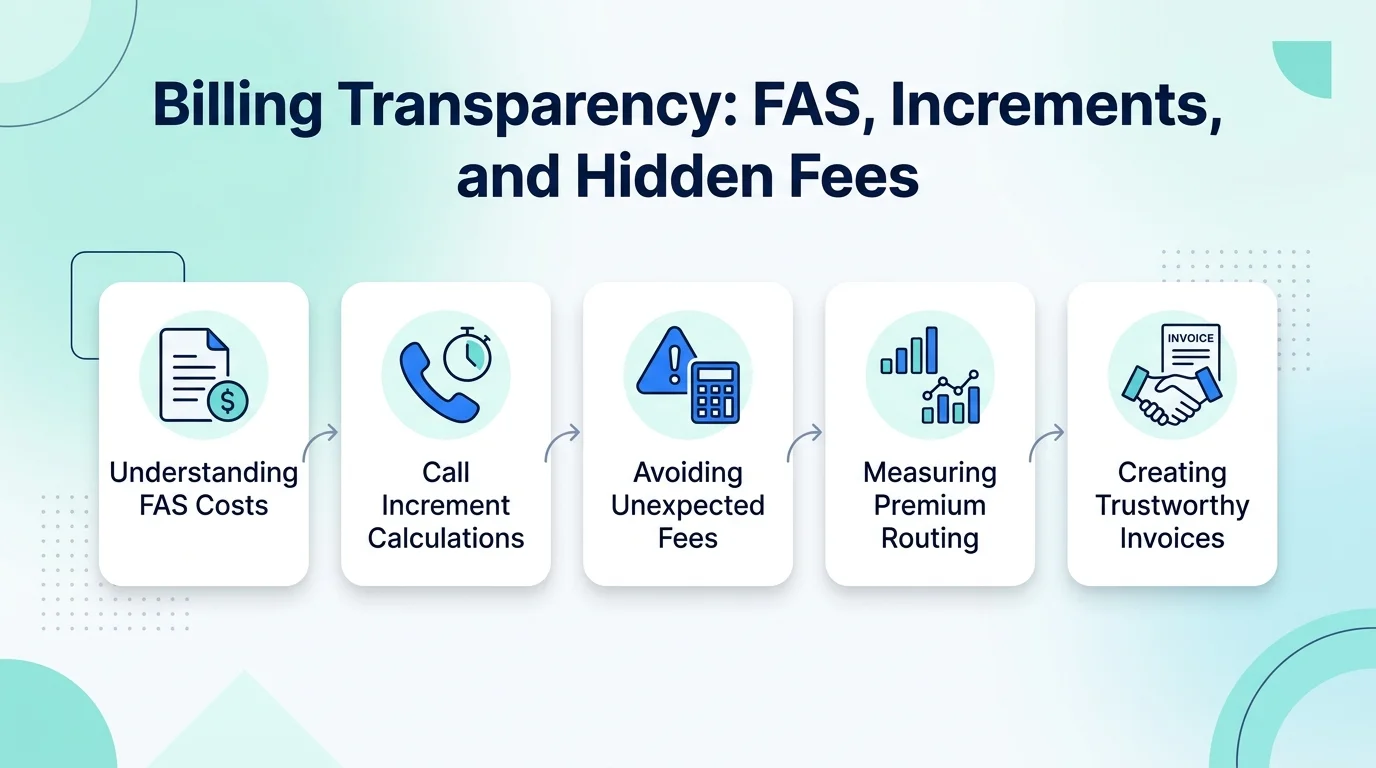
PDD accumulates across every SIP hop in the call path: each additional carrier the call transits before termination adds signaling processing time. A route with two intermediary hops can add 1–3 seconds of PDD versus a direct Tier-1 interconnect with none. On a Premium CLI route, PDD should stay under 6 seconds; anything consistently above that suggests multi-hop routing regardless of what the provider's sales material claims about "direct" connectivity.
When you request test data, ask specifically for PDD distribution, not just an average. A route averaging 4 seconds but spiking to 12 seconds during peak hours will look fine on a summary report and behave badly in production. Predictive dialers are especially sensitive to this variance because they pace outbound attempts based on expected connect timing.
4Route Tiers Explained: Premium CLI, Standard, and LCR
Wholesale voice routes are typically sold in three tiers, and understanding what each one actually guarantees — versus what it merely allows — is central to reading a rate card correctly. Premium CLI routes preserve caller ID end-to-end, run over direct or near-direct Tier-1 interconnects, and typically deliver 60–80% ASR with sub-6-second PDD. Standard routes accept a mix of direct and lightly-aggregated paths, landing around 45–65% ASR with more PDD variance. LCR (Least Cost Routing) routes are selected purely on price by the underlying carrier's routing engine and can shift path — and therefore quality — hour to hour without notice.
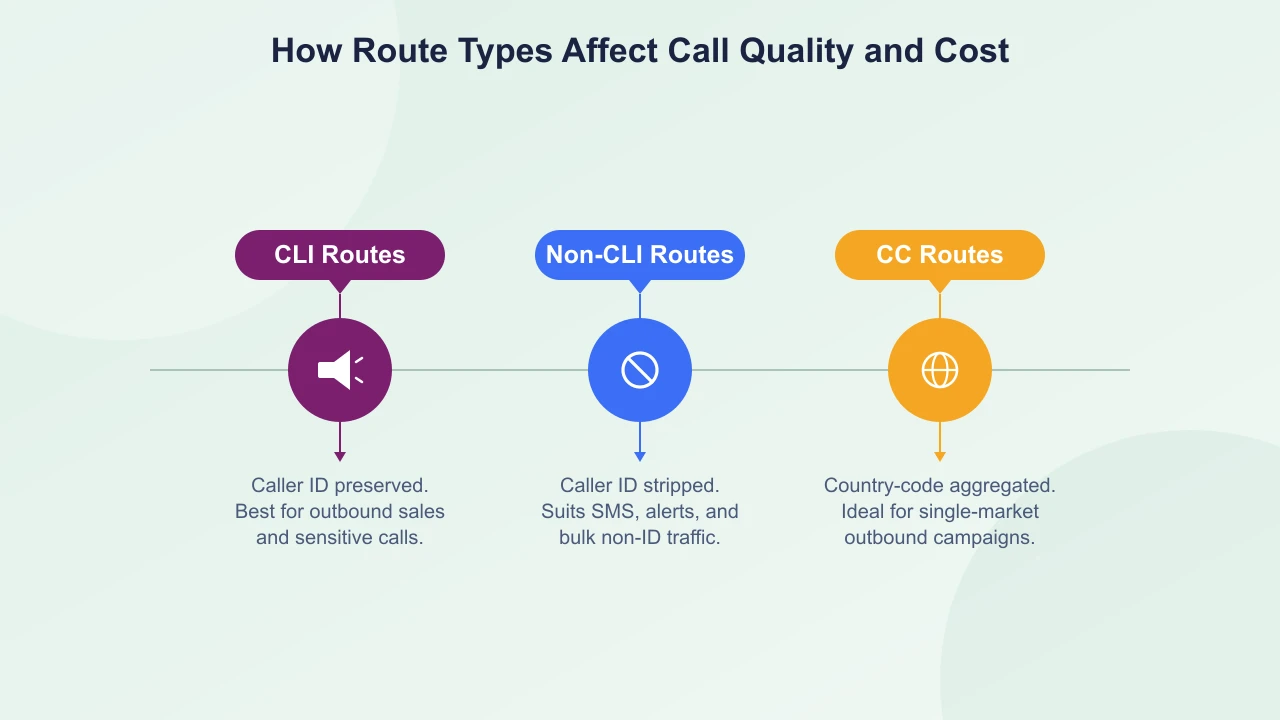
The practical risk with LCR is not the average quality — it is the volatility. Because the underlying carrier can re-route your traffic to a cheaper interconnect at any time, a route that tested well on day one can degrade by day thirty with no change on your end. Explore CLI Routes for destination-level tier availability and current benchmark ranges before choosing a tier for high-value traffic.
A useful rule of thumb: match tier to traffic value, not just budget. Outbound sales, customer callbacks, and anything where the recipient's trust in the call matters should run on Premium CLI. Bulk notifications, OTP callbacks, and disposable traffic where occasional drops are tolerable are reasonable candidates for Standard or LCR.
5CLI Delivery Guarantees: Verifying Caller ID Survives the Path
A "CLI route" is only as good as its weakest hop. Caller ID can be stripped, rewritten, or flagged anywhere along the signaling path, and a provider claiming CLI preservation on paper does not guarantee it holds in practice. STIR/SHAKEN attestation data is the objective way to check this: an A-level attestation confirms the originating carrier both authenticated the customer and verified authorization to use that calling number, while B or C-level attestation signals a weaker verification chain that downstream carriers and spam-analytics engines increasingly discount.
Ask any prospective provider for their attestation pass-rate by destination, not just a statement that they "support STIR/SHAKEN." A provider running 95%+ A-level attestation on US traffic is verifiably different from one running 60%, and that gap shows up directly as reduced spam-labeling and higher answer rates. The FCC's call authentication framework documents how attestation levels are assigned and why they increasingly affect call delivery outcomes even outside strict regulatory contexts.
6Requesting Live Quality Dashboards and Test Data Before You Commit Volume
Every claim in this guide should be verified against real numbers before you route production volume through a new provider. Request a supervised test window — a minimum of 500–1,000 call attempts on your actual top destinations, not a generic sample route — and ask the provider to grant temporary dashboard access rather than emailing you a static report.
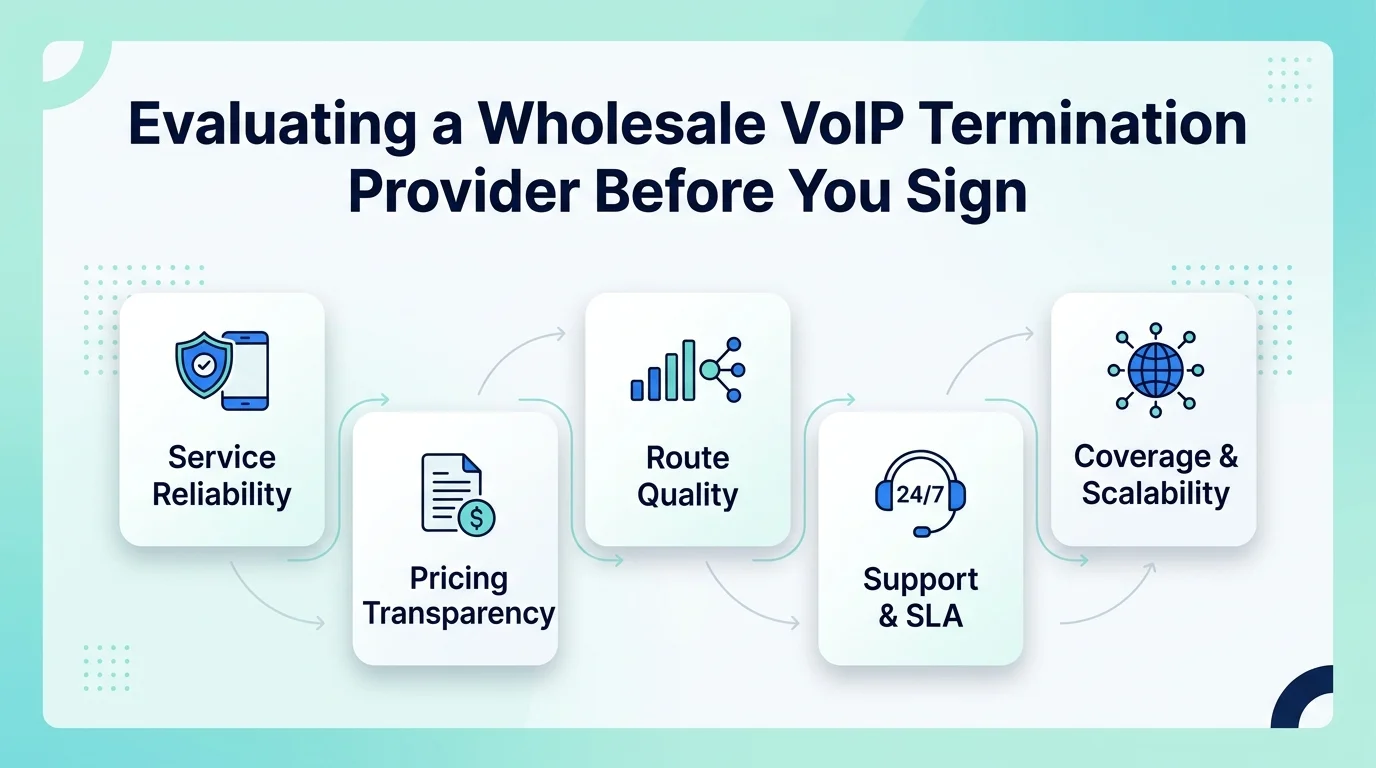
A live dashboard worth trusting shows, at minimum: ASR and NER broken out per destination, PDD as a distribution rather than a single average, SIP response code breakdown (a high proportion of 503 Service Unavailable or 480 Temporarily Unavailable responses is a red flag distinct from normal 486 Busy), and STIR/SHAKEN attestation level per call. If a provider cannot produce this during a trial, they will not produce it after you sign a volume commitment.
Run the test across at least one peak-traffic window and one off-peak window — quality that looks acceptable at 2am and collapses at 2pm during business hours is a common and easily missed failure mode. Compare the test-window figures against the provider's published benchmarks for that tier; a material gap between promised and measured performance is grounds to walk away before volume, not after.
7Conclusion
Route quality is measurable, and treating it as measurable rather than promotional is what separates a well-run voice operation from one that discovers its ASR problem after a customer complaint. ASR and NER tell you whether calls connect, PDD tells you whether callers wait long enough to find out, CLI attestation tells you whether your number survives the path intact, and route tier tells you what baseline to expect before a single test call runs.
Request a live trial on your actual destinations, insist on dashboard-level access to ASR, PDD, and attestation data during the test window, and only move production volume once measured results match the route tier you are paying for.
8Frequently Asked Questions
What is a good ASR for a wholesale VoIP termination route?
On Premium CLI routes, 60–80% ASR is the expected benchmark for most destinations. Standard routes typically run 45–65%, and LCR routes can fall below 45% with more volatility. ASR must be compared destination by destination — a naturally lower ASR in a mobile-heavy market is not necessarily a quality problem, but it should match what similar providers achieve on the same destination.
What PDD is acceptable before it affects call abandonment?
Post-Dial Delay under 6 seconds is the general benchmark for Premium CLI routes, with well-run direct interconnects often achieving 2–4 seconds. Once PDD consistently exceeds 8 seconds, callers begin hanging up before the call connects, which shows up as lost revenue even when the underlying ASR looks acceptable.
How is CLI delivery actually verified, rather than just promised?
CLI delivery is verified through STIR/SHAKEN attestation-level reporting per call — A-level confirms the carrier authenticated both customer identity and number authorization. Ask for the attestation pass-rate by destination rather than accepting a general statement that a route "supports CLI," since attestation can degrade at any intermediary hop in the path.
What is the difference between Premium CLI, Standard, and LCR routes?
Premium CLI routes run over direct or near-direct interconnects with the highest ASR and lowest PDD, suited to traffic where the recipient's trust matters. Standard routes trade some quality for lower cost. LCR routes are selected purely on price and can change underlying path — and therefore quality — without notice, making them appropriate mainly for low-value, disposable traffic.
What should I ask for before running a test on a new route?
Request a minimum of 500–1,000 call attempts on your actual top destinations, spanning both peak and off-peak hours, with temporary access to a live dashboard showing ASR, NER, PDD distribution, SIP response codes, and STIR/SHAKEN attestation per call. A provider unable to provide this level of detail during a trial is unlikely to provide it after you commit volume.