1Introduction
Wholesale voice traffic is the invisible backbone of every business call that crosses a network boundary. Mobile operators, ITSPs, BPOs, and SaaS apps trade billions of minutes a day through interconnect agreements — and the quality of those exchanges decides whether your customers hear a clean call or a one-second silence followed by a click.
This guide explains how wholesale voice traffic actually flows in 2026: the route types, the quality metrics that matter, the fraud and compliance landmines, and the buyer-side checklist that separates carrier-grade providers from resellers-of-resellers. Softtop terminates wholesale voice traffic across 165+ countries with 99.99% measured uptime, and this playbook draws on the questions our own customers ask most.
- →Wholesale voice traffic: the bulk exchange of voice minutes between operators, sold per-second at A-Z rates.
- →Quality lives in three numbers: ASR, MOS, and PDD. Anything published below those is marketing copy.
- →Fraud, not pricing, is what wipes out wholesale margins — spend caps and STIR/SHAKEN signing are non-negotiable.
2What Is Wholesale Voice Traffic?
Wholesale voice traffic is the bulk exchange of voice minutes between telecom operators and service providers. Instead of selling one phone line at a time, carriers trade aggregated capacity — millions of minutes a month — at per-second rates negotiated through interconnect agreements. For the broader concept of the wholesale voice market itself, see what wholesale voice is.
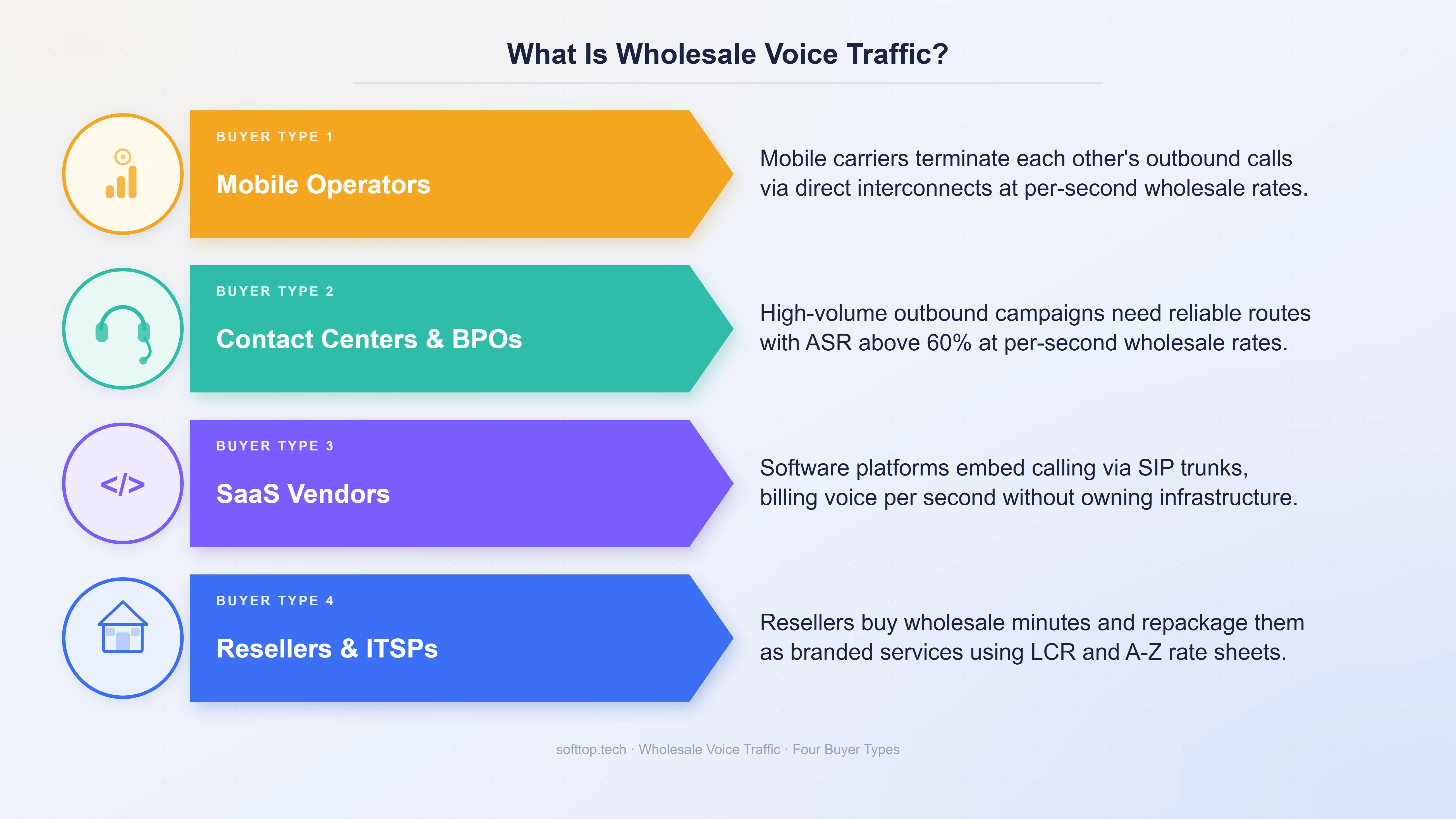
The buyers of wholesale voice traffic fall into four buckets: mobile operators terminating each other's outbound calls, contact centers and BPOs running high outbound volume, SaaS vendors embedding voice into their product, and resellers building their own retail offering on top of a wholesale base. Each segment values different things, but all of them depend on the same underlying mechanics: clean routes, transparent pricing, and reliable voice termination on the destination network.
The wholesale layer exists because building direct interconnects with every operator in every country is uneconomic for anyone but a Tier-1 carrier. A wholesale partner does that work once and shares the result through SIP trunks and A-Z rate sheets.
3How Wholesale Voice Traffic Flows Through a Network
Every minute of wholesale voice traffic passes through four stages: signaling, routing, transport, and termination.
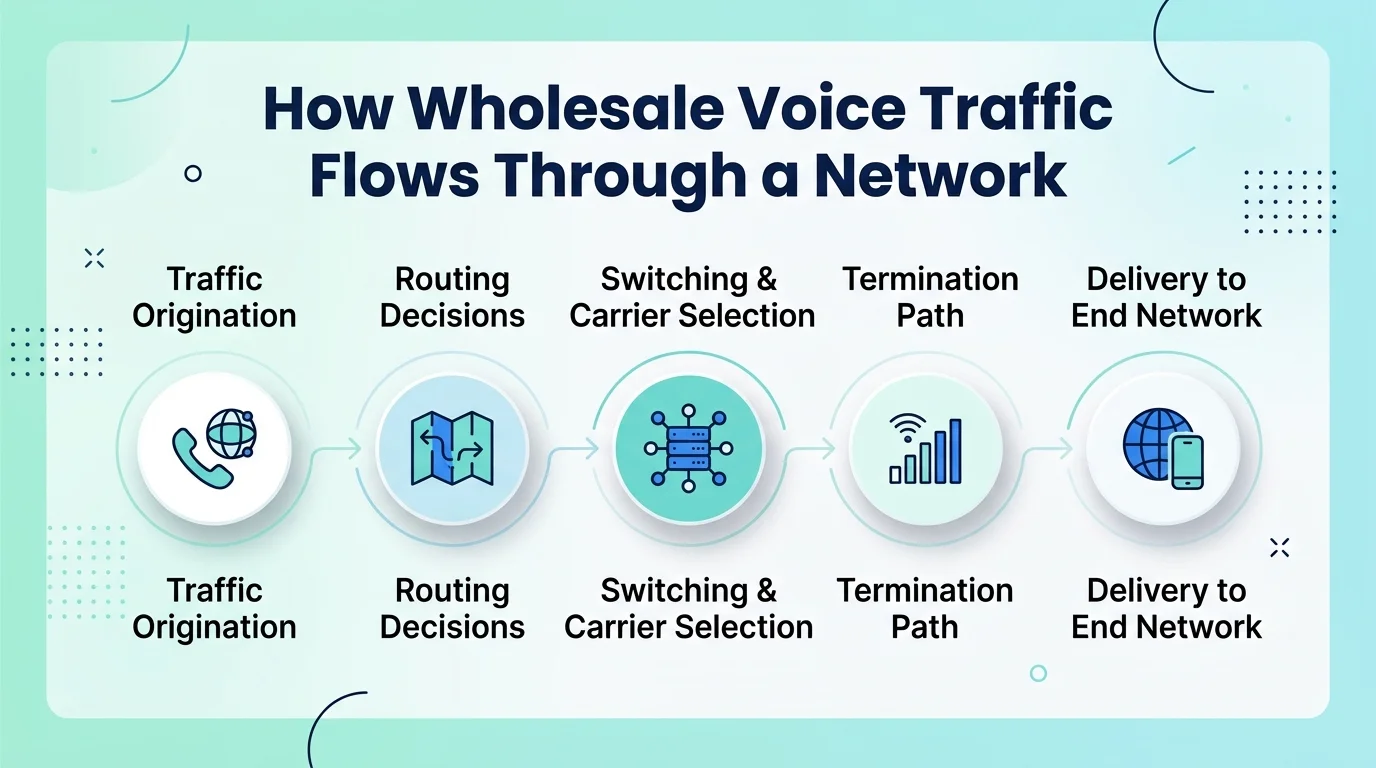
Signaling and call setup
SIP, defined by the IETF in RFC 3261, sets up and tears down the session. A session border controller authenticates the request, normalizes headers, and hands it to the routing engine. PDD is mostly decided here — anything over 6 seconds annoys end users.
Routing decisions
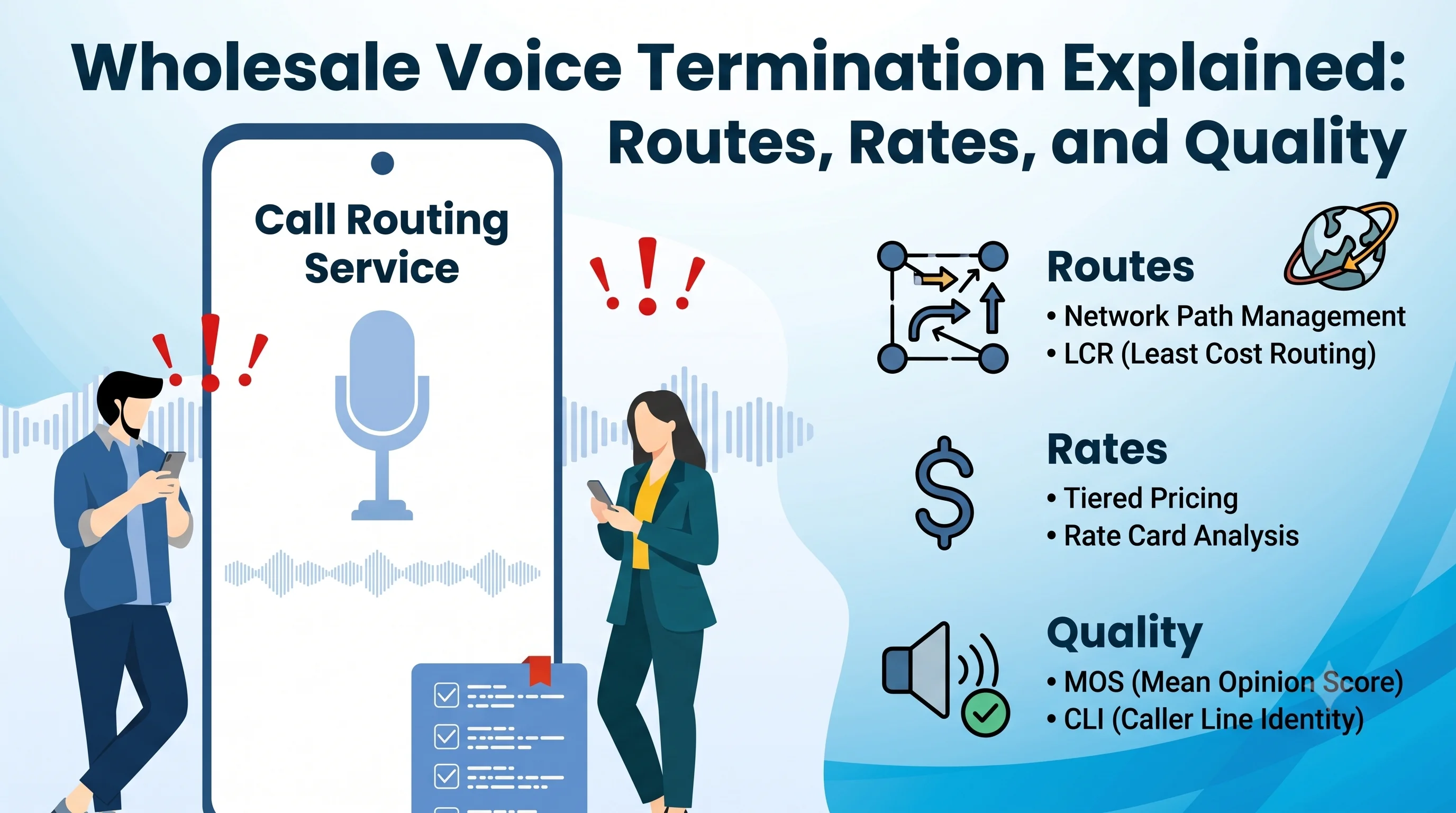
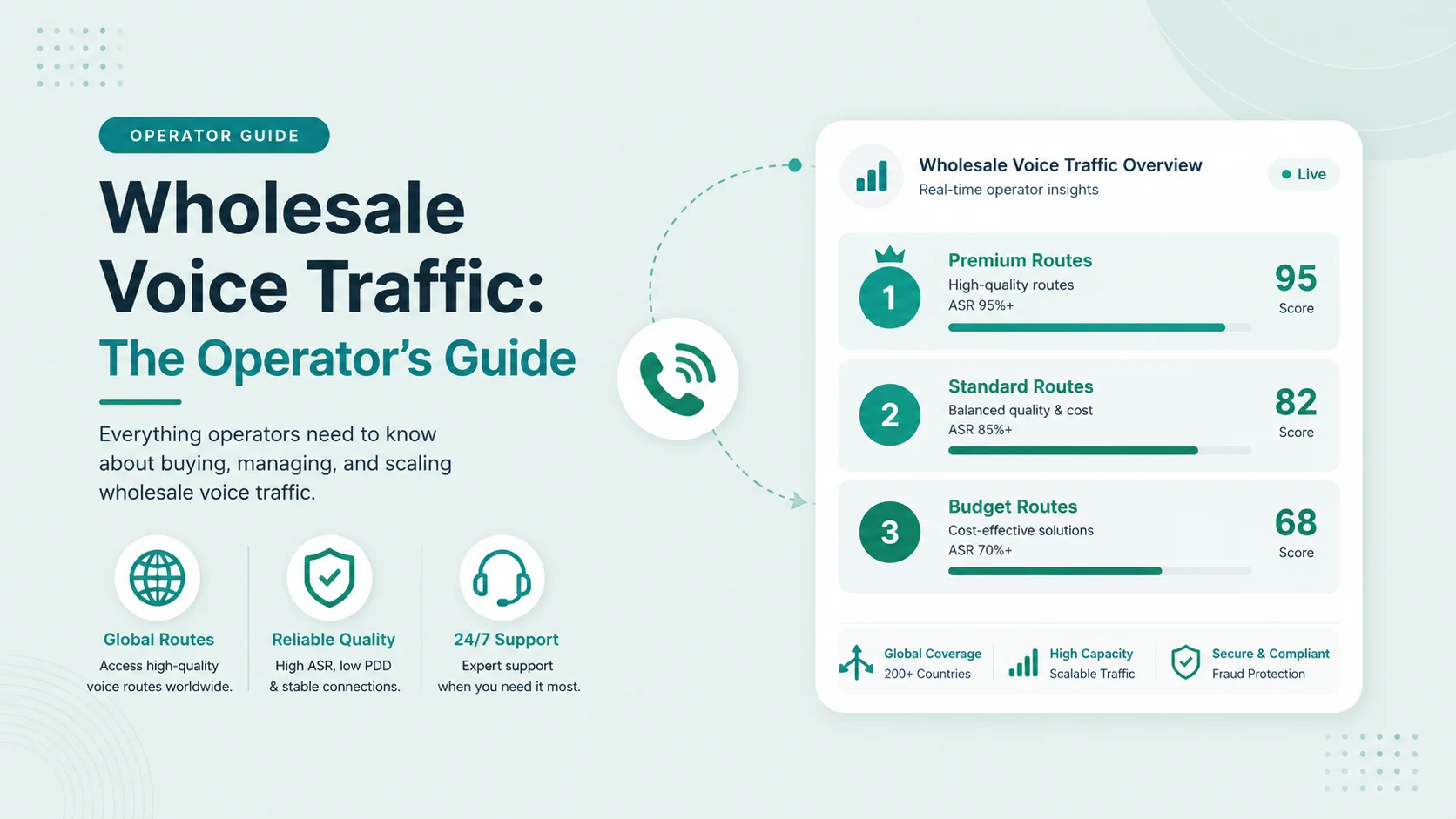
The routing engine picks an outbound path per call based on cost, live quality, and contractual rules. Premium routes prioritize MOS and ASR; standard routes prioritize price. Most operators run a hybrid: premium for revenue calls, standard for back-office.
Transport and termination
RTP carries the voice packets to the destination operator. Hop counts matter — every extra carrier adds 30–80 ms of latency and a chance of packet loss. Direct interconnects deliver cleaner audio because the call never leaves trusted infrastructure.
4Types of Wholesale Voice Traffic
Wholesale voice traffic breaks into four categories. The mix you buy or sell depends on your business model.
Call termination
The largest segment: delivering outbound calls across the global PSTN. Termination is priced per destination, per second, with separate rates for mobile and landline. This is the bread and butter of any wholesale voice provider.
Call origination
Inbound traffic delivered to a DID number. Origination matters when you need to receive calls in a country where you don't have a physical presence — global support lines, virtual offices, call deflection.
Direct Inward Dialing (DID)
Number inventory that routes inbound calls to specific extensions, queues, or apps. DID is usually bundled with origination — flat per-number monthly fee plus per-minute usage.
International Simple Resale (ISR)
A resale model where a provider buys minutes wholesale and resells them as their own retail product. ISR powers most regional ITSPs and white-label voice apps.
5What Decides Quality and Cost
Buyers who only compare per-minute rates lose money. The numbers that actually decide whether wholesale voice traffic is profitable sit one level deeper.
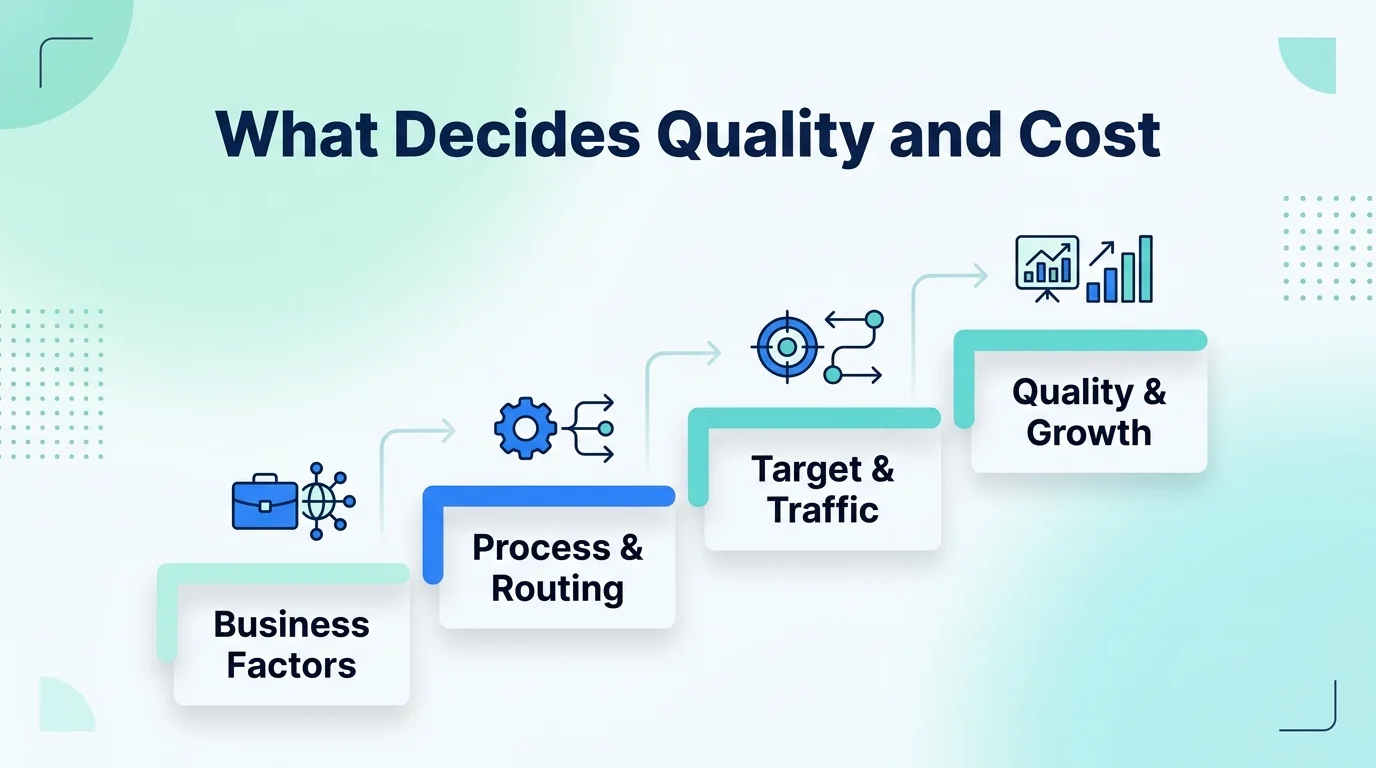
Three quality metrics that matter
- ASR (Answer-Seizure Ratio): completed calls divided by attempted calls. Anything under 45% on a major destination is a red flag.
- ACD (Average Call Duration): short ACD often means routing is dropping calls early.
- MOS (Mean Opinion Score): audio quality on a 1-to-5 scale. Below 3.5 and your end users will notice.
Three commercial terms that matter
Per-second billing is the 2026 standard — per-minute rounding silently adds 5–8% to your bill. Downloadable A-Z rate sheets let finance model true unit cost. Interconnect agreements should name the destination operators behind each route; vague language means resold capacity. According to the ITU's 2024 Facts and Figures report, global IP voice keeps growing even as fixed minutes decline — competitive pressure on rates and quality isn't slowing down.
6Challenges: Fraud, Security, and Compliance
The biggest single risk to wholesale voice traffic isn't pricing — it's fraud. The Communications Fraud Control Association estimates global toll fraud at over $39 billion a year, and most of it lands on unprotected SIP trunks.
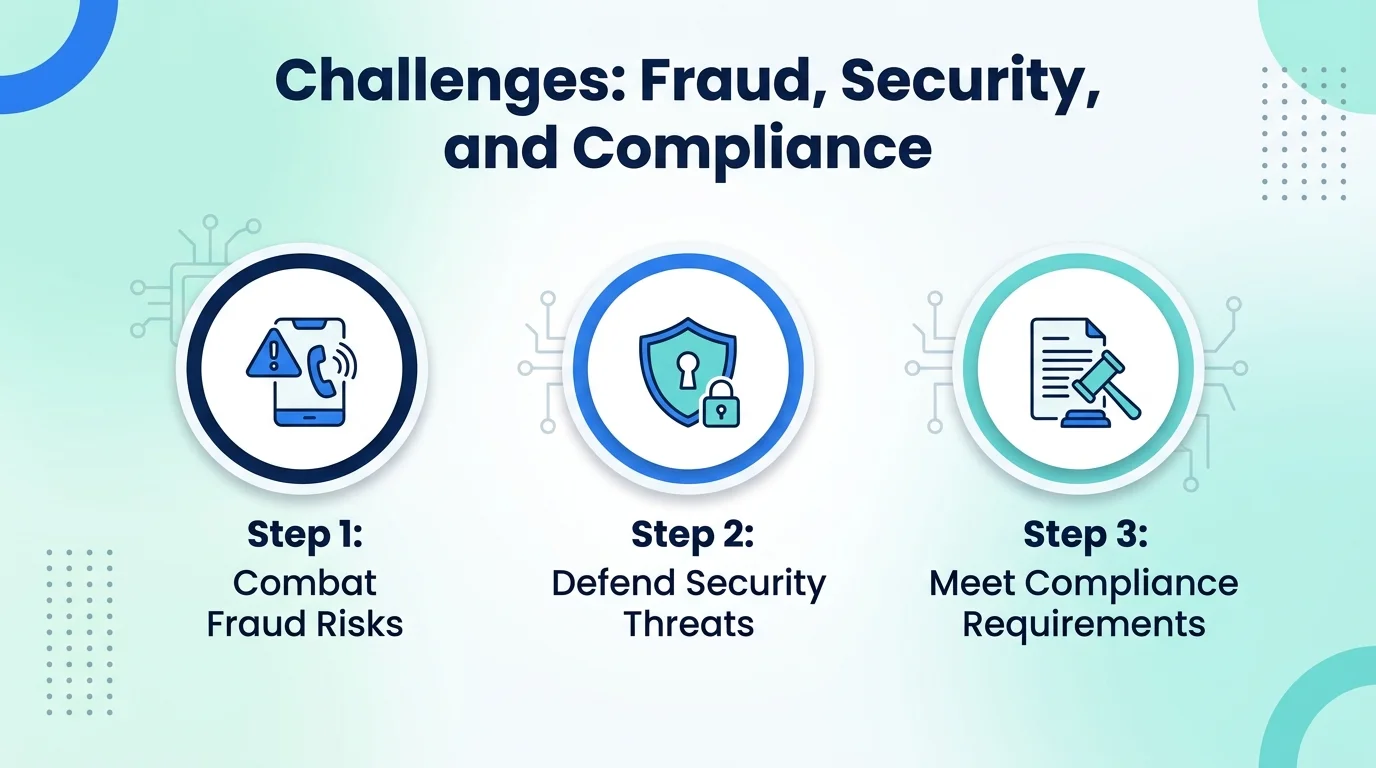
Fraud vectors to plan for
SIM-box arbitrage, traffic pumping, IRSF (international revenue share fraud), and stolen-credential dial-plan abuse are the most common. The pattern is identical: an attacker finds a weakly authenticated trunk and pushes calls to premium-rate numbers until you notice — usually after the invoice.
Controls that actually work
- IP authentication: for trunks
- Per-destination spend caps: halt runaway fraud before the invoice arrives
- Real-time alerting: on usage spikes
- STIR/SHAKEN signing: for US-bound traffic
Any carrier that doesn't offer all four by default is shifting risk to you.
Compliance overlay
GDPR-aligned processing terms for EU data, Business Associate Agreements for US healthcare traffic, and STIR/SHAKEN signing — now mandatory for US originating calls — are baseline. Confirm each in writing before routing regulated traffic.
7How Softtop Handles Wholesale Voice Traffic
Softtop runs a Tier-1-interconnected platform built specifically to move wholesale voice traffic at quality and scale. Our network covers 165+ countries with 99.99% measured uptime and direct peering with major mobile operators on every continent — which means fewer hops, lower PDD, and cleaner MOS scores than route-stack alternatives.
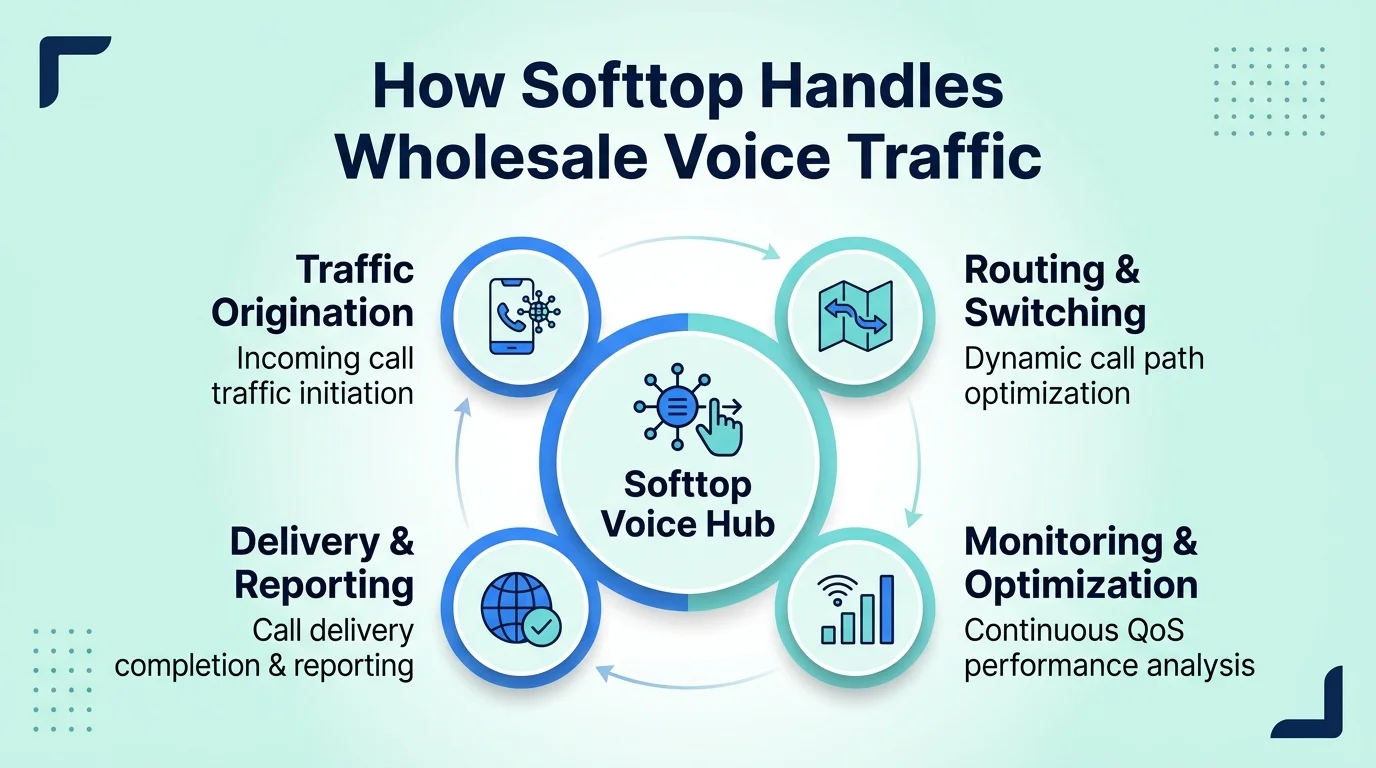
Three things our wholesale customers highlight day to day. First, every account gets a downloadable A-Z rate sheet and per-second billing, so finance can model true cost without a back-and-forth. Second, IP authentication, per-destination spend caps, and STIR/SHAKEN signing ship by default — the fraud controls that turn a healthy spread into a sustainable margin. Third, you can bundle Wholesale VoIP termination with SIP trunking, DIDs, and SMS on one contract, removing the integration tax of running three vendors.
Onboarding is short: most new accounts send their first production call within 48 hours of contract signature. If you want to see how your current traffic would price against our routes, our team will run a free analysis on a recent CDR sample.
8Conclusion
Wholesale voice traffic looks simple on a spec sheet — minutes, rates, destinations — and gets complicated the moment real volume hits the network. The operators who win in 2026 treat voice as a quality-and-margin problem, not a per-minute negotiation, and they measure ASR, MOS, and fraud exposure as carefully as they measure cost.
The shortlist for handling wholesale voice traffic well is short: direct interconnects, per-second billing, transparent A-Z rates, published quality metrics, and built-in fraud controls. Softtop built its platform around exactly that buyer checklist, which is why BPOs, ITSPs, and SaaS vendors use us as their primary upstream for wholesale voice traffic.
9Frequently Asked Questions
What is wholesale voice traffic in simple terms?
It's the bulk exchange of voice minutes between telecom operators and service providers. Carriers sell aggregated capacity — millions of minutes a month — to other operators, BPOs, or SaaS vendors at per-second rates instead of selling one phone line at a time.
How is wholesale voice traffic priced?
Per second, against an A-Z rate sheet that lists cost per destination. Reputable carriers also share live quality metrics (ASR, ACD, PDD) per destination. Per-minute billing is outdated in 2026 and adds 5–8% to your invoice through rounding.
What quality metrics should I track?
ASR (Answer-Seizure Ratio), ACD (Average Call Duration), PDD (Post-Dial Delay), and MOS (Mean Opinion Score). Track them per destination, not just in aggregate — one bad route can drag your blended numbers unnoticed.
What is the biggest risk in wholesale voice traffic?
Toll fraud. Unprotected SIP trunks get hijacked and pushed to premium-rate destinations overnight. Per-destination spend caps, IP authentication, real-time alerting, and STIR/SHAKEN signing are non-negotiable controls.
Can a small business buy wholesale voice traffic directly?
Yes, if call volume justifies it. Most modern platforms have no seat minimum — you sign up, authenticate, and start sending SIP traffic. Break-even is usually when monthly voice spend exceeds a retail seat-based plan.