1Introduction
Every phone call that crosses a carrier network passes through a wholesale voice layer before it reaches the subscriber at the other end. Whether it is a contact centre dialling thousands of prospects a day, a VoIP reseller routing outbound traffic for downstream clients, or an MVNO delivering inbound calls to its mobile subscribers, the underlying infrastructure is the same: bulk-rate voice capacity purchased from a provider with global network reach.
Wholesale voice differs from retail telephony in three fundamental ways — scale, pricing structure, and technical requirements. Rates are quoted per minute per destination, delivered over SIP interconnects, and governed by quality thresholds like ASR rather than flat monthly fees. Getting the model right lowers your cost per minute, lifts answer rates, and protects your margins; getting it wrong exposes you to dropped calls, hidden fees, and carrier fraud.
This guide covers everything an operator or procurement team needs — from the mechanics of termination to route types, pricing, and how to evaluate any prospective provider.
2What Is Wholesale Voice?
Wholesale voice is the bulk supply of call termination and origination capacity between carriers, VoIP providers, and resellers. Rather than paying retail per-minute rates, buyers negotiate high-volume pricing and route their traffic over the seller's global network to reach end destinations on the PSTN or other carrier infrastructures.
The model suits any organisation that generates enough traffic to warrant volume agreements: telecom carriers, VoIP resellers, ISPs, MVNOs, contact centres, and enterprise telephony teams managing international calling. Buyers typically connect via a SIP trunk and direct traffic to the wholesale provider's Class 4 softswitch, which then routes onward through its own carrier relationships.
A business moving 10 million minutes per month through wholesale channels can reduce its per-minute cost by 40–70% compared with retail VoIP rates, depending on destination mix and route quality. The savings are real — but only if the provider's quality metrics hold up under live traffic conditions.
3How Wholesale Voice Termination Works
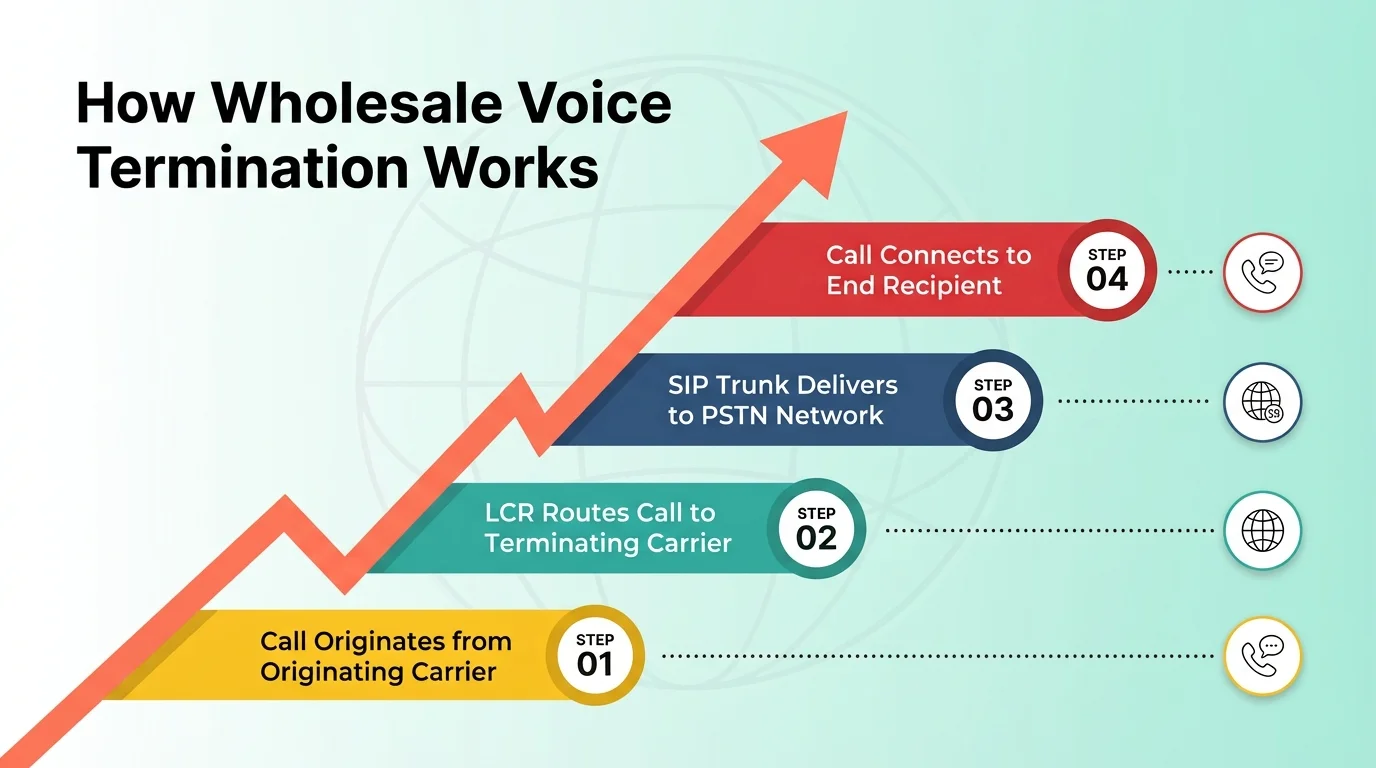
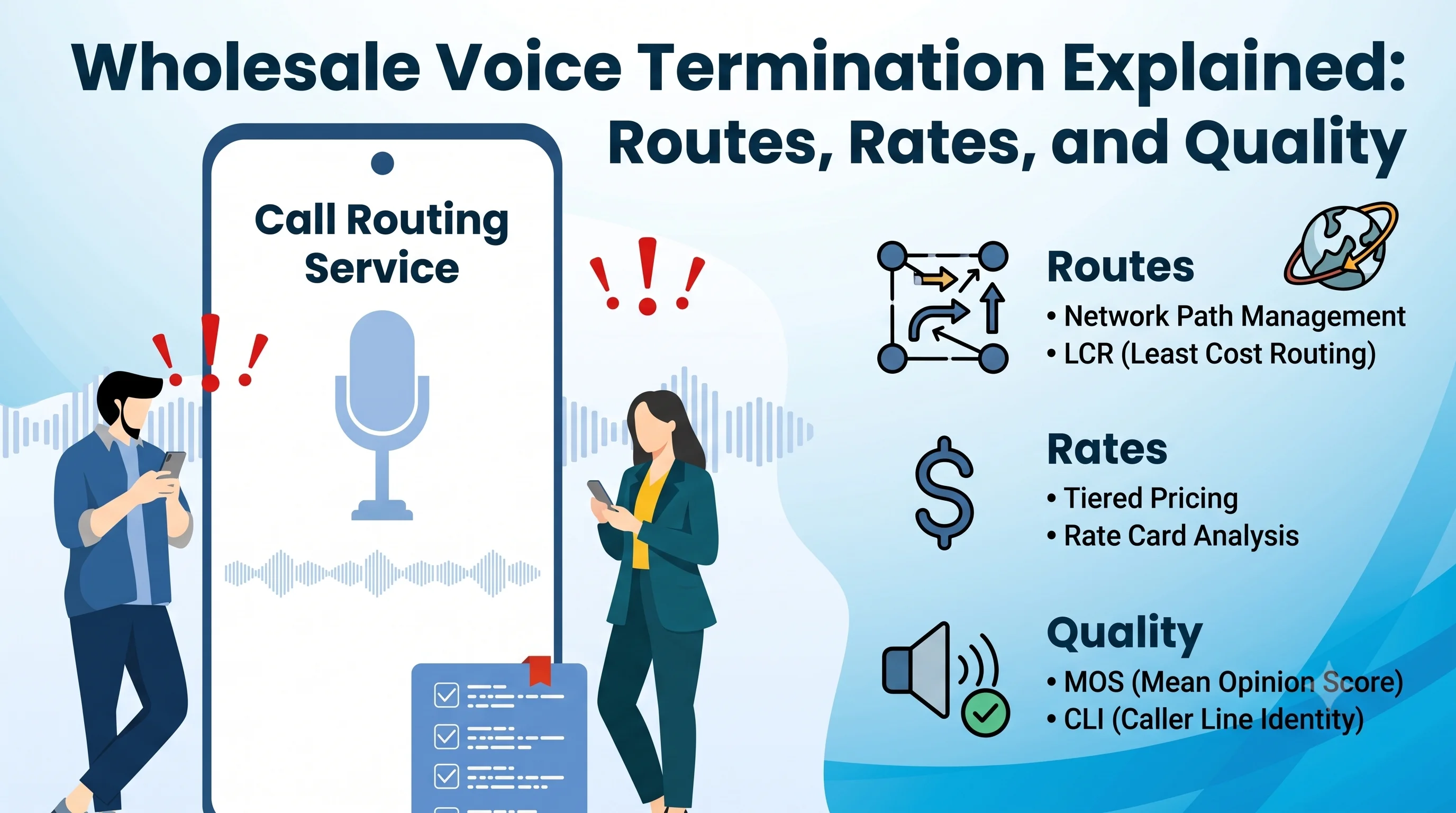
Voice termination is the process of completing an outbound call from its originating network to the destination subscriber. In a wholesale arrangement, the buyer hands off traffic via SIP to the provider's Class 4 switching infrastructure, which selects an onward route and delivers the call to the terminating network.
The routing decision is made by a Least Cost Routing (LCR) engine. A high-quality LCR system evaluates hundreds of signals per call — cost, ASR per destination, latency, and carrier reputation — and selects the best path in milliseconds. When a route's quality degrades, a smart LCR engine re-routes traffic automatically without operator intervention.
Each call passes through four stages:
- Origination: The call leaves the originating network and arrives at the wholesale provider's ingress point via SIP INVITE.
- Authentication: Credentials are validated and the call screened for fraud signatures (including STIR/SHAKEN verification on US traffic).
- LCR selection: The engine assigns the optimal route based on cost, live ASR, and destination-specific routing rules.
- Termination: The call is handed to the next carrier and connected to the destination subscriber on the PSTN.
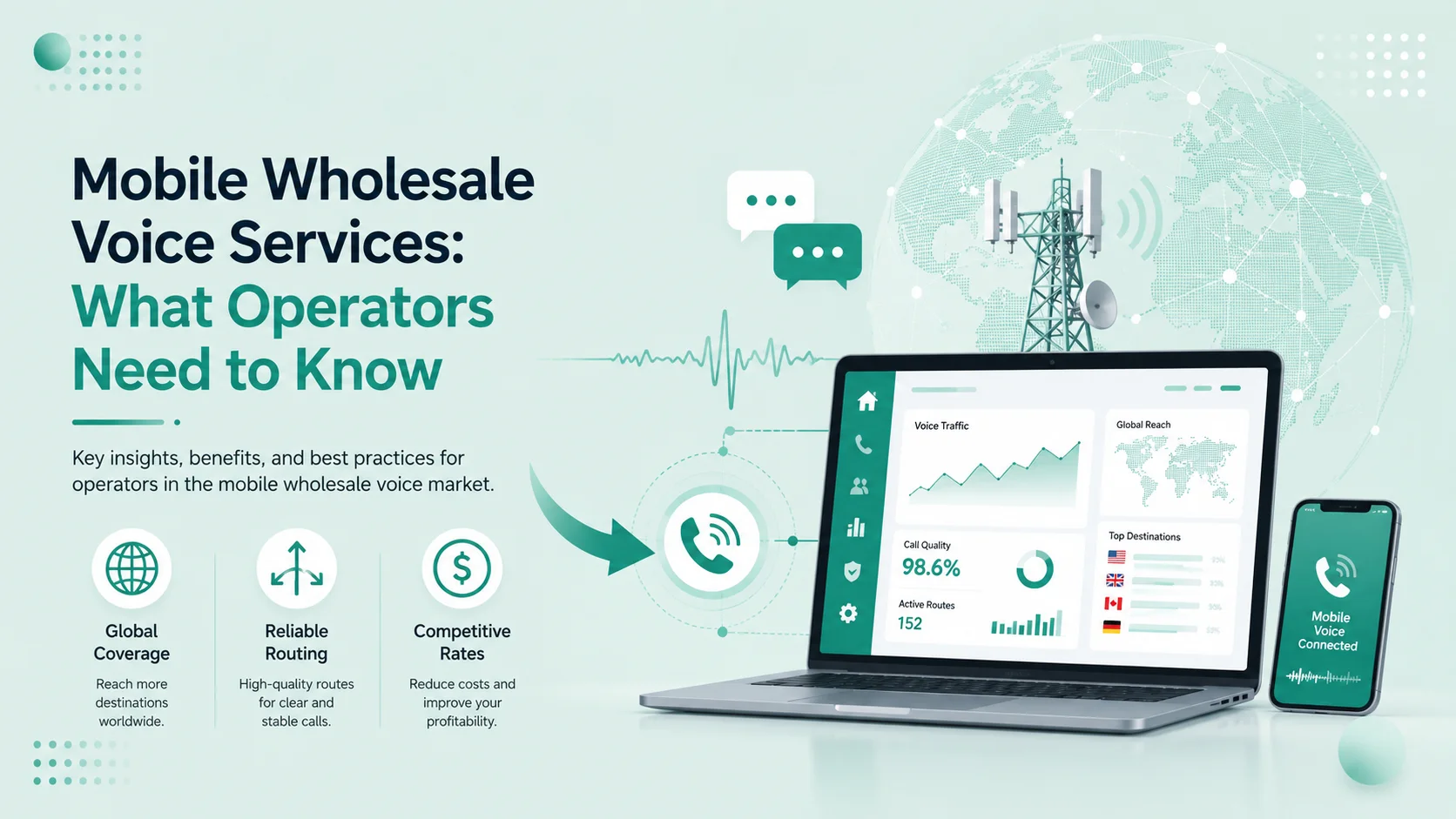
Quality providers publish live dashboards showing ASR, latency, and concurrent call counts per destination — so operators have full visibility into the paths their traffic takes at all times.
4The Three Route Types: CLI, CC, and A-Z
Not all wholesale voice routes are equal. Three types dominate the market, each optimised for a different traffic profile and business model.
CLI (Calling Line Identity) Routes
CLI routes preserve the originating caller ID end-to-end through the network. Because the number appears genuine to the terminating carrier, these routes achieve the highest answer rates — typically 65–74% ASR on premium destinations including the US, UK, Germany, and Australia. CLI routes are the default choice for business outbound calling, contact centres where answer rate drives revenue, and any use case where caller identity builds trust. Explore our CLI VoIP routes for live quality data and current rate cards.
CC (Call Centre) Routes
CC routes are engineered for high-volume outbound dialling campaigns where cost efficiency matters more than preserving a specific caller ID. They carry lower per-minute rates and suit collections, survey, and telesales traffic at scale. Per-second billing on CC routes reduces cost significantly on short-duration calls common in automated dialler environments.
A-Z Routes
A-Z termination provides a single rate deck covering every dialable international destination. Carriers use A-Z routes to simplify billing and ensure no destination is unreachable — including emerging markets and unusual ITU-T allocations where building individual bilateral agreements would be impractical. One SIP interconnect, every country.
5How Wholesale Voice Is Priced
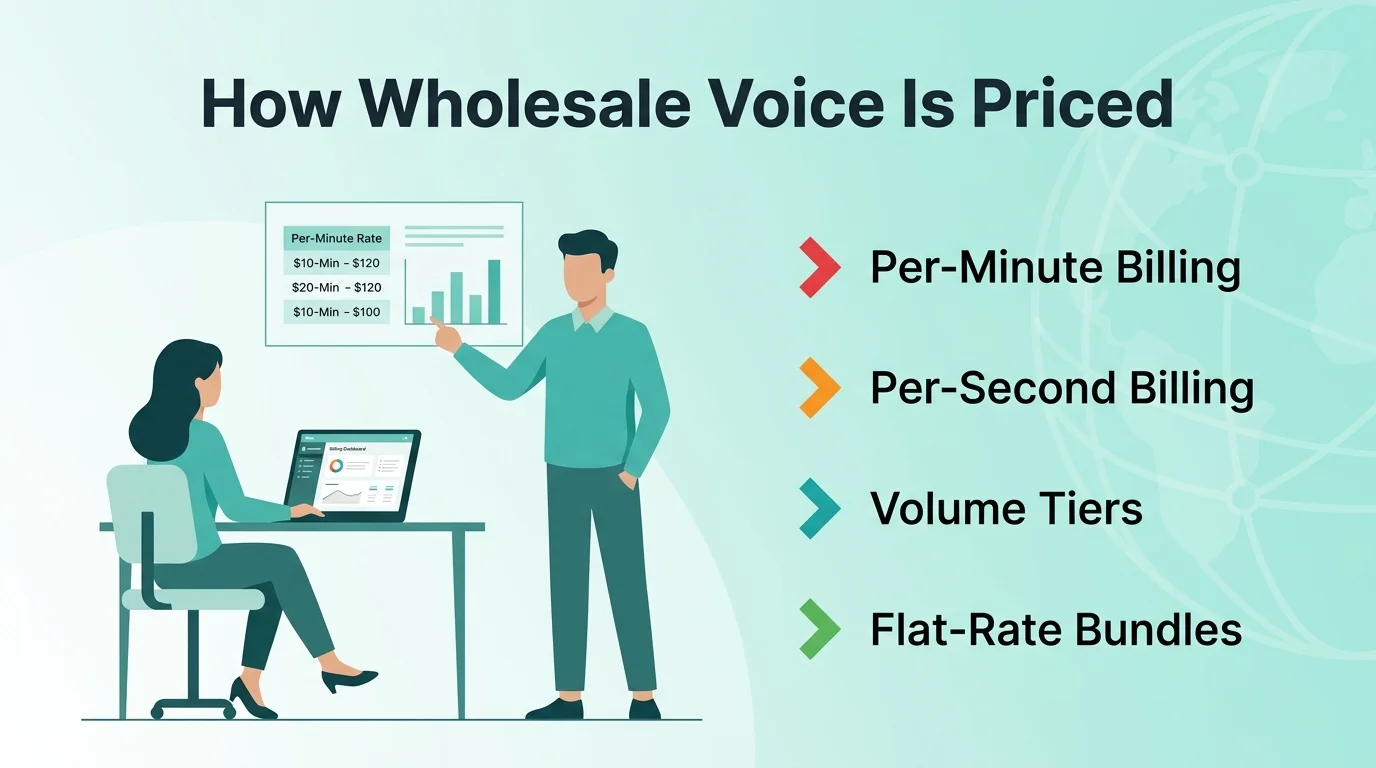
Wholesale voice termination is billed per minute, per destination, with rates varying by country, route type, and traffic volume. Premium CLI routes to North America and Western Europe typically range from $0.002 to $0.008 per minute; emerging-market and long-tail destinations can reach $0.03–$0.10 per minute.
Several billing practices significantly affect the true cost — often more than the headline rate itself:
- Per-second billing charges for the exact call duration, eliminating the over-billing introduced by six-second rounding. A meaningful saving on short calls common in dialler and IVR environments.
- Minimum call duration (MCD) clauses bill a floor of 6–30 seconds even for unanswered calls. At high volumes, this inflates cost substantially — always ask for MCD terms before signing.
- FAS (False Answer Supervision) is a fraud technique where the network bills call duration before the subscriber actually answers. Quality providers actively detect and suppress FAS traffic on all routes.
Volume commitments unlock tiered rate discounts. Reputable providers share a full rate deck before contract signature. If a provider will not show you rates upfront, that itself is a warning sign.
Softtop publishes transparent wholesale VoIP rates with per-second billing and zero FAS exposure across all CLI, CC, and A-Z routes. No minimum commitment required to view current destination pricing.
6Key Quality Metrics to Evaluate
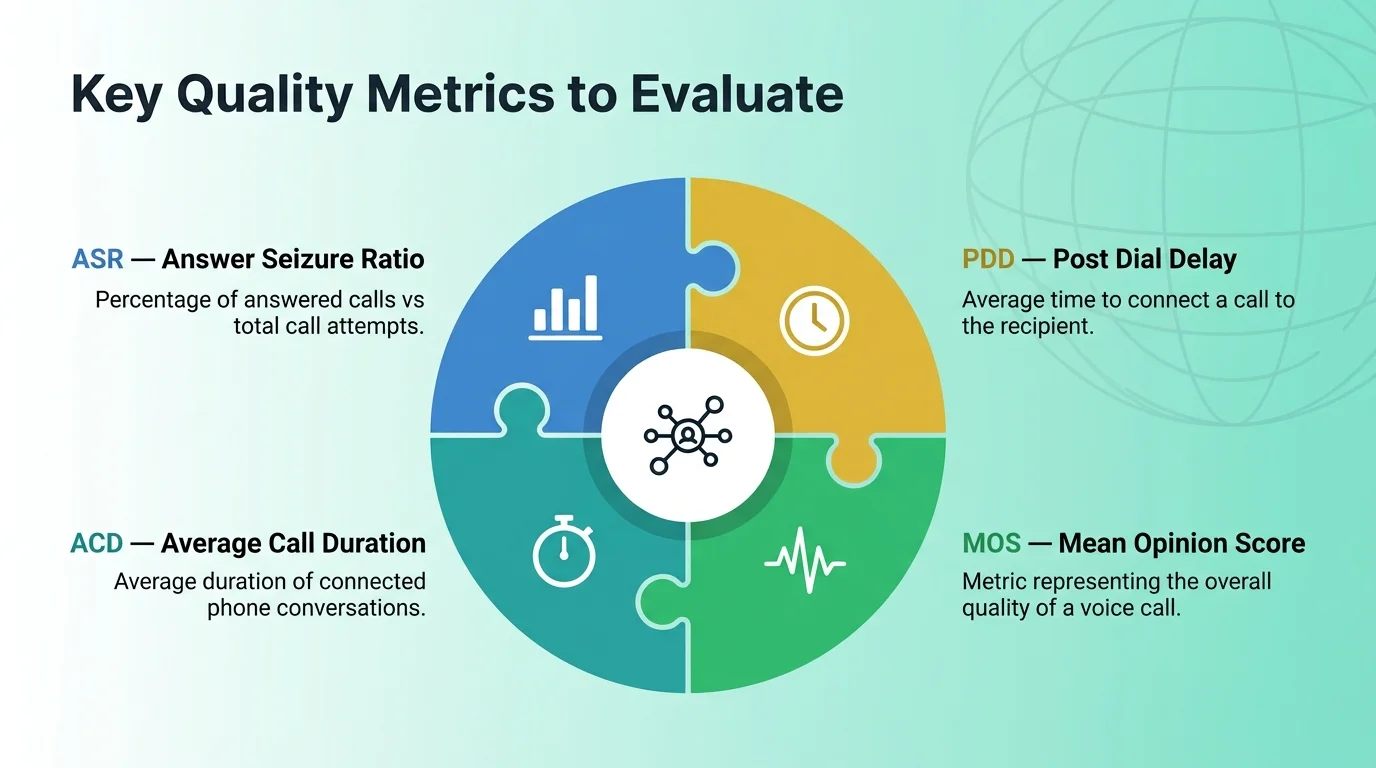
Evaluating wholesale voice quality requires understanding four core metrics — and knowing what values are acceptable for your specific traffic type.
ASR — Answer Seizure Ratio
The percentage of call attempts that are answered. Industry benchmarks start at 60% for Tier-1 routes; premium CLI routes to the US and UK should reach 68–74% under normal conditions. Below 55%, quality is unacceptable for business or contact-centre traffic.
ACD — Average Call Duration
The average duration of answered calls. A high ASR combined with an unusually low ACD can indicate FAS fraud — calls answered by automated systems rather than real subscribers, triggering billing without genuine connection.
PDD — Post Dial Delay
The time between dialling and the first ring reaching the caller. Under 3 seconds is standard on well-connected routes; over 5 seconds drives hang-ups before answer and frustrates both agents and customers on outbound campaigns.
NER — Network Effectiveness Ratio
NER measures call completions excluding user-caused failures such as busy signals or no-answer. It isolates genuine network-side failures, making it a cleaner indicator of route reliability than ASR alone. Request NER data alongside ASR when evaluating a new provider.
Always request real-time quality dashboards per destination before committing traffic. Historical averages can mask recent degradation. A provider confident in its network will give you live visibility from day one.
7What to Look for in a Wholesale Voice Provider
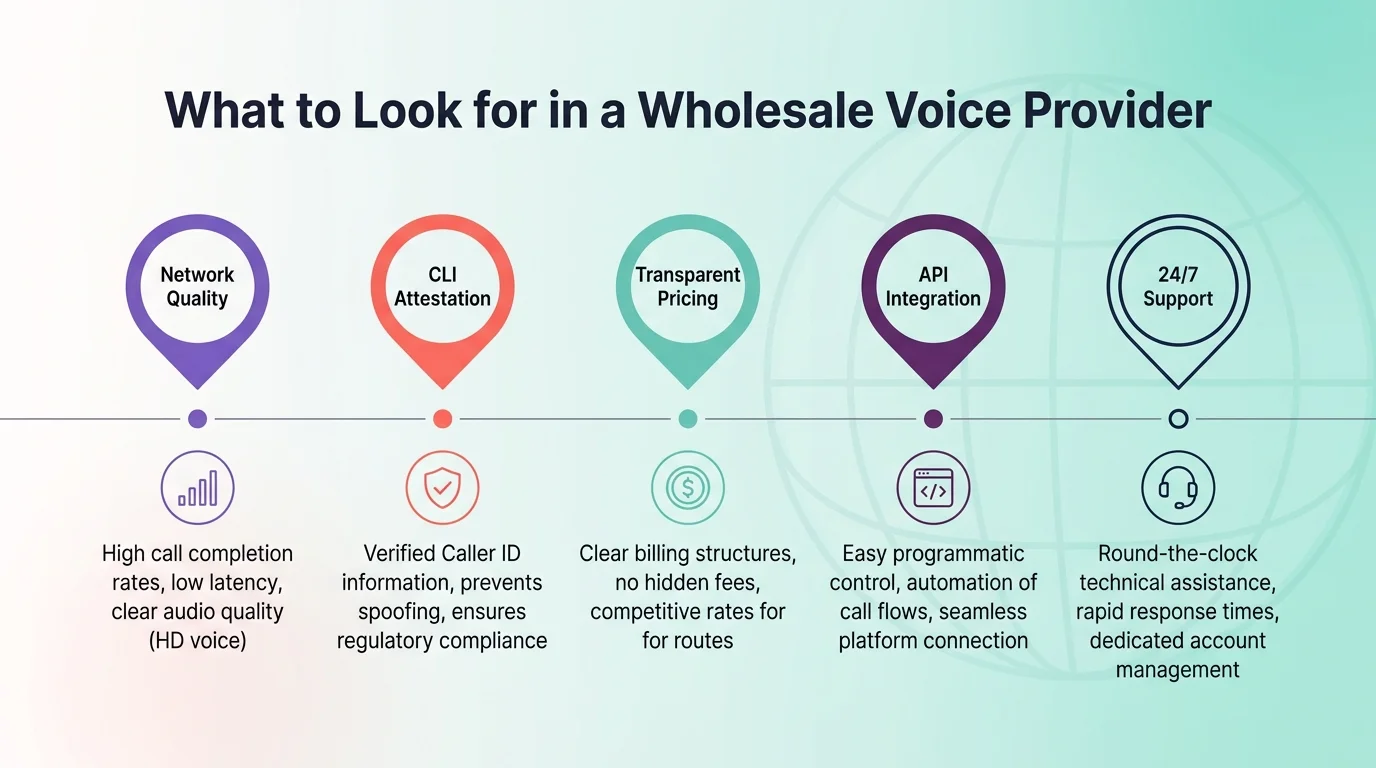
Choosing the right wholesale voice partner involves more than comparing per-minute rates. Score every candidate across five dimensions:
Network reach and carrier relationships
Direct Tier-1 interconnects in 150+ countries produce better quality and more predictable pricing than providers relying on third-party resellers for long-tail destinations. Ask specifically how many Tier-1 carriers the provider peers with directly — and which PoPs cover your highest-volume corridors.
Compliance and fraud protection
In the US, STIR/SHAKEN compliance is mandated by the FCC for all voice service providers. Full Attestation (Level A) prevents your traffic from being flagged as spam on US destinations. Confirm the provider actively suppresses FAS traffic and publishes anomaly alerts for unusual call patterns.
Technical integration depth
A REST API for programmatic provisioning, real-time CDR streaming via webhook, and native support for Asterisk, FreeSwitch, Metaswitch, Broadworks, and enterprise SBCs all reduce integration time and ongoing operational overhead. A self-service portal for rate management and route configuration is equally important for day-to-day operations.
SLA and uptime
Carrier-grade providers commit to 99.99% uptime with automatic failover and documented incident response. Request historical incident reports and mean time to restore (MTTR) data — not just a headline SLA percentage in a brochure.
Commercial transparency
Per-second billing, no hidden minimum call duration floors, no undisclosed surcharges, and a full rate deck available before you sign are strong signals of a trustworthy provider. Opaque billing structures and reluctance to share pricing details upfront are consistent red flags regardless of the headline rate.
8Conclusion
Wholesale voice is the infrastructure layer that keeps business communication moving at scale — from a reseller routing a few thousand minutes a day to a carrier managing hundreds of millions. The economics are compelling, but only when route quality, billing integrity, and provider compliance match your actual traffic profile and destination mix.
Start by mapping your destinations and volume to determine whether CLI, CC, or A-Z routes are the right fit. Then evaluate prospective providers against ASR benchmarks, live quality dashboards, and commercial transparency rather than headline rates alone. The right wholesale voice partner reduces per-minute costs and improves the call experience your customers and agents receive — simultaneously, not as a trade-off.
Softtop delivers carrier-grade wholesale voice with direct Tier-1 interconnects in 150+ countries, per-second billing, and 99.99% uptime. Explore the wholesale voice platform or request a custom rate deck from our carrier team today.
9Frequently Asked Questions
What is wholesale voice termination and how does it differ from retail VoIP?
Wholesale voice termination is the bulk-rate completion of outbound calls from one carrier to destination networks, sold at per-minute rates negotiated on traffic volume. Retail VoIP charges end-users flat monthly fees or metered rates. Wholesale termination targets carriers, resellers, and enterprises generating enough traffic to negotiate volume pricing — typically delivering 40–70% lower per-minute cost than retail, without the per-seat overhead.
What is the difference between CLI and A-Z routes in wholesale voice?
CLI routes preserve the originating caller ID end-to-end, producing the highest answer rates (65–74% ASR on premium destinations) and best suited for business outbound calls. A-Z routes cover every dialable destination under a single rate deck, trading some ASR performance for universal global coverage — ideal for carriers that need to reach unusual or long-tail destinations without managing separate bilateral agreements per country.
How is wholesale voice termination priced?
Pricing is per minute per destination. Premium CLI routes to North America and Western Europe typically range from $0.002–$0.008 per minute. Emerging-market destinations are higher. Always clarify billing increment (per-second vs. six-second rounding) and whether FAS-generated minutes are suppressed — these factors often have a larger impact on total cost than the headline per-minute rate.
What ASR should I expect from a Tier-1 wholesale voice provider?
A Tier-1 provider should deliver 60%+ network-wide average ASR, with premium CLI routes to the US, UK, Germany, and Australia reaching 68–74% under normal traffic conditions. Request live quality dashboards per destination — not just historical averages — before committing your traffic. A provider unwilling to share real-time quality data is a meaningful risk signal.
Is STIR/SHAKEN compliance required for wholesale voice providers?
In the US, STIR/SHAKEN compliance is mandated by the FCC under the TRACED Act for all voice service providers. Full Attestation Level A confirms the calling number is authorised and legitimate, preventing outbound calls from being flagged as suspected spam on US destinations. Confirm your provider supports Level A attestation — particularly important for contact centre and outbound sales traffic where answer rate directly affects revenue.