1Introduction
Finding the right VoIP wholesaler is one of the highest-leverage decisions a reseller, call center, or carrier can make. The wholesaler behind a platform determines answer rates, per-minute cost, and whether traffic stays compliant across every market it touches — yet the market is crowded with providers making identical claims on a rate sheet while delivering wildly different results in production. Separating a genuine Tier-1 source from a broker reselling degraded routes takes a structured evaluation, not a quick price comparison.
This guide breaks down what a VoIP wholesaler actually does, how the market is structured across quality tiers, what genuinely drives pricing, and the concrete criteria to use when choosing where to route real traffic.
2What Is a VoIP Wholesaler?
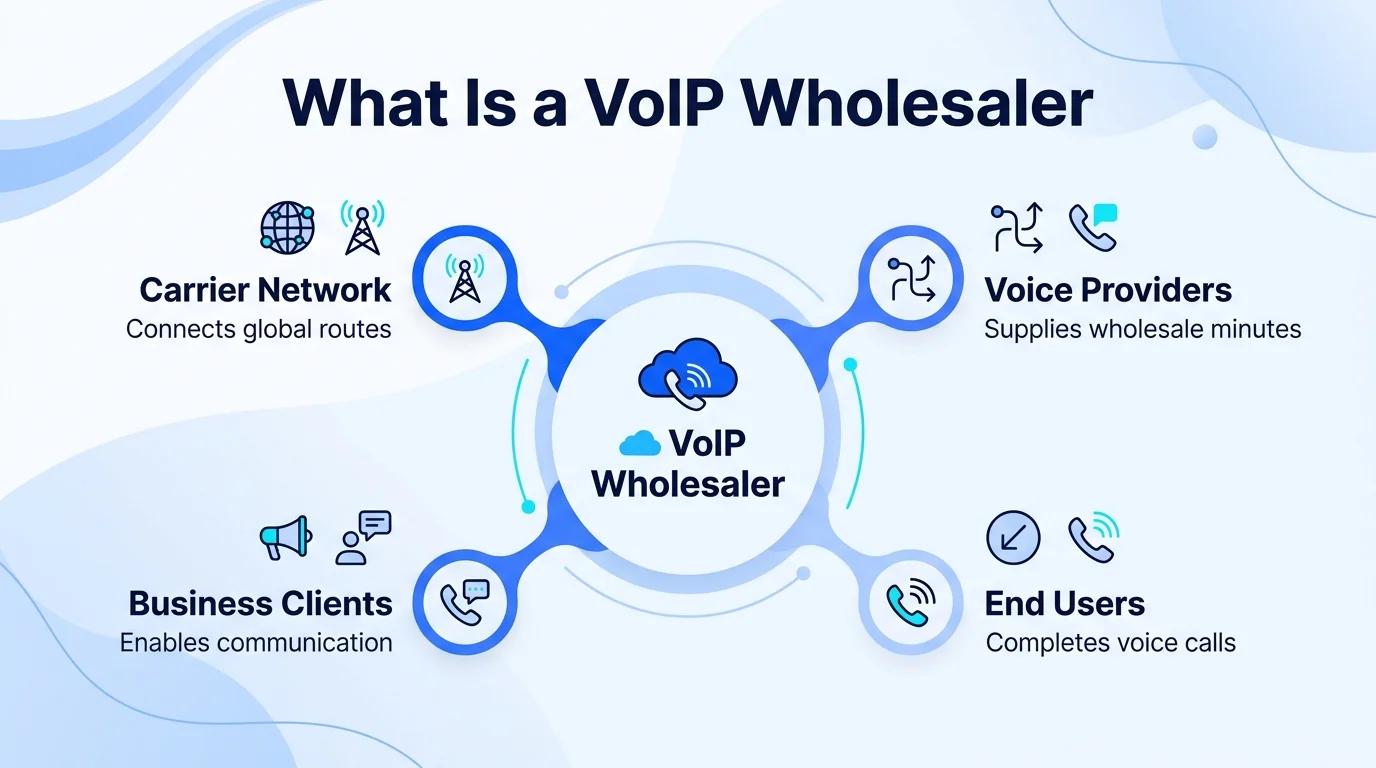
A VoIP wholesaler is a carrier-grade provider that sells bulk voice termination and origination capacity to resellers, call centers, ITSPs, and enterprises that generate high call volume. Instead of every business negotiating its own interconnect agreements with telecom operators worldwide, a wholesaler already holds those relationships and resells capacity at per-minute or per-second rates — typically a fraction of retail voice pricing.
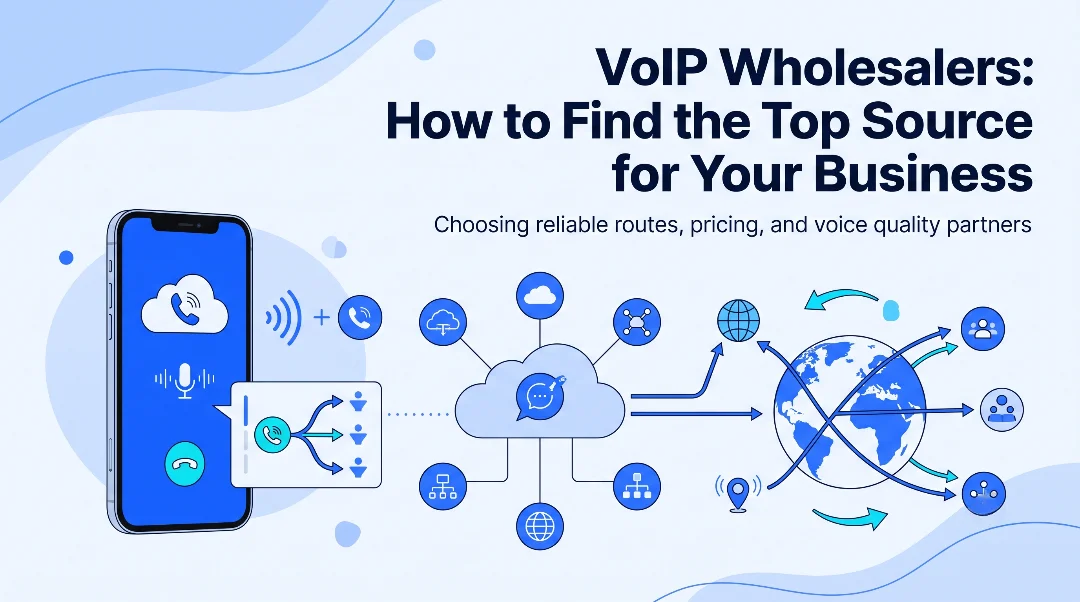
The wholesaler sits between the customer's platform and the destination network. Traffic arrives as SIP calls from a softswitch, hosted PBX, or CPaaS application, and the wholesaler's switching infrastructure routes each call to the correct destination carrier. The quality of that routing — direct versus multi-hop, CLI-preserved versus stripped — is what actually determines whether the wholesaler is worth the relationship.
3How VoIP Wholesalers Actually Operate
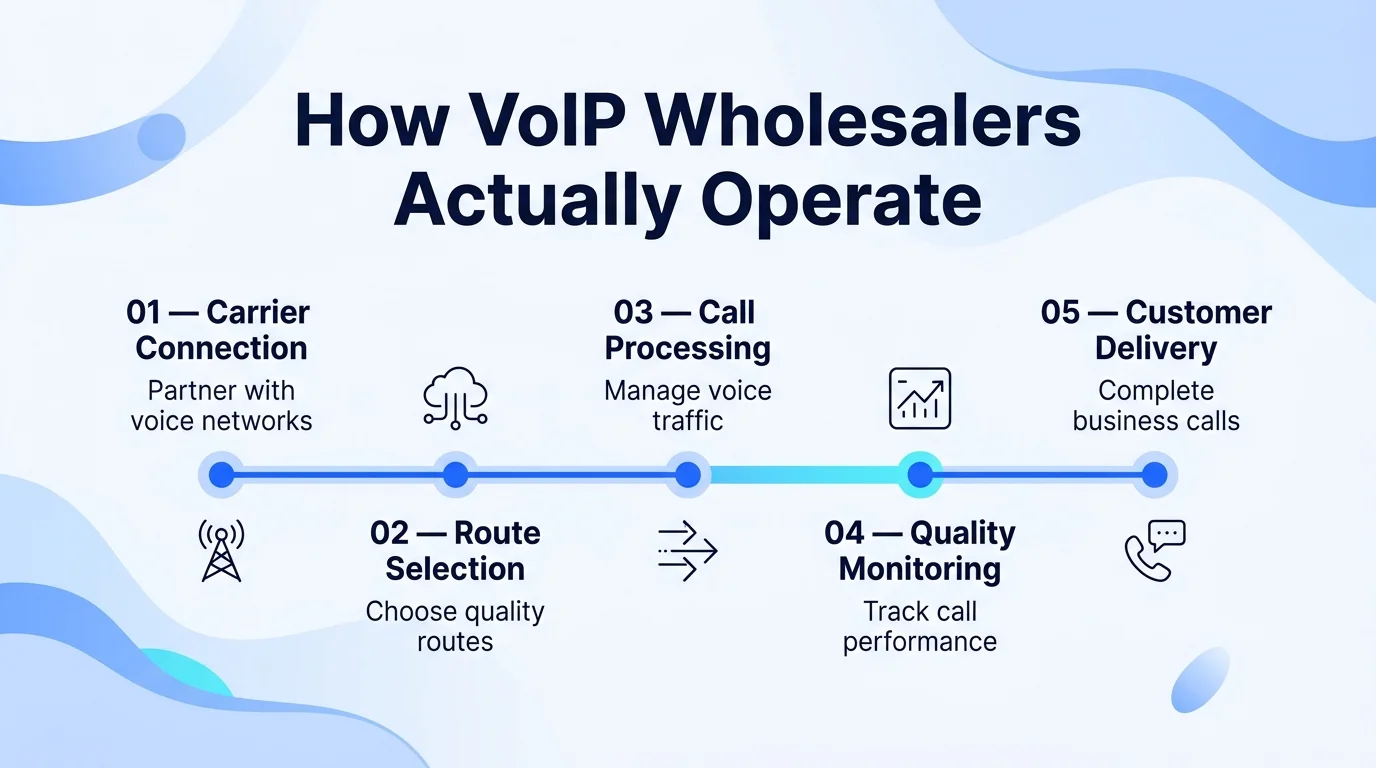
Understanding the mechanics clarifies why two wholesalers quoting the same rate can deliver completely different results:
- Interconnect ownership — Tier-1 wholesalers hold direct, bilateral agreements with local telecom operators in each destination market. Every hop below that tier means the traffic passes through an intermediary before reaching the destination.
- Route selection — a wholesaler's switching platform picks a path for each call based on cost, quality tier, and current network conditions, ideally favoring the most direct interconnect available.
- Billing and reporting — the wholesaler meters usage per-second or per-6-second, applies (or waives) false answer supervision charges, and reports call detail records back to the customer.
- Compliance layer — attestation, fraud monitoring, and regulatory filtering happen at the wholesaler's switch before a call ever reaches the destination carrier.
Every additional resale layer between the origin and the destination network adds latency, cost, and a new point of potential failure — which is exactly why the cheapest quoted rate on paper often produces the most expensive result once failed calls and re-dials are counted.
4Tier-1 vs Tier-2 vs Grey-Route Wholesalers
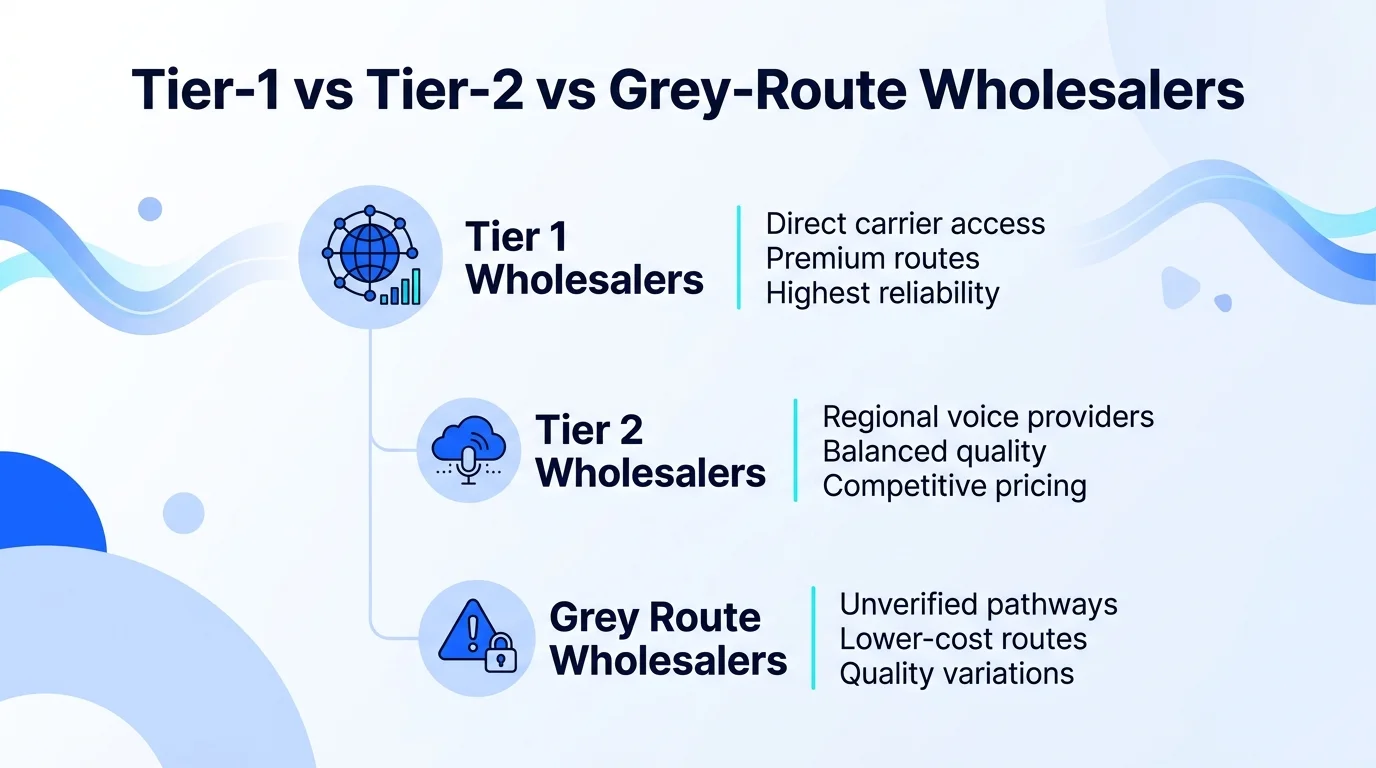
Not every VoIP wholesaler operates at the same level, and the difference shows up the moment real traffic hits the route:
- Tier-1 wholesalers own their switching infrastructure and hold direct interconnects with local carriers in the markets they serve. They can guarantee ASR benchmarks, deliver CLI reliably, and support current compliance attestation. Rates run higher per minute but are typically lower on a cost-per-completed-call basis.
- Tier-2 wholesalers blend owned capacity with routes leased from Tier-1 providers. Quality holds up on major corridors but thins out on smaller or emerging destinations routed through a third party.
- Grey-route resellers aggregate minutes from whichever upstream source is cheapest, sometimes using route manipulation or SIM-boxing to undercut legitimate pricing. These sources carry real regulatory exposure and a habit of getting blocked mid-contract as destination networks tighten fraud filtering.
Ask any prospective wholesaler directly whether they own their interconnects or resell from a named Tier-1 partner. A source that can't answer plainly is telling you something about where you'd actually sit in the routing chain. The tier a wholesaler operates at also predicts how it behaves when something breaks — Tier-1 providers troubleshoot at the switch level and can reroute traffic within minutes, while a grey-route reseller several hops removed from the actual carrier often has no visibility into why a route degraded in the first place.
5Criteria for Finding the Right VoIP Wholesaler
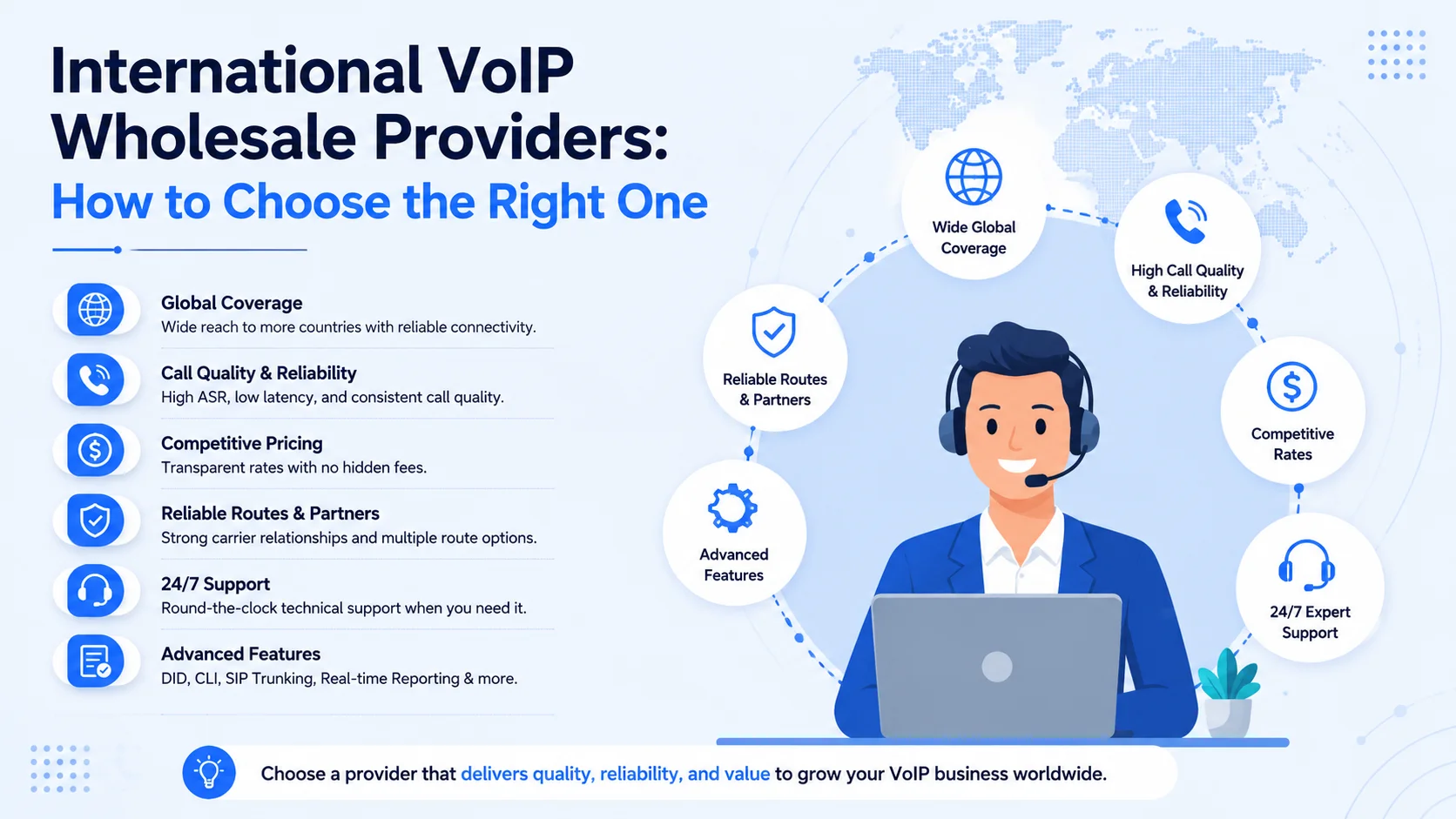
A rate sheet alone says almost nothing about how a wholesaler will perform once your traffic is live. Evaluate against these dimensions instead:
- Geographic coverage — how many of your actual target destinations sit on direct routes rather than transit paths
- ASR by destination, measured on live production traffic rather than a blended network average
- CLI delivery policy — which destinations get the real caller ID passed through, a legal requirement in many regulated markets
- Billing granularity — true per-second, FAS-free billing versus rounded increments and hidden charges
- Compliance posture — current STIR/SHAKEN attestation for any US-originating traffic, required under the FCC's call authentication rules
- Uptime SLA — a contractual figure backed by defined service credits, not a marketing claim
- Support model — a 24/7 network operations center with a defined response-time commitment
6What Drives Wholesale VoIP Pricing
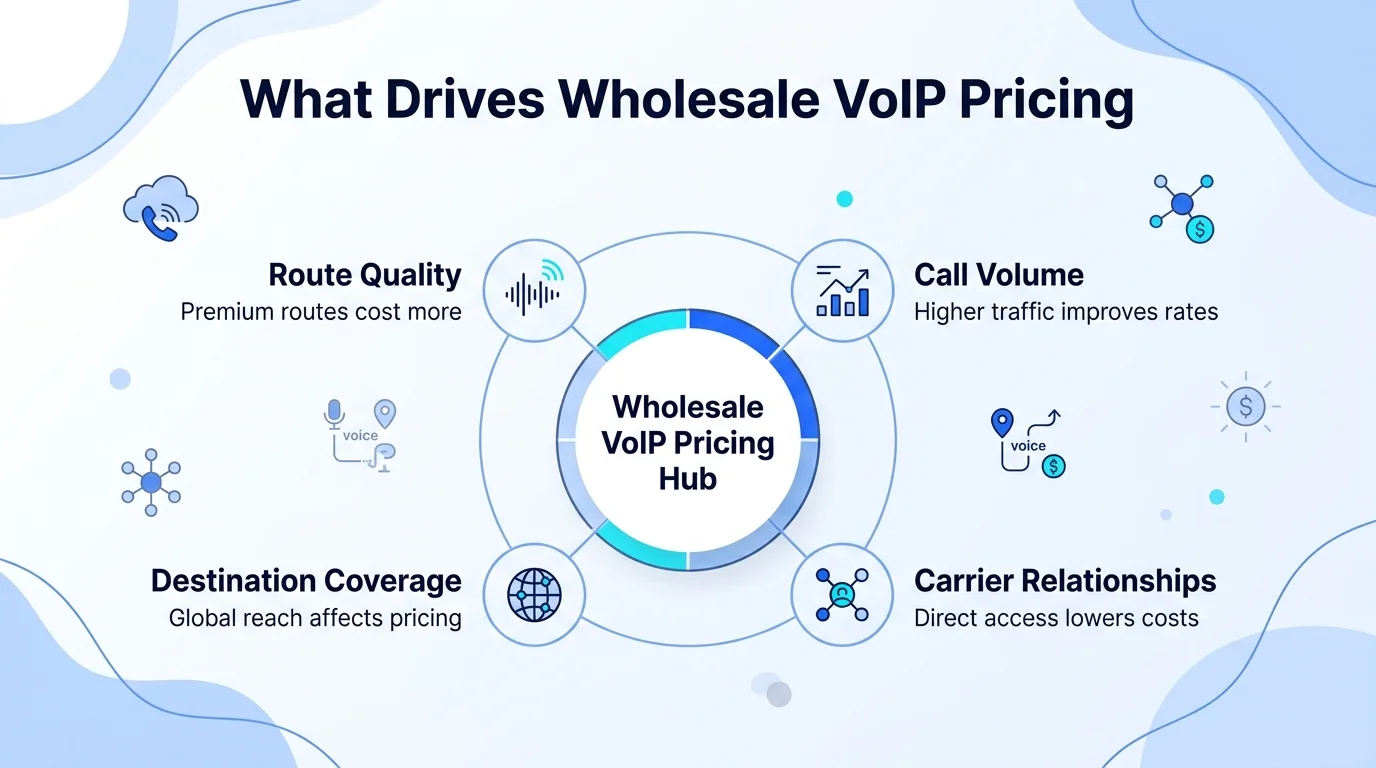
Wholesale pricing looks simple on a rate sheet and gets complicated once the variables that actually move cost come into play. Destination is the largest driver: US and Western European fixed-line rates often start near $0.003–0.005 per minute, mobile termination runs several times higher, and destinations with limited carrier competition can run five to ten times the US baseline. Route type adds another layer — CLI routes typically carry a 20–40% premium over non-CLI on the same destination, reflecting the cost of maintaining compliant, direct interconnects.
Billing model frequently matters more than the headline rate. A wholesaler charging a lower per-minute rate but billing in six-second increments, or applying false answer supervision — charging for calls that were never actually answered — can end up costing more per completed call than a source with a slightly higher rate and true per-second, FAS-free billing. Model total cost against actual traffic patterns rather than comparing headline numbers in isolation.
7Red Flags to Avoid When Choosing a Wholesaler
A handful of warning signs reliably predict a poor wholesale relationship:
- Rates meaningfully below the rest of the market with no clear explanation
- No published SLA, or one with no defined credit terms
- FAS billing or six-second increments buried in the fine print
- Reluctance to share live ASR data or allow a trial period
- Support only available during business hours for a service that runs continuously
None of these disqualify a source in isolation, but two or more together are a strong signal to keep evaluating alternatives.
8How to Evaluate a Wholesaler Before Committing Volume
The strongest VoIP wholesalers combine direct Tier-1 interconnects across a wide destination footprint with transparent, FAS-free billing, full CLI delivery, current compliance attestation, and a real, credit-backed uptime SLA. Before shifting meaningful volume, request a rate deck alongside a short live-traffic trial — typically 5–10% of real traffic across your top destinations for seven to fourteen days — and compare live ASR, billing accuracy, and support responsiveness directly against your existing source rather than relying on claims in a sales conversation. For a deeper look at routing mechanics and quality metrics, see our wholesale voice termination guide.
Document the trial results destination-by-destination rather than as a single blended average, since a wholesaler can look strong overall while quietly underperforming on the specific corridors that matter most to your traffic mix. Treat the trial period as a negotiating tool too — a source confident in its network has no reason to resist a structured, time-boxed comparison against a competitor.
9Conclusion
Choosing among VoIP wholesalers comes down to looking past the rate deck and into the infrastructure, billing mechanics, and compliance posture behind it. A source that owns direct interconnects, publishes real ASR data by destination, bills transparently with no hidden charges, and backs its uptime with a contractual SLA will consistently outperform a cheaper alternative once true cost per completed call is considered. Run a live trial before committing volume, and treat the red flags above as non-negotiable filters rather than minor inconveniences.
10Frequently Asked Questions
What is the difference between a VoIP wholesaler and a retail VoIP provider?
A retail VoIP provider sells finished phone service to a single business for its own employees. A VoIP wholesaler sells raw, bulk call-completion capacity to resellers, carriers, and platforms that then deliver voice service downstream to their own customers, typically at a fraction of retail per-minute cost.
How do I know if a VoIP wholesaler owns its own network?
Ask directly whether the wholesaler holds bilateral interconnect agreements with local operators in your target destinations, or ask them to name the underlying Tier-1 carrier they lease capacity from. A source that avoids the question directly is usually reselling multiple hops down the chain.
What is a good ASR for a VoIP wholesaler?
On premium CLI routes to major destinations, a healthy ASR typically falls in the 60–80% range. Figures consistently below 40–50% usually indicate carrier blocking, route congestion, or grey-route quality issues.
Why does billing granularity matter when comparing wholesalers?
A wholesaler billing in six-second increments or applying false answer supervision can cost more per completed call than one with a slightly higher headline rate but true per-second, FAS-free billing. Always model cost against actual call patterns, not the quoted rate alone.
How should I test a new VoIP wholesaler before switching volume?
Run a live trial of 5–10% of real traffic across your highest-volume destinations for one to two weeks, monitoring ASR and billing accuracy directly, before shifting the remainder of your traffic to a new source.