1Introduction
Every failed call costs real money. Answer rates below 40%, distorted audio, and long silences after dialing all signal broken route infrastructure. The global wholesale VoIP market is on track to surpass $55 billion by 2027, yet most businesses sourcing wholesale VoIP routes still choose providers on price alone, skipping quality signals that determine whether calls complete.
This guide breaks down what wholesale VoIP routes are, how CLI, Non-CLI, and CC types differ, which metrics tell you whether a route is reliable, and how to pick a provider who operates their own infrastructure instead of reselling someone else's. Softtop's carrier-grade platform covers 150+ countries, maintains 99.99% uptime, and backs every route with a 24/7/365 Network Operations Center.
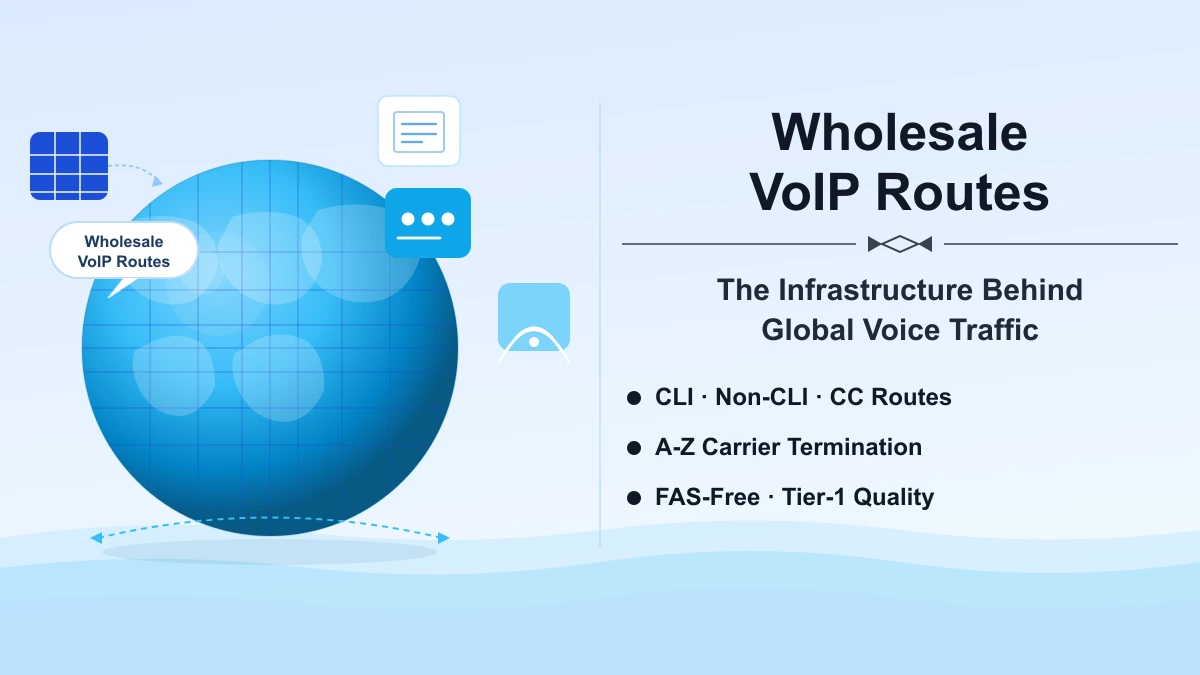
Wholesale VoIP routes are bulk voice pathways carrying high-volume calls between carrier networks at per-minute rates. CLI routes pass caller ID; Non-CLI routes don't; CC routes serve calling card traffic. Quality is measured by ASR, ACD, and PDD — not price per minute. FAS-free termination protects margins.
2What Are Wholesale VoIP Routes?
Wholesale VoIP routes are high-capacity digital pathways that carry bulk voice traffic between carrier networks. When a call travels over VoIP, it passes through a chain of interconnected networks — wholesale routes are the infrastructure and routing logic that determine which chain each call takes, and at what cost.
Unlike retail VoIP, which serves individual businesses with a handful of concurrent calls, wholesale routes handle millions of minutes per month. They're sold to telecom carriers, Internet Telephony Service Providers (ITSPs), call centers, and resellers who need to terminate large traffic volumes at competitive per-minute rates.
A wholesale VoIP route is a bulk voice traffic pathway between carrier networks, covering A-Z destination reach, route quality classification (CLI, Non-CLI, or CC), SIP-based interconnection, and real-time quality monitoring.
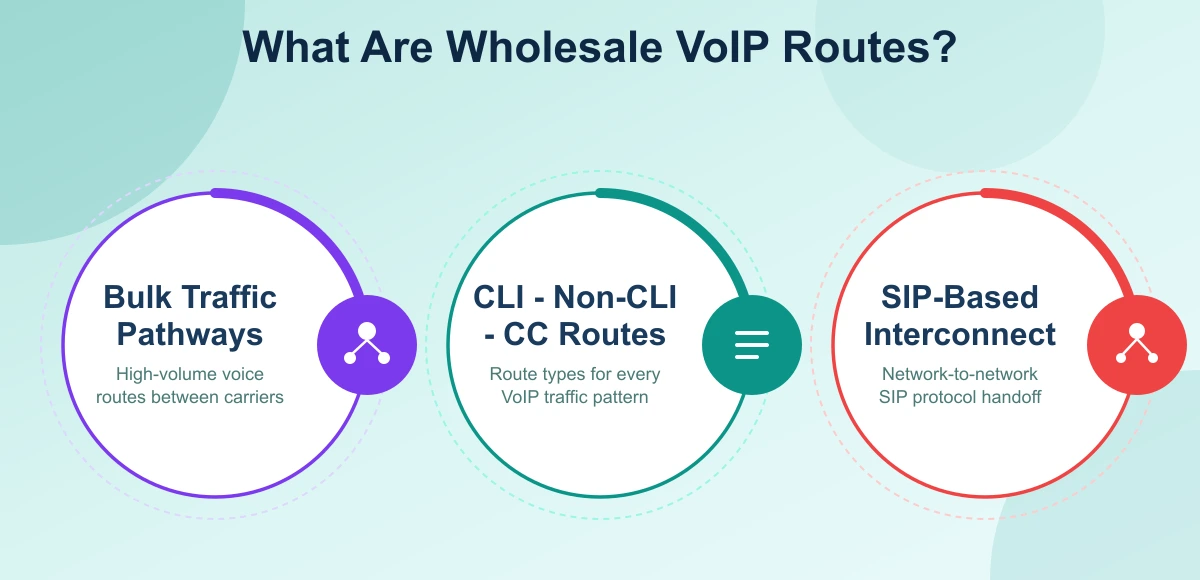
Wholesale termination rates typically run $0.003–$0.01 per minute — 3–10× cheaper than retail. But the rate only matters if the route completes the call. Providers operating direct Tier-1 interconnects deliver calls on owned infrastructure, not a chain of resold capacity with each hop adding risk. Partnering with a dedicated Voice Wholesaler gives businesses direct access to carrier-grade A-Z termination across 150+ countries without intermediary markups.
3CLI, Non-CLI, and CC Routes: Choosing the Right Wholesale VoIP Route Type
The classification you choose determines your cost structure, answer rates, and which traffic patterns you can serve reliably.
CLI Routes (Calling Line Identification)
CLI routes pass the caller's number to the called party — the recipient sees who is calling. For outbound sales teams and contact centers, CLI routes are essential. They cost more per minute, but a 60% ASR on a CLI route delivers more connected calls per dollar than a 20% ASR on a cheap Non-CLI route.
Non-CLI Routes
Non-CLI routes do not transmit caller ID. The recipient sees "Unknown." Per-minute rates are lower, making them appropriate for automated notifications, bulk dialing campaigns, and any traffic where caller identification is not a factor.
CC Routes (Calling Card Routes)
CC routes are engineered for prepaid calling card platforms. They handle the multi-leg signaling patterns of prepaid card traffic — when a caller enters a PIN before connecting. Standard CLI or Non-CLI routes are not designed for this pattern. If you serve South Asian, African, or Latin American calling card markets, CC routes are the correct choice.
| Route Type | Caller ID | Typical ASR | Relative Cost | Best For |
|---|---|---|---|---|
| CLI | Passed to recipient | 60–80% | Highest | Outbound sales, contact centers, business voice |
| Non-CLI | Shows as "Unknown" | 30–50% | Lowest | Bulk notifications, automated dialing campaigns |
| CC | Passed after PIN entry | 40–60% | Mid-range | Prepaid calling card and IVR-first platforms |
Sourcing all three from a single provider eliminates multiple SIP interconnections, separate billing relationships, and redundant configurations. Consolidated wholesale voice routes cut operational overhead significantly. Call quality across route types is formally modeled using the ITU-T G.107 E-model, the industry-standard tool for estimating end-user voice quality across different network conditions.
4Quality Metrics Every Wholesale VoIP Routes Buyer Should Track
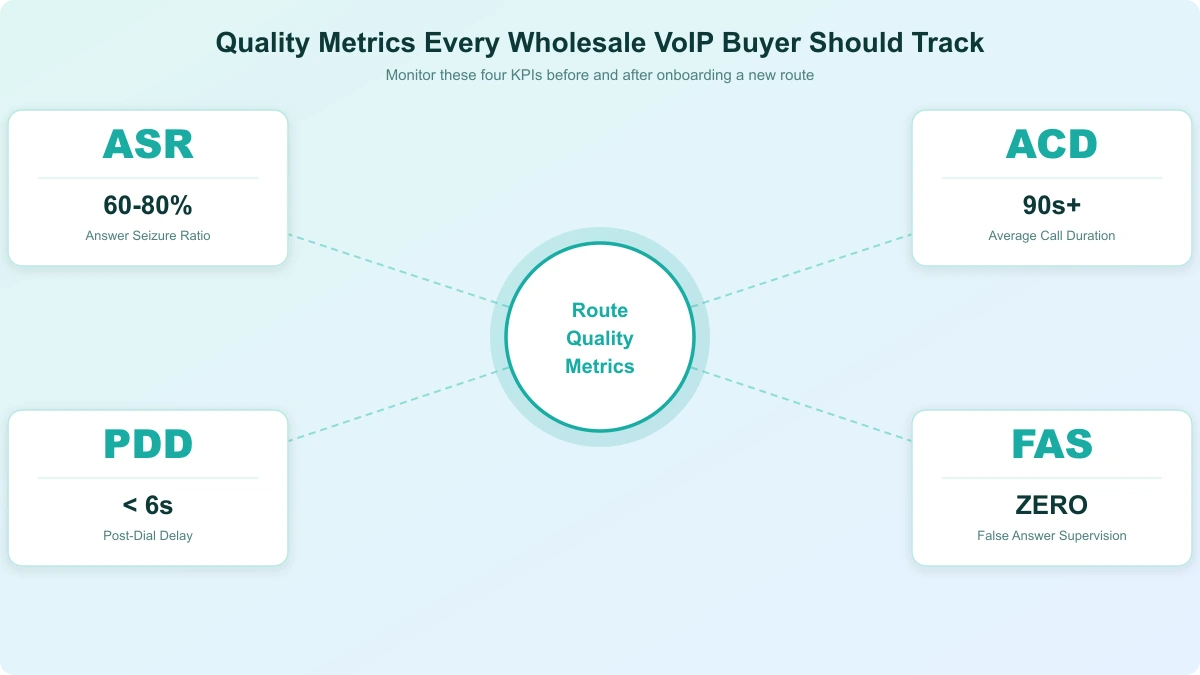
Route quality is invisible in a rate card. Four metrics reveal whether a wholesale VoIP route is worth paying for — and none of them is price per minute.
Answer Seizure Ratio (ASR)
ASR measures the percentage of call attempts that result in a genuine connection. Premium CLI Routes on major destinations should achieve 60–80% ASR. A route running 20% ASR means four out of five dials fail — and on some providers, you still pay for those attempts. Quality and compliance standards directly shape how carrier networks handle and prioritize voice traffic.
The gap between a cheap low-ASR route and a premium one is easier to see in real numbers than in a rate card. Here's what it takes to land 6,500 connected calls on two routes with identical per-minute pricing but different ASR:
| Metric | Route A (25% ASR) | Route B (65% ASR) |
|---|---|---|
| Dial attempts needed for 6,500 connections | 26,000 | 10,000 |
| Failed attempts | 19,500 | 3,500 |
| Extra dial attempts vs. Route B | +16,000 | — |
| Agent/system time wasted on dead calls | Significantly higher | Baseline |
Even when a provider only bills for connected minutes, the low-ASR route still costs more in practice: more retries, more agent hours spent redialing, and more customers who gave up before the call connected. Rate-card price per minute never captures that difference — only ASR does.
Average Call Duration (ACD)
ACD tracks how long connected calls actually last. High ACD signals calls are reaching real people and completing naturally. ACD below 90 seconds often indicates route quality problems — noise, dropped audio, or False Answer Supervision activity.
Post-Dial Delay (PDD)
PDD is the gap between dialing and the first ring. Anything above 6–8 seconds signals congested or low-quality routing paths and frustrates callers before they even hear a voice.
False Answer Supervision (FAS)
FAS is a billing fraud mechanism where a route charges for call duration before genuine human answer. FAS inflates your per-minute costs and corrupts your quality statistics. FAS-free termination — billing only on real answer — is a non-negotiable baseline. Get it in writing before signing any wholesale agreement.
5How Wholesale VoIP Call Termination Works, Step by Step
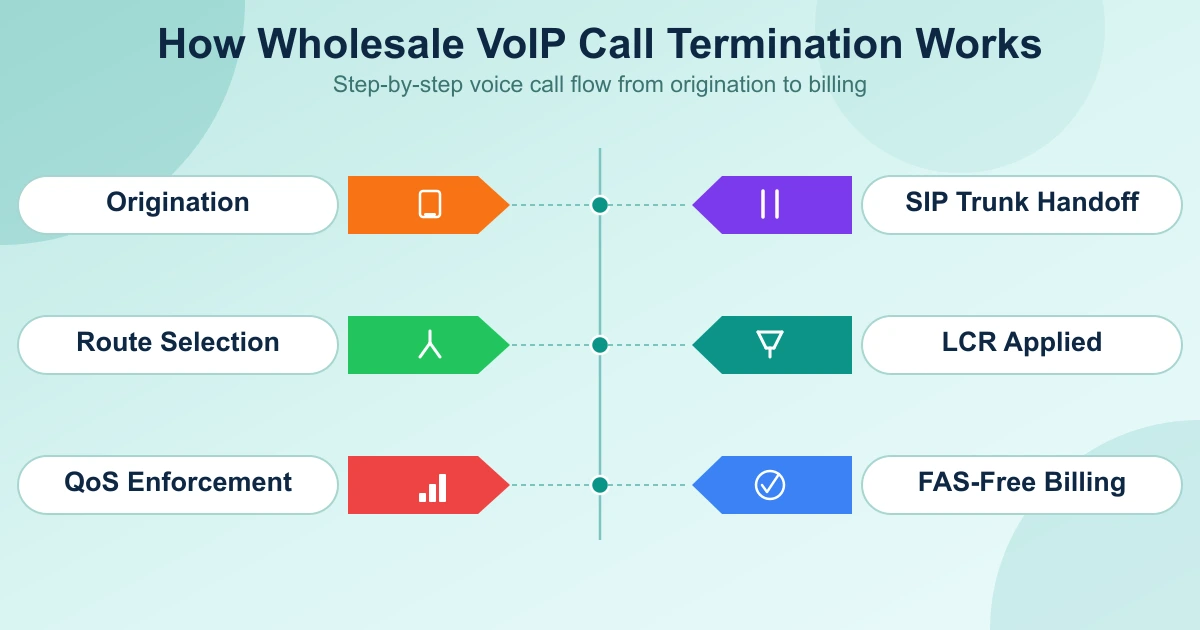
Understanding the call flow lets you pinpoint where quality problems originate and hold your provider accountable.
Origination
A caller dials from a VoIP endpoint. The call enters the originating provider's network and is handed off via SIP trunking — a virtual multi-channel link carrying both signaling and media.
Route Selection
The wholesale provider's platform applies routing logic, often Least Cost Routing (LCR), to select the most cost-effective path that still meets your quality threshold. Premium routes go direct; economy routes may traverse multiple hops, each adding latency risk.
QoS Enforcement
Voice packets cross the carrier network with Quality of Service mechanisms prioritizing them over lower-priority data. This prevents jitter and packet loss that degrade audio.
Termination
The call reaches the destination carrier, which delivers it to the recipient — whether landline, mobile, or another VoIP network.
Billing
FAS-free providers start the clock only on genuine human answer. When route quality degrades, PDD rises, ASR drops, and ACD shortens — which is why real-time CDR monitoring per destination is essential, not optional.
6Wholesale VoIP Route Best Practices: Maximizing Quality and Margins
Understanding call termination is only half the equation. How you configure, monitor, and manage your wholesale VoIP routes determines whether you extract full value from your carrier relationships — or leave margin on the table.
Implement Least Cost Routing (LCR)
LCR automatically directs each call to the lowest-cost route that still meets your defined quality threshold. Without it, calls default to static routes regardless of whether cheaper alternatives exist. A properly tuned LCR engine typically reduces termination costs by 20–35% without touching ASR or ACD targets — pure margin improvement with no call quality trade-off.
Diversify Your Route Portfolio
Relying on a single route per destination is a single point of failure. Maintain primary, secondary, and emergency routes for every high-traffic destination. When a primary route degrades — flagged by a falling ASR or rising PDD — automatic failover keeps calls completing while your NOC investigates the root cause.
Monitor Quality Metrics Per Destination in Real Time
Route quality can collapse in minutes. ASR, ACD, and PDD must be tracked per destination in real time — not in end-of-day reports. A live CDR dashboard per route lets you catch congestion, FAS activity, or route hijacking before it affects significant traffic volume and before customers notice.
Apply QoS Policies to Prioritize Voice Traffic
Voice packets are latency-sensitive. On networks carrying mixed traffic, Quality of Service policies place voice packets in a priority queue ahead of bulk data. Even 20ms of additional jitter can drop MOS scores below acceptable thresholds and make calls feel degraded — a problem preventable at the network configuration layer.
Audit Your Rate Decks Monthly
Wholesale per-minute rates on key destinations shift frequently as carrier competition changes. Monthly rate deck audits ensure you're not paying outdated rates when better options have entered the market. Cross-referencing actual CDR costs against your contracted rate deck also surfaces billing discrepancies before they compound.
Get SLA Commitments in Writing Before You Sign
Verbal quality commitments are worthless when traffic degrades at 2 AM on a Sunday. Before signing any wholesale agreement, secure minimum ASR floors, maximum PDD ceilings, FAS-free billing confirmation, and uptime guarantees in writing — with explicitly defined remedies when thresholds are breached.
7How to Choose a Wholesale VoIP Routes Provider
Not every company selling wholesale VoIP routes is a network operator. Many are resellers buying capacity from carriers and marking it up. When a route degrades, a reseller cannot fix it — they file a ticket with their upstream supplier while you wait.
Verify Network Ownership
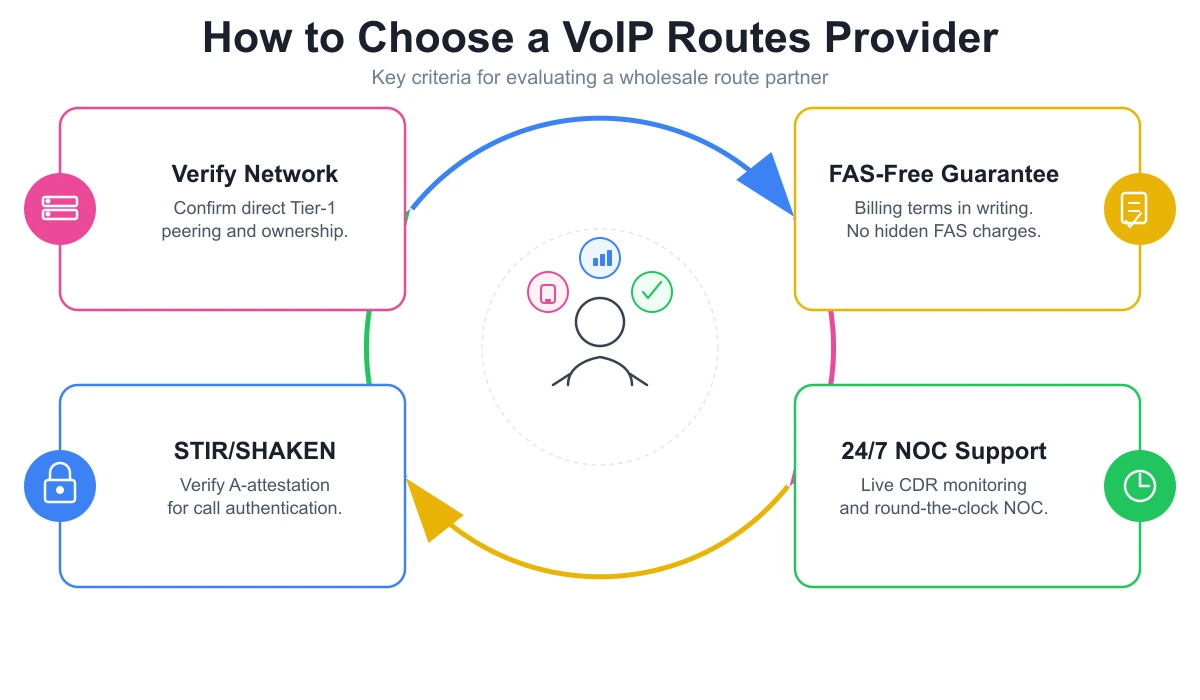
A genuine operator runs its own infrastructure, holds direct Tier-1 interconnects, and staffs a 24/7/365 NOC. Ask directly: "Is this your network, or are you reselling?"
Get FAS-Free Guarantees in Writing
Some providers imply FAS-free quality without committing to it contractually. Get an explicit FAS-free clause before signing any wholesale agreement.
Confirm STIR/SHAKEN Compliance
In the US market, carriers must cryptographically sign calls under STIR/SHAKEN. Providers attesting your calls at A-level protect them from being labeled "Spam Likely." Without this, answer rates suffer regardless of route quality.
Demand Rate Deck Transparency
A downloadable, destination-by-destination rate deck should be available before you sign. Hidden pricing is a red flag.
Softtop's self-service portal lets you monitor live CDRs, check ASR per destination, and adjust routing in real time — giving you full visibility before committing to a volume agreement.
8Conclusion
Wholesale VoIP routes are the infrastructure layer that determines whether calls reach their destination — at what quality, and at what true cost. Choosing the right route type for your traffic, tracking the metrics that matter (ASR, ACD, PDD, and FAS-free status), and working with a genuine network operator rather than a reseller are the decisions that separate reliable voice operations from expensive surprises.
Softtop operates carrier-grade wholesale VoIP infrastructure across 150+ countries on direct Tier-1 connections, backed by 99.99% uptime and a 24/7/365 NOC. Whether you're a reseller scaling a voice business, a call center managing outbound traffic, or a carrier expanding A-Z coverage, the route quality and cost control are here to support your growth.
9Frequently Asked Questions
What are wholesale VoIP routes?
Wholesale VoIP routes are bulk voice pathways between carrier networks that terminate high-volume calls at per-minute rates. They cover A-Z reach, CLI/Non-CLI/CC classifications, and SIP interconnection — sold to carriers, resellers, and call centers handling significant traffic volumes.
What is the difference between CLI and Non-CLI wholesale VoIP routes?
CLI routes pass the caller's number to the recipient — who is calling is visible. Non-CLI routes transmit no caller ID. CLI costs more per minute but drives higher answer rates, making it essential for outbound sales and contact centers. Non-CLI suits automated bulk traffic.
What does FAS-free mean for wholesale VoIP routes?
FAS (False Answer Supervision) charges for call time before genuine human answer — inflating costs and distorting quality stats. FAS-free routes bill only on real answer. Always confirm this contractually before sourcing any wholesale voice routes from a new provider.
What is ASR and why does it matter?
ASR (Answer Seizure Ratio) is the share of dials that connect successfully. A 20% ASR means 80% of calls fail — and you still pay termination fees on them. Premium CLI routes should achieve 60–80% ASR on major destinations. Monitor per destination to catch degradation early.
How do wholesale VoIP routes cut costs versus retail VoIP?
Wholesale termination rates run $0.003–$0.01/min — 3–10× below retail. Businesses switching to wholesale VoIP routes typically cut international call costs by 40–70% through bulk pricing, Least Cost Routing (LCR), and direct carrier interconnects that remove retail margin layers.