1Introduction
Businesses routing significant call volumes face a straightforward cost equation: every minute on the phone has a price, and that price is set by wholesale termination rates. A difference of half a cent per minute sounds trivial until you are moving ten million minutes a month — at that scale it equals $50,000. Understanding how termination rates are structured, what makes them move, and which billing practices erode margin without adding value gives procurement and telecom teams a concrete advantage.
This guide covers how wholesale call termination pricing is set, the route tiers that shape quality and cost, the quality metrics that protect call performance, and the contractual details that determine real-world savings. Softtop delivers voice termination across 150+ countries through direct Tier-1 carrier connections, giving enterprise buyers a transparent, FAS-free pricing baseline that benchmarks well against the market.
Wholesale termination rates are the per-minute fees carriers charge to complete calls — businesses that buy wholesale typically save 40–70% versus retail pricing. Rate levels are shaped by destination, volume, route tier, and regulatory surcharges. Choosing a direct Tier-1 carrier with FAS-free billing and per-second increments prevents hidden cost inflation.
2What Are Wholesale Termination Rates and How Are They Set?
At its core, a wholesale termination rate is the per-minute fee a carrier charges to deliver — or terminate — a call on the destination network. When a business dials an international number, that call typically crosses two or three carrier networks before it reaches the called party. Each handoff carries a cost, and the sum of those costs forms the rate the originating carrier pays.
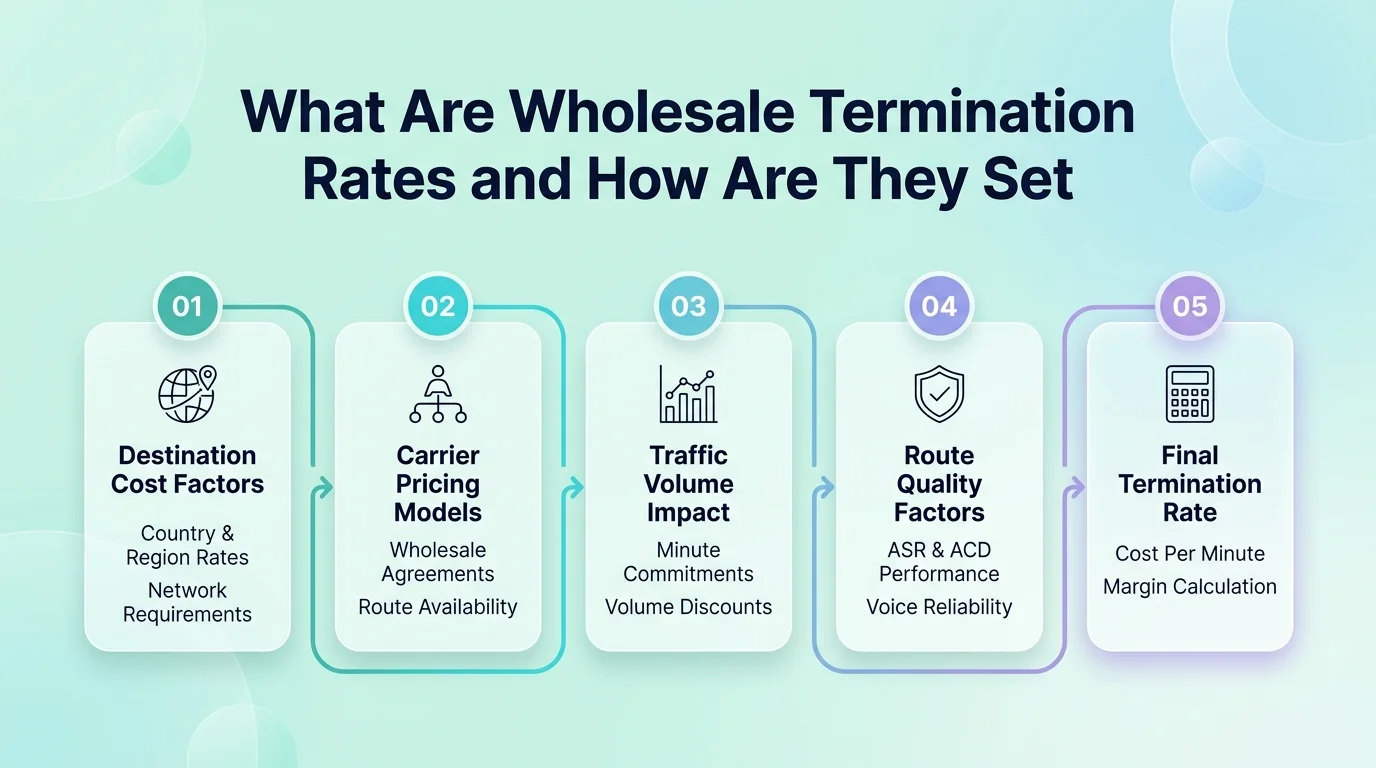
Most enterprise buyers never see this layer because they purchase from a retail provider that applies a markup. Working directly with a wholesale carrier removes that markup entirely. For a live view of current pricing, businesses can compare VoIP Termination Rates across destinations before committing to a volume agreement.
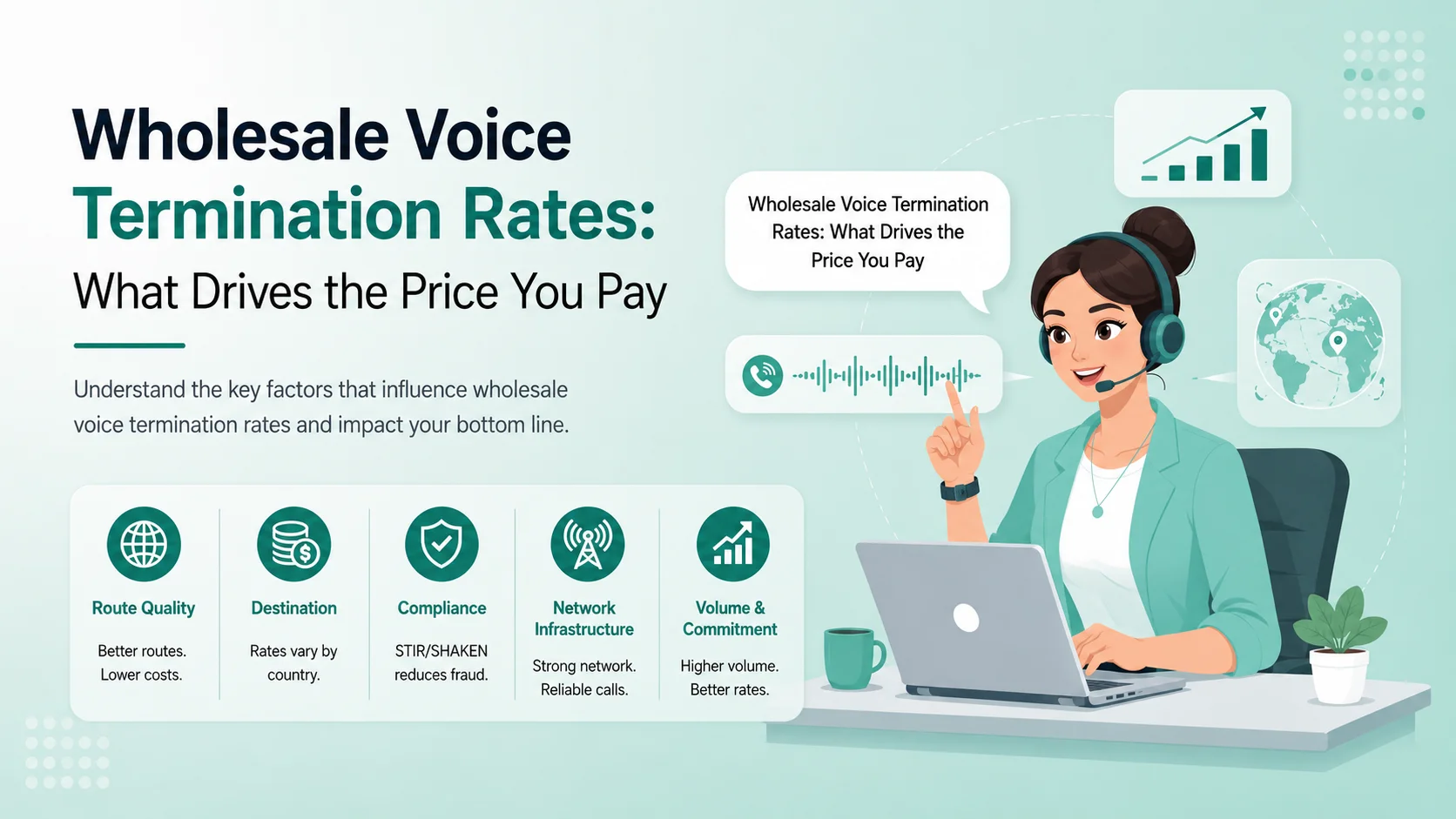
The rate a buyer actually receives depends on four main inputs: call destination, committed monthly volume, route tier selected, and current regulatory surcharges applied by destination countries. Volume commitments are the most actionable lever — carriers generally reward higher minimum monthly minutes with lower per-minute pricing, so understanding your traffic patterns before negotiating is important.
3The Three Route Tiers: Premium, Standard, and Economy
Not all wholesale call termination paths are equal. Carriers segment their routing capacity into tiers that reflect the quality of the underlying infrastructure, and each tier carries a different price point.
Premium (CLI) Routes
Premium or CLI routes connect through the fewest carrier hops, deliver the highest Answer Seizure Ratio (ASR) — typically 60–80% on well-maintained paths — and preserve Caller Line Identification so calls display correctly on the receiving end. Voice quality on these routes is benchmarked against the ITU-T P.800 standard for subjective quality measurement, which is widely used to validate premium route performance in enterprise outbound sales and contact center operations.
Standard Routes
Standard routes use a broader mix of carriers with slightly longer paths, producing moderate ASR and average cost. They suit the majority of business VoIP deployments where high ASR is desirable but some variability is acceptable.
Economy (LCR) Routes
Economy or Least Cost Routing (LCR) paths automatically select the cheapest available route at call setup, which minimizes spend but can introduce variability in call quality. Choosing the wrong tier for a use case — running a customer support line over economy routing, for example — is a common source of quality complaints that is entirely avoidable with correct tier selection from the outset.
4Key Factors That Drive International Termination Rates Up or Down
International termination rates vary more than domestic ones because multiple national regulatory frameworks overlap. Mobile Termination Rates (MTR), which are government-regulated fees charged by mobile operators to receive calls, differ significantly by country and are non-negotiable for carriers passing traffic to those networks. The United States imposes Universal Service Fund (USF) contributions that add a percentage surcharge to voice services. Working with an established Voice Wholesaler that holds direct interconnects in key markets helps buyers navigate these regulatory overlaps without paying unnecessary intermediary markups.
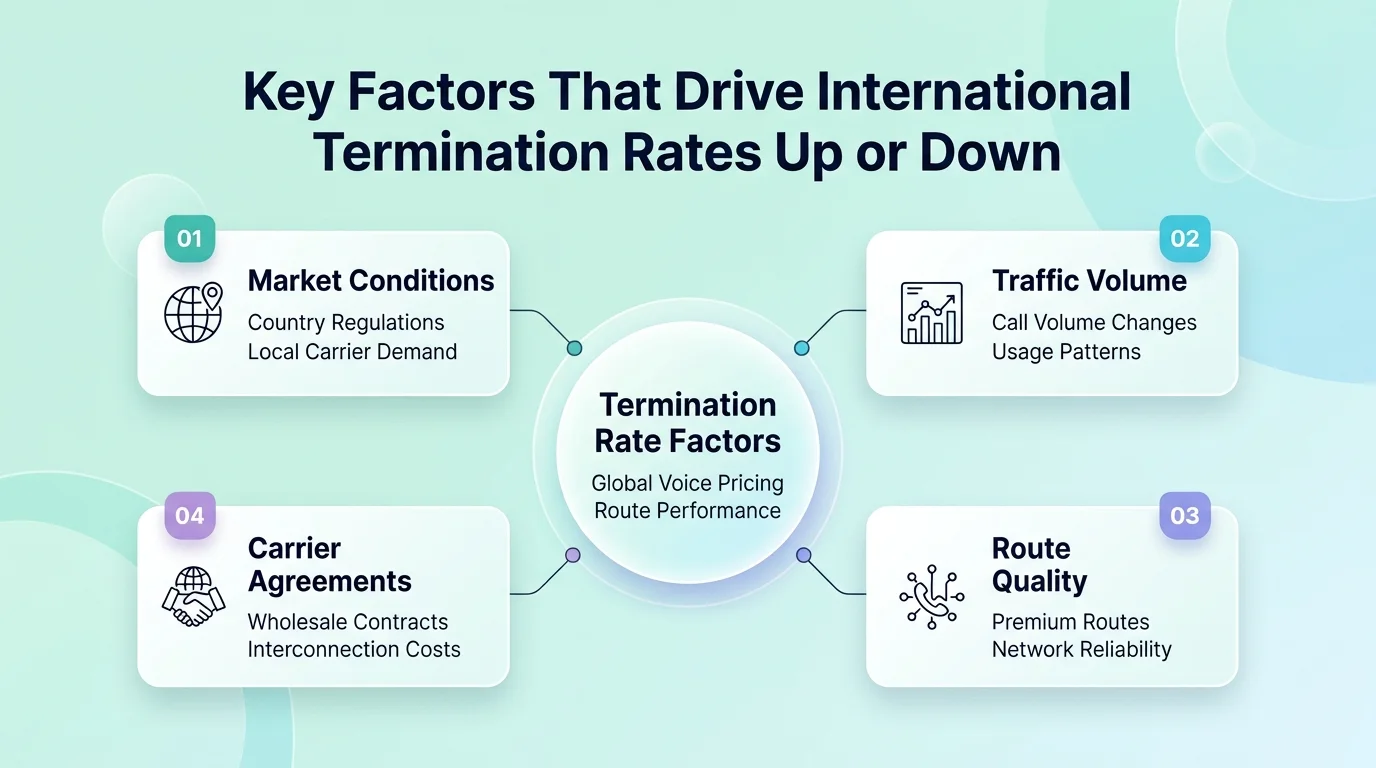
Beyond regulation, route availability matters: thinly covered destinations with fewer competing carriers command higher prices. Time-of-day pricing applies in some markets, with off-peak hours yielding lower rates. Traffic asymmetry — when a carrier receives far more traffic than it sends to a destination — can also trigger rate adjustments at contract renewal. Buyers with balanced two-way traffic profiles often negotiate better baseline rates than those with heavily one-directional volume.
5Billing Models and the Hidden Costs in Wholesale VoIP Rates
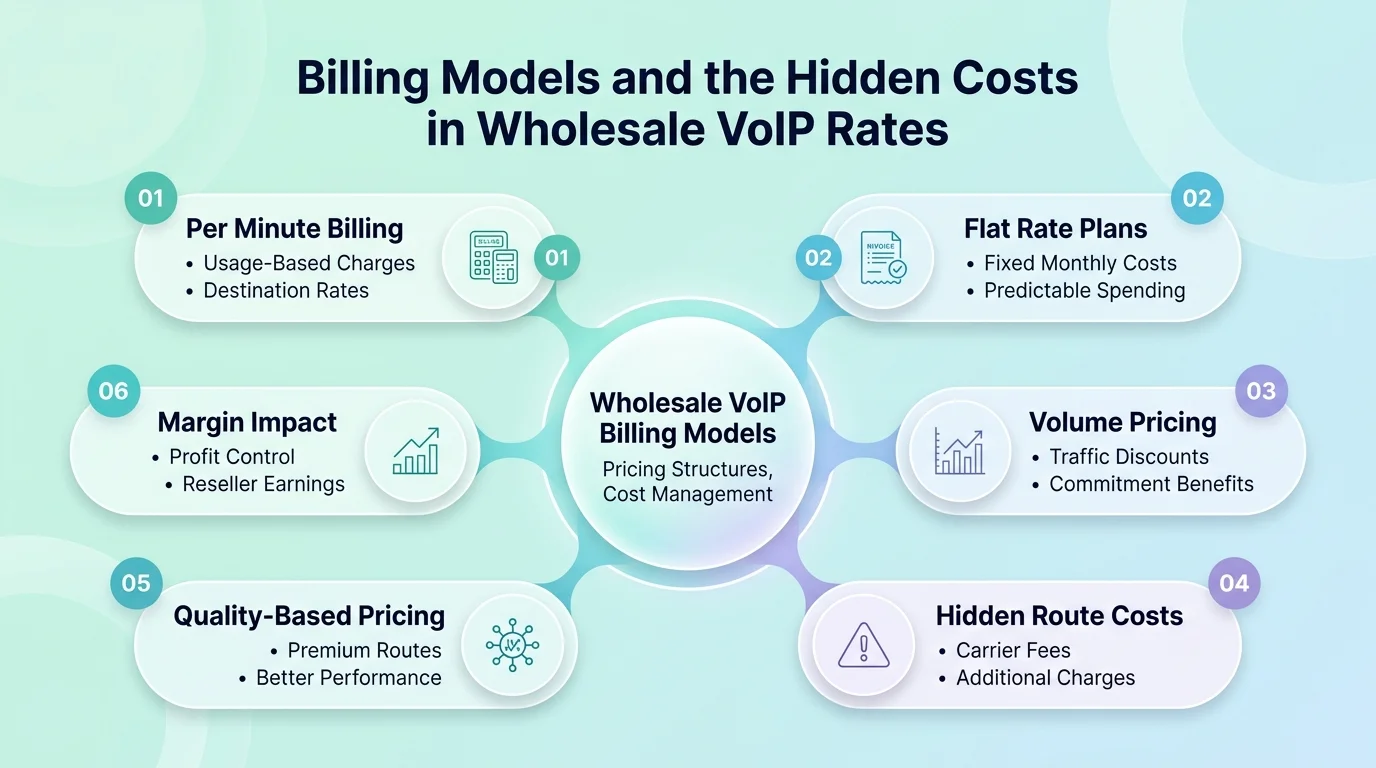
The headline per-minute rate is only part of what you pay. Billing increments, minimum call durations, and False Answer Supervision (FAS) practices each affect the real cost per conversation.
Billing Increments
Six-second billing increments charge for a full six seconds even if a call lasts three seconds — this inflates effective cost versus per-second billing, especially in markets with many short calls.
False Answer Supervision (FAS)
FAS is a fraudulent practice in which carriers bill for call duration that begins before a call is actually answered, effectively charging for ringing time. It can add 10–20% to reported minutes without delivering a single second of genuine conversation. Softtop's platform uses FAS-free billing exclusively, ensuring customers pay only for answered call time.
Per-second billing is available on supported routes and reduces rounding waste further. Buyers should ask any prospective carrier to confirm their FAS stance, billing increment, and whether minimum call duration charges apply before signing a volume agreement.
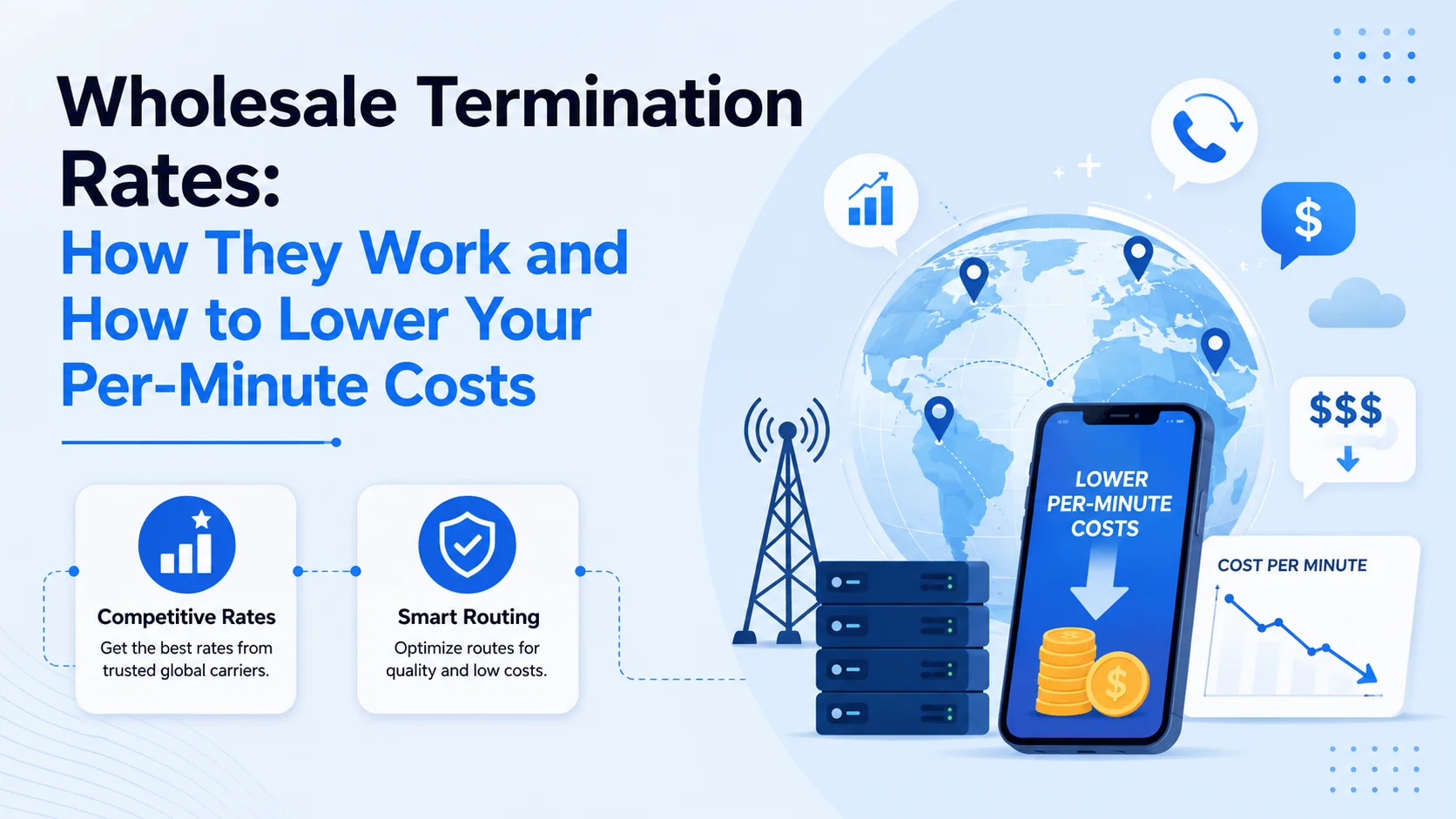
6How to Reduce Wholesale Termination Costs Without Sacrificing Call Quality
Understanding billing models is only the first step — acting on that knowledge is what converts awareness into actual savings. The following strategies are used by high-volume buyers to systematically lower effective per-minute cost while maintaining the call quality their operations depend on.
- Negotiate volume commitments early — even a modest monthly commitment (50,000–100,000 minutes) moves you into a lower pricing tier. Carriers price aggressively for committed volume because it reduces their capacity planning uncertainty.
- Match route tier to use case — Premium CLI routes cost more but deliver ASR of 60–80%; Economy LCR routes are appropriate for bulk campaigns where CLI delivery is not critical. Paying Premium rates for every destination is a common source of avoidable overspend.
- Demand FAS-free billing in writing — never assume. Require carriers to confirm in the contract that billing begins only on answered call seconds, not at seizure or ring time. FAS inflation silently adds 10–20% to effective call costs.
- Review destination rate decks monthly — international termination rates fluctuate with regulatory changes and carrier renegotiations. A scheduled monthly review catches destination-level increases before they compound into significant margin erosion.
- Consolidate traffic under one primary carrier — splitting volume across multiple providers often disqualifies you from tier pricing on each. Concentrating volume with a single Tier-1 carrier typically unlocks better rates than spreading the same traffic across three.
- Monitor ASR per destination, not just blended — a healthy overall ASR can mask a single failing destination route that inflates your true cost per completed call. Per-destination reporting should be non-negotiable in any wholesale agreement.
- Ask about per-second billing availability — on supported routes, switching from six-second increment billing to per-second billing reduces rounding waste, particularly for short-call traffic like IVR lookups, verification calls, and SMS fallback voice attempts.
For a deeper look at how per-minute pricing is structured across different traffic volumes and route types, our guide to VoIP Minutes Wholesale covers the full pricing model — including how to read a carrier rate deck and which commitment levels unlock the most significant tier discounts.
7Quality Metrics That Determine Real Value in Voice Termination Pricing
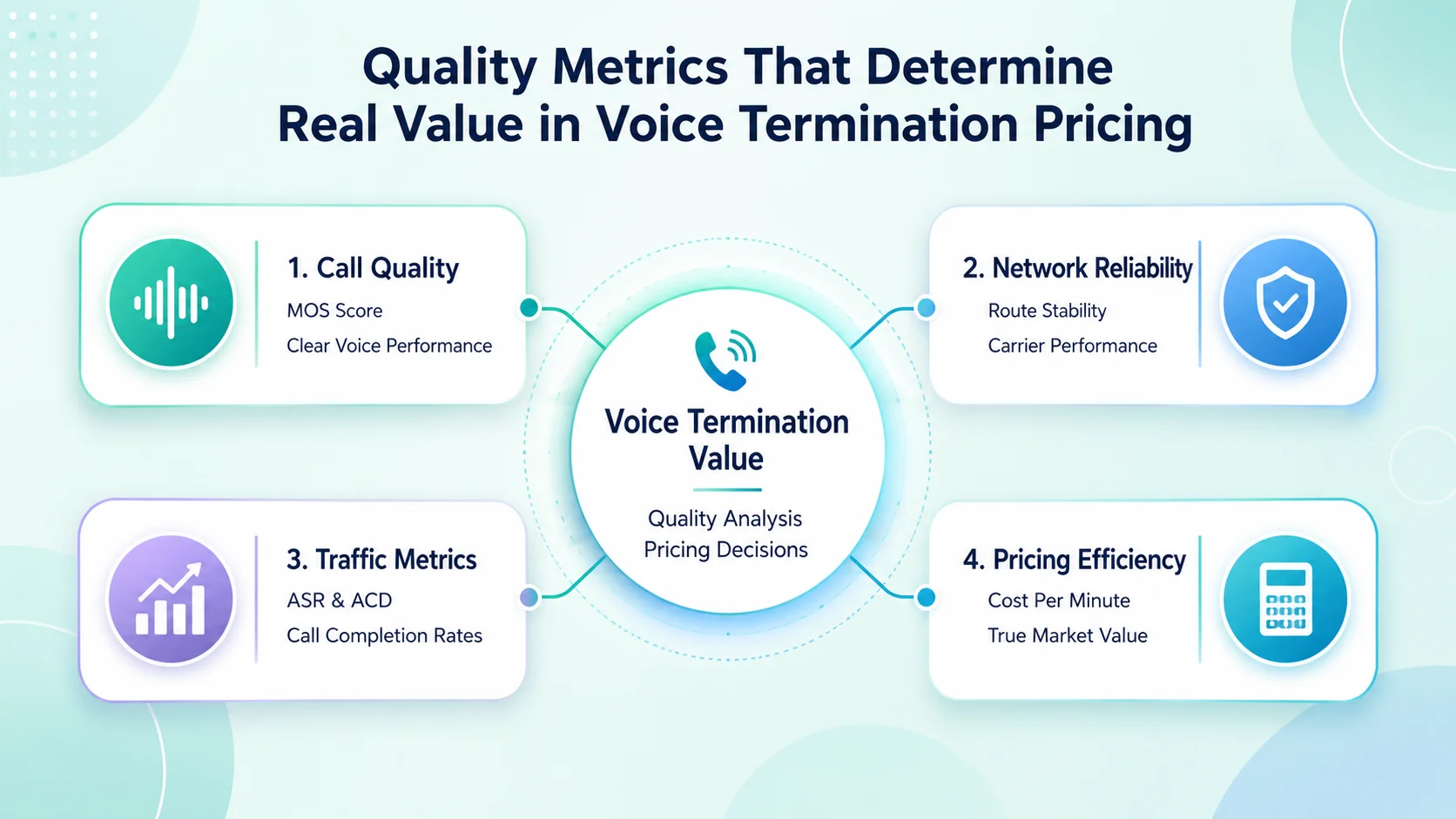
Price alone does not determine the value of a wholesale termination arrangement. Three operational metrics reveal whether a low rate actually delivers usable calls.
ASR (Answer Seizure Ratio)
ASR measures the percentage of call attempts that connect successfully. A low ASR means your dialing system is burning capacity on unanswered attempts, which inflates effective cost even on cheap routes.
ACD (Average Call Duration)
ACD is a proxy for call quality — extremely short ACD often signals that calls are connecting but dropping, or that CLI issues are causing recipients to hang up immediately.
PDD (Post-Dial Delay)
PDD is the time between dialing and hearing ringback; delays above three seconds create a perception of poor call quality. Carriers with direct Tier-1 infrastructure consistently outperform resellers on all three metrics because fewer hops mean fewer points of failure. Softtop operates a 24/7/365 NOC with 99.99% platform uptime, and its STIR/SHAKEN compliance — including A-level attestation for US traffic — prevents calls from being flagged as "Spam Likely," which directly protects ASR for outbound US campaigns.
8Conclusion
Wholesale termination rates are built from overlapping layers: base carrier economics, route tier quality, destination regulatory fees, and billing mechanics. Businesses that treat per-minute cost as the only variable often discover later that FAS inflation, poor ASR, or incorrect tier selection erased the savings they expected.
The most durable cost reductions come from matching route tier to use case, negotiating volume commitments against realistic traffic forecasts, and choosing a carrier that bills transparently. Wholesale termination rates in the $0.003–$0.01 per minute range are achievable through direct carrier relationships, and the 40–70% savings versus retail pricing is a realistic outcome for businesses with consistent monthly volume. Softtop's 150+ country coverage, Tier-1 direct connections, and FAS-free billing model are designed to make those savings straightforward to capture and to sustain as your traffic grows.
9Frequently Asked Questions
What is a typical wholesale termination rate for international calls?
Wholesale termination rates for international calls generally range from $0.003 to $0.01 per minute depending on destination, volume commitment, and route tier. High-traffic destinations such as Western Europe and North America sit at the lower end, while less-served or heavily regulated markets carry higher rates.
How much can a business save by switching from retail to wholesale call termination?
Businesses with consistent monthly call volume typically save 40–70% when moving from retail per-minute pricing to a direct wholesale carrier relationship. The exact saving depends on current retail rates, the destinations in the traffic mix, and the volume tier the carrier assigns based on committed minutes.
What does FAS-free billing mean and why does it matter?
FAS stands for False Answer Supervision, a practice where carriers bill before a call is actually answered — charging for ringing time. FAS-free billing means you pay only for genuine answered call seconds, which can reduce effective per-minute cost by 10–20% on routes where FAS was previously applied.
What is the difference between Premium CLI routes and Economy LCR routes?
Premium CLI routes use fewer carrier hops, preserve Caller Line Identification, and deliver ASR of 60–80%. Economy LCR routes select the cheapest available path at call setup, lowering cost but introducing variability in call quality and CLI delivery on the receiving end.
How does STIR/SHAKEN compliance affect wholesale termination for US traffic?
STIR/SHAKEN cryptographically verifies caller identity. Carriers with A-level attestation sign outbound calls so US mobile networks recognize them as verified, significantly reducing the chance calls are labeled "Spam Likely." This directly protects ASR and answer rates on US-destined outbound campaigns.