1Introduction
Wholesale voice termination rates sit at the heart of every carrier, MVNO, and enterprise telephony budget. Whether you operate a call center, run a SIP trunking reseller, or manage international communications for a global workforce, the per-minute cost of completing a call directly shapes your margins. Industry rates typically range from $0.003 to $0.01 per minute depending on destination, route quality, and volume commitments — a spread wide enough to make or break a business case.
Softtop connects traffic across 150+ countries through direct Tier-1 carrier relationships, delivering competitive wholesale voice termination rates without the False Answer Supervision billing traps that inflate costs on lower-quality networks. This guide breaks down every factor that moves the needle on termination pricing so you can negotiate smarter and route more efficiently.
Wholesale voice termination rates typically range from $0.003 to $0.01/min, with savings of 40–70% versus retail. Key price drivers include destination country, route tier (Premium/Standard/Economy), volume, and regulatory fees. FAS-free billing and per-second options ensure you only pay for genuine connected call time.
2What Are Wholesale Voice Termination Rates and How Are They Structured?
Wholesale voice termination rates are the per-minute or per-second prices carriers and service providers charge to complete a voice call on the PSTN or a VoIP network at the destination end. Unlike retail telephony, wholesale pricing is negotiated in volume tiers and expressed in fractions of a cent.
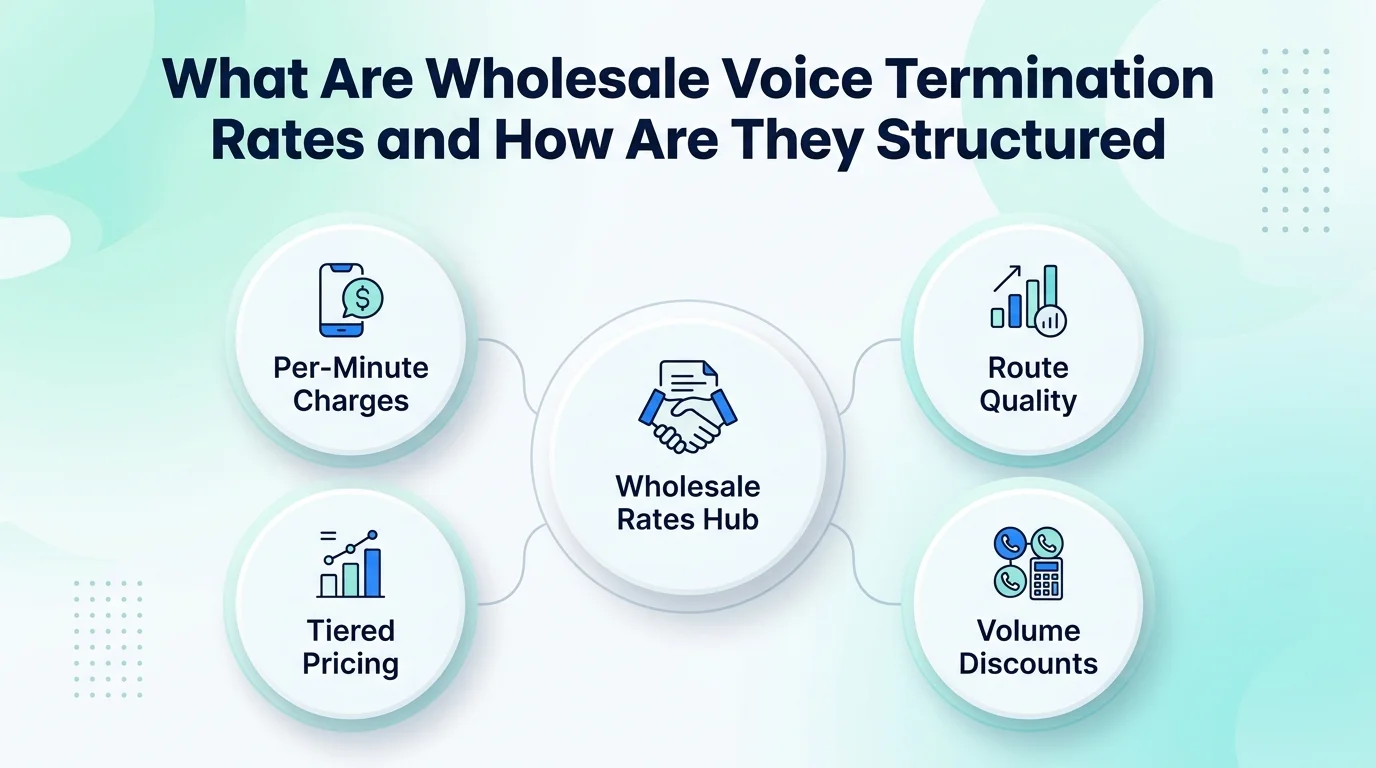
Three primary rate tiers govern most wholesale agreements. Premium or CLI routes preserve the caller ID signal end-to-end and deliver the highest Answer Seizure Ratios — Softtop's premium routes achieve ASR of 60–80%, meaning the majority of attempted calls connect successfully. Standard routes offer a middle ground between cost and quality, while Economy or Least Cost Routing options prioritize price over consistency.
Rates are typically quoted per minute, but per-second billing options eliminate the rounding waste that accumulates on short-duration calls. For high-volume operations, the difference between six-second and sixty-second billing increments can represent thousands of dollars monthly. Understanding which tier fits your traffic profile is the first step toward controlling wholesale voice termination costs.
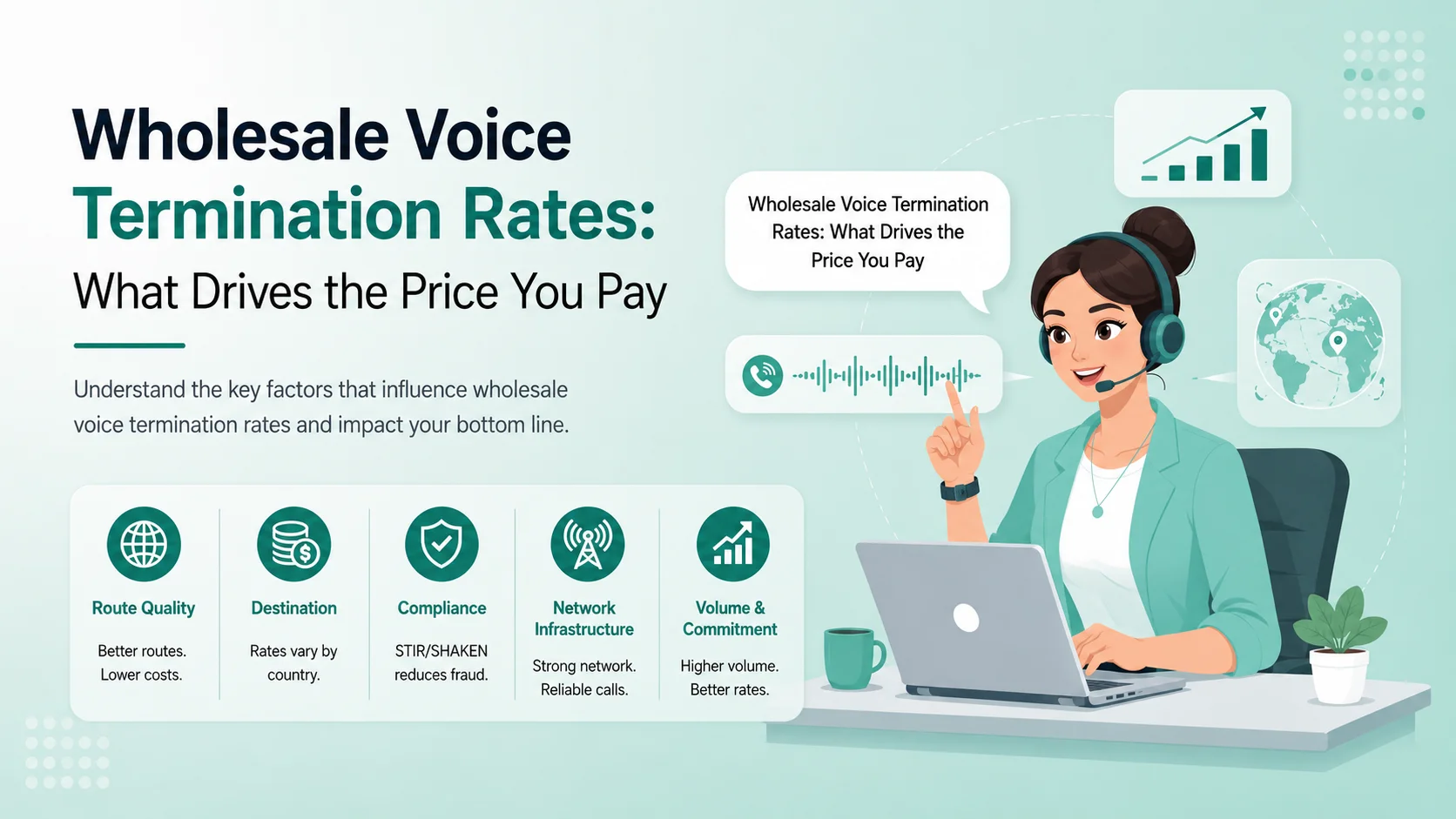
3The Five Factors That Drive Wholesale Voice Termination Rates Up or Down
No single variable sets your wholesale voice termination rates — pricing reflects several interdependent factors that carriers evaluate simultaneously when quoting a rate deck.
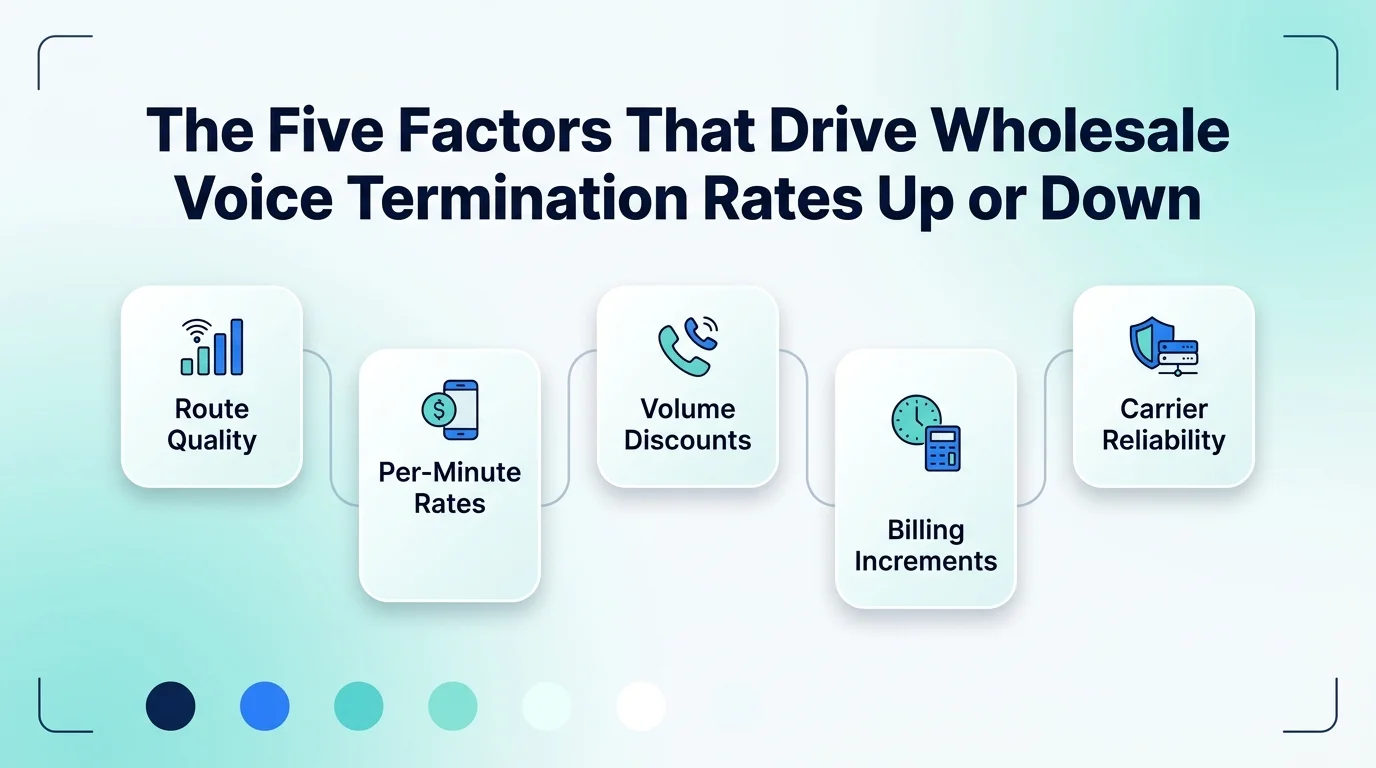
Destination Country
Terminating to a mobile number in Western Europe costs more than terminating to a fixed line in a high-volume corridor like the US or India. Regulatory frameworks, local interconnect agreements, and intermediary carrier count all shift the floor price.
Volume Commitments
Carriers price aggressively for guaranteed monthly minute minimums. A partner routing 500,000 minutes per month will see lower per-minute costs than one sending 10,000 minutes on an ad-hoc basis.
Route Tier Selection
Choosing Premium/CLI versus Economy/LCR carries a real price differential and an ASR differential. A route that costs 20% less but connects 30% fewer calls can actually cost more in effective spend.
Time of Day
Peak-hour surcharges apply in some markets, particularly where terminating carriers face congestion on physical infrastructure.
Regulatory Fees
Mobile Termination Rates, Universal Service Fund contributions, and PSTN access charges flow through to wholesale pricing. These statutory costs are embedded in the rate and are not negotiable.
4How Regulatory Fees and MTRs Influence International Termination Pricing
Regulatory cost components are among the least-understood elements of wholesale voice termination rates, yet they can account for a significant portion of the per-minute charge on certain routes.
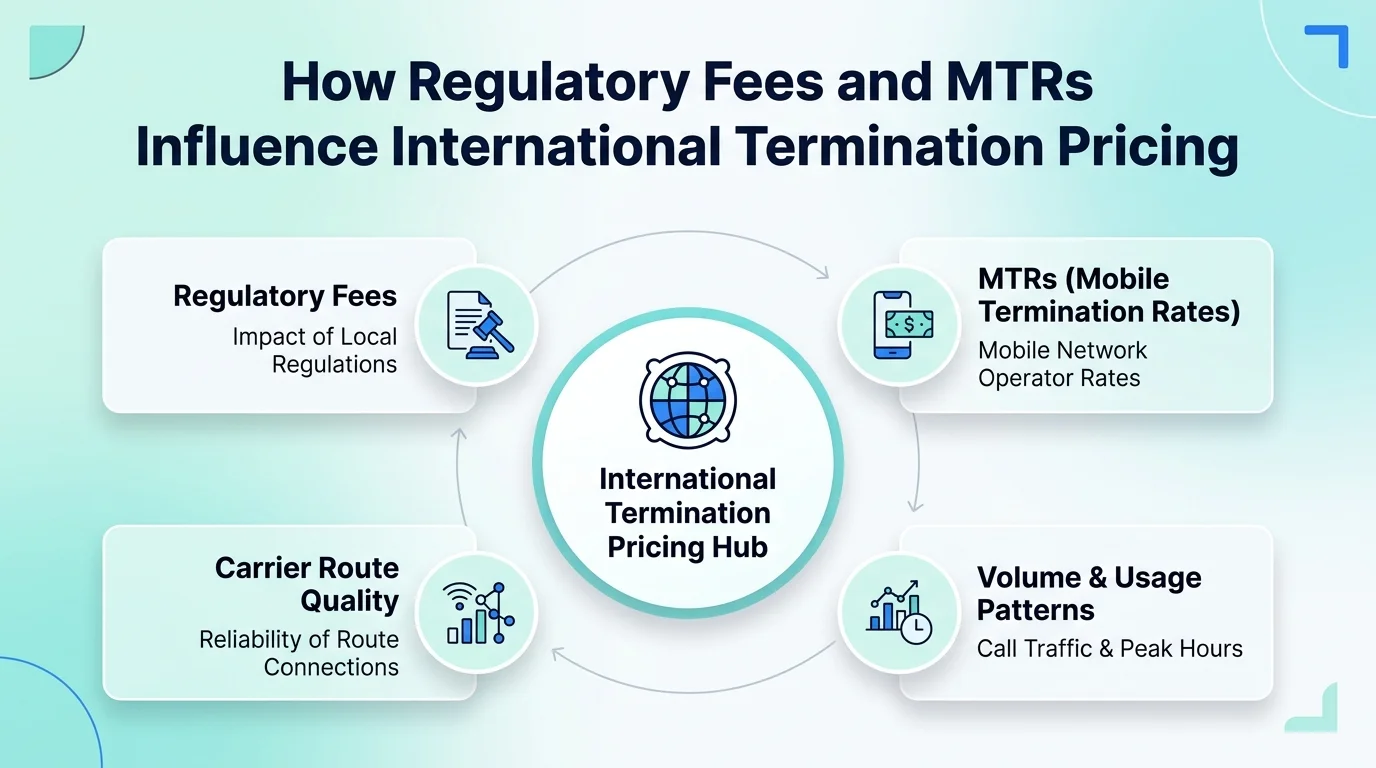
The Federal Communications Commission mandates intercarrier compensation rules that govern how US carriers settle traffic exchange, directly influencing domestic termination floors. Internationally, Mobile Termination Rates set by each country's telecoms regulator establish the maximum rate a mobile operator can charge for terminating a call on its network. Regulated MTRs across EU member states have declined steadily over the past decade, contributing to lower wholesale rates in those corridors.
For traffic destined for markets with unregulated or high MTRs — certain African, Caribbean, and Pacific routes — rates reflect true market supply and demand. Surcharges for USF contributions in the United States and equivalent levies elsewhere appear as pass-through line items on wholesale invoices and must be accounted for when comparing rate decks. Failing to factor in these mandatory fees leads to inaccurate cost modeling and budget overruns.
5FAS-Free Billing and Per-Second Options: Why Billing Method Changes Your Effective Rate
The headline per-minute rate on a wholesale voice termination contract tells only part of the cost story. Two billing practices — False Answer Supervision and coarse billing increments — can silently inflate effective costs well above the quoted rate.
False Answer Supervision occurs when a carrier bills from the moment a call enters its network rather than waiting for genuine human answer. On routes where FAS is common, customers pay for ring time and failed connection attempts. Softtop operates FAS-free billing across all routes, meaning charges begin only upon authentic answer detection. Over millions of call attempts, FAS elimination directly reduces effective cost per connected minute.
Per-second billing compounds these savings on short-duration traffic. A call center handling large volumes of sub-30-second calls pays a fraction of what sixty-second minimum billing generates on identical traffic. Always normalize quoted rates to a cost-per-connected-second basis using your actual average call duration. STIR/SHAKEN A-level attestation further protects billing integrity by authenticating caller ID at origination, reducing fraudulent traffic that inflates minutes without generating revenue.
6How to Benchmark and Negotiate the Best Wholesale Voice Termination Rates
Securing competitive wholesale voice termination rates requires systematic benchmarking, traffic analysis, and disciplined negotiation. Entering a carrier conversation without traffic data puts the pricing advantage entirely on the supplier's side.
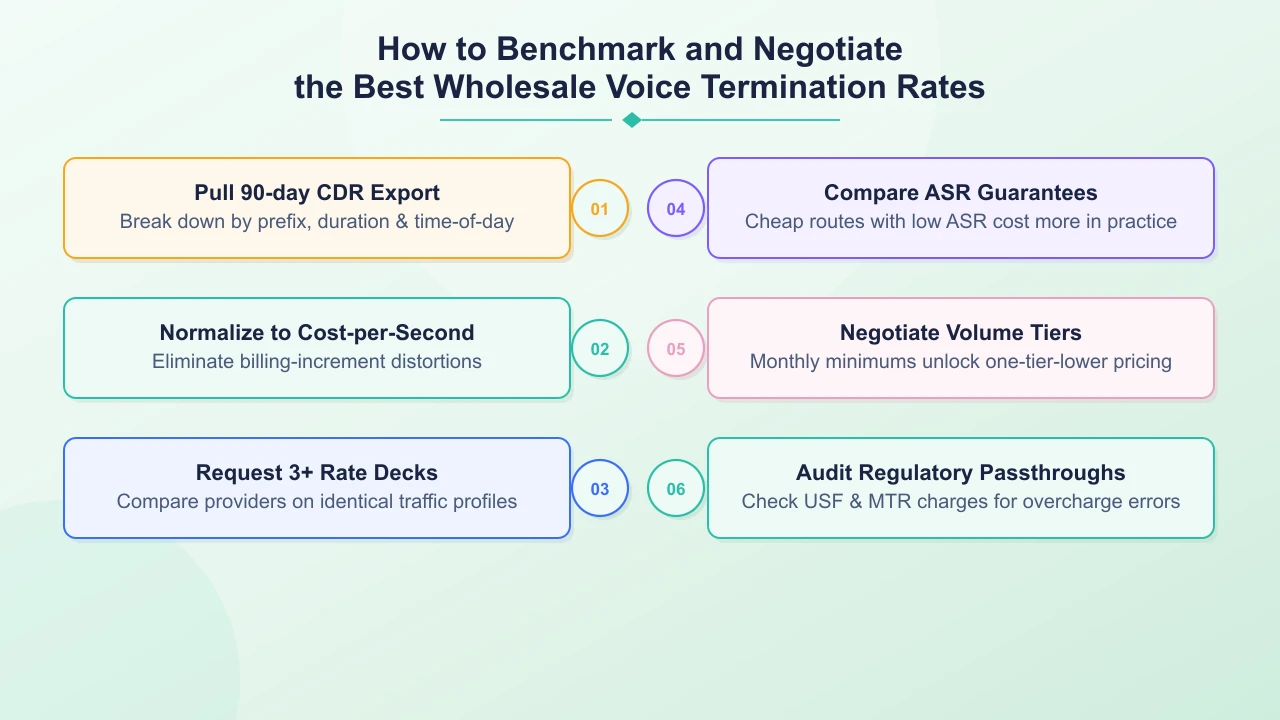
Start by pulling a 90-day CDR export broken down by destination prefix, call duration, and time-of-day pattern. This reveals which routes carry the most spend and which have poor ASR. Carriers respond to specificity — sharing your actual traffic profile enables destination-specific rates rather than generic blended pricing.
Request rate decks from at least three providers and normalize them to cost-per-connected-second to eliminate billing-increment distortions. Compare ASR guarantees alongside headline prices, because a cheap route with low ASR is an expensive route in practice. Volume tiering negotiation is particularly valuable in the $0.003–$0.01/min band — committing to a monthly minimum across a defined destination group often unlocks pricing one tier below your current consumption level.
Finally, audit existing invoices for regulatory passthrough accuracy. Overcharging on USF contributions or MTR passthroughs is not uncommon on legacy contracts. View Softtop's wholesale rate card →
7Conclusion
Wholesale voice termination rates are not a fixed commodity — they are a dynamic function of destination, route quality, billing methodology, volume, and regulatory cost components that vary by market and provider. Businesses that treat rate cards as interchangeable miss material differences between FAS-free billing and FAS-laden contracts, between genuine 99.99% uptime and paper guarantees, and between direct Tier-1 carrier connections and multi-hop routing.
Softtop's network spans 150+ countries with STIR/SHAKEN A-level attestation, per-second billing, and Premium CLI routes achieving 60–80% ASR. Understanding what drives wholesale voice termination rates gives your business a framework to evaluate providers on total cost, not just headline cents per minute.
8Frequently Asked Questions
What is a typical wholesale voice termination rate per minute?
Wholesale voice termination rates typically range from $0.003 to $0.01 per minute, depending on destination, route tier, and monthly volume commitments. Premium CLI routes sit at the higher end; Economy LCR routes at the lower end. Effective cost per connected minute varies further based on billing increment and ASR.
What is the difference between Premium CLI and Economy LCR routes?
Premium CLI routes preserve caller ID end-to-end and prioritize call quality, delivering ASR of 60–80%. Economy LCR routes apply least-cost routing logic and carry lower per-minute prices but typically lower ASR, meaning more unanswered attempts and a higher effective cost per connected call.
What is FAS billing and why should I avoid it?
False Answer Supervision charges for a call from the moment it enters the network, including ring time and failed attempts, rather than from genuine human answer. FAS-free billing ensures you pay only for calls that actually connect, reducing effective per-minute costs significantly on high-volume traffic.
How do Mobile Termination Rates affect my wholesale invoice?
Mobile Termination Rates are regulated fees that mobile operators charge for receiving calls on their networks. Wholesale carriers pass these costs through, so routes to mobile numbers in high-MTR markets carry higher baseline prices independent of the carrier's own margin.
Can per-second billing make a meaningful cost difference?
Yes, particularly for operations handling short-duration calls. If your average call duration is 25 seconds and your provider bills in 60-second increments, you pay for 35 seconds of unused time per call. Per-second billing eliminates this waste entirely, reducing spend in proportion to how short your average call duration is.