1Introduction
Mobile wholesale is the backbone of modern telecom infrastructure. Whether you operate an MVNO, run a regional carrier, or manage a contact center at scale, the wholesale tier is where your margin is made or lost. Rates, route quality, and reliability determine whether your business scales profitably or bleeds on every connected minute.
Softtop connects operators to direct Tier-1 carrier relationships across 150+ countries, with 99.99% uptime backed by a 24/7/365 NOC. That combination of reach and reliability is what separates a wholesale partner worth depending on from one that costs you customers. This guide walks through what mobile wholesale actually covers, how to evaluate providers, and what pricing and technical benchmarks you should be demanding before you sign anything.
2What Is Mobile Wholesale and Why It Matters for Operators
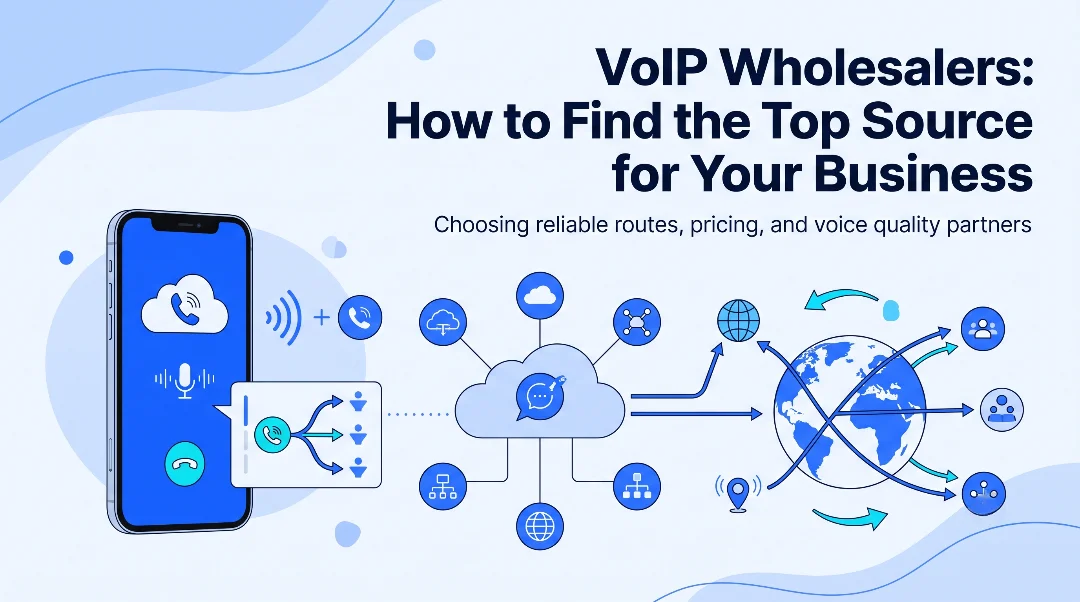
Mobile wholesale refers to the bulk purchase of voice minutes, data capacity, or messaging services by carriers, MVNOs, and resellers from upstream providers. Rather than building out their own international interconnects and maintaining bilateral agreements with hundreds of carriers, operators buy access to those routes wholesale — at volume rates that retail customers never see.
The economics are straightforward. Retail voice services price in the cost of customer acquisition, support, billing, and margin. Wholesale strips those layers away. Operators paying retail-equivalent rates on termination are leaving 40–70% in savings on the table, according to Softtop's published rate comparisons across CLI and Non-CLI routes.
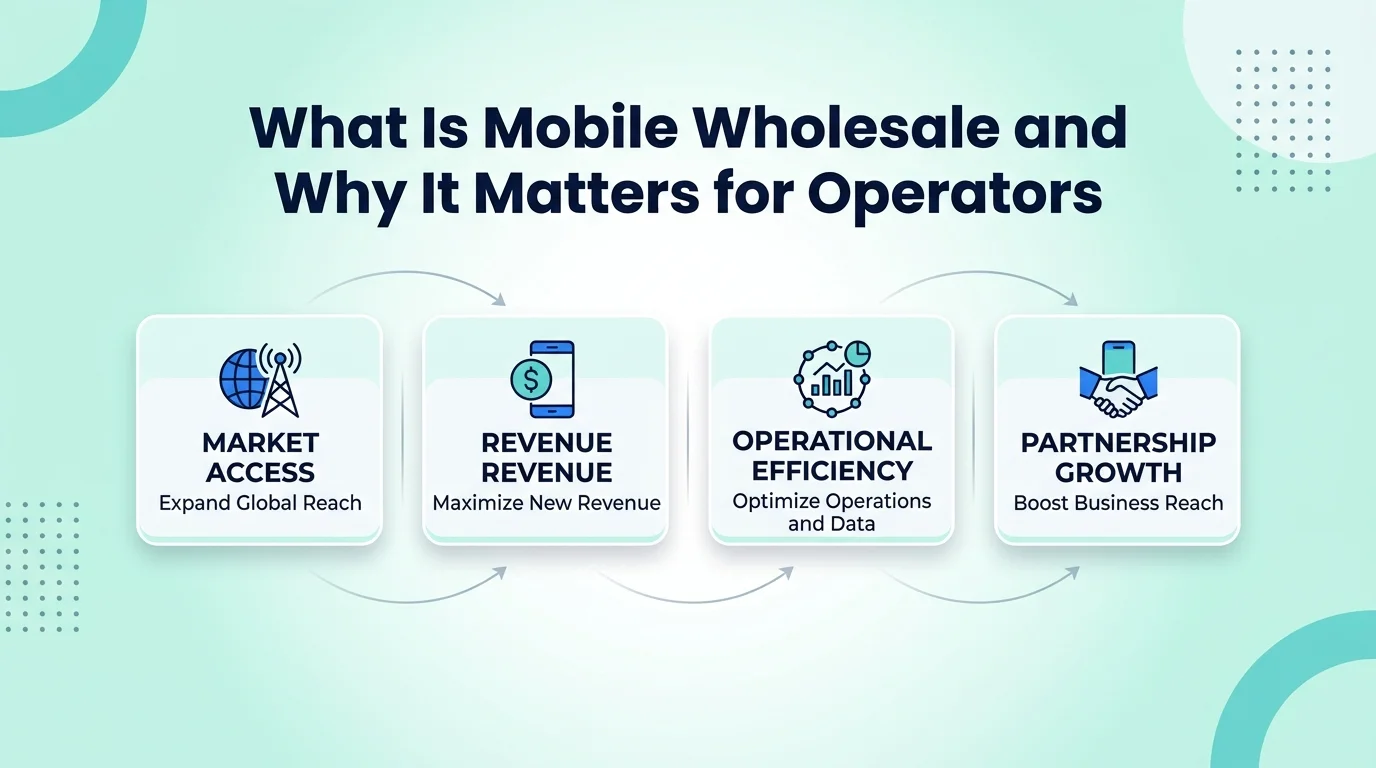
For MVNOs in particular, mobile wholesale is not optional — it is the entire network layer. The wholesale partner you choose sets your floor on call quality, your ceiling on margin, and your exposure to fraud. Getting this decision right is foundational to your commercial model. A poor wholesale relationship compounds every downstream problem: high call failure rates, fraud exposure, and billing disputes all trace back to the interconnect tier.
3How Mobile Wholesale Pricing Works: Rates, Routes, and Route Types
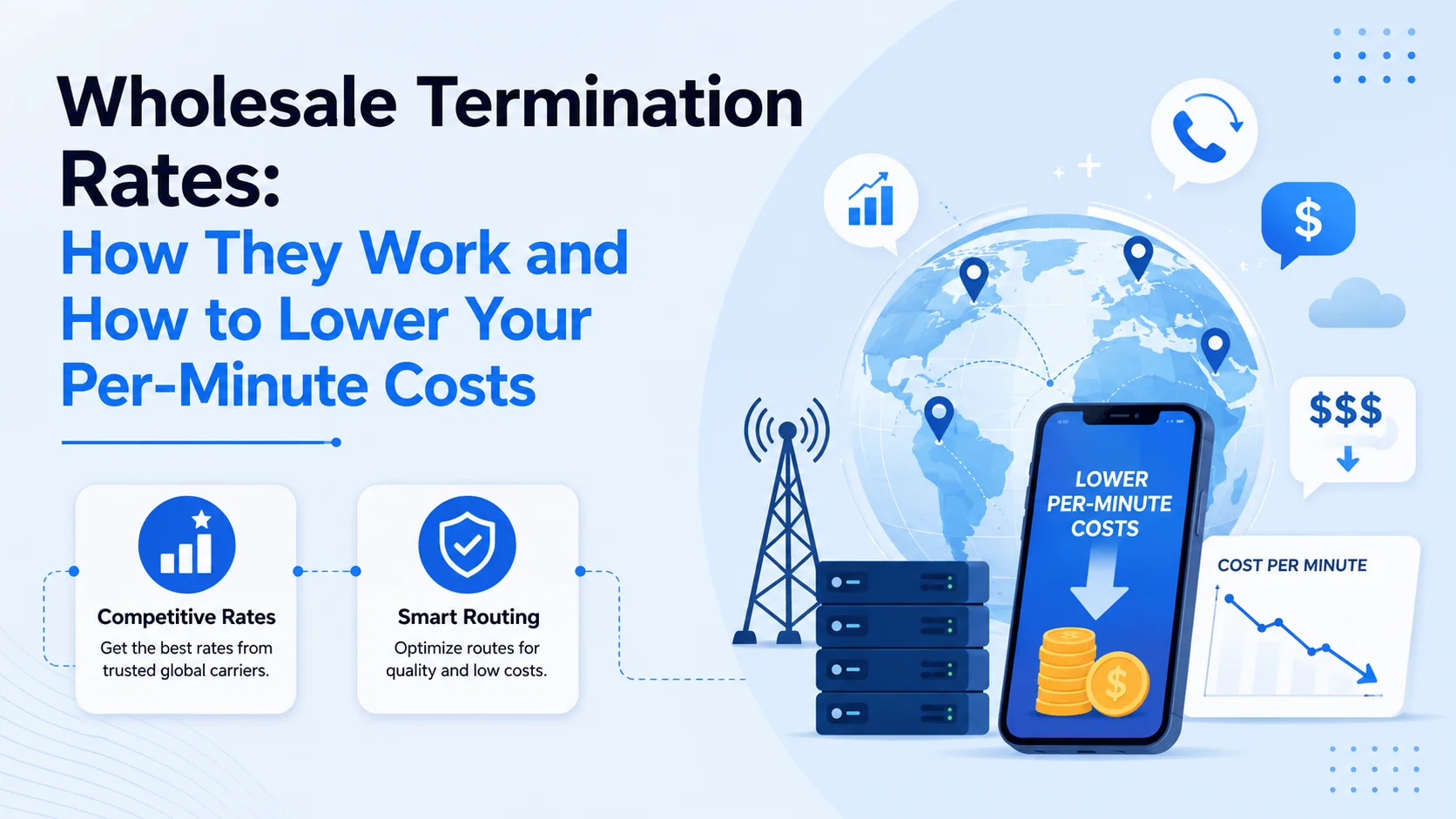
Wholesale voice pricing is driven by destination, route type, and volume commitment. Softtop's Wholesale VoIP rates run from $0.003 to $0.01 per minute depending on destination and route class — competitive across both high-volume corridors like the US and EU and more challenging A-Z destinations.
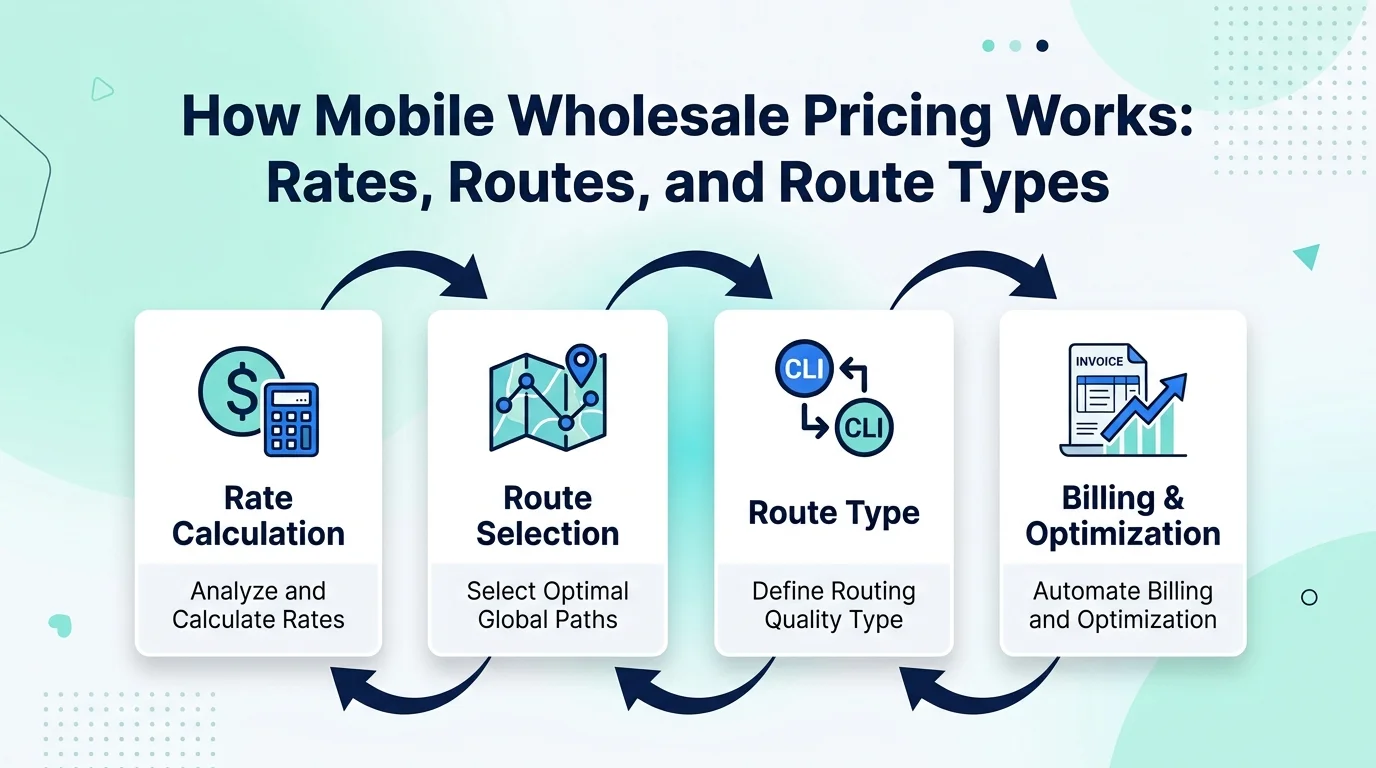
Route types matter significantly. CLI (Calling Line Identification) routes preserve caller ID and typically deliver higher answer rates. Non-CLI routes strip caller ID but carry lower per-minute costs. CC (calling card) routes serve prepaid and virtual calling card platforms. The right mix depends on your use case: CLI routes are standard for business voice and MVNO subscribers; Non-CLI suits bulk notification or automated calling campaigns. See our full breakdown of route types for how to choose.
LCR (Least Cost Routing) layers on top, dynamically selecting the cheapest qualifying route for each destination at the moment of call setup. Paired with ASR targets of 60–80% on premium routes and PDD under 6 seconds, LCR lets operators balance cost and quality without manual intervention.
4Termination Quality: ASR, PDD, and What the Numbers Mean
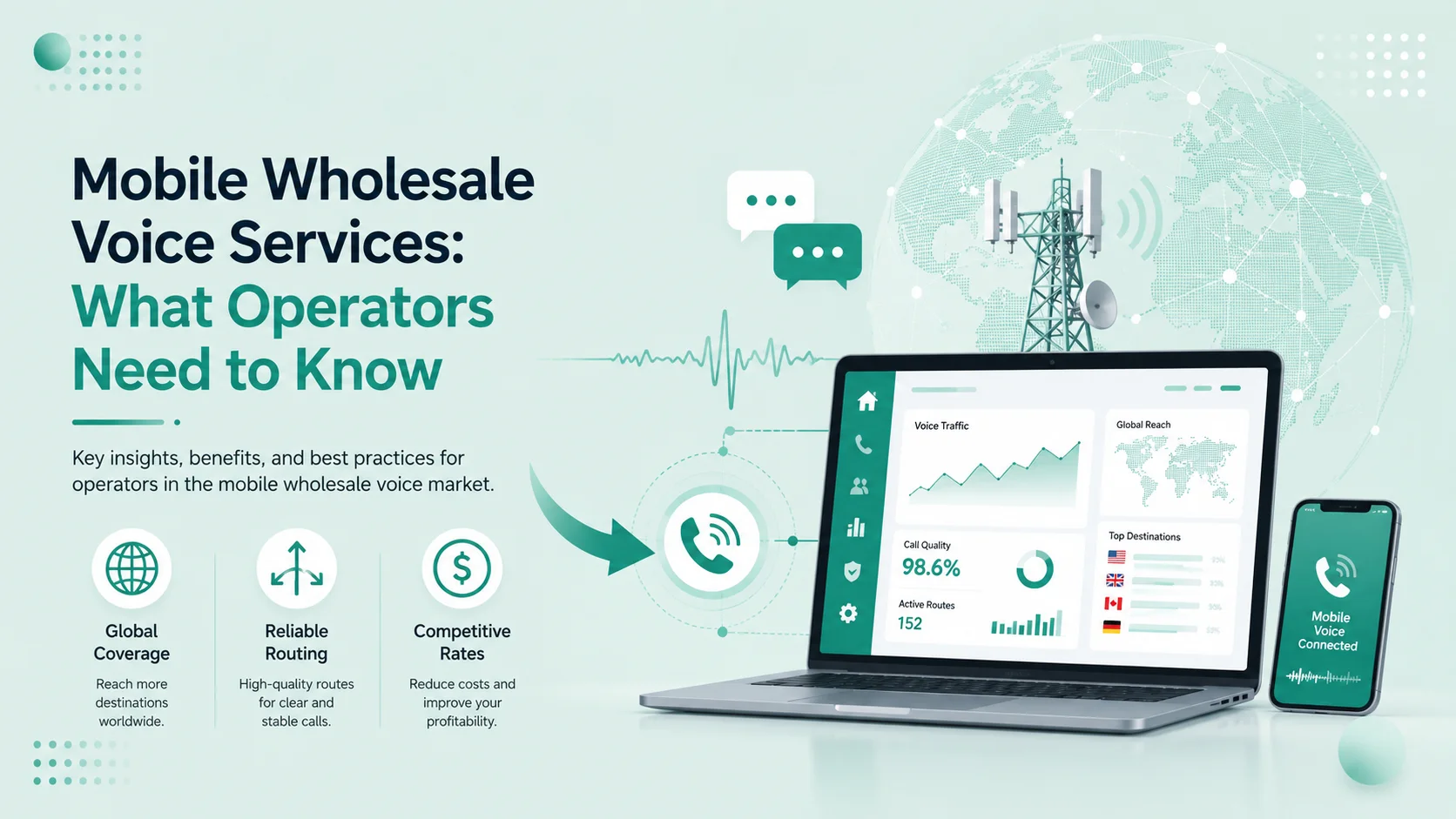
Call quality in mobile wholesale is measured by two primary metrics. ASR — Answer Seizure Ratio — expresses the percentage of call attempts that result in an answered call. Industry-standard premium routes run 60–80% ASR; anything below 50% signals route quality problems that will drive subscriber complaints.
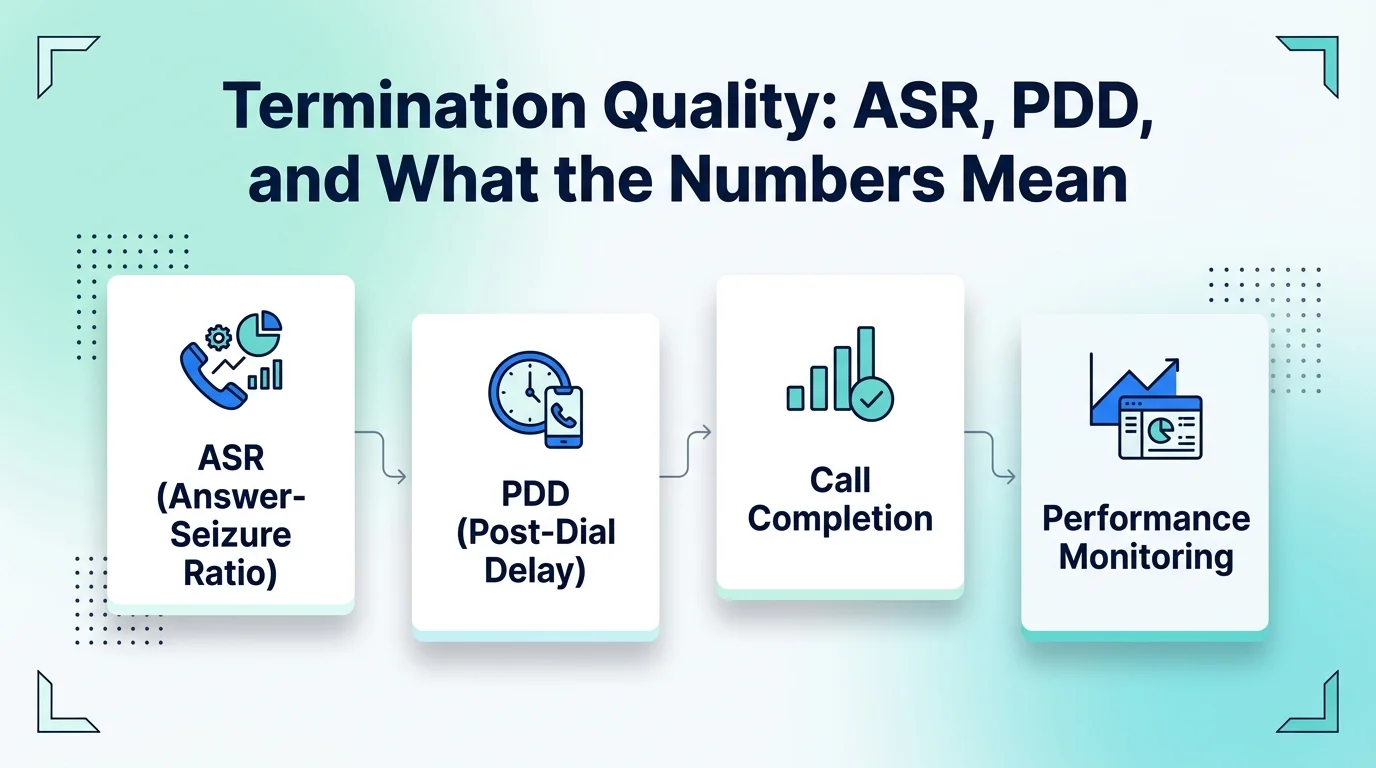
PDD, or Post-Dial Delay, is the time between dialing and the first ringback tone. Under 6 seconds is the acceptable threshold for most voice applications. Higher PDD increases abandonment, particularly on automated outbound campaigns where callers hang up before connection.
The ITU-T G.114 recommendation sets a one-way delay limit of 150ms for acceptable voice quality, and PDD feeds directly into perceived latency. Softtop's Voice Termination infrastructure is engineered to stay within these thresholds across its global route portfolio, using direct Tier-1 carrier connections rather than multi-hop paths that accumulate delay.
FAS (False Answer Supervision) is a billing fraud where a carrier charges for answered call time before the call is actually answered. FAS-free billing — a Softtop standard — ensures operators pay only for genuinely connected minutes.
5Fraud Prevention and Compliance in Mobile Wholesale
Telecom fraud costs the global industry an estimated $38.95 billion annually, according to the Communications Fraud Control Association (CFCA). In wholesale voice, the primary vectors are IRSF (International Revenue Share Fraud), bypass fraud, and CLI spoofing. Each can generate significant unexpected charges before detection.
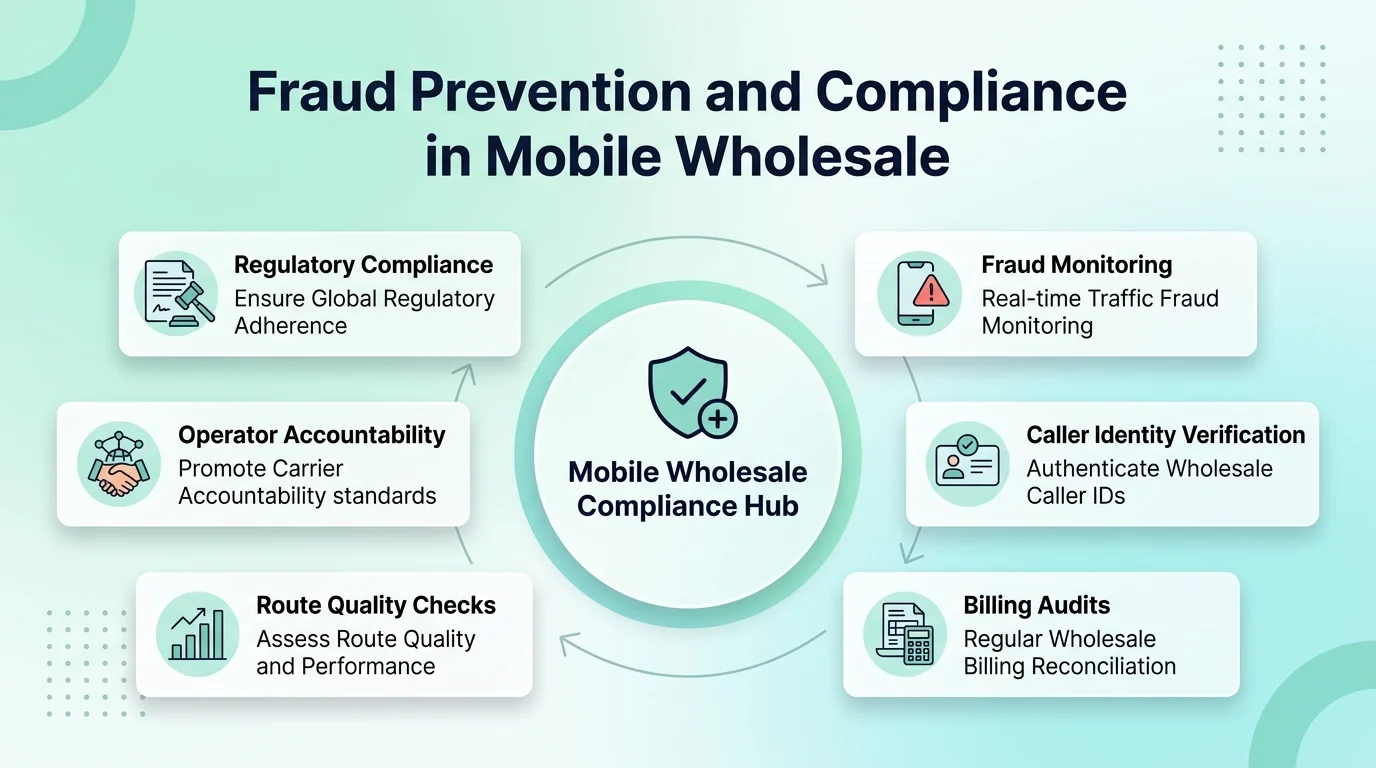
Softtop deploys AI-powered fraud detection that monitors traffic patterns in real time, flagging anomalies consistent with IRSF and robocall injection before they escalate. STIR/SHAKEN A-level attestation is applied on applicable US origination, meeting FCC mandates and reducing the risk that your traffic is blocked or labeled as spam by downstream carriers.
For operators in regulated markets, STIR/SHAKEN compliance is increasingly a commercial requirement, not just a regulatory checkbox. US carriers are required under TRACED Act rules to implement STIR/SHAKEN or face call-blocking by major terminating carriers. Working with a wholesale provider that delivers A-level attestation protects your origination reputation and reduces customer-facing call completion failures.
6Evaluating Mobile Wholesale Providers: A Practical Checklist
Choosing a wholesale partner requires looking past headline rates to the operational and contractual details that determine actual cost and reliability. Five criteria matter most.
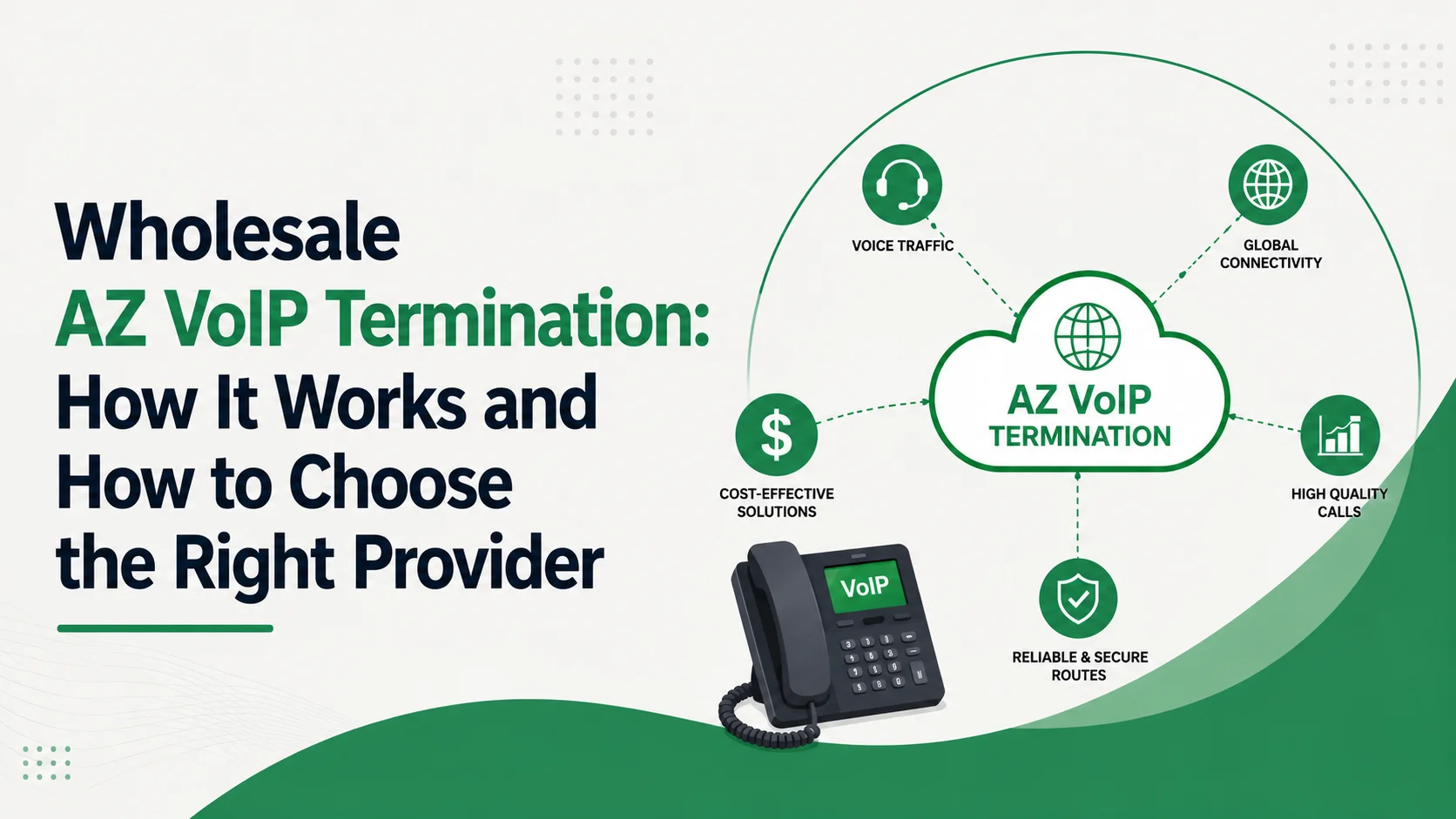
Network reach. A-Z coverage across 150+ countries means you can consolidate vendors rather than managing separate agreements for different regions. Fragmented wholesale relationships create operational overhead and inconsistent quality.
Uptime guarantees. A 99.99% uptime SLA translates to roughly 52 minutes of downtime per year. For voice traffic, anything less affects subscriber experience and creates SLA liability downstream. Softtop's 24/7/365 NOC actively monitors the network rather than waiting for alerts.
Billing transparency. FAS-free billing and per-second or per-6-second increments rather than per-minute rounding protect your margin. Small billing unit differences compound significantly at scale.
Technical integration. SIP trunking with standard SIP/RTP protocols, support for multiple codec profiles, and DID number availability all reduce integration friction. See Softtop's SIP Trunking for technical specifications.
Support responsiveness. Wholesale voice issues are often time-critical. A provider without dedicated NOC support will cost you in incident response time.
7Conclusion
Mobile wholesale is a commodity market on the surface and a highly differentiated one in practice. The difference between a 99.99% uptime guarantee backed by a real NOC and a paper SLA shows up in your subscriber churn numbers. The difference between FAS-free billing and a provider that allows it shows up in your monthly invoices. The difference between direct Tier-1 carrier connections and multi-hop routes shows up in your ASR and PDD statistics.
Operators who treat mobile wholesale as a cost line to minimize rather than a capability to optimize consistently underperform on service quality. The right wholesale partner gives you global reach, transparent billing, and the fraud controls to protect margins — at rates between $0.003 and $0.01 per minute that support a profitable service offering. Evaluate on the full picture, not the headline rate.
8Frequently Asked Questions
What is mobile wholesale voice service?
Mobile wholesale voice service is the bulk purchase of voice termination capacity by carriers, MVNOs, and resellers from upstream providers. It gives operators access to global call routing at volume rates, typically 40–70% below retail, enabling competitive pricing for end subscribers without building bilateral carrier interconnects.
What wholesale mobile voice rates should I expect?
Wholesale mobile voice rates vary by destination and route type. Standard CLI routes on major corridors run $0.003–$0.006 per minute. Non-CLI and CC routes are lower. Premium A-Z destinations carry higher rates. Volume commitments and direct Tier-1 connections both reduce per-minute costs versus spot-rate purchasing from smaller resellers.
What is FAS and why does FAS-free billing matter?
False Answer Supervision (FAS) is a fraud technique where a carrier charges for call duration before the called party actually answers. FAS-free billing ensures you only pay for genuinely connected call time. At scale, FAS exposure can inflate wholesale costs by several percentage points, making FAS-free terms a meaningful commercial protection.
How does STIR/SHAKEN affect mobile wholesale?
STIR/SHAKEN is a cryptographic caller ID authentication framework mandated by the FCC for US voice traffic under the TRACED Act. A-level attestation confirms both the caller identity and the call origination. Wholesale providers without STIR/SHAKEN compliance risk having traffic blocked or labeled spam by US terminating carriers, reducing call completion rates.
What technical specifications should I check before choosing a wholesale provider?
Key specifications include ASR of 60–80% on premium routes, PDD under 6 seconds, per-second billing increments, SIP/RTP compatibility, codec support (G.711, G.729 minimum), DID number availability in target markets, and LCR capability. Uptime SLAs should be 99.99% or above with documented NOC coverage and escalation procedures.
Softtop's mobile wholesale platform delivers direct Tier-1 carrier access across 150+ countries, FAS-free billing, and AI-powered fraud protection — with rates starting at $0.003 per minute. Contact our team for a custom wholesale quote tailored to your traffic profile and destinations.