1Introduction
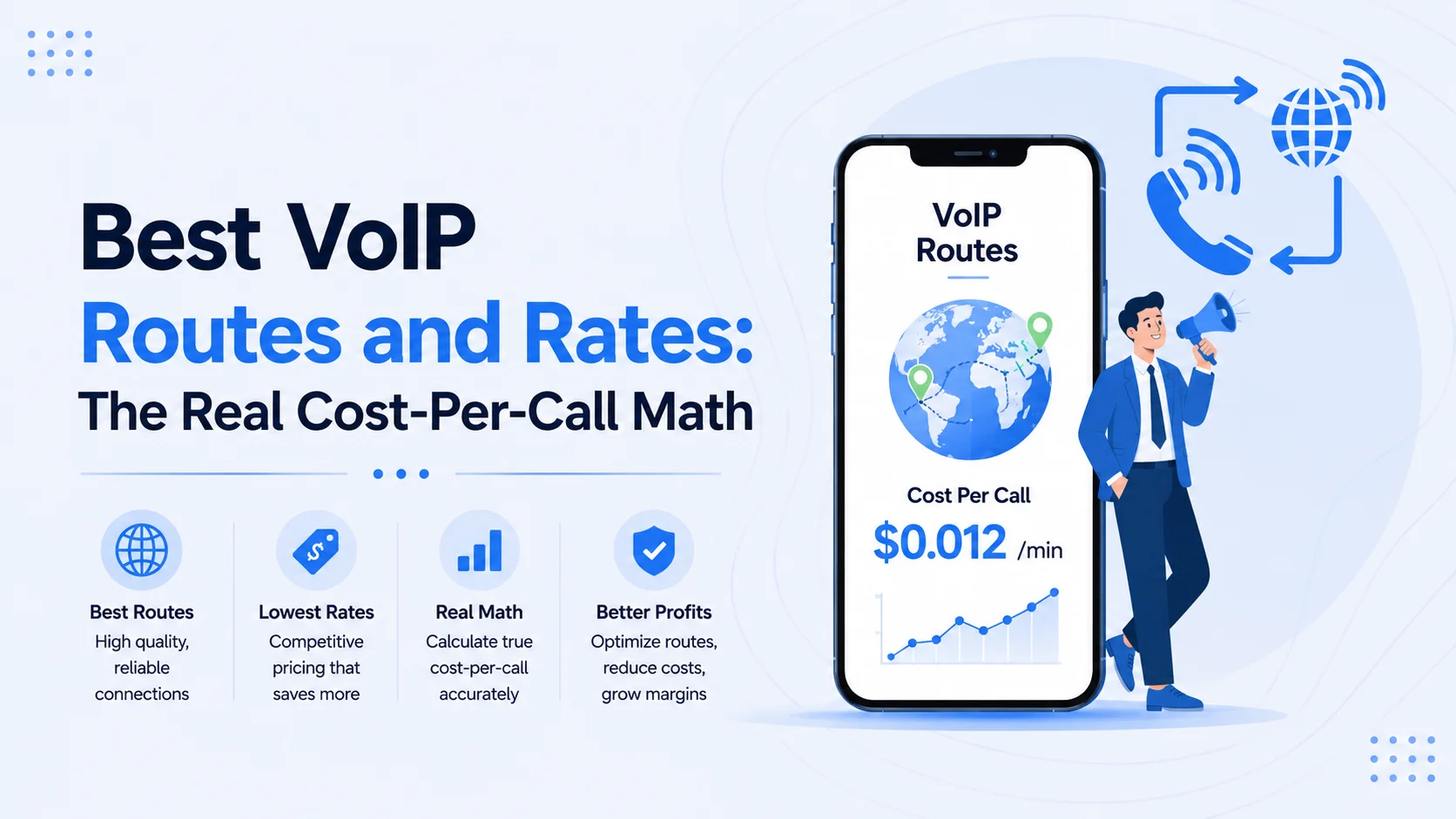
Finding the best VoIP routes and rates means balancing three variables that rarely move together: cost per minute, route quality, and destination coverage. A rate deck advertising $0.002 per minute to a major destination looks attractive until it turns out to be a grey route with a 50% answer rate — meaning half of every call attempt fails, which doubles the real cost per completed call and generates the kind of customer complaints that erase any savings on paper.
For businesses, resellers, and carriers routing meaningful call volume, choosing the best VoIP route isn't a one-time rate comparison — it's an ongoing evaluation of quality, cost, and reliability across every destination a business calls. This guide breaks down how VoIP routing actually works, the trade-offs between route types, what genuinely drives pricing, and how to benchmark quality before committing volume to any provider.
2What Makes a VoIP Route the Best?
The "best" VoIP route isn't simply the cheapest one — it's the route that delivers the lowest cost per completed call while meeting the quality bar a specific traffic type requires. A route priced at $0.006 per minute with a 75% answer rate produces more completed calls per dollar than a route priced at $0.003 per minute with a 40% answer rate, even though the second option looks cheaper on a rate sheet.
This distinction matters because VoIP routes aren't interchangeable commodities. Each route reflects a specific path through the network, a specific carrier relationship, and a specific quality commitment — and those differences show up directly in how many of your calls actually connect.
3How VoIP Routing Actually Works
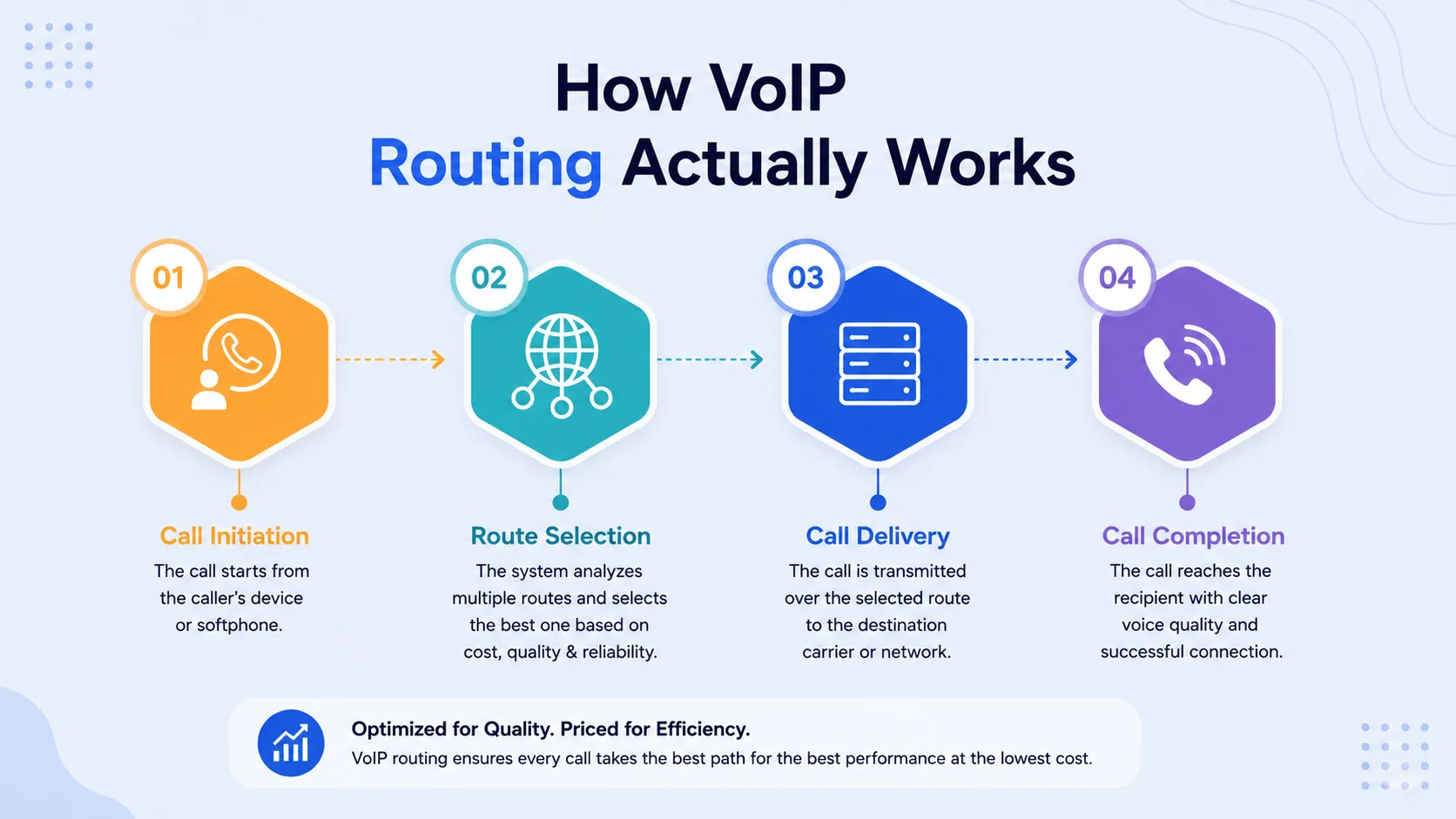
Understanding the mechanics behind a VoIP call clarifies why route quality varies so much between providers:
- Origination — the calling platform sends the call as SIP traffic to a termination provider.
- Route selection — the provider's switching platform checks its routing tables and selects a path to the destination based on cost, quality tier, and current network conditions.
- Interconnection — the call is handed to the destination carrier either directly, through a Tier-1 interconnect, or through one or more transit hops.
- Termination — the destination network completes the call and returns call-progress signaling back through the chain.
Every additional hop between the originating platform and the destination network adds latency, cost, and a new point of possible failure. This is why two routes quoting an identical rate for the same destination can produce very different real-world results — ask any provider plainly whether a given destination sits on a direct interconnect or a transit path before assuming the rate reflects comparable quality.
4Route Types and Their Trade-Offs
VoIP routes fall into distinct quality tiers, and each one carries a different cost and reliability profile:
- CLI (Premium) routes pass the caller's real phone number through to the terminating party, use direct carrier interconnects, and typically deliver the highest answer rates — often 65–80% on international traffic. They cost more per minute but are required in most regulated markets under frameworks like the FCC's call authentication rules, and essential for any use case where a callback matters.
- Non-CLI routes are cheaper and appropriate for outbound campaigns where caller ID delivery isn't operationally important, but they face higher blocking rates as destination networks tighten anti-fraud filtering.
- CC (country-code) routes offer the lowest per-minute rate but carry the highest failure risk, and progressive blocking by destination carriers can make them unreliable over time even when they work initially.
For most business applications, the additional $0.001–0.003 per minute premium for a CLI route is fully offset by the higher completed-call ratio it delivers.
5What Drives VoIP Route Rates
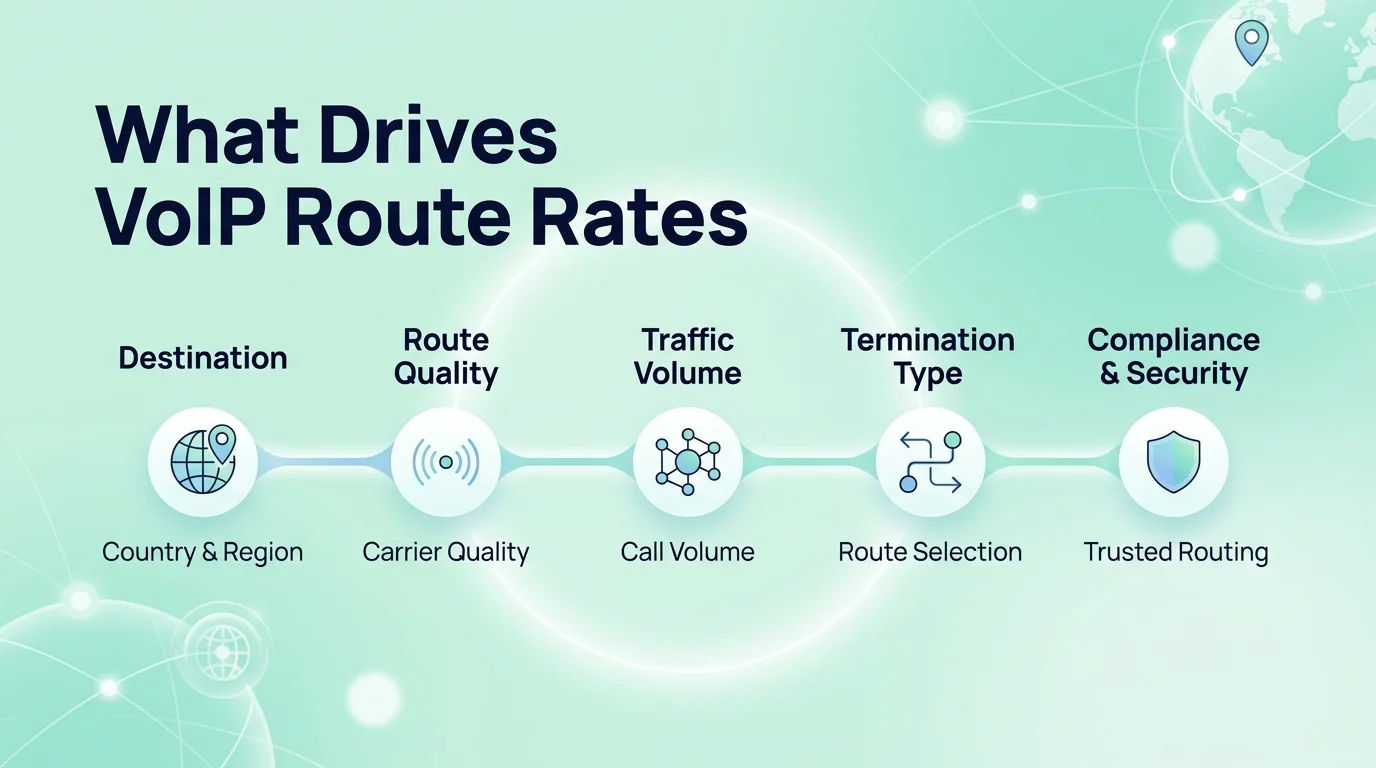
Destination is the single largest factor behind any VoIP route rate. US and Western European fixed-line termination often starts near $0.003–0.005 per minute, mobile termination runs several times higher, and destinations with limited carrier competition can run five to ten times the US baseline. Route type adds another layer on top of that — CLI routes typically carry a 20–40% premium over non-CLI routes on the same destination, reflecting the direct interconnects and compliance overhead required to support them.
Billing model matters just as much as the quoted rate. A route billed in six-second increments, or one that applies false answer supervision (charging for calls that were never actually answered), can produce a higher real bill than a route with a slightly higher headline rate but true per-second, FAS-free billing.
6Least-Cost Routing (LCR) Explained
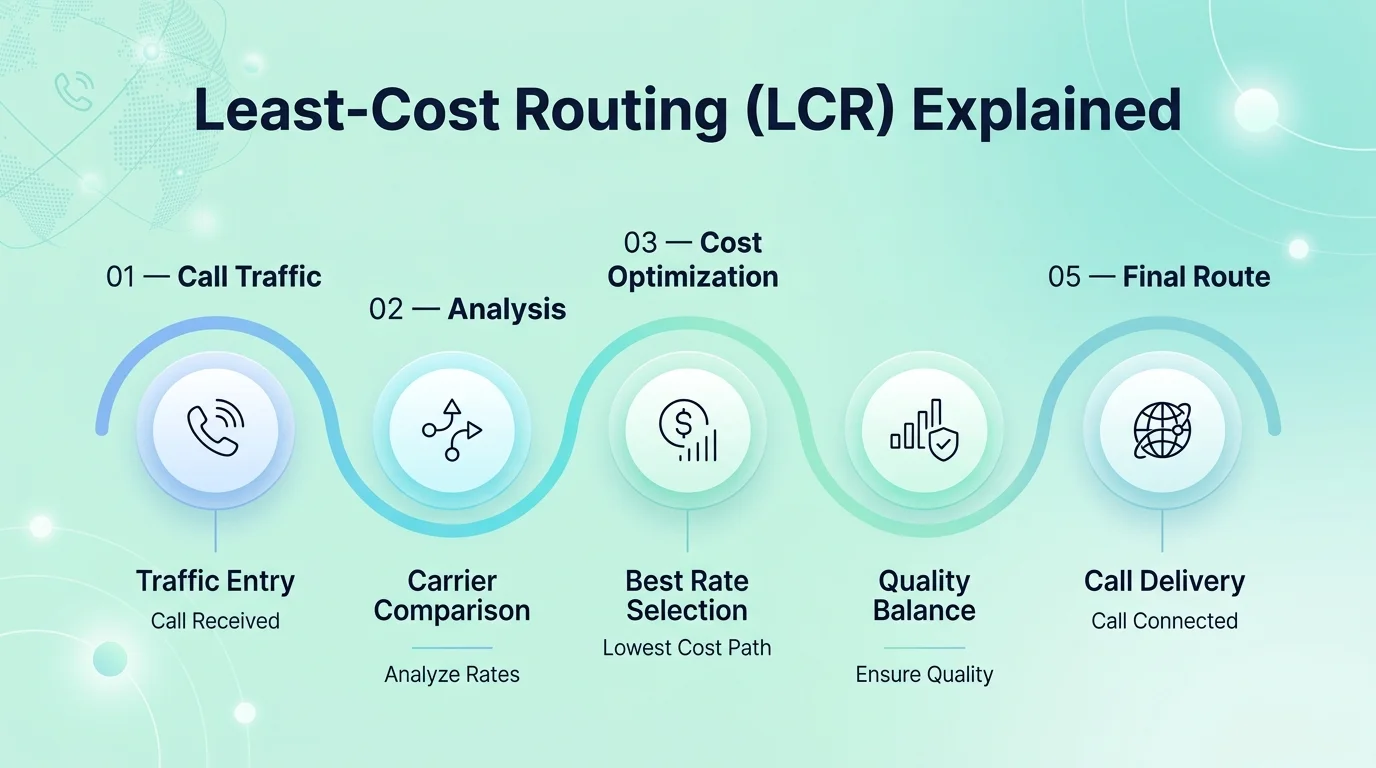
Least-cost routing is the system operators use to automatically select the cheapest available route that still meets a defined quality threshold for each call destination. Rather than manually assigning a single carrier to every destination, an LCR engine maintains relationships with multiple carriers and routes each call dynamically based on real-time cost and quality data.
An effective LCR configuration does three things well: it monitors ASR (answer seizure ratio) continuously rather than relying on static benchmarks, it fails over automatically to a secondary route when a primary route's quality drops below threshold, and it re-evaluates routing decisions as carrier pricing and quality shift over time. This approach captures the cost advantages of working with multiple providers while protecting call quality — something a single-carrier setup can't do as effectively.
7Quality Metrics to Benchmark Before You Commit
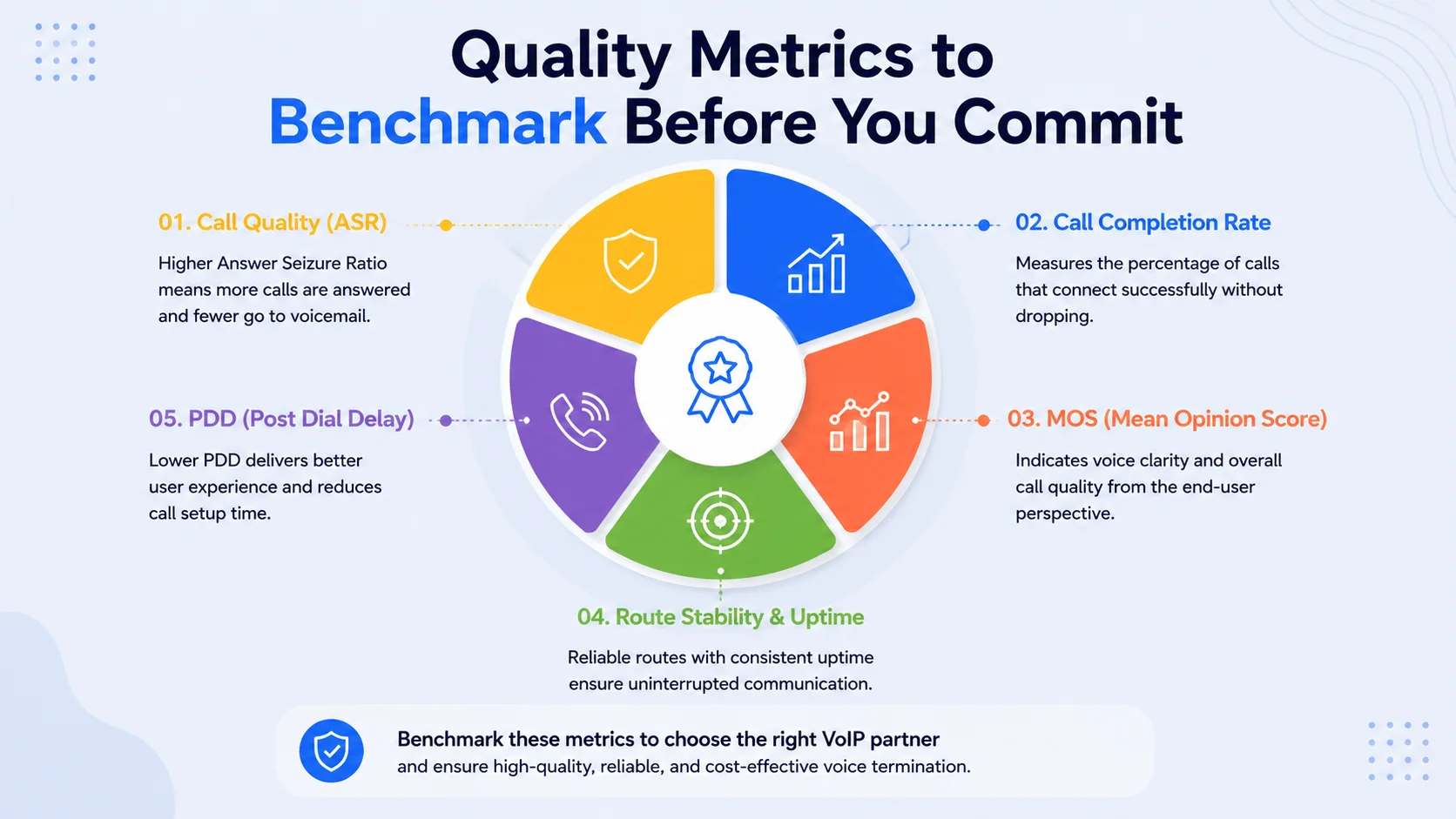
Three metrics separate a VoIP route worth paying for from one that quietly erodes margin:
- ASR (Answer Seizure Ratio) — the percentage of call attempts that result in an answered call. Premium CLI routes typically land in the 65–80% range on major destinations; figures consistently below 40–50% signal route quality problems or carrier blocking.
- ACD (Average Call Duration) — the mean length of completed calls, which helps confirm that calls are genuinely connecting and holding rather than dropping shortly after answer.
- PDD (Post-Dial Delay) — the time between the last dialed digit and the first ring. Anything over 5–6 seconds is a red flag, since most callers hang up before the delay resolves.
Request live, destination-level data for all three metrics — not a blended network average — before shifting meaningful volume to a new route. Document results by destination rather than as a single averaged figure, since a route can look strong overall while quietly underperforming on the specific corridors that make up most of your actual traffic.
8How to Choose the Best Route for Your Traffic
Matching route type to traffic type is one of the highest-leverage decisions a buyer makes. Customer-facing traffic where callbacks matter should run on CLI routes regardless of the cost premium; high-volume, low-stakes outbound traffic can often tolerate non-CLI pricing without meaningfully hurting outcomes. Before committing volume to any route, request a rate deck broken down by destination and route type, ask for live ASR data rather than a blended average, confirm the billing increment and FAS policy in writing, and run a short live-traffic trial to verify real-world performance against the provider's stated benchmarks. For a deeper look at what actually drives that rate deck, see our wholesale VoIP rates guide.
9Conclusion
The best VoIP routes and rates aren't found by chasing the lowest number on a rate sheet — they come from matching route type to traffic type, verifying real ASR data at the destination level, and understanding the billing mechanics behind the headline price. A route with a slightly higher quoted rate but strong CLI delivery and transparent, per-second billing will consistently outperform a cheaper grey route once cost-per-completed-call is the actual measure. Evaluate routes on that basis, run a live trial before committing volume, and revisit the comparison periodically as carrier pricing and quality shift.
10Frequently Asked Questions
What is the difference between CLI and non-CLI VoIP routes?
CLI routes pass the caller's real phone number to the terminating party and typically deliver 65–80% ASR on international traffic. Non-CLI routes omit caller ID, cost less, and are suited to outbound campaigns where the caller's number isn't operationally important.
What is a good ASR for a VoIP route?
On premium CLI routes to major destinations, a healthy ASR typically falls in the 65–80% range. Figures consistently below 40–50% usually indicate carrier blocking, route congestion, or grey-route quality issues.
How does least-cost routing improve call quality?
LCR systems monitor route quality in real time and automatically fail over to a secondary carrier when a primary route's quality drops below a defined threshold, capturing cost savings across multiple carriers without sacrificing reliability on any single route.
Why do cheaper VoIP routes sometimes cost more overall?
A cheap route with a low answer rate produces more failed call attempts, which raises the effective cost per completed call. Billing practices like six-second increments or false answer supervision can also inflate the real bill beyond what the headline rate suggests.
How do I test a new VoIP route before committing volume?
Request live, destination-level ASR, ACD, and PDD data from the provider, confirm billing increment and FAS policy in writing, and run a short trial with a portion of real traffic before shifting meaningful volume away from your current route.