1Introduction
Switching wholesale VoIP carriers sounds like a simple vendor swap — until the cutover window arrives and live traffic is on the line. Get it wrong and you get dropped calls, a week of overlapping invoices, or a support queue full of angry resellers. Get it right and the switch is invisible to every subscriber on your network.
Carrier migrations happen for good reasons: a route quality problem that never got fixed, a rate increase you didn't agree to, a compliance gap, or simply the arrival of a better-engineered partner. Whatever the trigger, the operational challenge is the same — you must move live SIP trunks, DIDs, and call volume from one termination network to another without a gap where calls fail to connect or bill twice.
A safe carrier migration runs old and new routes in parallel, validates the new carrier's ASR and PDD on real traffic before full cutover, shifts volume gradually rather than all at once, and keeps the legacy contract active until the new route has proven itself over a full billing cycle.
2Why Carrier Switches Go Wrong
Most failed migrations share the same root cause: teams treat the switch as a single event — flip the routing table, cancel the old contract, done — instead of a phased process. A hard cutover means every call in flight at the moment of the switch, and every call placed before DNS or gateway changes propagate, is exposed to the new carrier's untested routes with zero fallback.
The failure modes are predictable: destinations that tested fine in a sandbox but fail at production volume once the new carrier's routing tables get real traffic; SIP trunk re-pointing that breaks authentication or codec negotiation mid-switch; and a billing overlap where both carriers invoice for the same traffic window because nobody set a hard decommission date on the old route. Each of these is avoidable with a planned, staged migration rather than a single flip of the switch.
3Planning the Migration Before You Touch a Single Trunk
Before any technical work begins, build a complete inventory of what actually needs to move: every SIP trunk, every DID range, every destination-specific route, and every custom LCR rule tied to the outgoing carrier. Review your current contract for notice periods and minimum-volume commitments — many Wholesale VoIP Solution agreements carry a 30- to 90-day cancellation window, and starting that clock too early or too late is one of the most common budgeting mistakes in a switch.
Map traffic by destination and volume so you know exactly which routes carry the highest risk if something goes wrong — a low-volume niche destination can tolerate a rougher cutover than your top revenue-generating corridor. Document current ASR, PDD, and MOS baselines for every major destination on the outgoing carrier so you have an objective standard the new carrier must match or beat before you shift meaningful volume.
Set a Realistic Timeline
A migration that touches meaningful call volume should never be compressed into a single weekend. Plan for a testing phase of one to two weeks, a parallel-run phase of two to four weeks, and a decommissioning phase that only begins once the new carrier has held quality benchmarks through at least one full billing cycle.
4Running Parallel Routes During the Switch
The single most important technique in a zero-downtime migration is running both carriers live at the same time, with the old route still handling full production traffic while the new one comes online alongside it. Configure your softswitch or session border controller with both carriers as active routes, using least-cost routing priority or percentage-based traffic splitting to control exactly how much volume flows to each side.
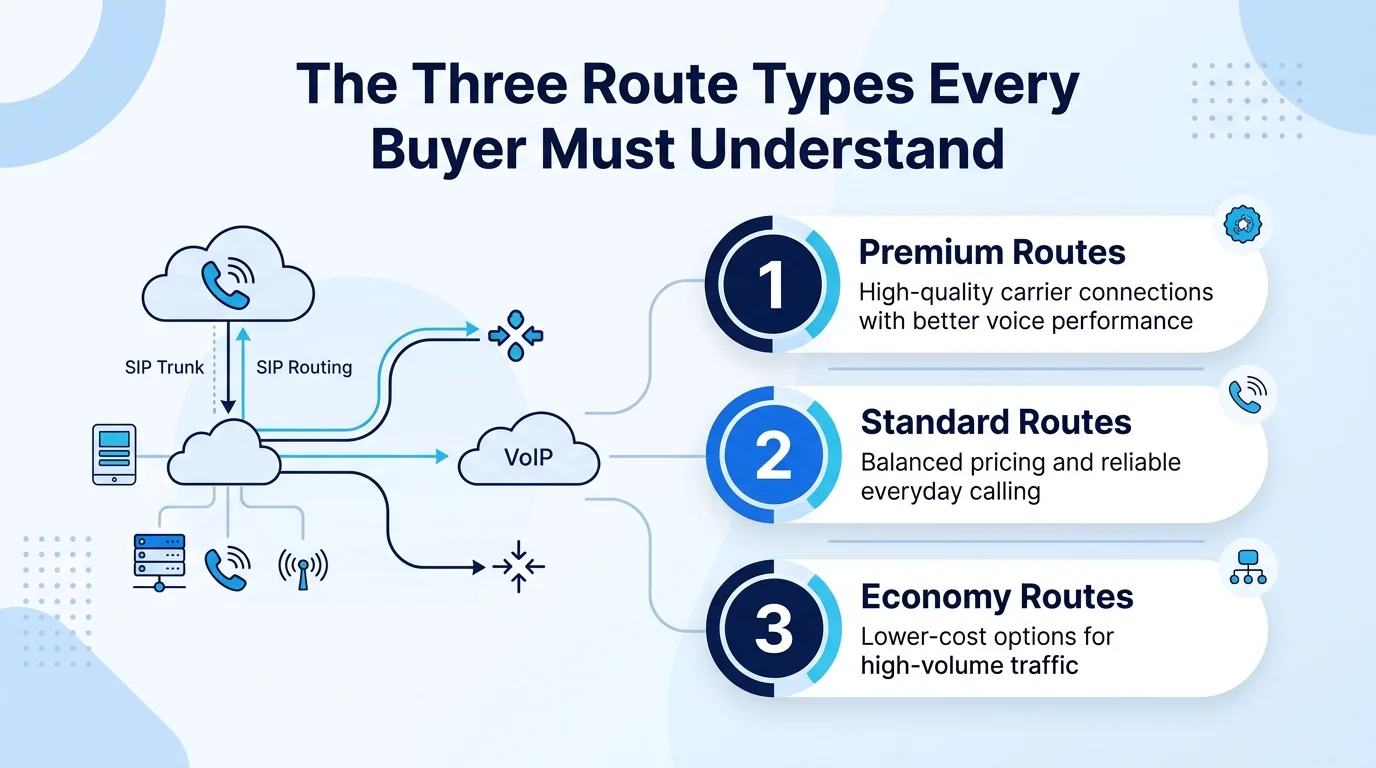
Start the new carrier at a deliberately small traffic percentage — 5 to 10% is typical — routed to a handful of lower-risk destinations first. This limits blast radius if something in the new carrier's routing or authentication setup is misconfigured, while still generating real production CDRs you can use to validate quality. Keep the old carrier's trunk fully provisioned and untouched throughout this phase; it is your instant fallback, not a decommissioned relic.
5Testing the New Carrier's Routes Before Full Cutover
Never trust a new carrier's rate sheet or sales-provided quality claims — validate everything against your own traffic. Run structured test calls across every destination you plan to migrate, checking answer behavior, audio quality, DTMF passthrough, and fax or SMS compatibility if those services ride the same trunk. Compare the results directly against the ASR, PDD, and MOS baselines you documented during planning.
Beyond synthetic tests, let the small percentage of live traffic from the parallel-run phase accumulate for at least several days per destination before drawing conclusions — a route that looks perfect on 50 test calls can behave very differently once real subscriber traffic, with its natural mix of mobile, landline, and VoIP-to-VoIP destinations, hits it at scale. Voice Termination quality that holds up under real volume is the only signal worth trusting before you commit more traffic.
Set explicit go/no-go thresholds in advance — for example, ASR must stay within 5 percentage points of your baseline and PDD must stay under 6 seconds for three consecutive days — so the decision to expand traffic share isn't made on gut feel under deadline pressure.
6Re-Pointing SIP Trunks and Cutting Over Traffic Gradually
Once the new carrier has proven itself on a limited slice of traffic, increase its share incrementally rather than jumping straight to 100% — a common cadence is 10%, then 25%, then 50%, then 100%, with a 24- to 48-hour observation window at each step. This gives you multiple checkpoints to catch a degradation before it affects your whole customer base, and each step is trivially reversible by adjusting routing weight back toward the old carrier.
When you re-point SIP trunks, update authentication credentials, IP whitelisting, and codec preferences on the new carrier before shifting any traffic weight — not simultaneously with the shift. Keep DNS TTLs low in the days leading up to cutover if your architecture relies on hostname-based routing, and lower SIP registration timers temporarily so devices re-register against updated trunk settings faster if you need to roll back.
7Avoiding Double Billing and Dropped-Traffic Windows
Billing overlap is one of the most common — and most avoidable — costs of a poorly planned migration. It happens when a carrier contract renews or a minimum-commit period resets while you're still routing meaningful volume to them, or when the old carrier's contract isn't formally terminated until well after traffic has fully shifted away. Set a specific calendar date for old-carrier decommissioning as soon as the parallel-run phase begins, tied to your notice-period obligations, and hold to it.
To avoid a dropped-traffic window at the tail end of the migration, never terminate the old carrier's trunk the same day you reach 100% traffic share on the new one. Hold the old route live but inactive — zero traffic weight, fully provisioned — for at least one full billing cycle so you have an immediate fallback if a rare destination or edge case surfaces once the new carrier is carrying everything. Only decommission after that observation window closes cleanly.
Don't cancel the outgoing carrier's account the moment cutover finishes. Keep the trunk provisioned at zero traffic weight for a full billing cycle — reactivating a live route in minutes is far safer than renegotiating a cancelled contract during an active outage.
8Step-by-Step Wholesale Carrier Migration Checklist
Use this sequence as a working checklist for any wholesale carrier switch, adjusting timelines for your traffic volume and contractual constraints.
The Zero-Downtime Migration Sequence
- Inventory every trunk, DID range, and destination-specific route tied to the outgoing carrier, and document current ASR, PDD, and MOS baselines per destination.
- Confirm contract notice periods and minimum-volume commitments on both the outgoing and incoming carrier before setting a migration timeline.
- Provision the new carrier's trunk fully — credentials, IP whitelisting, codecs — without touching the live routing table yet.
- Run structured synthetic test calls across every destination against your documented baselines, checking audio quality, DTMF, and fax/SMS compatibility.
- Enable parallel routing at a small traffic percentage (5–10%) on lower-risk destinations, keeping the old carrier fully live as fallback.
- Monitor real production CDRs from the new carrier for several days per destination against pre-set go/no-go thresholds.
- Increase traffic share incrementally (10% → 25% → 50% → 100%) with a 24–48 hour observation window at each step.
- Hold the old carrier's trunk live at zero traffic weight for one full billing cycle after reaching 100% on the new carrier.
- Formally decommission and cancel the outgoing carrier's contract only after the observation window closes without incident.
Following this sequence turns a high-risk cutover into a series of small, reversible steps — the opposite of a single all-or-nothing flip that leaves no room to correct course.
9Conclusion
Switching wholesale VoIP carriers doesn't have to mean an outage window, a billing dispute, or a scramble to roll back a broken cutover. The operators who migrate cleanly treat it as a staged process — inventory and baseline first, parallel-run and test second, gradual traffic shift third, and a deliberate, delayed decommission last.
Whether you're leaving a carrier over quality issues, chasing better rates, or consolidating routes after a merger, the discipline is the same: never remove your fallback until the new route has proven itself on real production volume over a full billing cycle. That patience is what separates an invisible migration from one your customers notice.
10Frequently Asked Questions
How long should a wholesale VoIP carrier migration take?
For meaningful traffic volume, plan on four to eight weeks end to end: one to two weeks of testing, two to four weeks of parallel running with gradual traffic shift, and a final observation period of one full billing cycle before decommissioning the old carrier. Rushing this timeline is the single biggest cause of migration incidents.
What is parallel routing and why does it prevent downtime?
Parallel routing means keeping both the outgoing and incoming carrier live and provisioned at the same time, using traffic-splitting or LCR priority to control how much volume flows to each. It prevents downtime because the old carrier remains available as an instant fallback throughout the entire migration, rather than being switched off the moment the new carrier goes live.
How do I avoid double billing when switching carriers?
Set a specific decommissioning date for the outgoing carrier as soon as the migration begins, based on your contract's notice period, and hold to it. Avoid overlapping minimum-commit periods by timing the switch around contract renewal dates, and don't let both carriers bill for the same traffic window by leaving the old route active with real traffic weight after the new one has taken over.
Should I test the new carrier before moving any live traffic?
Yes, always. Run synthetic test calls across every destination first, then validate with a small percentage of real production traffic — 5 to 10% — before expanding further. A route that performs well on test calls can behave differently under real subscriber volume, so live validation on a limited slice of traffic is a required step, not an optional one.
When is it safe to cancel the old carrier's contract?
Only after the new carrier has carried 100% of migrated traffic cleanly for at least one full billing cycle. Keep the old trunk provisioned at zero traffic weight during that window so you can reactivate it in minutes if an issue surfaces, rather than renegotiating a cancelled contract during a live incident.