1Introduction
The wholesale voice carrier market is the layer of the global telecommunications industry where bulk voice minutes trade hands. Carriers, resellers, ITSPs, and enterprises buy and sell them before calls reach a final destination network. Every international call from a business phone system, contact center, or embedded calling app travels through this market at some point Yet most businesses never deal with it directly. They deal only with the wholesale carrier they've chosen to route their traffic.
Anyone routing meaningful call volume needs to understand three things. First, how this market is structured. Second, what is driving pricing and quality right now. Third, how to tell a genuine Tier-1 carrier from a reseller several hops removed from the real network. This guide breaks the market down from the ground up.
2What Is the Wholesale Voice Carrier Market?
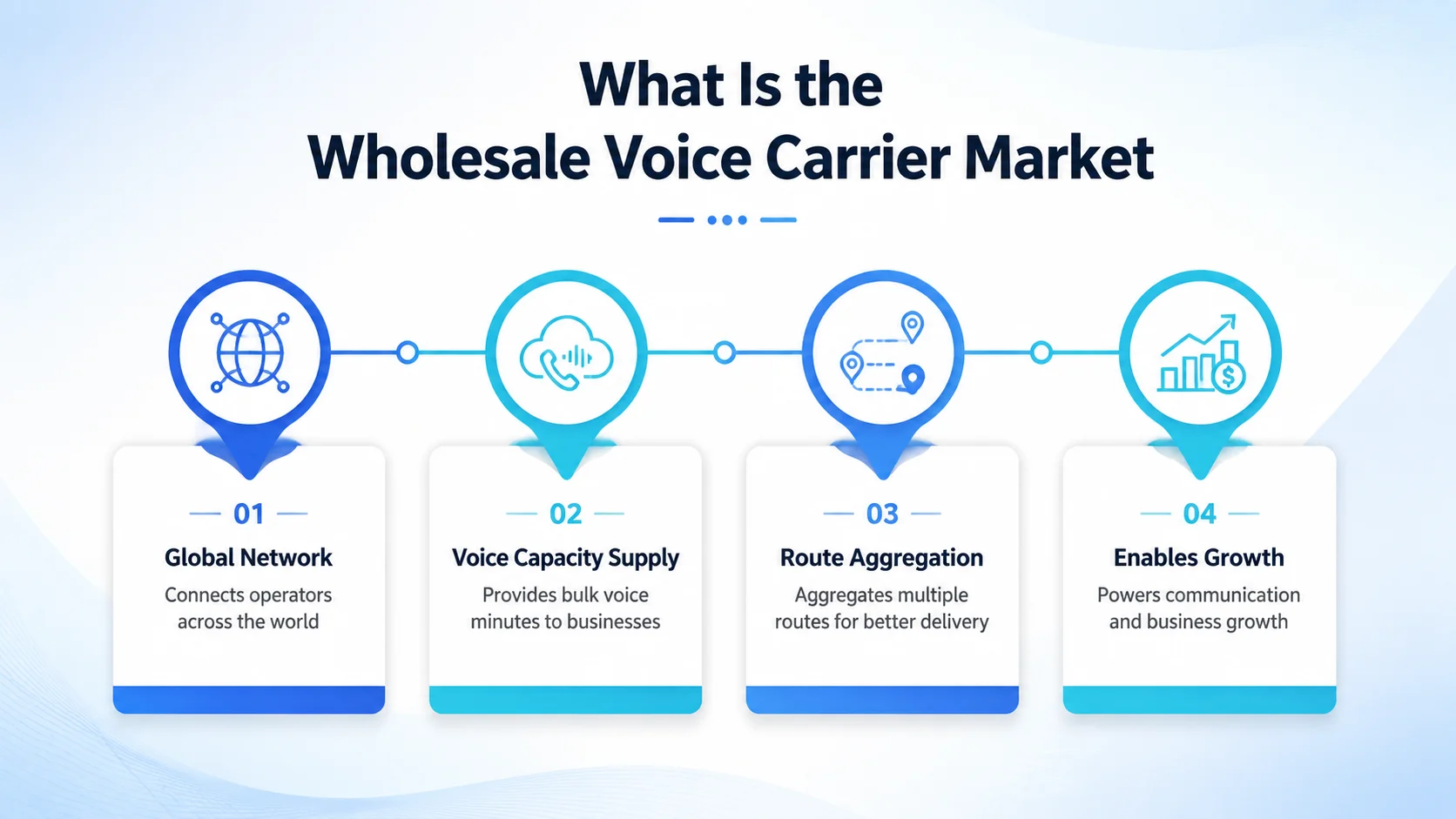
The wholesale voice carrier market consists of companies that sell bulk wholesale voice termination and origination capacity. Their buyers are businesses that need to complete large volumes of calls. They do not sell finished phone service to individual end users. A retail VoIP provider sells a business phone system to a single company for its own employees. A wholesale voice carrier sells raw call-completion capacity to carriers, resellers, and platforms. Those buyers then deliver voice service to their own customers.
This market exists because building direct interconnect relationships with telecom operators in every country is too costly for most businesses. Wholesale carriers have already made that investment. They spread the cost across thousands of customers, which is why wholesale rates run a fraction of retail voice pricing.
3Market Structure: How Wholesale Voice Trades Hands
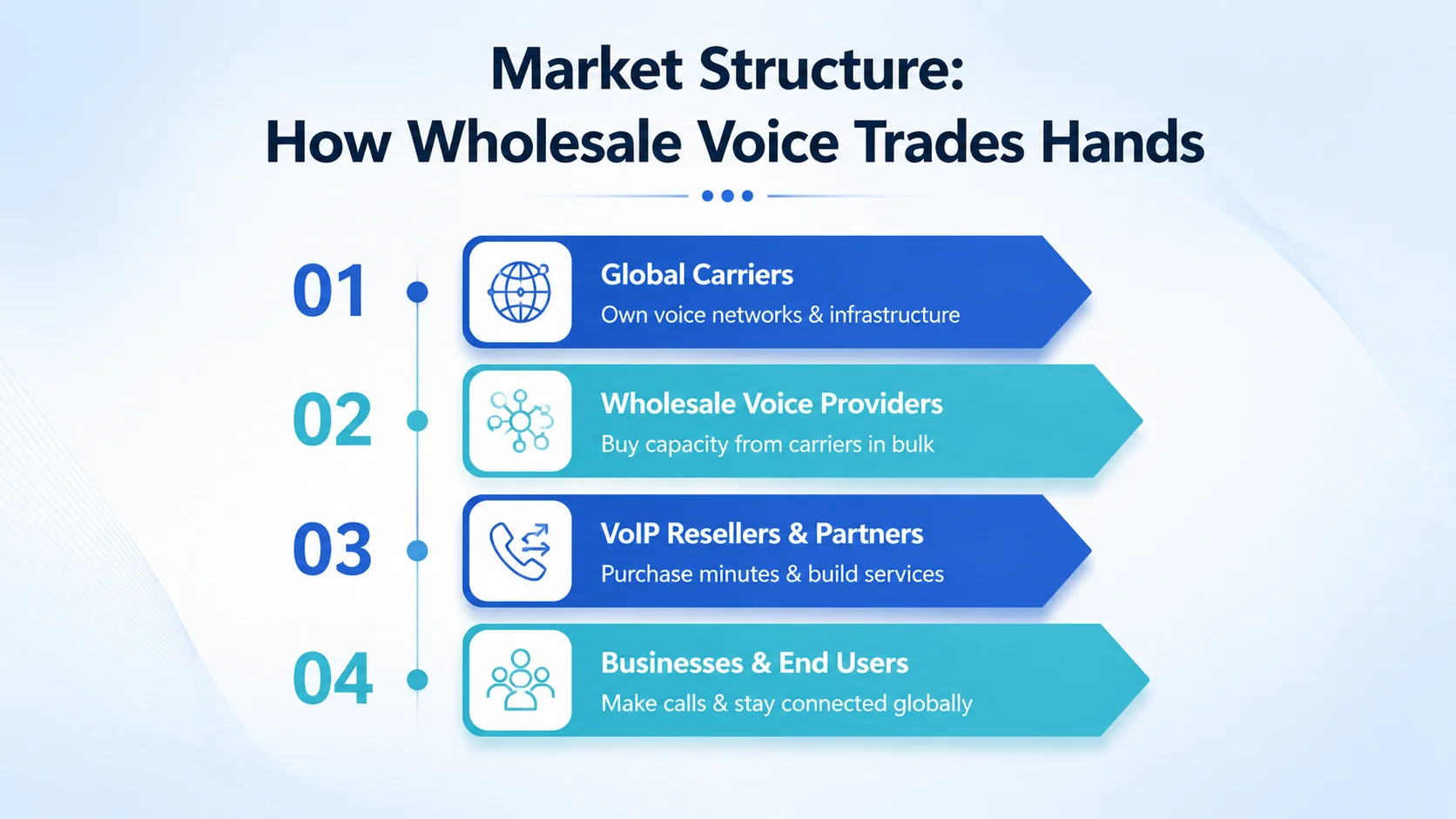
The wholesale voice carrier market operates in layers. Where a given carrier sits in that structure predicts how it will actually perform:
- Origination carriers receive inbound calls from the PSTN and hand them off to an IP network.
- Termination carriers take outbound IP traffic and complete it to phone numbers on the destination PSTN or mobile network.
- Transit carriers sit between origination and termination. They route traffic across multiple networks when no direct interconnect exists.
- Resellers and aggregators buy capacity from any of the above and resell it downstream. Some blend multiple upstream sources into a single rate deck.
Every layer between the originating call and the final destination network adds cost, latency, and a new point of possible failure. That is why two carriers quoting an identical rate for the same destination can produce completely different call quality in practice.
4Key Trends Reshaping the Market
A few structural shifts are reshaping how the wholesale voice carrier market operates. Independent research from Mordor Intelligence's wholesale voice carrier market report shows the market growing steadily. Per-minute costs trend down, but volume keeps climbing:
- IP has displaced traditional interconnects. The overwhelming majority of international voice minutes now travel over IP networks rather than legacy TDM circuits. This changes how carriers price and route traffic.
- Compliance attestation is becoming a hard requirement, not a selling point. STIR/SHAKEN call authentication is now enforced for US-originating traffic. Carriers without current attestation face rising call-blocking rates, whatever their price.
- Billing transparency is becoming table stakes. Per-second, FAS-free billing is increasingly what the market expects. Carriers still billing in six-second increments or applying false answer supervision lose business to competitors with clearer pricing.
- Route quality data is becoming a genuine selling point. Buyers increasingly demand live, destination-level ASR data rather than accepting blended network averages.
5Tier-1 vs Tier-2 vs Grey-Route Carriers
Not every participant in the wholesale voice carrier market operates at the same level. The tier a carrier sits at predicts both its pricing and its reliability:
- Tier-1 carriers own their switching infrastructure. They hold direct, bilateral interconnect agreements with local telecom operators in each market they serve. They can guarantee ASR benchmarks, deliver CLI reliably, and support current compliance attestation. The per-minute rate is higher, but it's often lower per completed call.
- Tier-2 carriers blend owned capacity with routes leased from Tier-1 providers. They hold up well on major corridors. On smaller or emerging destinations routed through a third party, quality thins out.
- Grey-route carriers aggregate minutes from whichever upstream source is cheapest. Some use route manipulation to undercut legitimate pricing. This carries real regulatory exposure. These carriers also tend to get blocked mid-contract, as destination networks tighten fraud filtering.
Ask any prospective carrier plainly whether they own their interconnects or resell from a named upstream partner. A carrier that can't answer directly is telling you where you'd actually sit in the routing chain. The tier also predicts how a carrier behaves when something breaks. A Tier-1 provider can troubleshoot and reroute at the switch level within minutes. A grey-route carrier several hops removed from the actual network often has little visibility into why a route degraded in the first place.
6What Drives Wholesale Voice Pricing
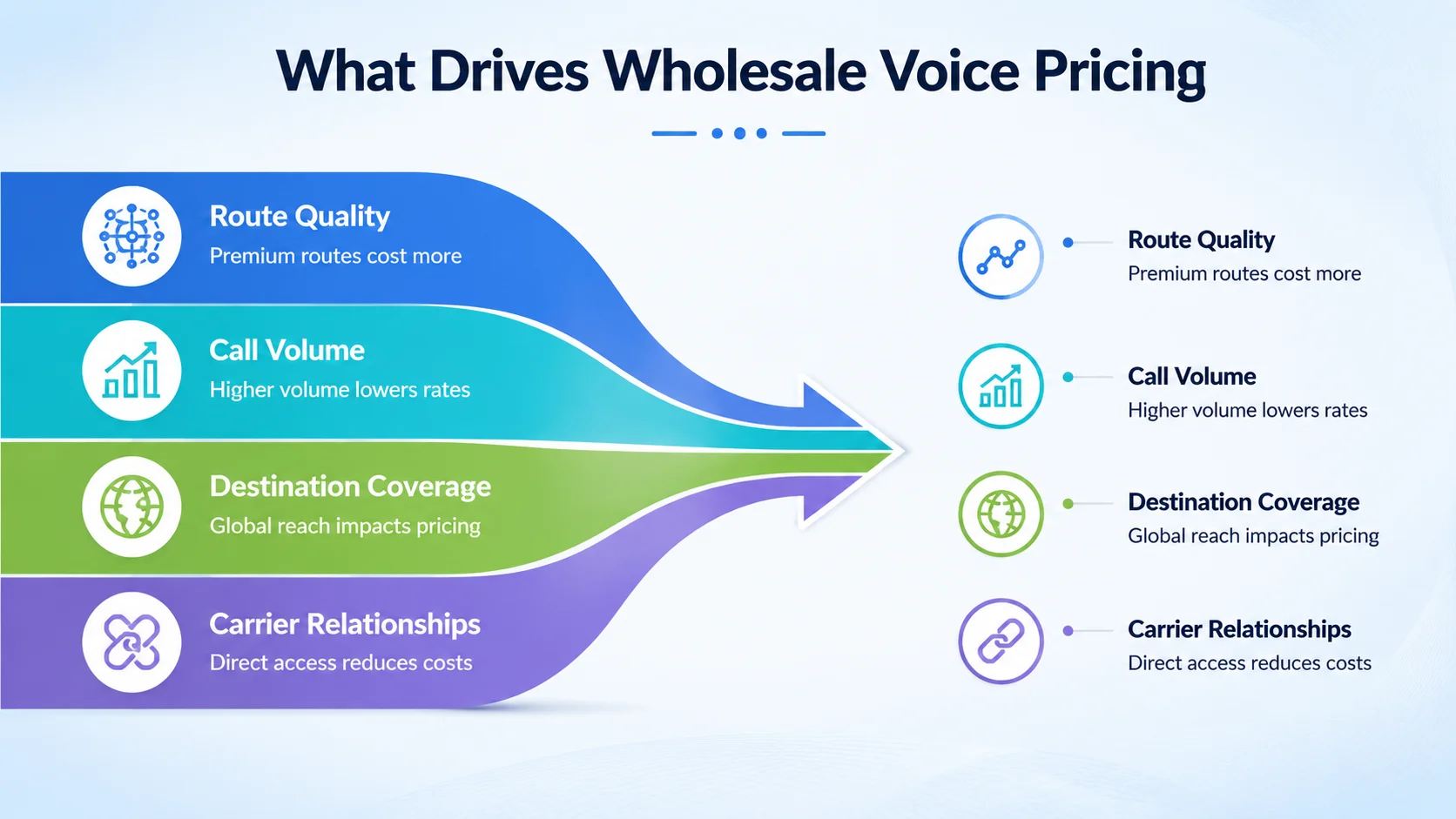
Pricing in the wholesale voice carrier market looks straightforward on a rate sheet. It gets complicated once you look at the variables that actually move cost. Destination is the largest driver. US and Western European fixed-line rates often start near $0.003–0.005 per minute. Mobile termination runs several times higher. Destinations with limited carrier competition can run five to ten times the US baseline. Route type adds another layer. CLI routes typically carry a 20–40% premium over non-CLI on the same destination, reflecting the cost of maintaining compliant, direct interconnects.
Billing model frequently matters more than the headline rate. A carrier with a lower per-minute rate may bill in six-second increments or apply false answer supervision. That carrier can end up costing more per completed call than one with a slightly higher rate and true per-second, FAS-free billing. Always model total cost against actual traffic patterns and typical call duration. Don't compare headline rates in isolation.
7Quality Metrics That Separate Carriers
Three metrics reliably separate a wholesale voice carrier worth paying for from one that quietly erodes margin:
- ASR (Answer Seizure Ratio) — the percentage of call attempts that result in an answered call. Premium CLI routes typically land in the 60–80% range on major destinations. Consistently lower figures signal route quality problems or carrier blocking.
- ACD (Average Call Duration) — the mean length of completed calls. It helps confirm calls are genuinely connecting and holding, not dropping shortly after answer.
- PDD (Post-Dial Delay) — the time between the last dialed digit and the first ring. Anything over 5–6 seconds is a red flag, since most callers hang up before the delay ends.
Before committing volume to any carrier, request live, route-level data for these metrics. Blended network averages are not enough.
8How to Choose a Wholesale Voice Carrier
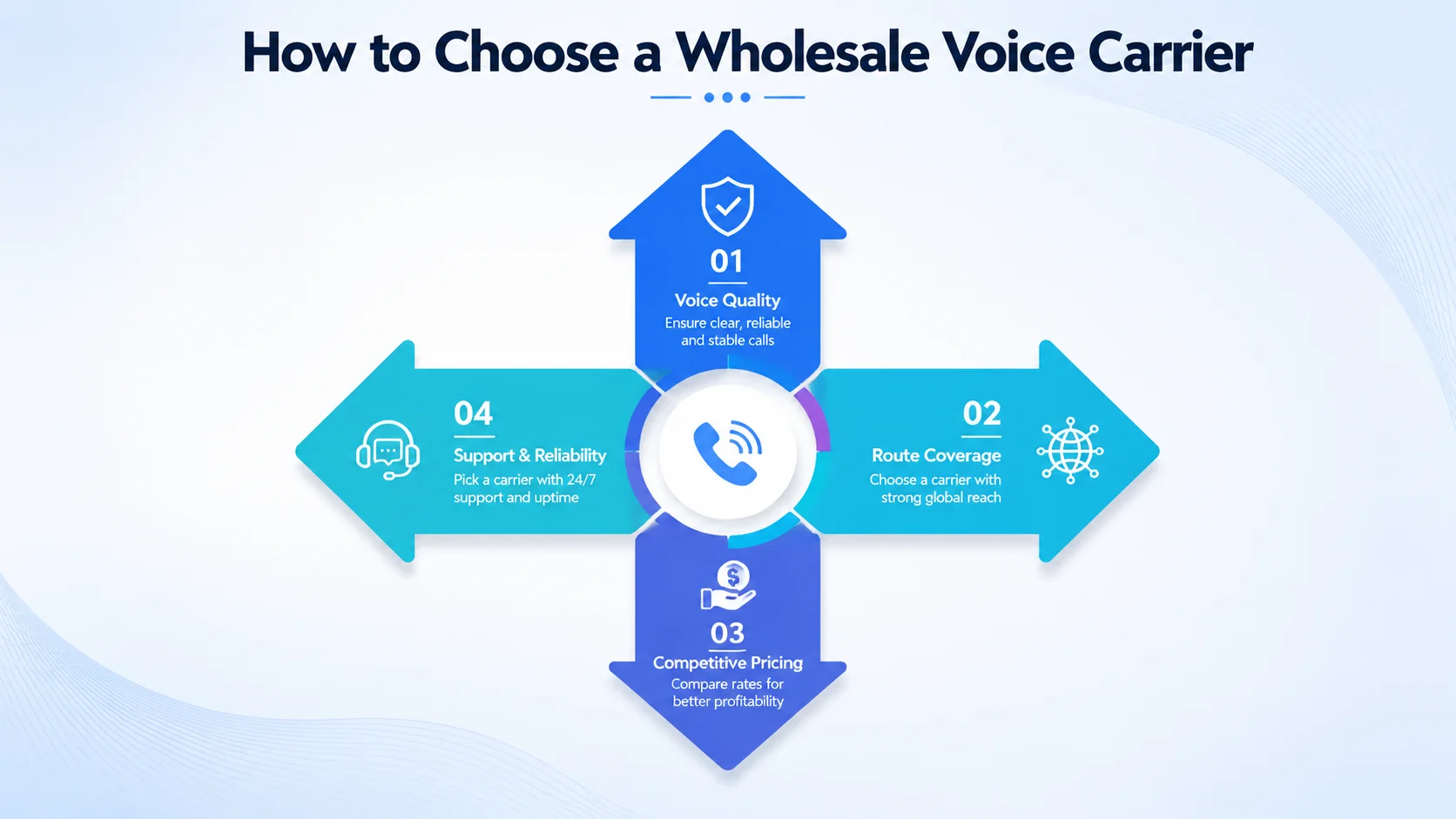
A rate sheet alone tells you almost nothing about how a carrier will perform once real traffic is live. Evaluate against these criteria instead: network ownership and interconnect depth, live ASR data by destination, CLI delivery policy, and current STIR/SHAKEN attestation. Also check for true per-second FAS-free billing, a contractual uptime SLA backed by service credits, and a 24/7 support model with a defined response-time commitment.
Before shifting meaningful volume, request a rate deck alongside a short live-traffic trial. A typical trial covers 5–10% of real traffic across your top destinations for one to two weeks. Compare real-world ASR, billing accuracy, and support responsiveness directly against your current carrier. Don't rely on sales claims. Document the results destination by destination. A carrier can look strong on a blended average while quietly underperforming on the specific corridors that matter most to your traffic mix. For a deeper framework on evaluating sources before committing volume, see our guide to finding the right VoIP wholesaler.
9Conclusion
The wholesale voice carrier market rewards buyers who look past the rate sheet. They look at the infrastructure, billing mechanics, and compliance posture behind it. A carrier that owns direct interconnects, publishes real ASR data by destination, bills transparently with no hidden charges, and backs its uptime with a contractual SLA will consistently outperform a cheaper alternative once true cost per completed call is considered. Evaluate on cost-per-completed-call rather than cost-per-minute. Run a live trial before committing volume to any new carrier.
10Frequently Asked Questions
What is the wholesale voice carrier market?
It's the segment of the telecommunications industry where carriers, resellers, and platforms buy and sell bulk voice minutes. They do not sell finished phone service to individual end users. The trading happens before calls reach their final destination network.
What is the difference between a Tier-1 and Tier-2 wholesale voice carrier?
A Tier-1 carrier owns its switching infrastructure and holds direct interconnect agreements with local operators in each destination market. A Tier-2 carrier blends owned routes with capacity leased from Tier-1 providers. This usually holds up on major corridors but thins out on smaller destinations.
Why is STIR/SHAKEN attestation important when choosing a wholesale voice carrier?
For US-originating traffic, STIR/SHAKEN attestation is now enforced across the carrier ecosystem. It directly affects whether calls get labeled as spam or blocked outright, however competitive the carrier's rates are.
What is a good ASR in the wholesale voice carrier market?
On premium CLI routes to major destinations, a healthy ASR typically falls in the 60–80% range. Figures consistently below 40–50% usually indicate carrier blocking, route congestion, or grey-route quality issues.
How do I evaluate a wholesale voice carrier before committing volume?
Request live ASR, ACD, and PDD data by destination rather than network averages. Confirm whether interconnects are direct or resold. Verify current compliance attestation. Then run a short live-traffic trial alongside your existing carrier before shifting meaningful volume.