1Introduction
Over 500 billion minutes of wholesale voice traffic crossed international networks last year — and the operators routing those calls built a market worth an estimated $44.53 billion in 2026, projected to reach $73.63 billion by 2031 at a 10.58% CAGR. If you are evaluating a wholesale voice carrier business, the opportunity is measurable and growing.
The challenge is understanding exactly how these businesses work: what infrastructure they need, which tier they occupy, how they price routes, and what compliance requirements they must meet. This guide covers every layer — from Class 4 softswitch selection to interconnect agreements — so you can build or scale with clarity. Softtop supports operators across 150+ countries with a turnkey platform designed for carriers at every stage.
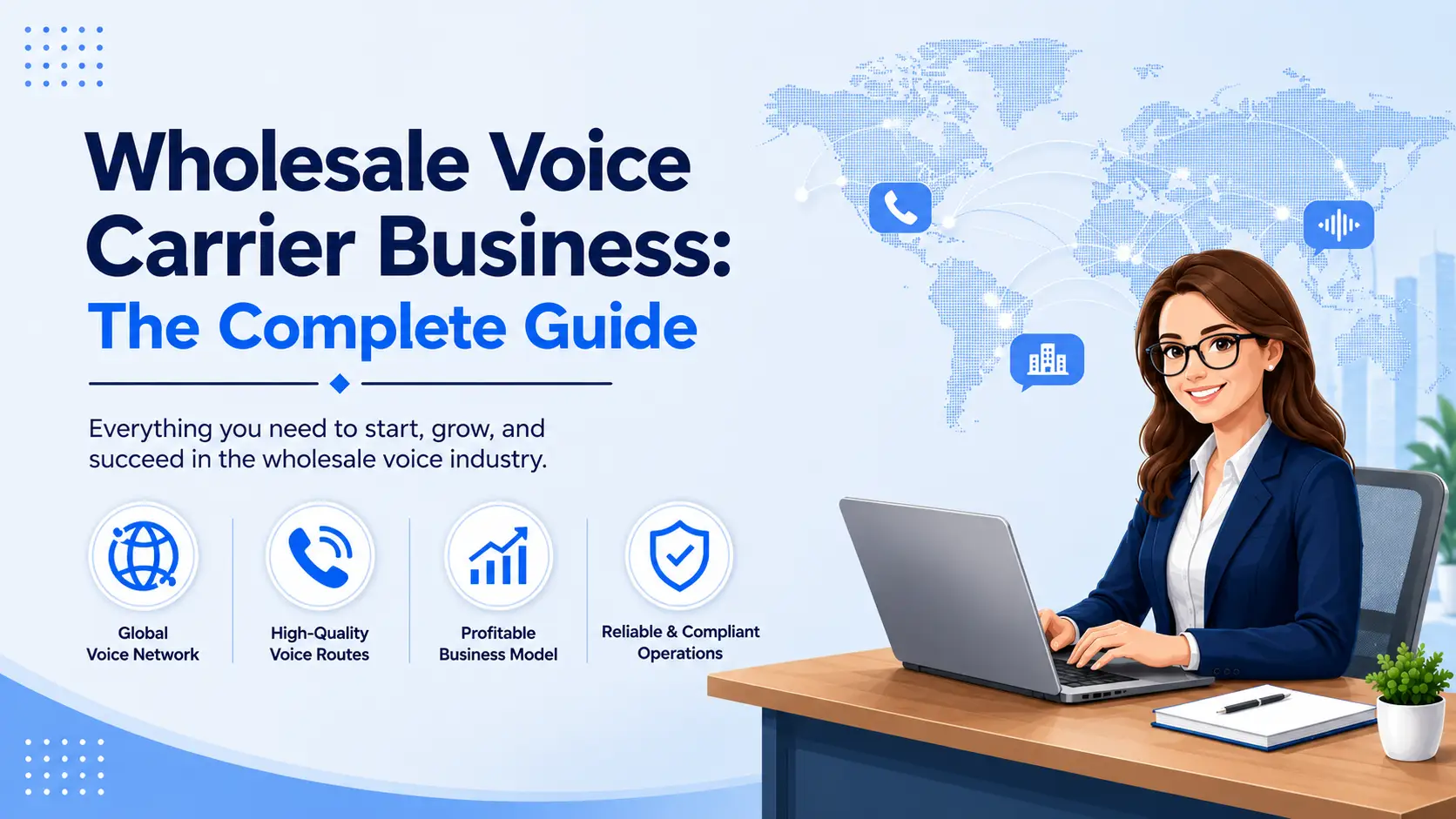
A wholesale voice carrier business buys and resells large volumes of voice traffic, operating at Tier 1, 2, or 3 depending on owned infrastructure. Margins of 50–70% are achievable with white-label models and smart LCR routing. Softtop's carrier-grade platform handles routing, billing, fraud management, and compliance out of the box.
2What Is a Wholesale Voice Carrier Business?
A wholesale voice carrier business purchases termination capacity in bulk from upstream carriers and resells that capacity to downstream buyers — typically other carriers, MVNOs, call centers, UCaaS platforms, or large enterprise accounts. Unlike a retail VoIP provider, a wholesale carrier deals in minutes-based volume, negotiating per-minute rates on A-Z routes. Softtop's wholesale VoIP platform is built for operators at every tier who need carrier-grade capacity without owning physical infrastructure.
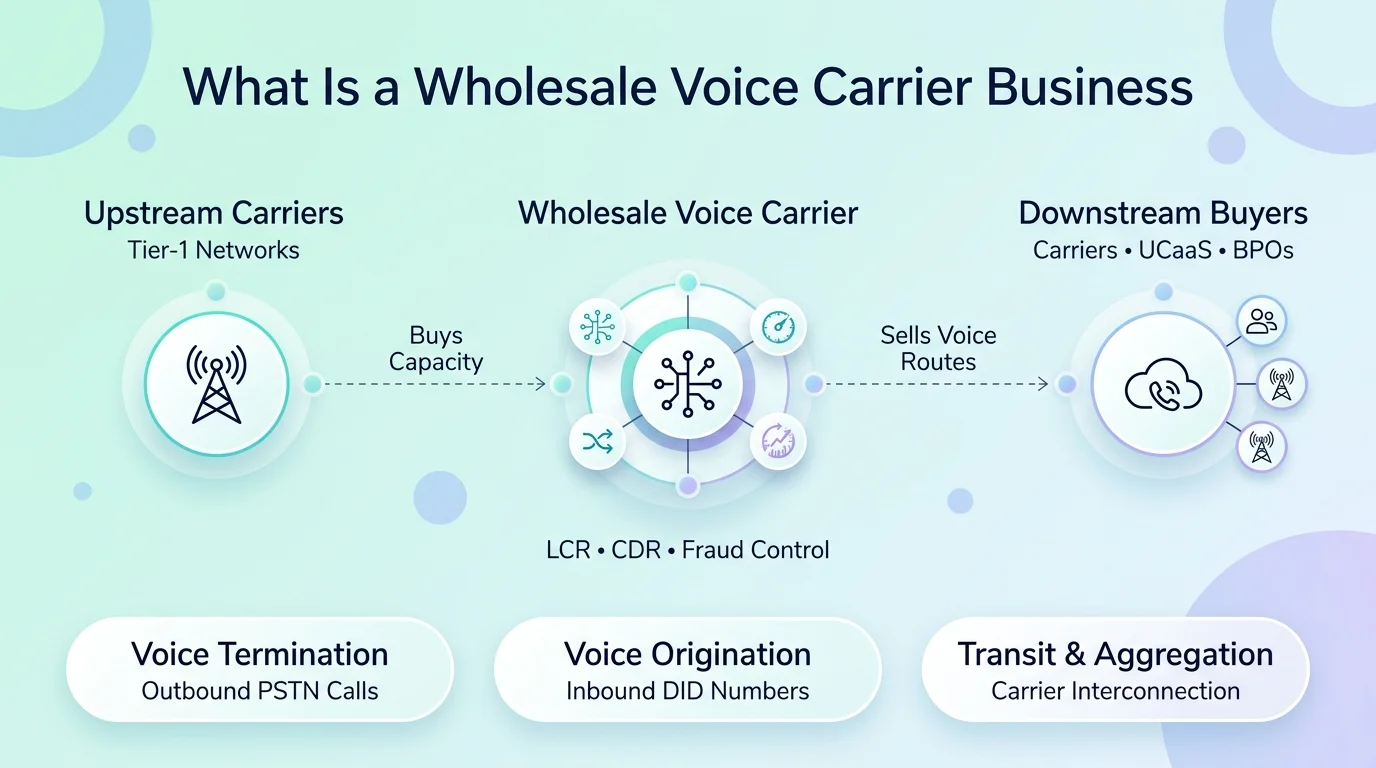
The defining characteristic is interconnect. A wholesale carrier must establish peering or transit agreements with other networks, sign numbering agreements, and configure routing tables that send each call down the lowest-cost or highest-quality path available. Profitability hinges on the spread between what you pay upstream and what you charge downstream, managed through Least Cost Routing (LCR) engines.
The Three Core Revenue Streams
- 1Voice termination — charging per minute to complete outbound calls to PSTN or mobile endpoints.
- 2Voice origination — providing inbound DID numbers that ring through to a customer's platform.
- 3Transit / aggregation — acting as a middle layer between two carriers who lack a direct peering relationship.
3Which Tier Should You Target When Starting Out?
Knowing that Tier 1, Tier 2, and Tier 3 carriers exist is one thing — deciding which tier actually makes sense for your business is the harder, more practical question, and it comes down to capital, timeline, and how much infrastructure risk you're willing to own on day one.
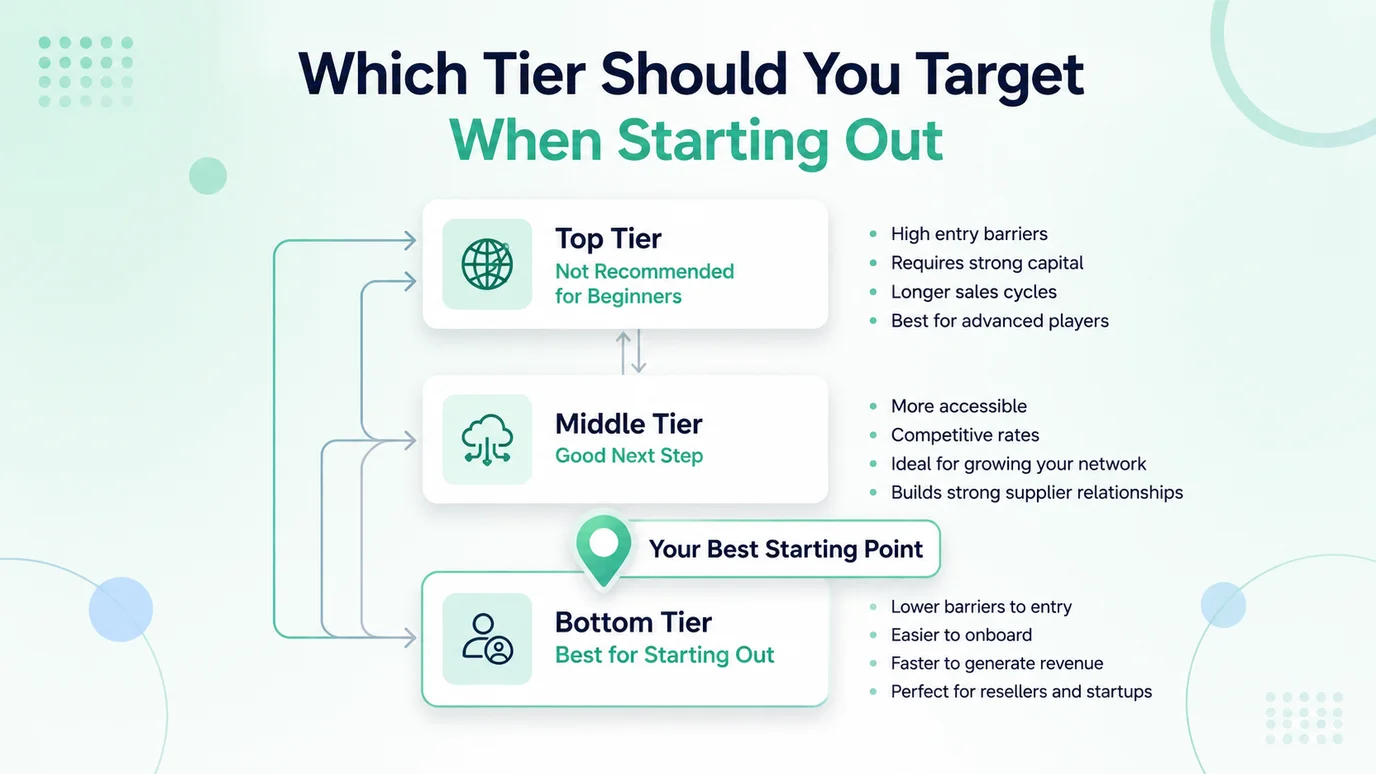
Targeting Tier 1 as a starting point almost never makes sense. It requires hundreds of millions in capital for fiber runs, data centers, and direct peering agreements with every other Tier 1 network — this is a multi-year infrastructure build, not a launch strategy, and virtually no new entrant starts here.
Tier 2 is a realistic target only if you're a well-funded regional operator with existing infrastructure in at least one geography and the capital to lease transit for everywhere else. If you're starting from scratch without that regional footprint already in place, Tier 2 is a growth stage to reach later, not a starting point.
For nearly every new entrant, Tier 3 — operating as an aggregator on leased capacity — is the only realistic starting tier, and it's a legitimate business model rather than a compromise: you compete on service quality, pricing flexibility, and value-added features instead of owned infrastructure, which is exactly the model a white-label platform like Softtop is built to support. Whichever tier you target, budget for compliance from day one — the FCC's STIR/SHAKEN implementation applies regardless of tier, and skipping it is not an option once you're carrying US-bound traffic.
4Core Infrastructure: What Your Platform Needs
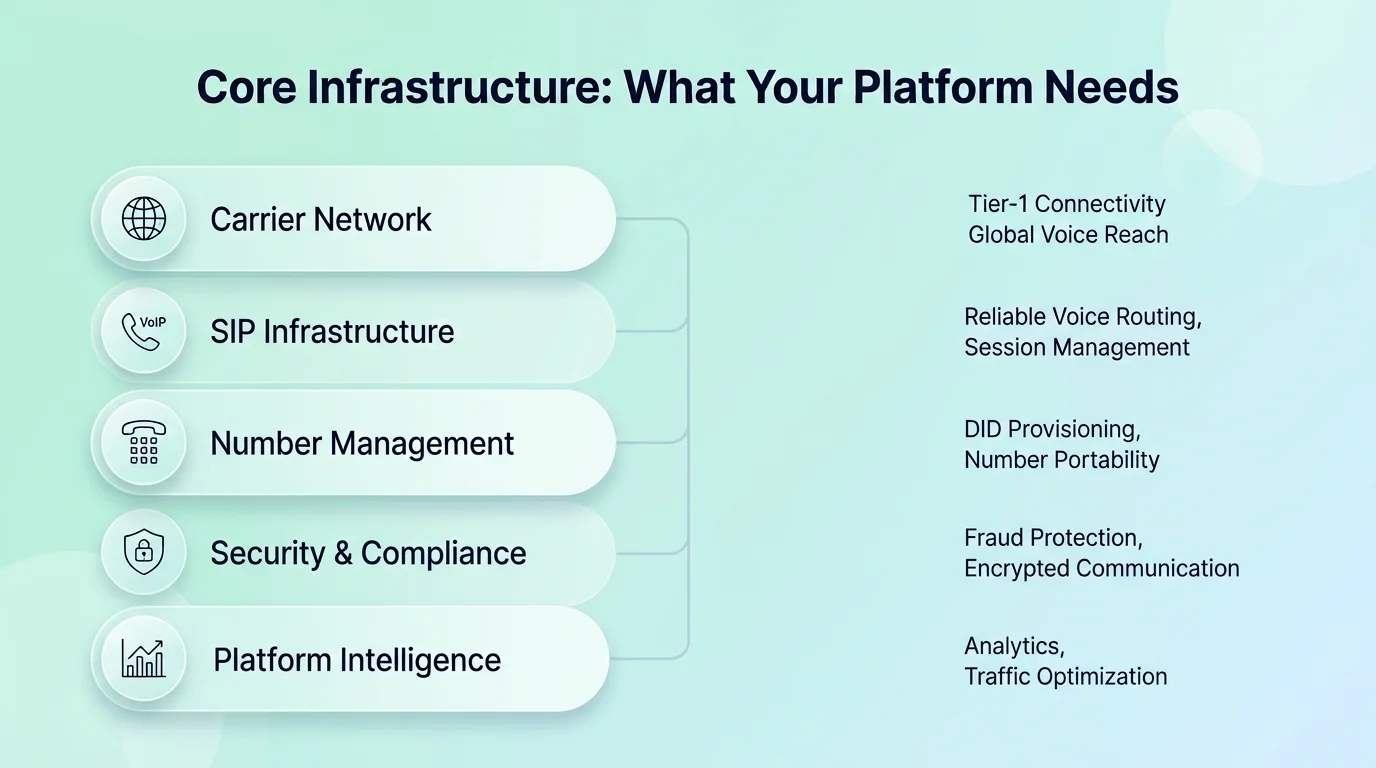
Running a wholesale voice carrier business requires several interconnected technology layers working together reliably.
Class 4 Softswitch
A Class 4 softswitch handles carrier-to-carrier routing. It does not connect end users directly; it routes calls between carrier nodes based on LCR tables, capacity limits, and quality thresholds. Every wholesale carrier needs a Class 4 softswitch at the center of its routing architecture.
Session Border Controller (SBC)
An SBC sits at the edge of your network, handling SIP signaling normalization, NAT traversal, denial-of-service protection, and transcoding where needed. It is the enforcement point for your interconnect policies and a critical piece of your fraud management stack. Without a properly configured SBC, your network is exposed to toll fraud and call injection attacks.
Billing and CDR Processing
Wholesale billing runs on CDR files generated by your softswitch. Your billing system must ingest these records in near-real time, apply rate tables, handle disputes, and generate invoices. Any lag in CDR processing creates revenue leakage. Softtop's platform integrates CDR billing natively, removing the integration risk of bolting a third-party billing tool onto a carrier platform.
Fraud Management
International Revenue Share Fraud (IRSF) and Wangiri attacks target wholesale networks specifically. An automated fraud management system that monitors call patterns, flags anomalous destinations, and can block traffic in real time is a baseline requirement for any carrier operating A-Z termination routes. Softtop's wholesale VoIP solution includes native fraud controls and real-time CDR monitoring across all destinations.
5Structuring Your Own Rate Deck and Margin Strategy
Once you've decided which route tiers to offer, the harder operational question is how to price them as your own downstream product — the margin decisions you make here determine whether the business is actually profitable, not just technically functional.
A common early mistake is pricing every route tier at a flat markup over your own upstream cost. In practice, premium CLI capacity supports a thinner percentage margin at higher volume (buyers expect to pay close to cost-plus for guaranteed quality), while LCR-tier capacity can carry a wider margin because buyers are already trading quality for price and are less rate-sensitive on the exact number.
Segment your rate deck by customer type, not just route tier: contact centers and enterprise accounts buying premium CLI routes tolerate less price negotiation but demand contractual quality guarantees, while resellers buying LCR capacity in volume will negotiate hard on price but tolerate more variability. Building two distinct commercial motions — a quality-led sale for premium accounts and a volume-led sale for LCR resellers — typically outperforms a single one-size-fits-all rate card.
Your LCR engine's routing rules are also a margin lever, not just a technical setting: the destination prefixes, time-of-day rules, and quality thresholds you configure directly decide how much of your traffic lands on your cheapest available capacity versus your most expensive. Reviewing and re-tuning those rules as your route portfolio and cost structure change is a recurring commercial task, not a one-time setup step.
Softtop's route portfolio includes premium, standard, and LCR options across 150+ countries, giving operators the flexibility to build a segmented rate deck without managing multiple upstream carrier relationships.
6Compliance and Number Integrity
Regulatory compliance has become a serious operational cost in the wholesale voice carrier business, particularly in North America and the EU.
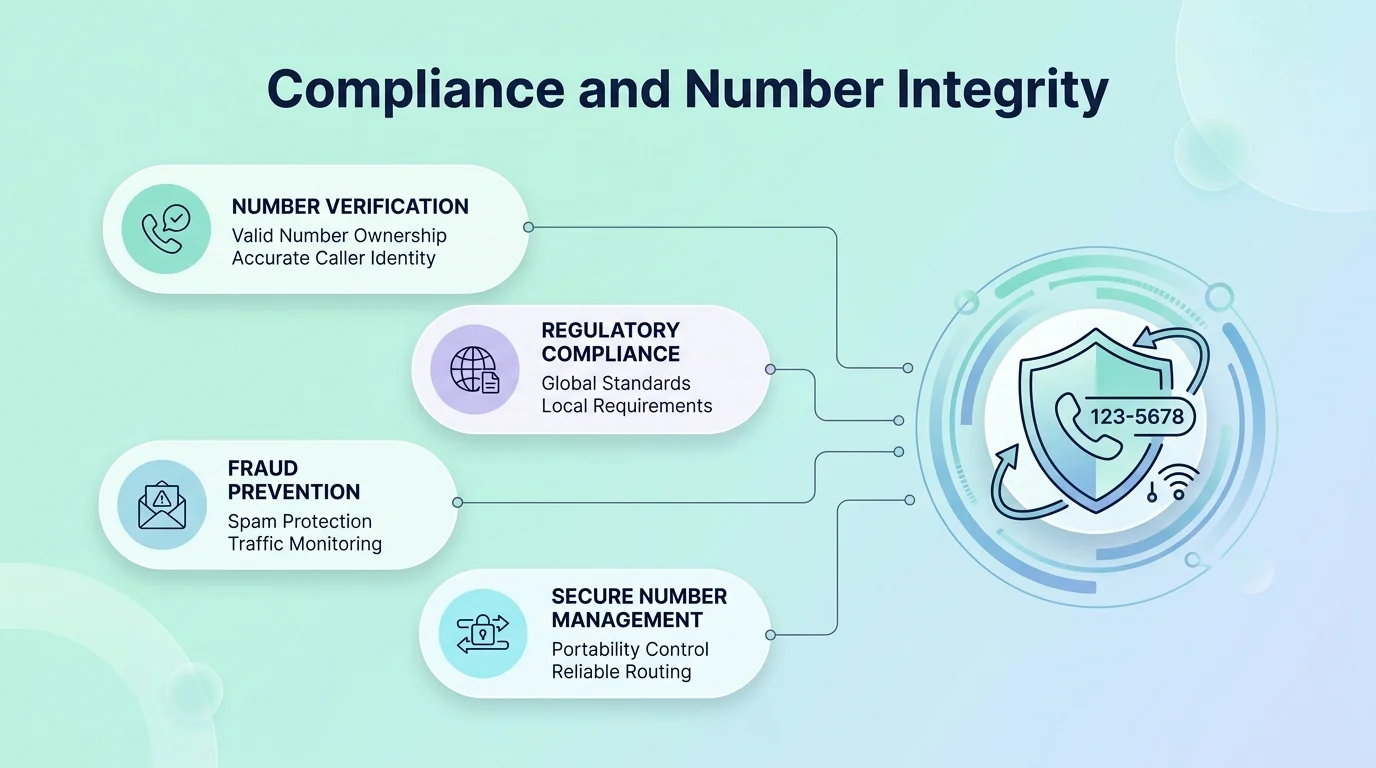
STIR/SHAKEN (Secure Telephone Identity Revisited / Signature-based Handling of Asserted information using toKENs) is a mandatory call authentication framework in the US, governed by the FCC's STIR/SHAKEN implementation. Wholesale carriers must sign outbound calls with attestation levels (A, B, or C) based on how well they know the originating customer. Failure to comply results in calls being labeled as spam or blocked outright by downstream carriers.
Interconnect agreements must define traffic types, quality thresholds, payment terms, and liability limits. A properly drafted interconnect agreement protects both parties when traffic anomalies or disputes arise.
Number portability obligations vary by jurisdiction but generally require carriers to support Local Number Portability (LNP) queries so ported numbers route correctly across networks. SIP signaling standards for number handling are defined in IETF RFC 3261, the foundational specification for the Session Initiation Protocol that every wholesale carrier must implement.
TDM-to-IP migration is still ongoing in many markets, meaning wholesale carriers also need to handle legacy PSTN interconnects through gateway equipment or TDM termination partners until those networks complete their own IP transitions.
7Building Your Customer Base as a Wholesale VoIP Reseller
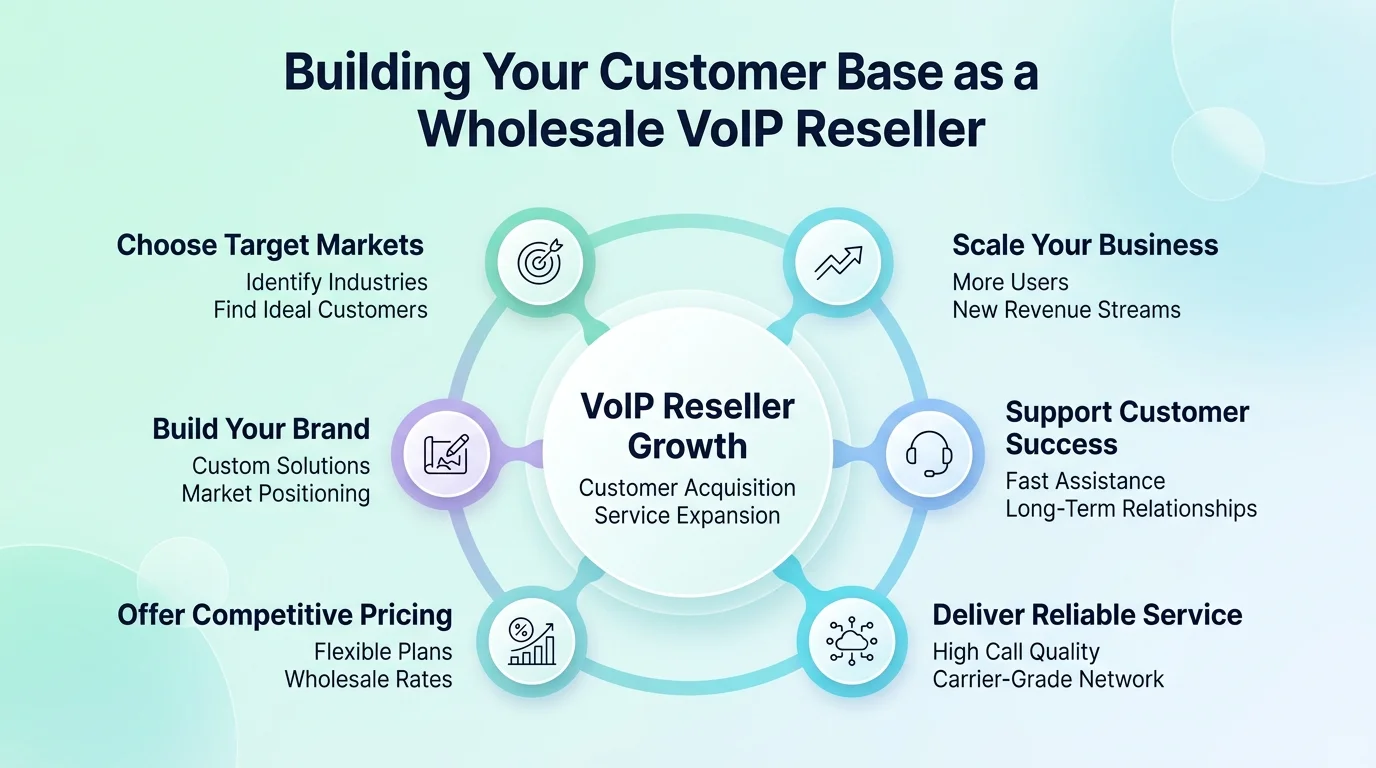
The commercial side of a wholesale voice carrier business requires a distinct go-to-market approach from retail VoIP. Your buyers are businesses and carriers, not individuals. Sales cycles are longer, contracts are larger, and relationships matter more than individual transaction pricing.
Key customer segments
- Retail VoIP providers who need upstream termination for their end-user base
- UCaaS platforms requiring carrier-grade SIP trunking for their enterprise customers
- Call centers running high-volume outbound dialing
- MVNOs needing voice termination to complement their mobile data service
- Other regional carriers who want a Tier 2 or Tier 3 partner for geographies they do not cover
Pricing is competitive. To win, you need either a cost advantage on specific routes, a service quality differentiator, or a value-added feature like real-time analytics, fraud alerting, or white-label reseller access. Softtop's voice wholesaler services include white-label reseller capabilities, allowing your customers to onboard their own sub-resellers under your brand from a single platform.
8Conclusion
A wholesale voice carrier business combines technical infrastructure, commercial relationships, and regulatory discipline into a single operation. The market is large — $44.53 billion in 2026 and growing — and the margin structure rewards operators who invest in the right routing, billing, and compliance stack.
Whether you are entering at Tier 3 with a white-label platform or building toward regional Tier 2 infrastructure, the fundamentals are the same: reliable interconnects, accurate CDR billing, fraud protection, and a customer base you can grow through competitive pricing and service quality. Softtop provides the carrier-grade infrastructure, 99.9% uptime guarantee, and support across 150+ countries that wholesale voice operators need to compete and scale.
9Frequently Asked Questions
What is a wholesale voice carrier business?
A wholesale voice carrier business purchases large volumes of voice termination capacity from upstream networks and resells that capacity to downstream buyers — other carriers, VoIP providers, call centers, and enterprises — charging per-minute rates on A-Z routes and generating margin through the spread between buy and sell rates.
How much capital do I need to start a wholesale voice business?
Entry costs vary by tier. A Tier 3 wholesale VoIP reseller using a white-label platform like Softtop can launch for far less than building proprietary infrastructure — often in the low tens of thousands of dollars for licensing, SBC hardware or cloud instances, and initial interconnect deposits. Tier 2 operations with owned infrastructure require significantly more capital.
What is LCR routing and why does it matter?
Least Cost Routing (LCR) automatically selects the cheapest available route for each call based on destination prefix, rate tables, and quality thresholds you define. A well-configured LCR engine is the primary margin driver in wholesale voice — it ensures you never pay more than necessary to terminate a call while still meeting your quality commitments.
What compliance requirements apply to wholesale voice carriers?
In the United States, STIR/SHAKEN call authentication is mandatory. Carriers must also comply with FCC regulations on number portability, interconnect filing requirements, and fraud prevention standards. EU operators face additional obligations under national telecom regulatory frameworks and GDPR where customer data is processed.
What is the difference between a Class 4 and Class 5 softswitch?
A Class 4 softswitch handles carrier-to-carrier routing and does not connect end users directly. A Class 5 softswitch provides end-user features — voicemail, IVR, call forwarding, and PBX functions — and connects directly to subscriber endpoints. Wholesale carriers primarily operate Class 4 infrastructure; retail providers and UCaaS platforms use Class 5.
How do I evaluate wholesale VoIP rates?
Compare per-minute rates by destination prefix, but also evaluate route quality metrics: Answer Seizure Ratio (ASR), Average Call Duration (ACD), and Post Dial Delay (PDD). A cheaper rate on a low-ASR route can cost more in revenue terms than a slightly higher rate on a premium route, especially for call center customers.
Can I offer white-label carrier services to my own resellers?
Yes. A white-label wholesale VoIP model allows you to brand the platform, set your own pricing, and onboard sub-resellers who sell under your brand. This is one of the fastest ways to scale call volume without expanding your direct sales team. Softtop's platform supports this model natively.