1Introduction
Over 4.5 billion VoIP calls are completed globally every single day — and wholesale AZ VoIP termination is the backbone routing most of them. If you run a call center, a BPO, or a voice reselling operation, this service determines whether your calls connect clearly, your caller ID appears correctly, and your per-minute costs stay manageable at scale.
This guide cuts through the noise. You will learn how AZ termination works under the hood, which metrics separate a quality route from a costly one, what grey routes will do to your business reputation, and the five questions to ask any provider before committing. Softtop's network spans 180+ countries with 99.999% uptime — and this guide is built so you can hold every provider, including us, to the same standard.
2What Is Wholesale AZ VoIP Termination?
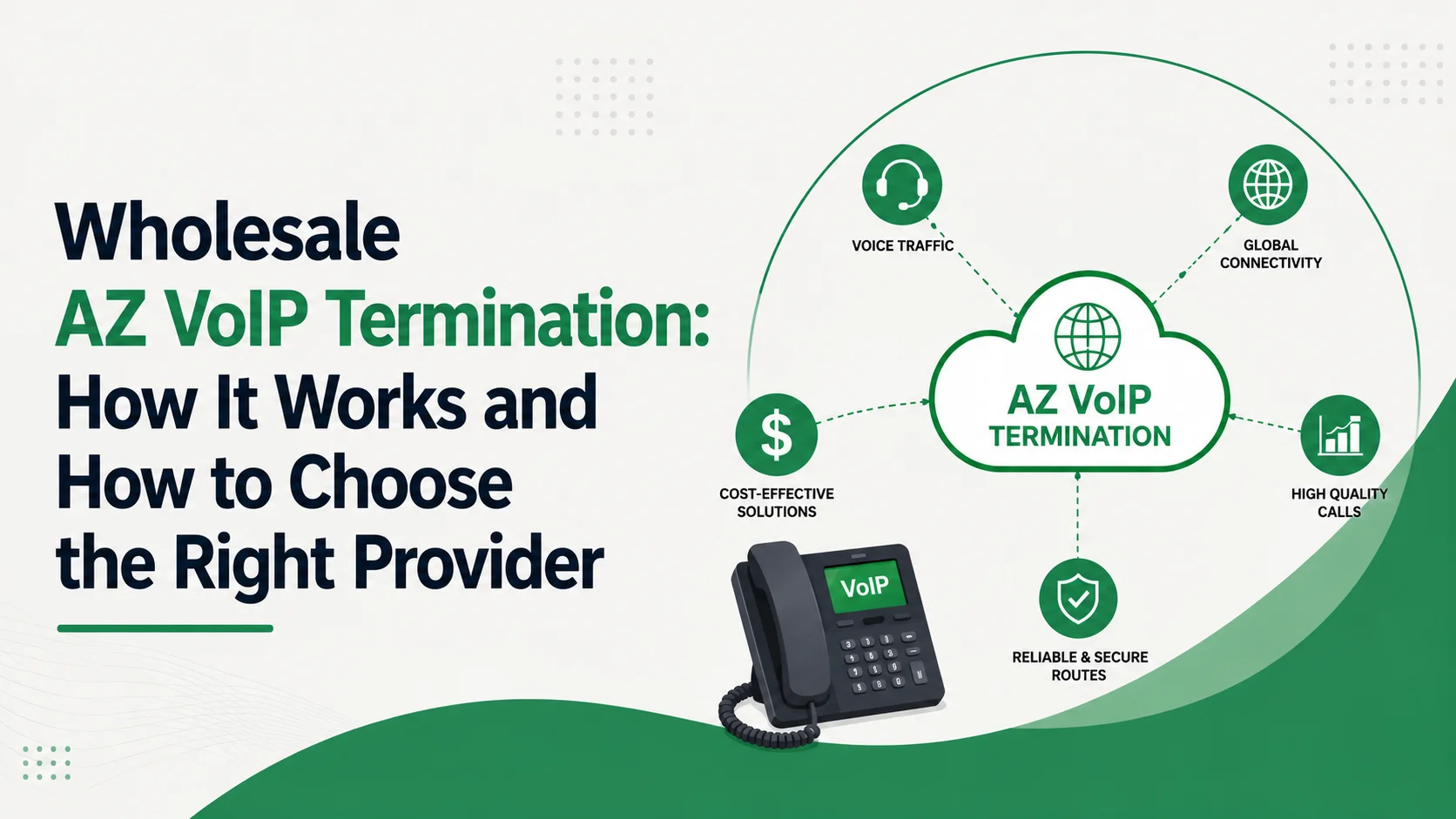
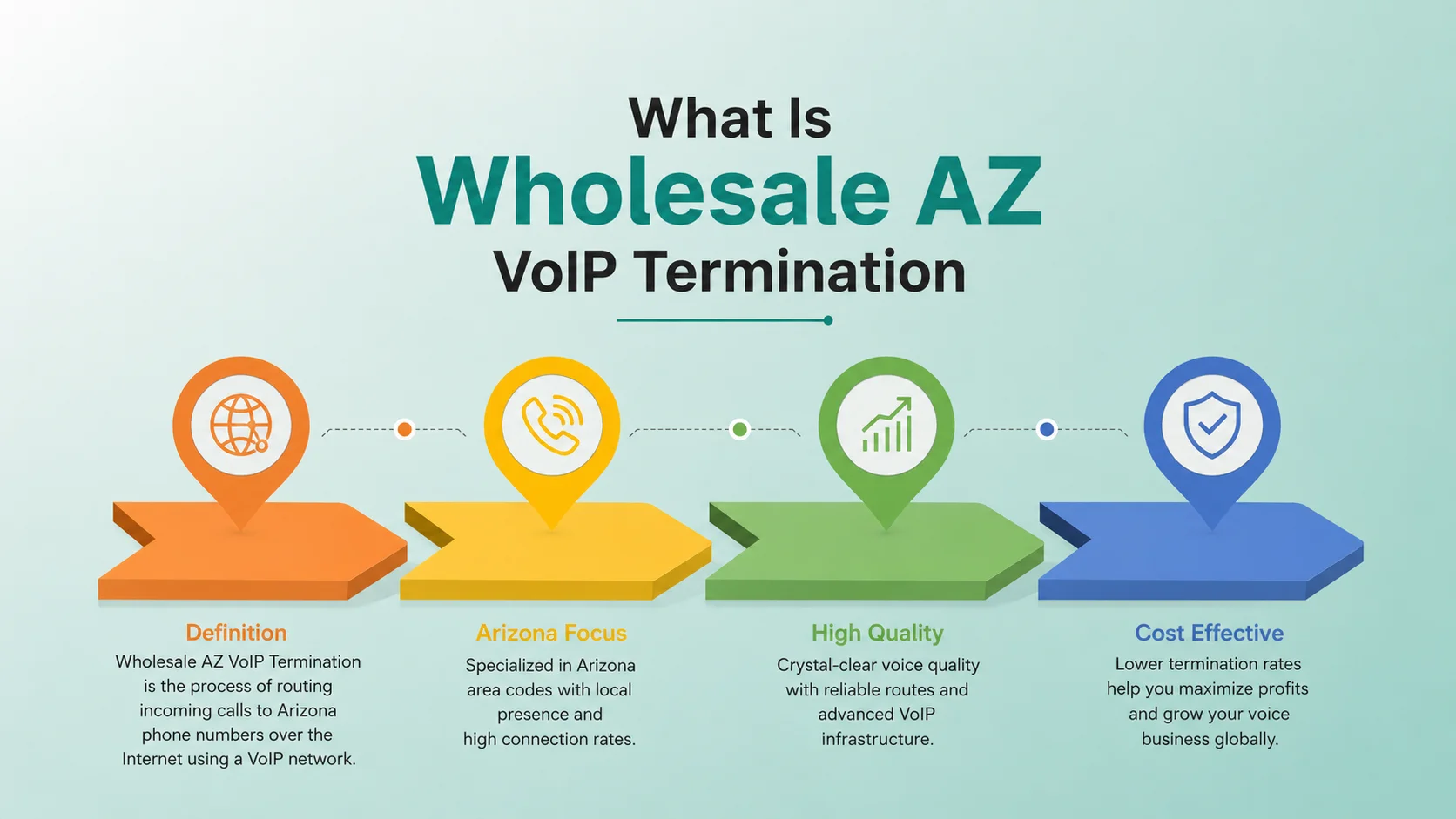
Wholesale AZ VoIP termination is a B2B service that routes VoIP calls from your platform to any phone network worldwide. "A-Z" means the provider covers every country on a single rate deck. "Termination" is the final handoff connecting your internet call to a customer's landline or mobile, via the Public Switched Telephone Network (PSTN).
- Wholesale — sold in bulk at carrier rates. You are buying capacity for thousands or millions of calls, not individual lines.
- A-Z — a global rate deck covering every dialable destination. One provider, one SIP trunking connection, one invoice — whether you are calling São Paulo or Seoul.
- VoIP Termination — the process of taking a call that originated on the internet and landing it on a traditional phone.
This is the operational backbone for call centers routing thousands of daily outbound calls, VoIP resellers bundling voice into their platforms, OTT apps with international dialing, and enterprises connecting distributed global teams.
Step 1 — Initiation via SIP Trunk
Your PBX, auto-dialer, or contact center software originates a call and pushes it over the internet to your provider's network using a SIP Trunk. Think of the SIP trunk as a high-capacity digital on-ramp — no physical phone lines required, and capacity scales in software.
Step 2 — Routing via Softswitch and LCR
The instant your call arrives, a softswitch reads the destination number. Basic providers use Least Cost Routing (LCR) — logic that picks the cheapest available route. More capable platforms layer AI on top, factoring in live ASR performance, network congestion, and STIR/SHAKEN attestation before routing. That intelligence is the difference between a connected call and an unanswered one.
Step 3 — PSTN Handoff and Termination
The selected route hands off to a local carrier in the destination country, which terminates the call on your customer's device. In a healthy setup, this entire process completes in under 200 milliseconds. When it breaks down, the symptom is missed connections, prolonged silence before ringing, or a Spam Likely label on your customer's screen.
3Key Quality Metrics: ASR, PDD, and ACD Explained
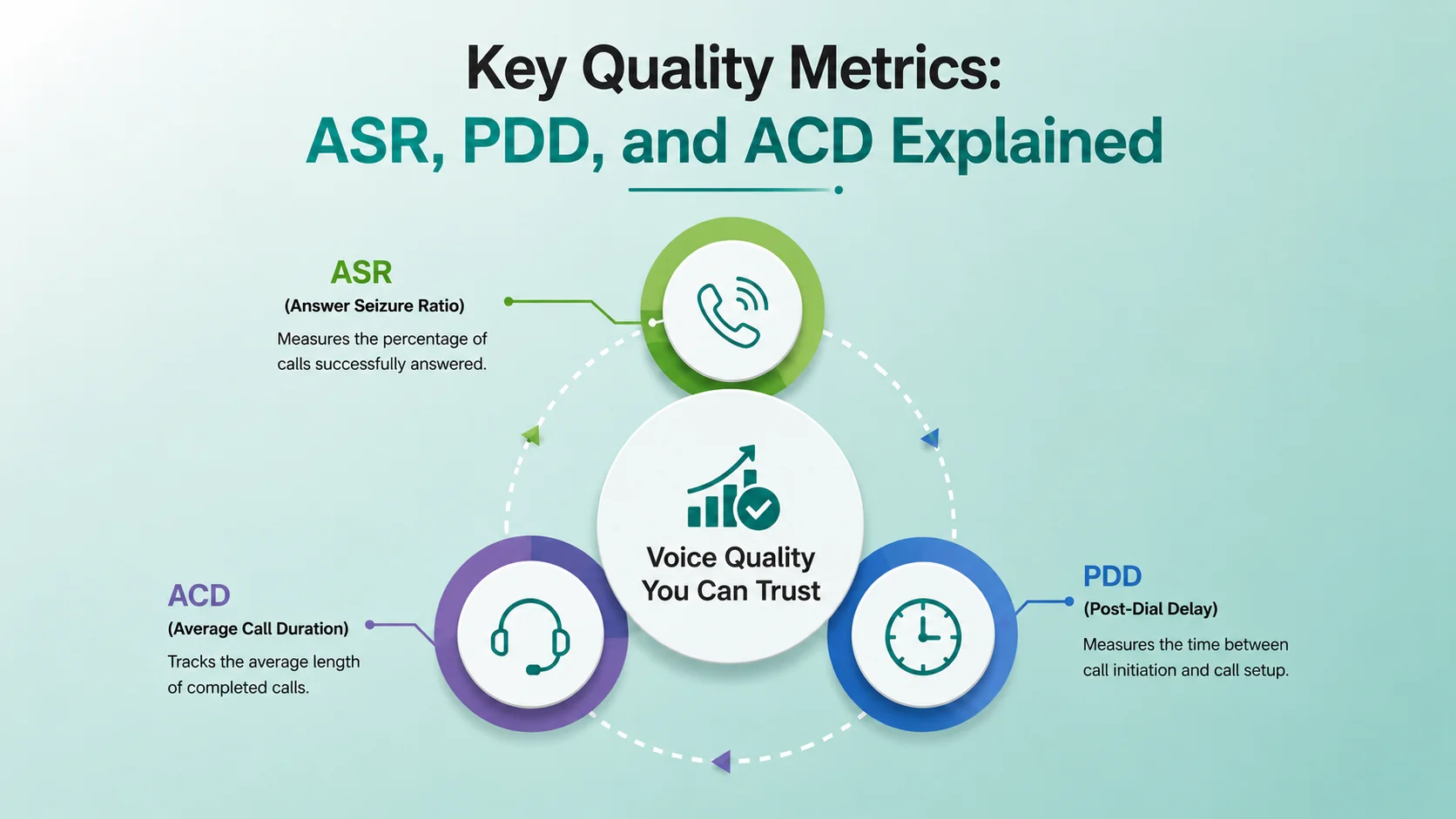
Providers all claim high quality. Metrics do not. Ask for these three numbers broken down by destination — not as a global average. These benchmarks align with ITU-T voice quality standards used across the industry.
ASR — Answer Seizure Ratio
ASR is the percentage of call attempts that successfully connect to a live answer. Benchmark: 65%+ is acceptable; 75%+ is strong. If a provider's ASR sits at 20–40%, you are paying for calls that never reach a human. For a call center placing 50,000 dials per month, a 20-point ASR drop means 10,000 lost connections — every month.
PDD — Post-Dial Delay
PDD is the gap between when your system dials and when your customer's phone starts ringing. Anything over 6–7 seconds causes agents and customers to abandon the call. Aim for under 4 seconds on your top destinations.
ACD — Average Call Duration
A healthy ACD shows calls are connecting and lasting. An ACD of 0–2 seconds is a red flag — calls are connecting and dropping instantly, a classic sign of route instability or active carrier blocking.
Always request destination-specific data. A provider with strong US ASR and poor MENA performance looks fine on a blended average, but fails your most critical markets when it matters.
5How to Choose a Wholesale AZ VoIP Termination Provider: 5 Essential Questions
Forget the marketing deck. Use these five questions to qualify any provider before committing volume.
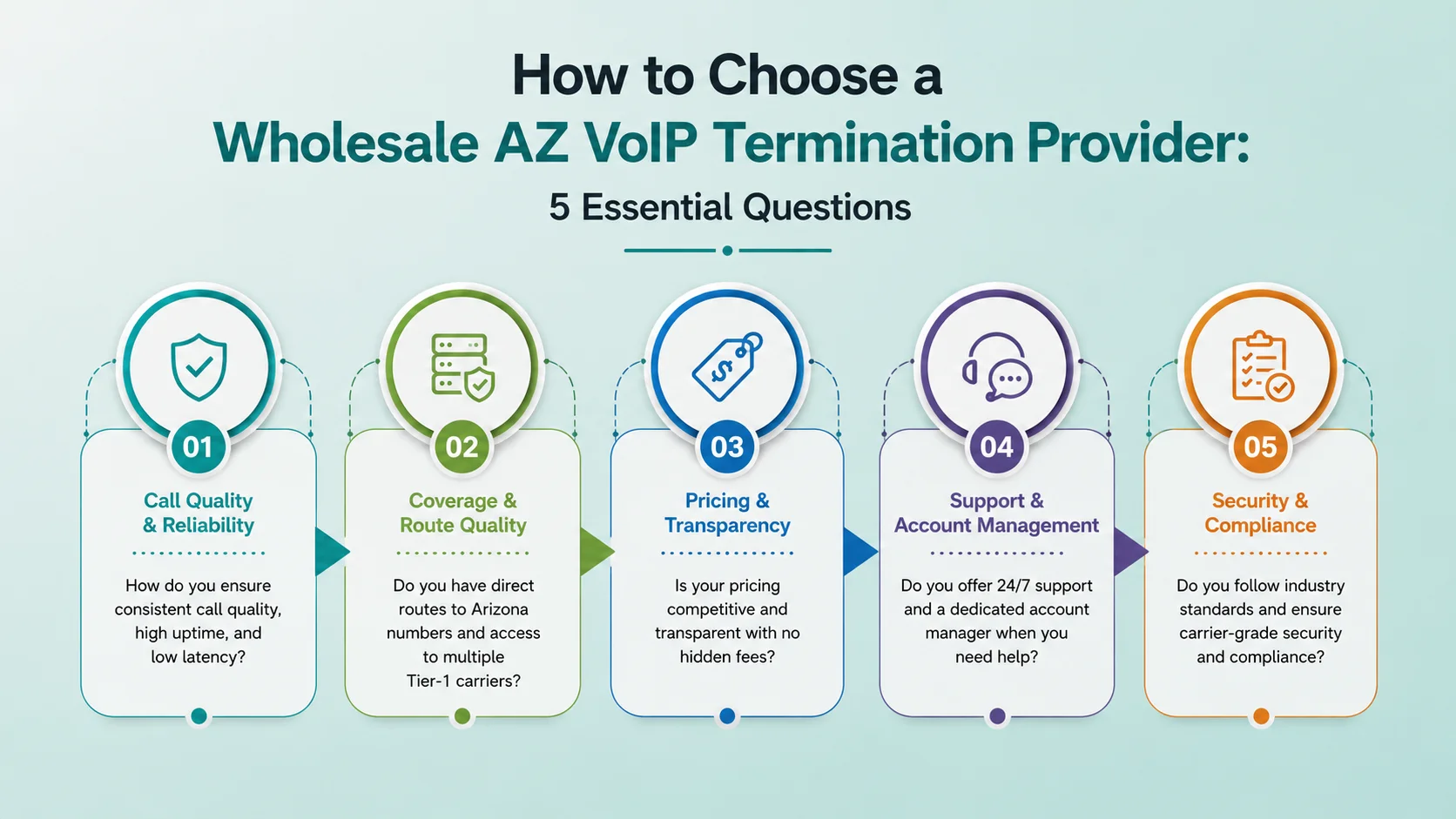
- 1What are your ASR, PDD, and ACD for my top-10 destination countries? Any reputable provider has this data and shares it willingly. Vague answers like industry-leading quality are not answers.
- 2Do you guarantee CLI delivery on all routes? Guaranteed CLI means your registered caller ID reaches the recipient every time. If a provider offers non-CLI options, they are selling grey routes with cleaner language.
- 3How do you handle STIR/SHAKEN for US-terminating traffic? Ask at what attestation level they sign your calls. Level A is full authentication end-to-end. Anything less raises your spam risk.
- 4What does your real-time fraud detection look like? International Revenue Share Fraud (IRSF) can generate five-figure bills overnight. The system must provide real-time traffic analysis, automated blocking, and instant alerts.
- 5Who answers your call at 3 AM on a Sunday? Ask whether you reach NOC engineers directly or a first-line helpdesk. A helpdesk logs problems. A NOC fixes them.
A provider that answers all five questions clearly is rare. Compare published wholesale VoIP rates against these quality answers — never price in isolation.
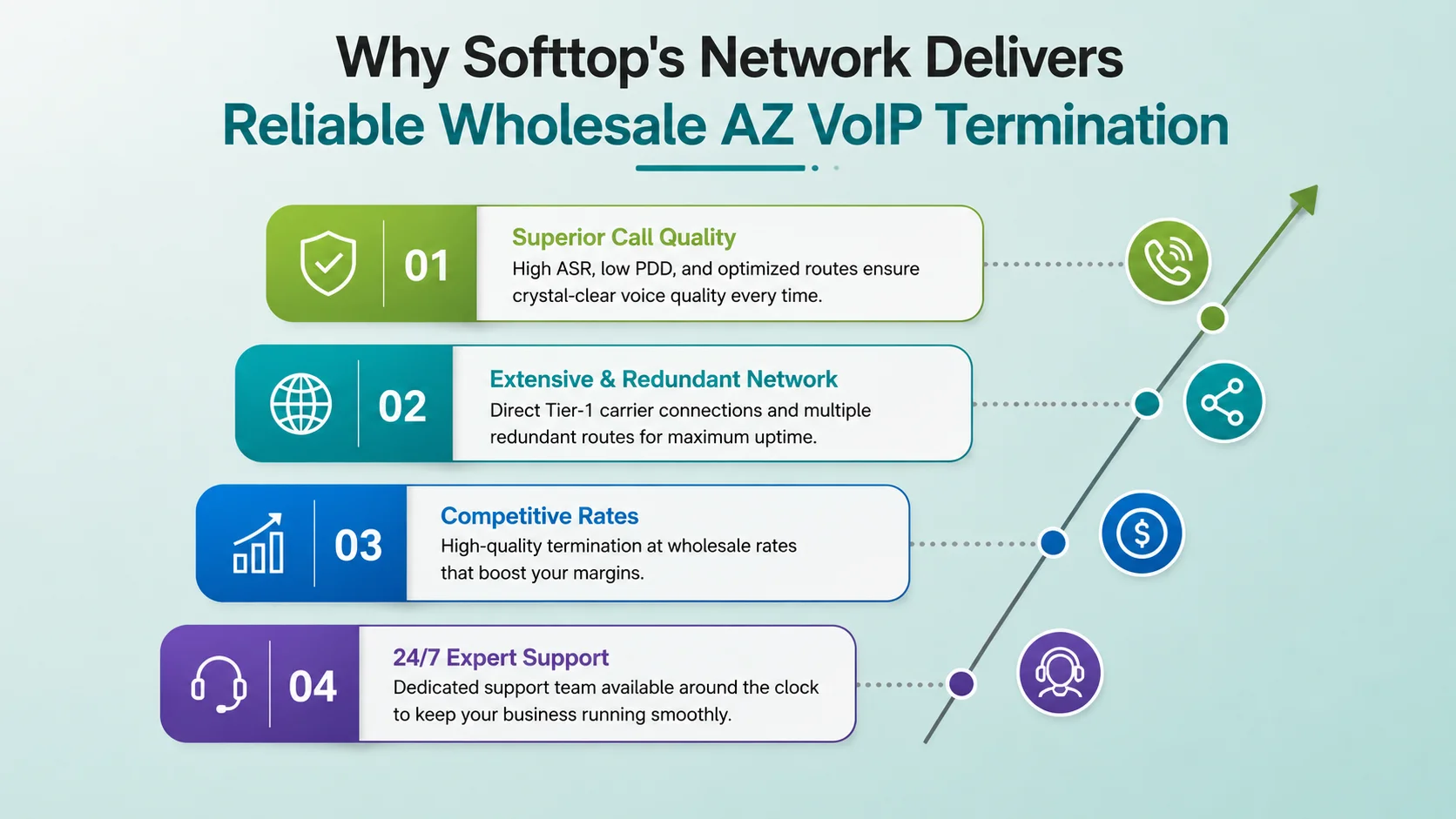
6Why Softtop's Network Delivers Reliable Wholesale AZ VoIP Termination
Softtop addresses every failure point in standard wholesale AZ VoIP termination delivery.
AI-Powered Quality Routing
Where basic platforms stop at Least Cost Routing, Softtop's engine evaluates live ASR, PDD latency, STIR/SHAKEN attestation scores, and carrier capacity in real time before selecting a route. Calls are sent to the highest-performing path, not just the cheapest.
Guaranteed CLI on Every Route
Every Softtop route is a guaranteed CLI route. Your caller ID arrives on your customer's screen every time — no grey routes, no reputation risk.
Proactive AI Fraud Protection
Our system learns your normal call patterns. Unusual destination clusters or off-hours volume spikes trigger automatic blocking and an immediate NOC alert — before a fraudulent charge accumulates.
24/7 NOC Access
Softtop's engineers monitor your traffic continuously. When a route underperforms, we re-route proactively — you see the fix, not the problem.
7Conclusion
Wholesale AZ VoIP termination is not a commodity — the gap between a carrier-grade provider and a grey-route reseller is the gap between a business that scales and one that burns its reputation. Prioritize a provider with guaranteed CLI, verified ASR above 65%, STIR/SHAKEN Level A compliance, and proactive fraud protection, and you build a calling infrastructure that holds at any volume.
Softtop delivers all of that across 180+ countries, backed by 24/7 NOC support that treats route problems as emergencies, not tickets. Whether you are routing 10,000 calls a month or 10 million, the foundation is the same: quality routes, transparent metrics, and a partner who is accountable. Start a trial and run the numbers yourself.
8FAQ
What does A-Z mean in wholesale VoIP termination?
A-Z refers to the global coverage of the rate deck. A provider offering A-Z termination can route calls to any country on Earth — from Afghanistan to Zimbabwe — on a single connection, invoiced under one account. It eliminates the need to manage multiple regional carriers for different international destinations and dramatically simplifies your vendor stack.
How is wholesale AZ VoIP termination different from standard VoIP?
Standard VoIP is designed for individual users or small office teams. Wholesale AZ VoIP termination is a B2B carrier-grade service designed for high volumes — typically millions of minutes per month. Pricing is per minute at bulk rates, and the buyer manages routing through their own softswitch or contact center platform rather than a consumer app.
What ASR should I expect from a quality wholesale AZ VoIP termination provider?
A reliable provider should deliver ASR of 65–75% or higher across your key destination countries. Below 50% signals unstable or grey routes. Always request destination-specific ASR data rather than a global average — blended numbers hide poor performance in your highest-traffic markets, where it matters most.
What are grey routes and why should I avoid them?
Grey routes use unauthorized pathways — often SIM card farms — to bypass official carrier interconnects at lower cost. They strip your Caller ID, fail STIR/SHAKEN compliance, and get your numbers flagged as Spam Likely. In the long run, they cost far more in lost connections and brand damage than the per-minute savings ever justify.
Is STIR/SHAKEN compliance required for wholesale AZ VoIP termination?
STIR/SHAKEN is mandatory for calls terminating to US numbers under FCC rules. Your provider must sign your traffic with a Level A attestation certificate — anything less raises spam risk and can result in active blocking by US carriers. Always confirm your provider's compliance level before routing any US volume through their network.
How quickly can I scale capacity with a wholesale AZ VoIP termination provider?
With a cloud-based provider like Softtop, you can increase call capacity within hours — no hardware procurement, no physical line installation. Adjust your SIP trunk capacity through the portal and the additional channels are available immediately. This on-demand scalability is one of the main reasons businesses migrate from legacy PBX infrastructure.
What should I test during a free trial of wholesale AZ termination?
Test ASR and PDD on your top-10 destination countries, verify CLI delivery on every test call, and place calls at different times of day to check for consistency. Run 100–200 calls in a controlled burst and compare the resulting ASR and ACD metrics directly against your current provider's benchmarks.