1Introduction
Telecommunications carriers route billions of minutes every month, and the margin between profit and loss often comes down to fractions of a cent per call. That's why wholesale VoIP LCR — Least Cost Routing — became the standard engine powering every serious voice network. By automatically selecting the cheapest available carrier route for each call, LCR can reduce termination costs significantly and keep operations lean at scale.
But here's what most introductions to LCR leave out: routing purely on cost is one of the most common ways voice platforms destroy their call quality and get their numbers flagged as spam. The real skill is knowing how LCR works, which variables matter beyond price, and how modern AI-powered platforms are replacing simple cost logic with something far smarter. Softtop's network handles wholesale routing across 180+ countries with 99.999% uptime — and this guide reflects how we actually think about it.
2What Is Wholesale VoIP LCR?
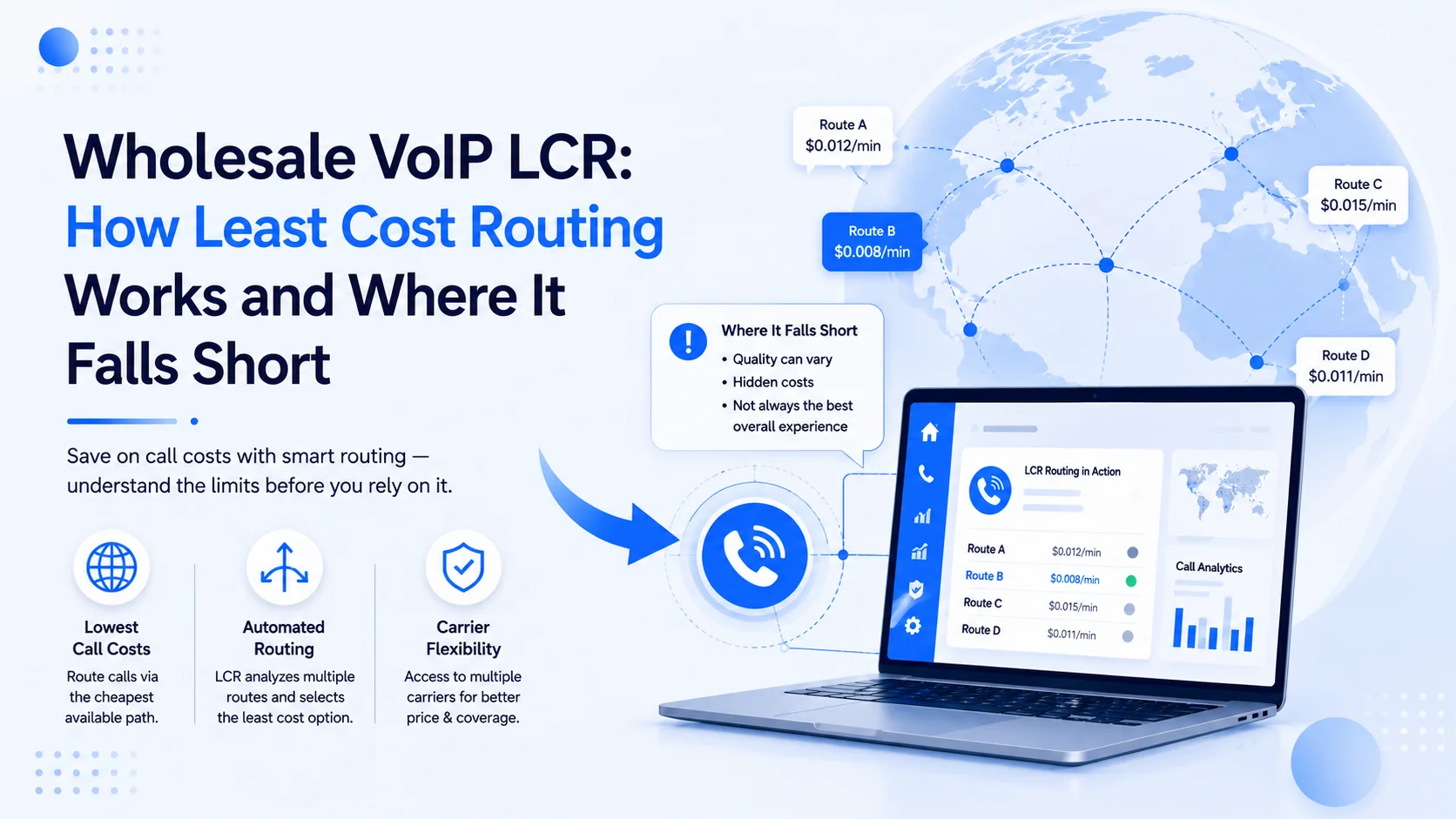
Wholesale VoIP LCR (Least Cost Routing) is a real-time routing method used by wholesale voice providers to automatically select the lowest-cost carrier path for each outbound call, based on destination number, carrier rate tables, and availability — without human intervention.
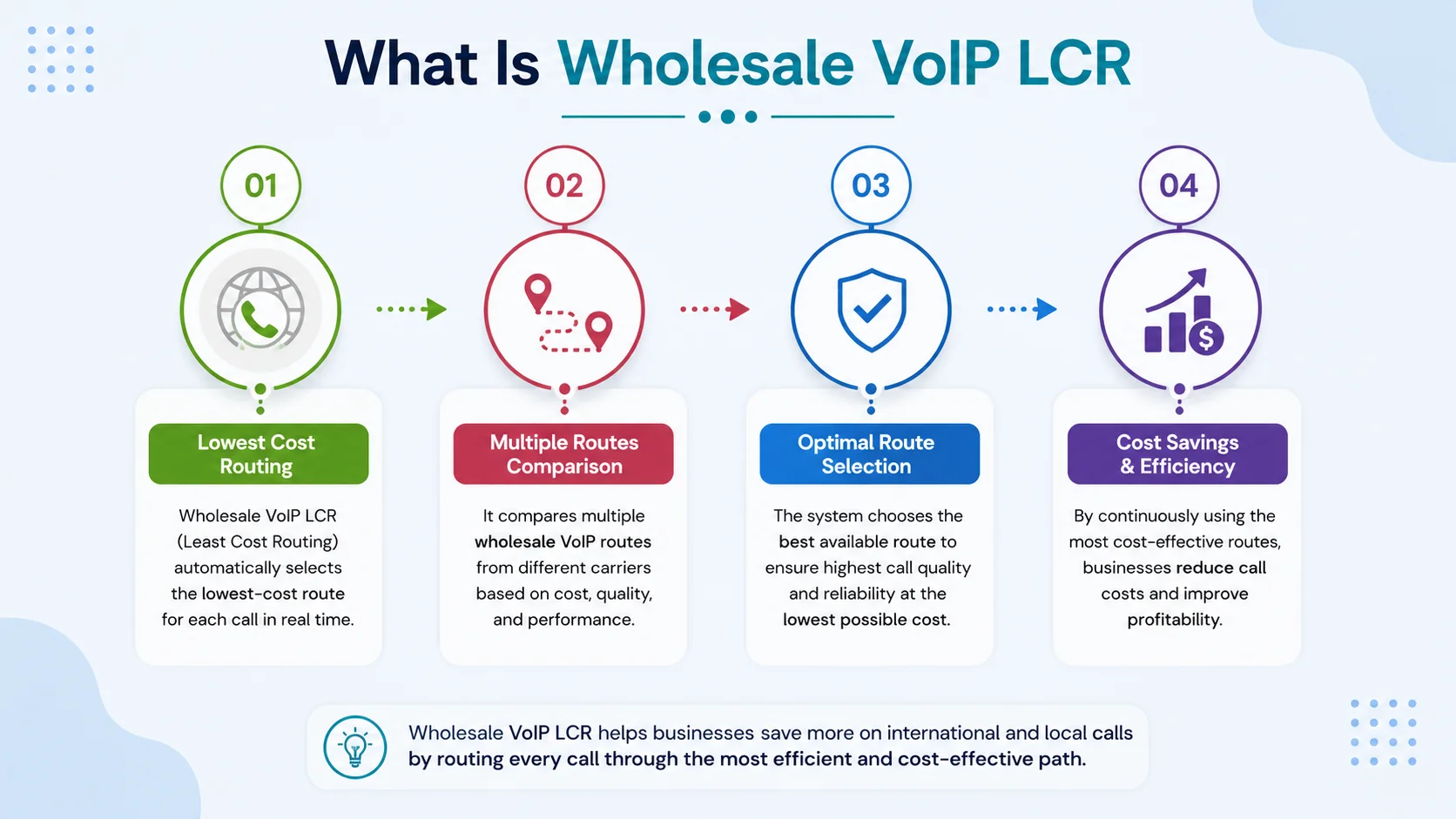
When you originate a call on a wholesale VoIP platform, LCR triggers instantly. The system reads the destination number, queries a live database of carrier rates for that prefix, ranks available routes by cost, and connects the call through the cheapest viable option — typically in milliseconds.
LCR is the backbone of commercial voice routing because it directly controls the largest operating expense in any wholesale voice business: termination costs. For a carrier routing 10 million minutes per month, even a $0.002/min saving on average termination cost translates to $20,000 per month in recovered margin.
The challenge is that 'cheapest' and 'best' are not the same thing. A route priced at $0.001/min that connects 25% of calls is objectively more expensive — per connected call — than a $0.004/min route that connects 80%. Pure LCR systems miss this entirely. Understanding why is the key to using LCR effectively.
3How Wholesale VoIP LCR Works: Step by Step
Understanding the mechanics lets you spot weaknesses in your current setup and ask better questions of any provider.
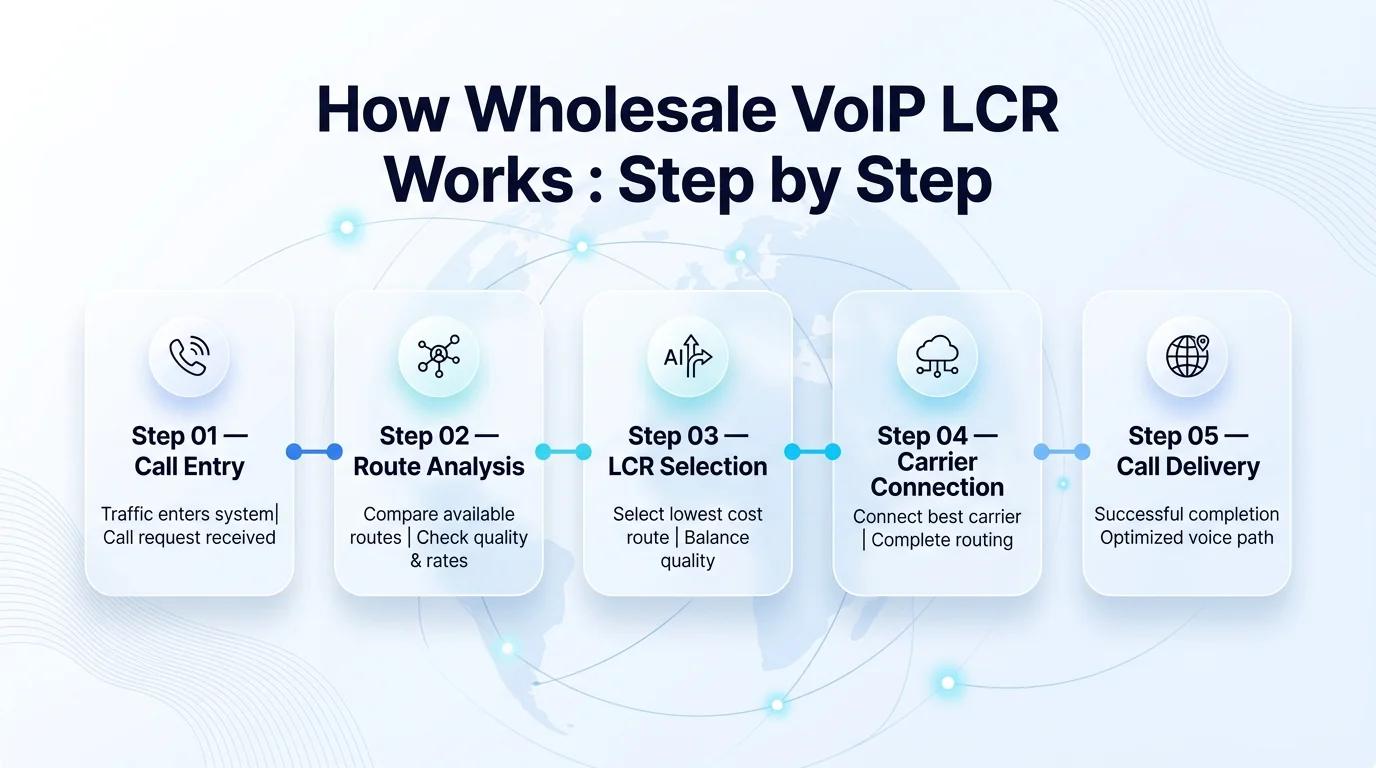
Step 1 — Rate Table Ingestion
Your LCR engine pulls current rate sheets from each carrier in your network. These are updated continuously — carrier rates shift daily — so a stale rate table means your 'cheapest route' is already wrong.
Step 2 — Prefix Matching
When a call is placed, the softswitch reads the destination number and identifies the most specific matching prefix in each carrier's rate deck. A call to a UK mobile number (+44 7xxx) will match a different row than a UK fixed line (+44 1xxx), often at a significantly different price.
Step 3 — Route Ranking and Selection
The engine ranks all matching routes by rate and selects the cheapest one with available capacity. Basic systems stop here — they pick the lowest price and move on.
Step 4 — Call Delivery and Monitoring
The selected carrier receives the call and attempts to terminate it. A real-time monitoring layer should be tracking ASR, PDD, and call duration throughout. If a route fails or drops below quality thresholds, a capable system re-routes automatically — a process called failover routing — without the caller noticing.
4The 5 Factors a Smart LCR Engine Must Weigh
Price is just one signal. A wholesale VoIP LCR engine that only sorts by rate will consistently choose routes that look cheap on paper but cost more per successfully delivered call. The five factors a well-configured system must consider:
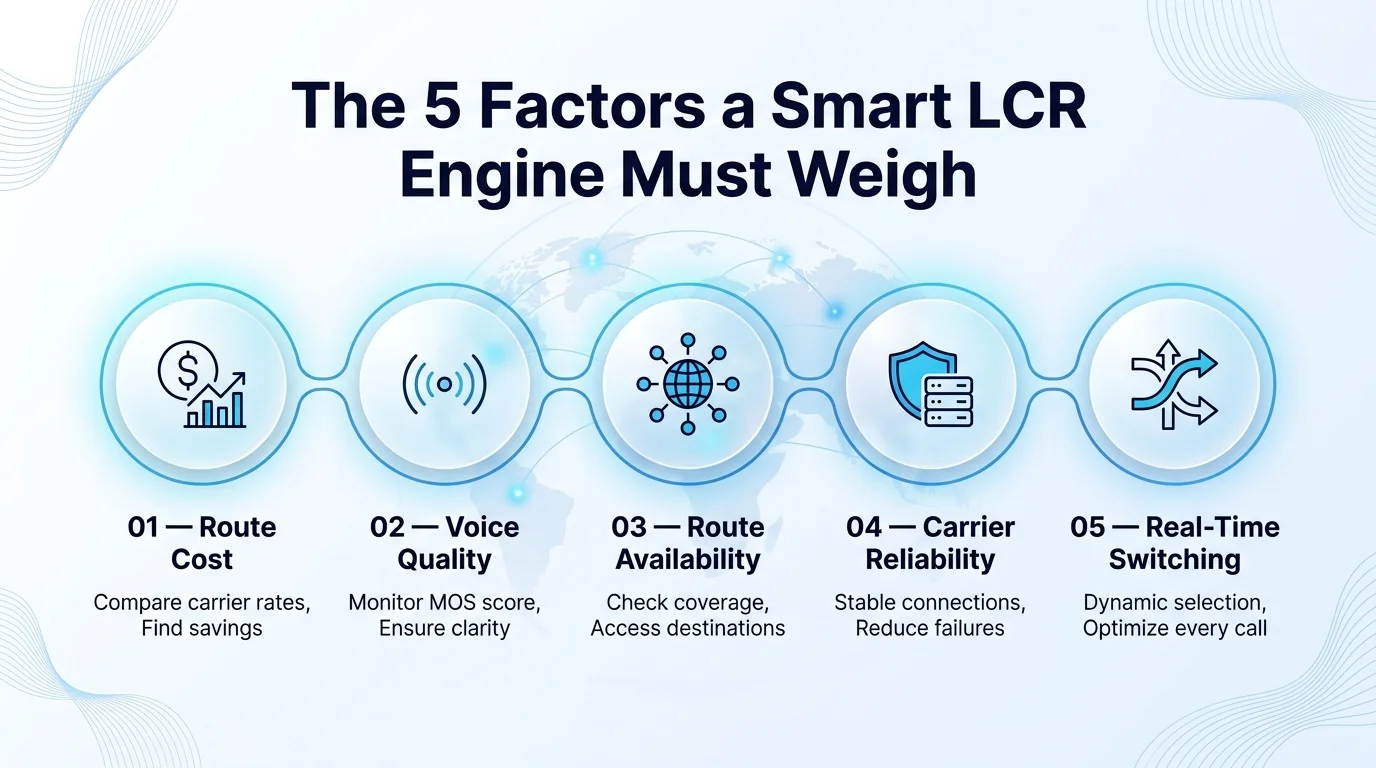
- Termination Rate ($/min). The baseline — but always evaluated alongside the other four, never in isolation.
- ASR — Answer Seizure Ratio. The percentage of calls that successfully connect. A route with 35% ASR is effectively wasting 65% of your origination traffic. Quality CLI routes deliver 65–75%+ ASR consistently.
- PDD — Post-Dial Delay. How long before the customer's phone starts ringing. Over 5–6 seconds, abandonment rates spike sharply. A cheaper route with 8-second PDD will cost you more in lost connections than it saves per minute.
- ACD — Average Call Duration. Short ACDs (0–2 seconds) indicate calls connecting and dropping instantly — a sign of an unstable or fraudulent route. Healthy ACD is the most reliable signal of route integrity.
- CLI Delivery. Does your registered Caller ID reach the recipient? Routes that strip CLI get your numbers flagged as "Unknown" or "Spam Likely" — destroying answer rates across your entire number portfolio.
5LCR vs Quality-Based Routing: What's the Difference?
This is where most explanations of wholesale VoIP LCR fall short. LCR and quality-based routing are often treated as opposites, but the most effective systems blend both.
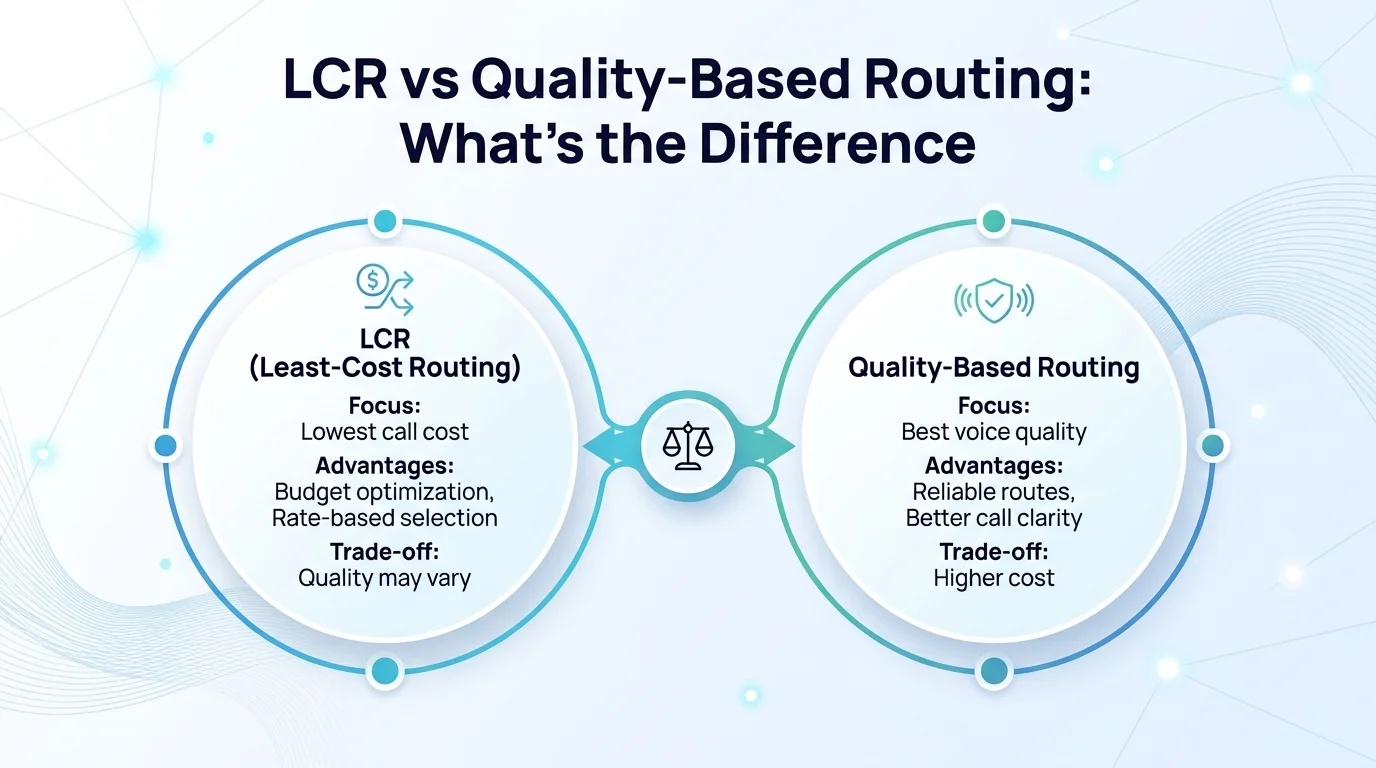
Pure LCR is fast, simple, and cheap to operate — but it consistently steers traffic toward unstable, low-quality, or grey routes because it has no quality floor.
Quality-based routing prioritizes the cleanest path regardless of cost, which protects call quality but can erode margins quickly.
The smart hybrid approach — which is how Softtop's platform works — runs LCR within quality constraints. The system only considers routes that meet minimum ASR, PDD, and CLI thresholds, then selects the cheapest among those qualifying routes. You get cost efficiency without sacrificing the metrics that determine whether calls actually land.
Only routes that pass minimum ASR, PDD, and CLI thresholds enter the cost comparison. This single design decision is what separates a smart LCR engine from a race to the cheapest grey route.
6Why Pure LCR Can Actively Damage Your Business
The biggest blind spot in standard wholesale VoIP LCR implementations is grey routes. When your LCR engine is purely cost-driven, it will reliably select grey routes — unauthorized carrier paths built on SIM arrays — because they are almost always the cheapest option available.
- CLI stripping. Grey routes cannot carry your registered caller ID. Outbound calls appear as "Unknown" or display random numbers. Answer rates fall immediately.
- Spam flagging. High volumes of unidentified calls trigger automatic carrier fraud detection. Once your numbers are flagged, that label is extremely difficult to remove — and it affects all calls, not just the ones using grey routes.
- STIR/SHAKEN failure. The FCC's call authentication framework requires all US-terminating calls to carry a signed attestation. Grey routes cannot provide this, resulting in active traffic blocking by major US carriers.
- Unpredictable ASR collapse. Carriers hunt and shut down grey routes. A path delivering 65% ASR on Monday may deliver 10% on Friday.
For every dollar saved on a cheaper grey route, operators typically lose multiples in failed connections, reputation damage, and number remediation costs. Compare wholesale VoIP rates on quality-floor-enforced routes against your current per-connected-minute cost — the economics almost always favour the cleaner path.
7How AI Is Evolving Wholesale VoIP LCR Beyond Simple Cost Logic
Traditional LCR is essentially a sorted table — cheapest first. Modern AI-powered routing treats LCR as a continuous prediction problem, and the results are measurably better.
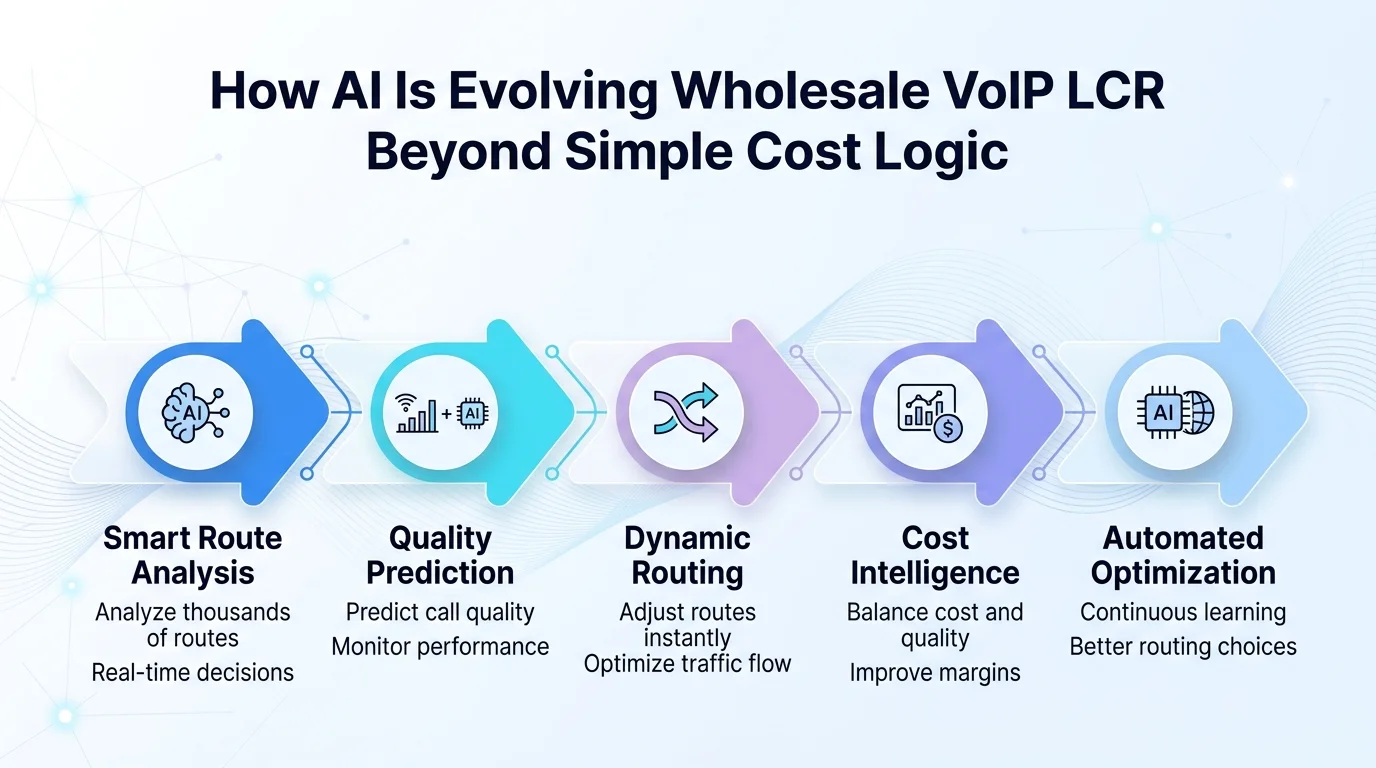
Softtop's routing engine doesn't just read the current rate table. It analyses billions of historical data points — route-level ASR trends, time-of-day performance patterns, carrier congestion signals, STIR/SHAKEN attestation scores — and uses that data to predict which route will perform best right now, not just which is cheapest on paper.
- Predictive failover. Instead of waiting for a route to fail and then re-routing, the AI detects performance degradation early and moves traffic before quality drops.
- Time-of-day awareness. Carrier performance varies by hour and day. The AI weights routes differently at peak versus off-peak based on historical patterns.
- Fraud pattern detection. Unusual destination spikes, off-hours volume bursts, and IRSF-pattern traffic are flagged and blocked automatically, before charges accumulate.
The result is a system that consistently delivers better ASR, lower PDD, and guaranteed CLI — at competitive per-minute rates — because it's optimising across all five factors simultaneously, not just one. Explore how wholesale VoIP carriers structure their networks to understand the full landscape this engine operates across.
8Conclusion
Wholesale VoIP LCR is one of the most powerful cost-control tools in any voice operator's stack — when it is implemented correctly. A well-configured LCR engine with a quality floor, live metric weighting, and CLI enforcement consistently delivers better economics than a pure price-sort ever will. The risks of cost-only routing — grey routes, CLI stripping, STIR/SHAKEN failure — are not edge cases; they are the predictable outcome of ignoring the quality signals that actually determine call success.
Softtop's AI-powered platform applies wholesale VoIP LCR with all five quality factors weighted in real time, across 180+ countries, with 24/7 NOC monitoring to catch and correct any route degradation before it affects your traffic.
9FAQ
What does LCR stand for in wholesale VoIP?
LCR stands for Least Cost Routing. In wholesale VoIP, it refers to a real-time system that automatically selects the lowest-cost carrier route for each outbound call based on destination prefix and current carrier rates. It is the standard routing logic used by most wholesale voice platforms to control termination costs at scale.
Is LCR the same as VoIP routing?
No — LCR is one type of VoIP routing, specifically one that optimises for cost. Other routing approaches include quality-based routing (which prioritises metrics like ASR and PDD) and hybrid routing (which applies quality thresholds before cost comparison). Modern platforms typically use a hybrid approach to balance cost efficiency with reliable call delivery.
Why does pure LCR sometimes produce poor call quality?
Pure LCR ranks routes exclusively by price, which means it regularly selects grey routes — cheap, unauthorised carrier paths that strip CLI, fail STIR/SHAKEN compliance, and collapse in ASR without warning. Poor call quality from LCR is almost always a symptom of no quality floor being enforced before cost comparison.
What is a quality floor in the context of wholesale VoIP LCR?
A quality floor is a minimum performance threshold — typically defined by ASR, PDD, and CLI delivery requirements — that a route must meet before it is considered for cost comparison. Only routes that pass the quality floor enter the LCR ranking. This prevents cheap-but-poor routes from being selected automatically.
How does AI improve LCR performance in wholesale VoIP?
AI improves LCR by moving from a static sorted rate table to a dynamic, predictive model. Instead of just picking the cheapest route from today's rate sheet, AI-powered systems analyse historical performance patterns, real-time carrier signals, and fraud indicators to select the route most likely to deliver the best outcome — balancing cost, quality, and compliance simultaneously.
How do I know if my current LCR setup is using grey routes?
The clearest signals are: CLI appearing as 'Unknown' or a random number on customer devices, ASR that varies unpredictably week to week, calls flagged as 'Spam Likely' by carriers, and STIR/SHAKEN attestation failures on US-terminating traffic. If you are seeing any of these patterns, your LCR engine is routing through unverified or grey paths and needs a quality floor implemented immediately.