1Introduction
If your team makes thousands of calls a month — across borders, into contact centers, or through a SaaS app — your phone bill is likely the second-largest line item in your operations budget. Wholesale VoIP carriers exist to fix that. They sell voice termination at bulk rates, route calls over IP instead of legacy circuits, and let you scale capacity in minutes rather than weeks.
This guide explains what wholesale VoIP carriers do, how they price calls, which features matter when you compare providers, and where security risks hide. By the end, you will know exactly what to ask before you sign. Softtop terminates calls in 165+ countries with 99.99% network uptime, and we built this guide on what our customers ask most.
- →Wholesale VoIP carriers sell voice termination at bulk per-minute rates, well below retail telco pricing.
- →The right carrier proves three things: route quality (ASR, MOS, PDD), 99.99%+ uptime, and direct interconnects rather than resold routes.
- →Bundle termination with SIP trunking and DIDs from one vendor to cut latency and billing complexity.
2What Are Wholesale VoIP Carriers?
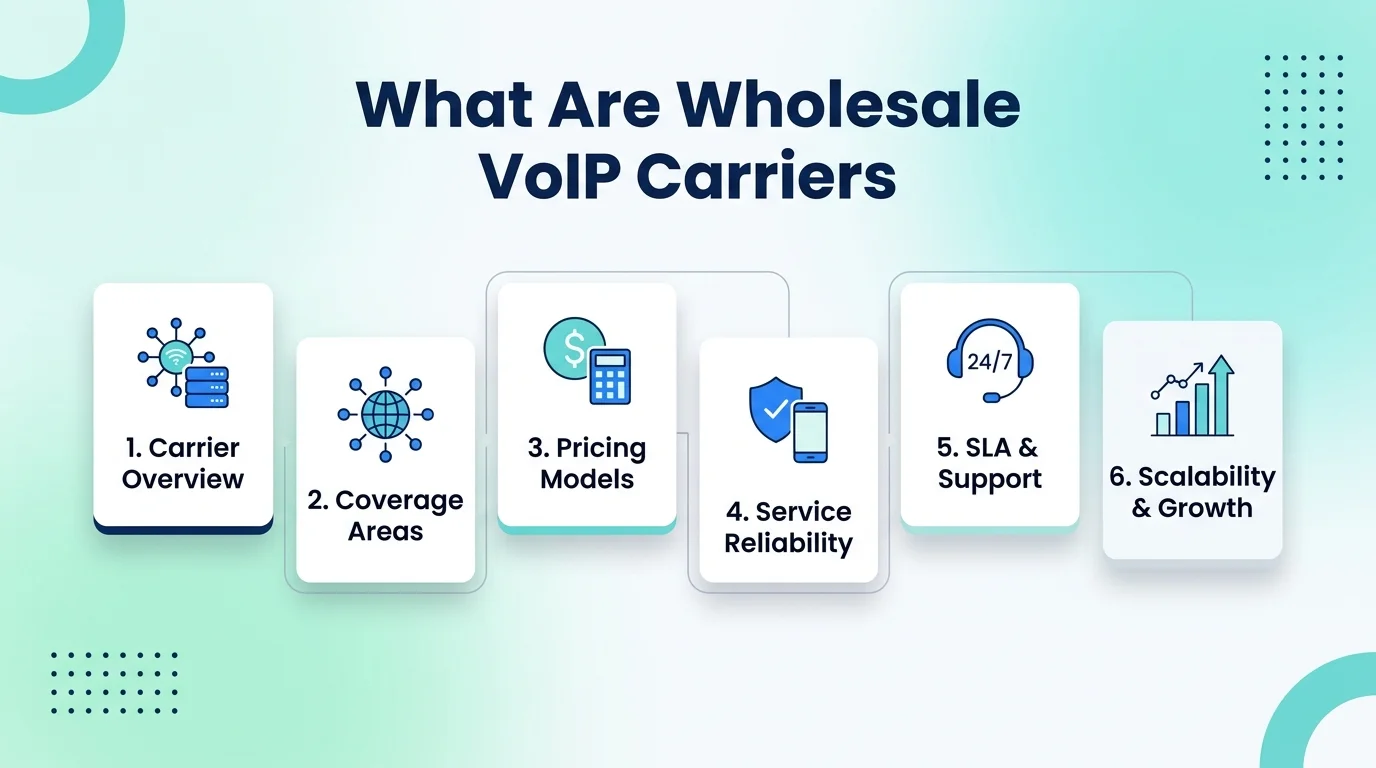
A wholesale VoIP carrier is a telecom operator that sells voice minutes in bulk to other businesses — software vendors, contact centers, resellers, mobile operators, and enterprises with heavy call volumes. Instead of selling minutes one phone line at a time, they sell capacity that you bolt onto your own platform.
The "wholesale" part matters. Retail VoIP plans bundle features (auto-attendant, voicemail, mobile app) for a flat per-seat fee. Wholesale skips seat licensing and gives you raw, programmable voice — A-Z routes, SIP trunks, and DIDs you control. You pay only for what you use.
That model only works if the carrier owns or directly interconnects with the underlying networks. Tier-1 wholesale voice termination providers run their own switches, peer with Tier-1 telcos, and route on the shortest path. Resellers hand traffic to a third party and skim a margin — which usually shows up as higher post-dial delay and lower answer-seizure ratios.
3How Wholesale VoIP Carriers Work
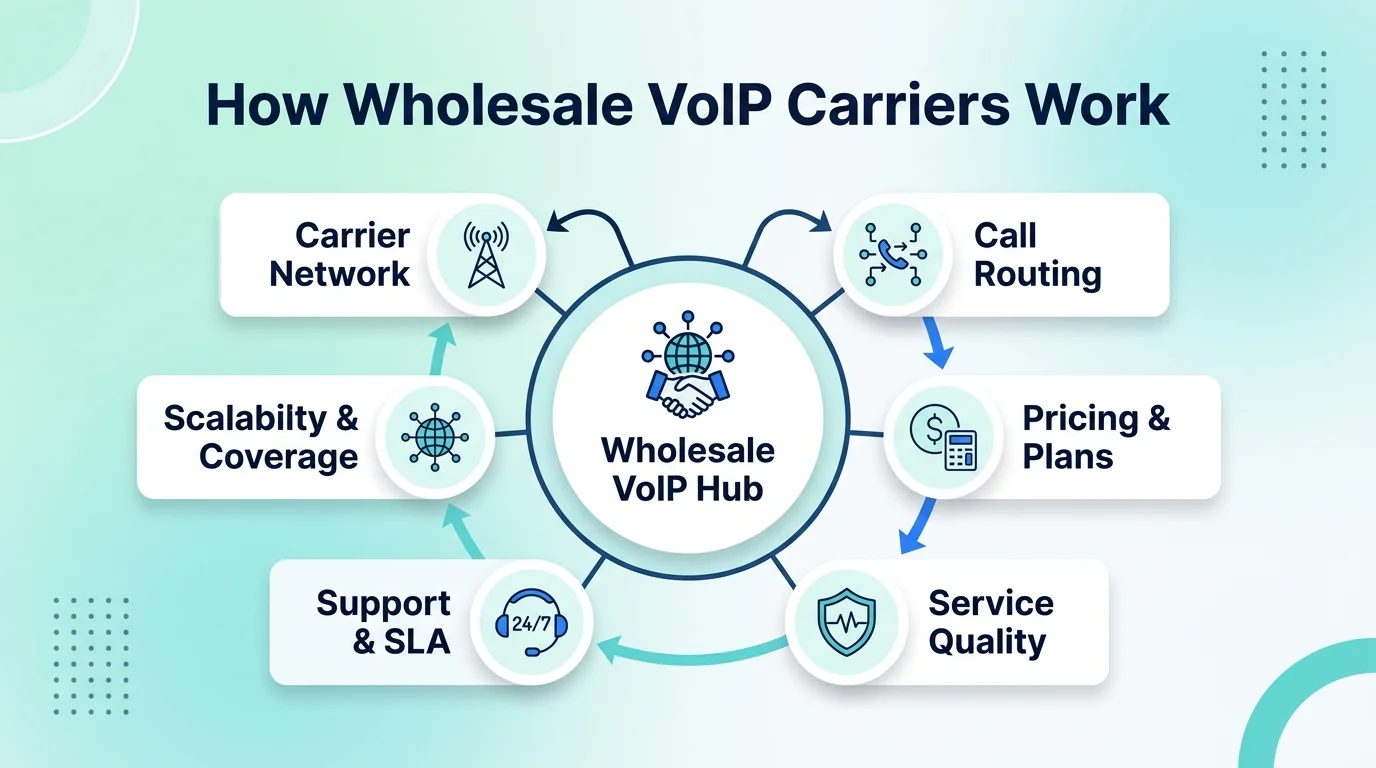
Every call moves through four stages: signaling, routing, transcoding, and termination. SIP, defined by the IETF in RFC 3261, sets up and tears down the session. RTP carries the voice packets. Session border controllers sit at the edge to authenticate and secure traffic.
Real-time routing
Once a call is signaled, the carrier's routing engine picks a path. It weighs cost (least-cost routing), live quality (MOS scores from recent calls), and regulatory rules. Premium routes prioritize quality; standard routes prioritize price. Most enterprises want a blended profile: premium for revenue calls, standard for back-office traffic.
Termination on the destination network
Termination is where the call lands — a mobile operator in Brazil, a landline in Germany, a softphone in Manila. Carriers with direct interconnects to local PSTNs deliver cleaner audio and faster connect times because the call never leaves trusted infrastructure. Hop counts matter: each extra carrier adds 30–80 ms of latency and a chance of packet loss.
4Cost and Business Benefits
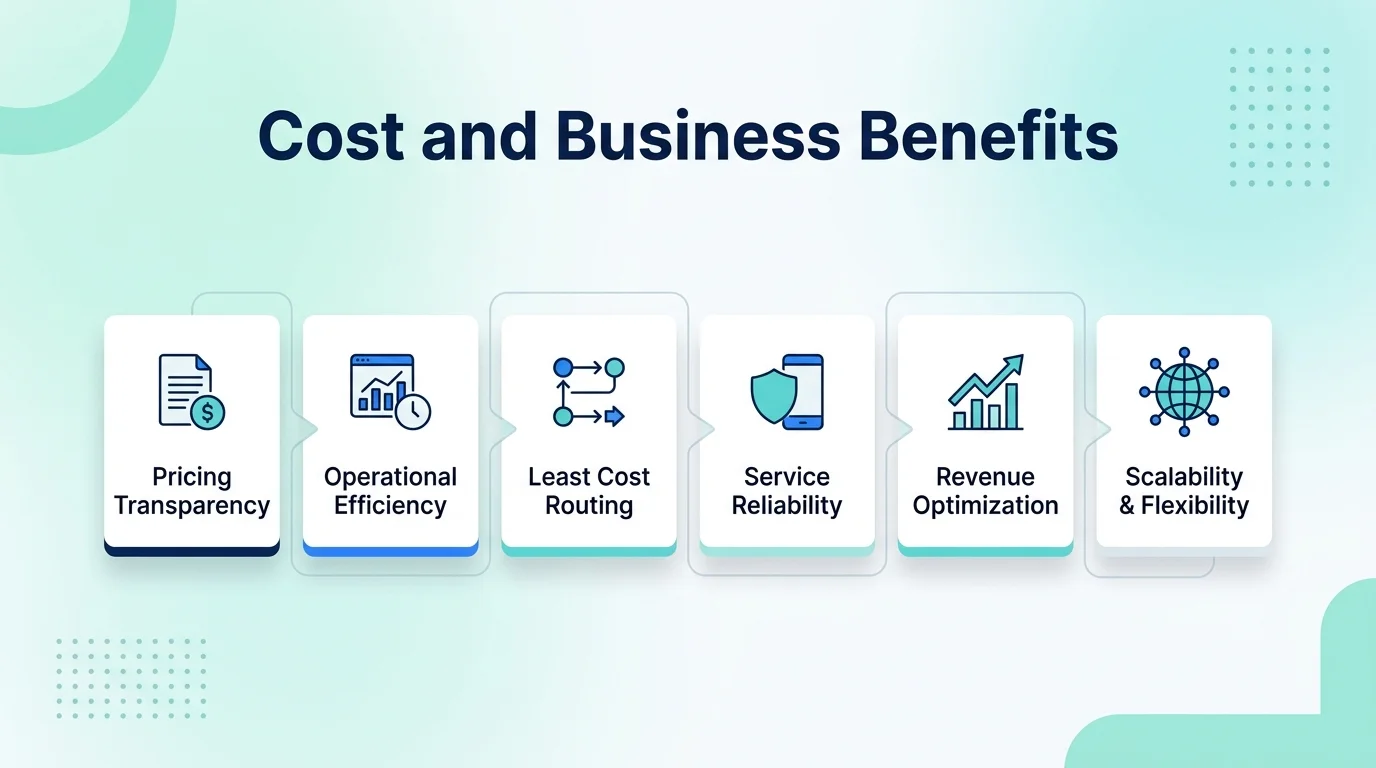
The financial case is straightforward. According to the ITU's 2024 Facts and Figures report, IP voice traffic keeps displacing circuit-switched calls, and the per-minute price gap is widening. Wholesale rates frequently land 60–80% below retail telecom plans for the same destinations.
Cost is only one of three benefits worth flagging:
- Elastic capacity: A SIP trunk scales from 10 to 10,000 concurrent channels in hours. Legacy PRI lines take weeks.
- Geographic reach without local entities: One contract gives you DIDs in 80+ countries — an Austin startup can sound local in Lagos without opening an office.
- Programmability: Wholesale APIs let you provision numbers, route calls, and pull CDRs from your own dashboard.
The catch: bulk pricing only beats retail if you commit to volume or accept variable per-minute billing. Run a 30-day audit of your call patterns before negotiating. Carriers quote sharper rates against real data than estimates.
5Key Features to Compare in a VoIP Wholesale Provider
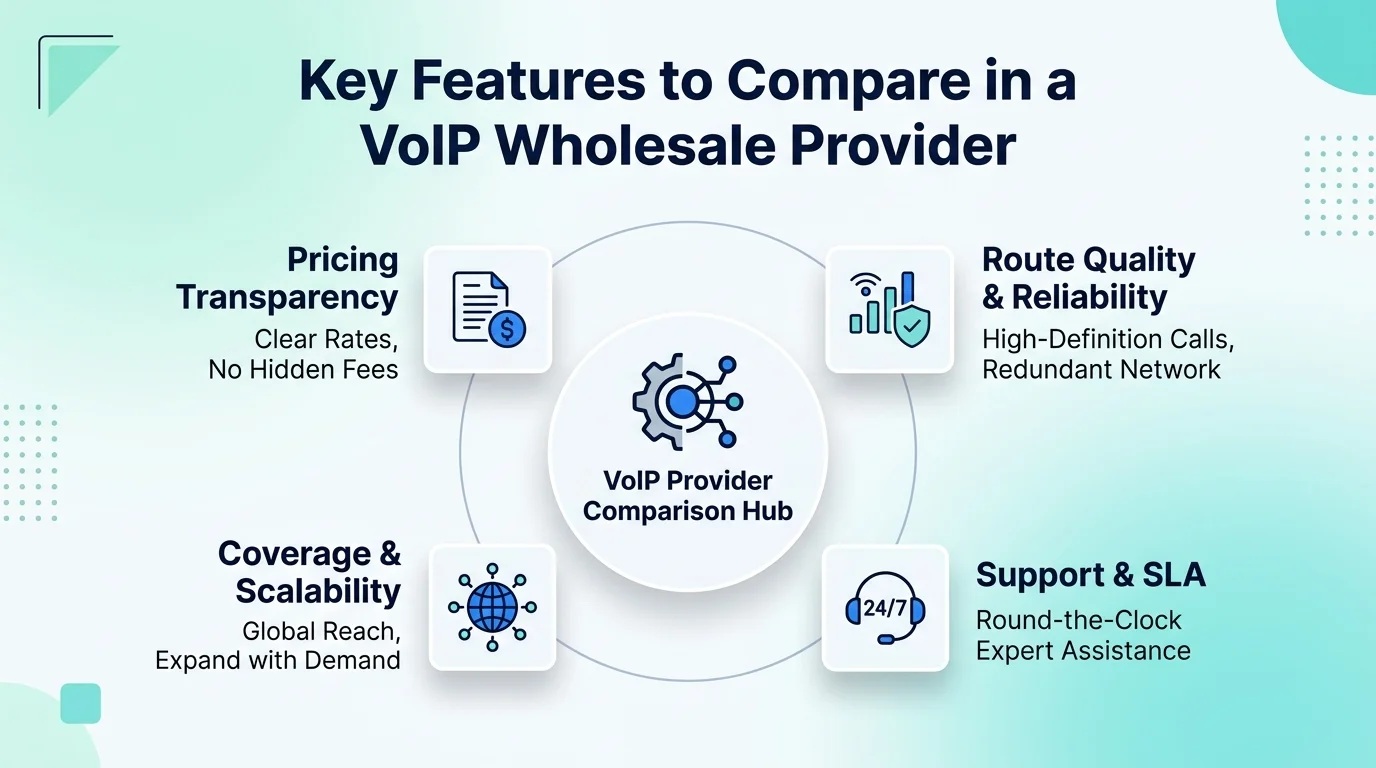
Most carrier sites repeat the same claims: low rates, high quality, global reach. Here is the shortlist that actually separates one VoIP wholesale provider from another.
Route quality metrics
Ask for live ASR (Answer-Seizure Ratio), ACD (Average Call Duration), and PDD (Post-Dial Delay) by destination. Reputable carriers publish or share these on request. Anything under 45% ASR for a major destination is a red flag.
SIP trunking and number coverage
A unified vendor for termination, SIP trunking for business, and DIDs cuts integration time and concentrates support under one SLA. Number porting should be free or low-cost.
Codec and billing transparency
G.711, G.729, and Opus cover most use cases — confirm support if your platform forces a specific codec. Per-second billing is standard in 2026; per-minute billing is a tell that the carrier is behind. You should be able to download an A-Z rate sheet without a sales call.
6Security and Compliance for Wholesale VoIP Traffic
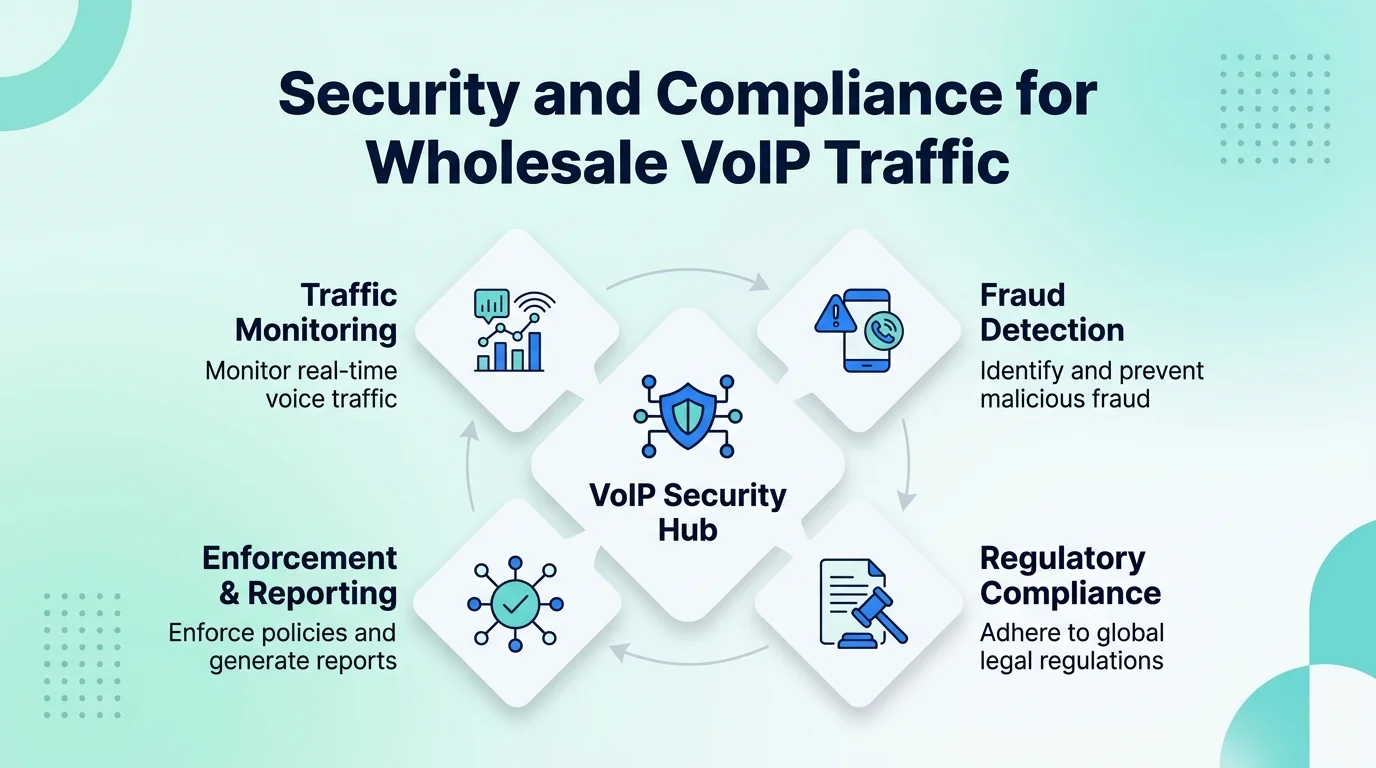
Voice traffic is data, and data carries risk. Toll fraud alone cost the industry an estimated $39 billion in 2023, per the Communications Fraud Control Association. The most common attacks against wholesale VoIP carriers are credential theft, SIP registration hijacking, and dial-plan abuse — usually through exposed trunks left unauthenticated.
A serious carrier offers, at minimum, IP authentication for trunks, automatic per-destination spend caps, and real-time fraud alerting on anomalous spikes. Encryption matters too: SIP over TLS protects signaling, and SRTP protects the media stream.
Compliance is a separate conversation. European user data needs GDPR-aligned processing terms. US healthcare calls require a Business Associate Agreement for regulated data handling. STIR/SHAKEN is now mandatory for US originating traffic — confirm your carrier signs calls correctly so they aren't flagged. Do not assume any of this is included by default; ask for documentation.
7How Softtop Delivers Wholesale Voice
Softtop runs a Tier-1-interconnected voice network built for software companies, BPOs, and resellers that need predictable quality at scale. Our Wholesale VoIP platform delivers termination across 165+ countries with 99.99% measured network uptime and direct peering with major mobile operators on every continent.
Three things customers tell us matter day to day. First, billing is per-second with a downloadable A-Z rate sheet, so finance can model true cost without back-and-forth. Second, every account ships with IP authentication, per-destination spend caps, and STIR/SHAKEN signing for US traffic — fraud controls that catch the spend leaks legacy carriers ignore. Third, you can mix wholesale termination with SIP trunking, DIDs, and SMS on one contract, which removes the tax of running three vendors.
Onboarding is short: most customers send their first production call within 48 hours of contract signature. If you want to see how your call mix would price against our routes, our team will run a free traffic analysis from a recent CDR sample.
8Conclusion
Wholesale VoIP carriers turn voice from a fixed cost into a programmable utility. Picked well, they cut spend by more than half, scale with your volume, and let you reach customers in markets where opening a local entity would take a year. Picked badly, they show up as dropped calls, surprise invoices, and fraud incidents that erase the savings.
The shortlist for a serious wholesale VoIP carrier is short: direct interconnects, transparent A-Z rates, per-second billing, published quality metrics, and built-in fraud controls. Test those before you sign, not after. Softtop built its network around that exact buyer checklist, which is why teams from BPOs to fintechs use us as their primary voice carrier.
Ready to put real numbers behind your voice strategy? Send our team a recent CDR sample and we will price your traffic within two business days. Talk to our voice team →
9Frequently Asked Questions
What does a wholesale VoIP carrier sell?
It sells voice termination — delivering outbound calls to numbers anywhere in the world — at bulk per-minute rates, plus services like SIP trunks and DIDs. You integrate via SIP, control routing yourself, and pay for usage rather than per seat.
How is wholesale VoIP different from a hosted phone system?
Hosted systems bundle features (mobile apps, voicemail, IVR) for a flat seat price. Wholesale VoIP gives you raw capacity and APIs to build what you want. SaaS vendors and contact centers prefer wholesale; small offices prefer hosted.
Are wholesale VoIP carriers safe for regulated or GDPR workloads?
Yes, but only with signed compliance terms — a Business Associate Agreement for regulated healthcare data, GDPR-aligned processing terms for EU data — plus encrypted signaling (SIP/TLS) and media (SRTP). Confirm in writing before routing regulated traffic.
What quality metrics should I ask a carrier to share?
Request ASR (answer-seizure ratio), ACD (average call duration), PDD (post-dial delay), and recent MOS scores by destination. Reputable carriers share dashboards or recent reports on request. If they refuse, route around them.
How quickly can I switch carriers if a route degrades?
You can reroute traffic between carriers in minutes by updating SIP endpoints. Number porting takes longer — 5 to 30 business days depending on country regulations. Keep at least one secondary carrier for resilience.