1Introduction
Every minute a call travels across a network, someone is paying a fraction of a cent for it. For carriers, resellers, and enterprises routing thousands of calls per day, wholesale call termination rates are the single biggest cost lever in their voice operation. Get them wrong and margins evaporate; get them right and you can build a profitable, scalable business.
The global wholesale voice carrier market reached $44.53 billion in 2026 — signaling how much money changes hands over per-minute pricing decisions every year. Softtop delivers carrier-grade call termination services across 150+ countries with 99.9% uptime, giving buyers transparent rate access without the guesswork.
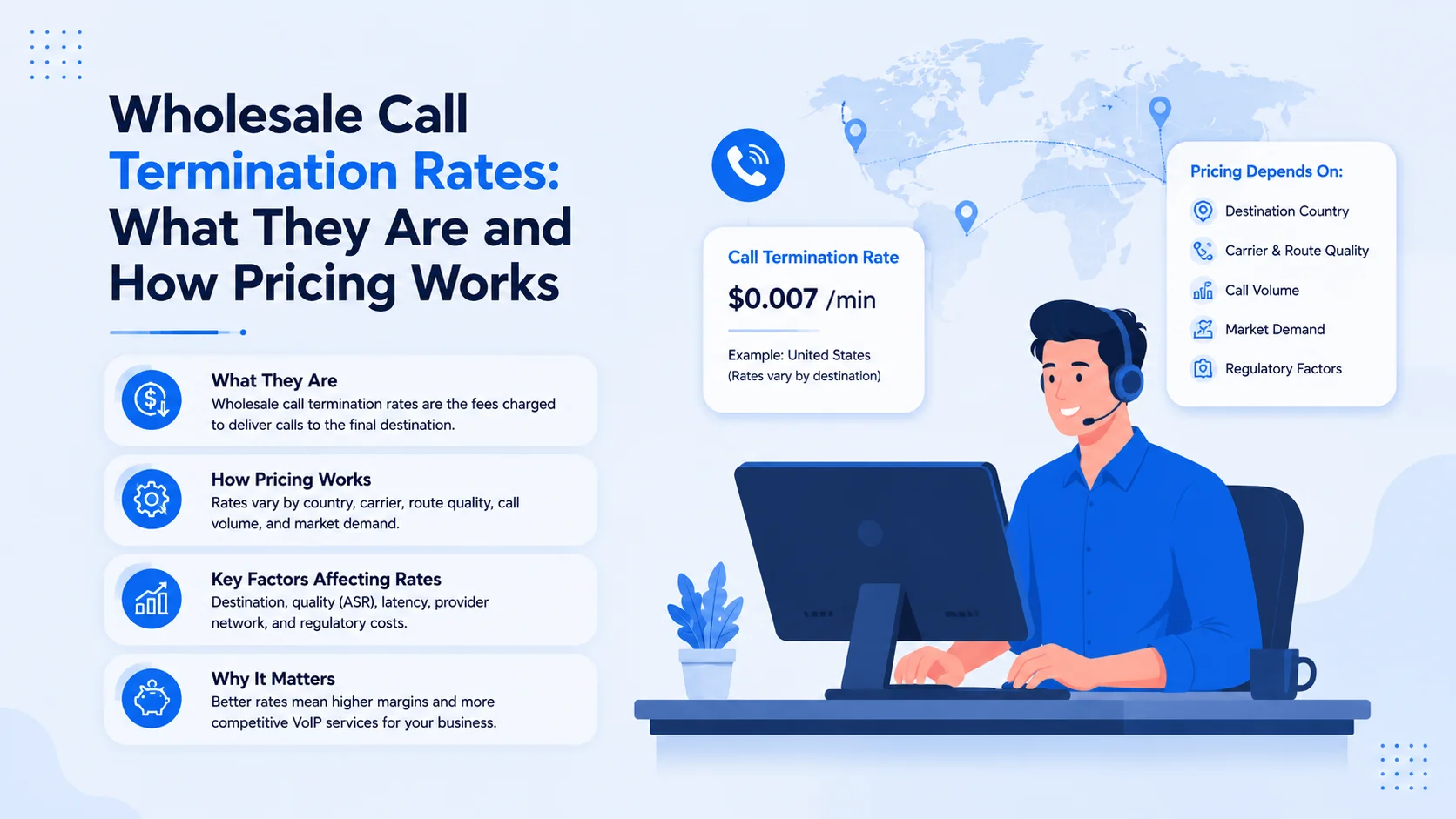
Wholesale call termination rates are the per-minute fees carriers charge to complete a call — typically $0.005–$0.010/min for US domestic routes at wholesale. Route quality tiers (Premium, Standard, LCR) directly determine what you pay and what call quality your end users experience. Billing increments, ASR thresholds, and destination type (fixed vs. mobile) all affect your true per-minute cost.
2What Are Wholesale Call Termination Rates?
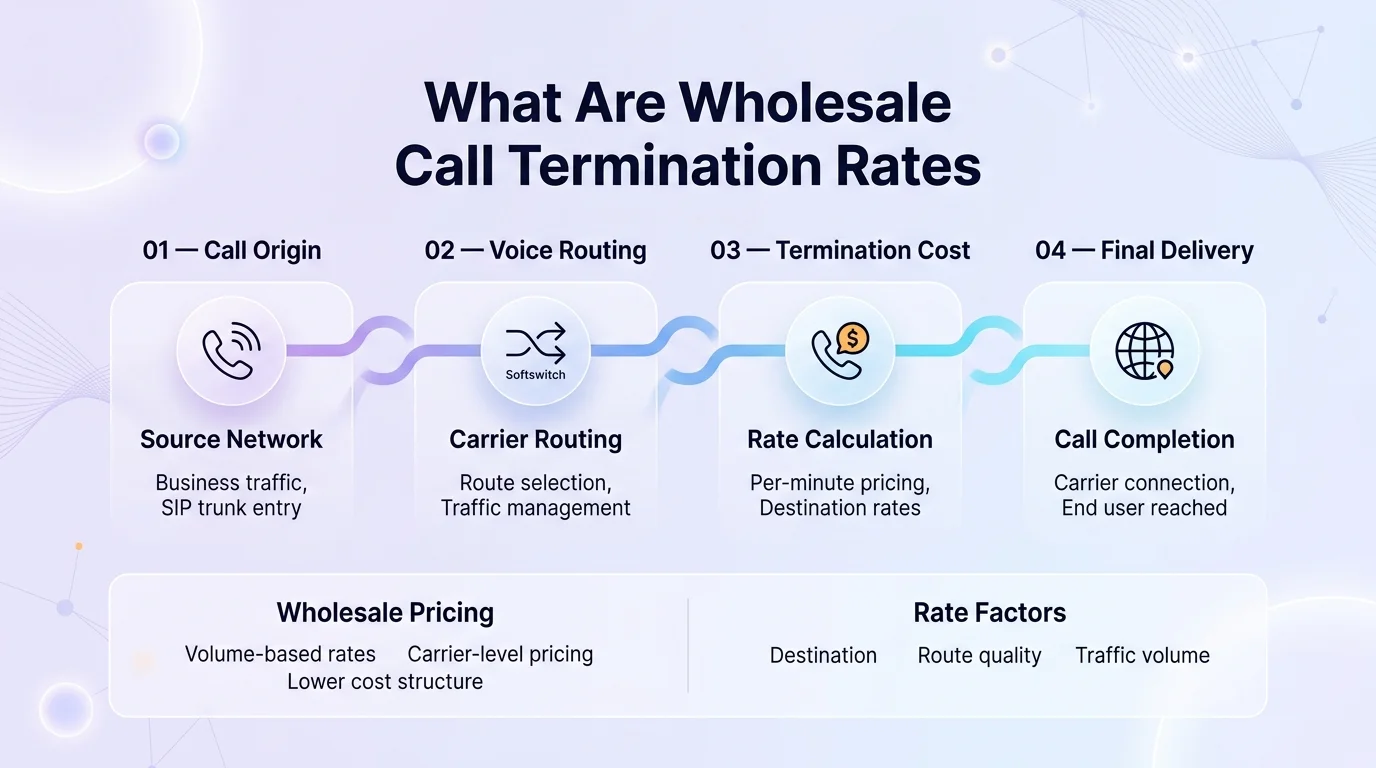
When a call leaves your network — whether via a SIP trunk or traditional PSTN connection — it must be "terminated" on a destination network. The carrier that completes that final leg charges a termination fee, expressed as a per-minute rate. At wholesale volumes, these rates are negotiated between carriers, aggregators, and large resellers rather than paid at retail.
Call termination pricing differs from retail VoIP pricing in one critical way: it is stripped of any support, portal, or feature cost. You are paying purely for the switching and transport of voice traffic across a softswitch and onward to the called party. This makes wholesale voice rates far lower than what a business subscriber pays, but it also means quality assurance falls entirely on your supplier relationship and the technical metrics attached to each route.
Regulators also set a floor for certain routes. Ofcom updated its wholesale call termination caps effective June 2026: UK fixed-line is capped at 0.0377 pence per minute, while mobile termination sits at 0.504 pence per minute. For operators benchmarking against carrier-grade rates, Softtop's call termination services provide transparent per-minute pricing across 150+ countries without hidden fees.
3How Wholesale Call Termination Pricing Is Structured
Per-Minute Rates by Destination
VoIP termination rates vary enormously by destination. US domestic wholesale termination typically runs between $0.005 and $0.010 per minute at the carrier level; retail resellers re-price this at $0.02–$0.03/min. International call termination rates span a much wider band — some Tier 1 European fixed destinations sit below US domestic rates, while remote island or satellite-connected territories can exceed $0.50/min.
Fixed vs. Mobile Termination
The distinction between fixed-line and mobile termination is especially important for international routes. Mobile termination rates are almost universally higher because mobile network operators charge more to receive calls, and that cost passes upstream. When you evaluate an international call termination rates sheet, always check whether a destination has split fixed/mobile pricing or a blended rate.
Billing Increments
Billing increment is a quiet but material pricing variable. A 60-second minimum with 6-second increments means a 7-second call is billed as 12 seconds. A 1-second increment bills that same call as 7 seconds. At high call volumes — common in contact center traffic — the difference can represent 5–15% of total termination spend. Ofcom and the ITU Telecommunication Standardization Sector treat billing increment transparency as a core wholesale pricing fairness requirement.
4Route Quality Tiers: Premium, Standard, and LCR
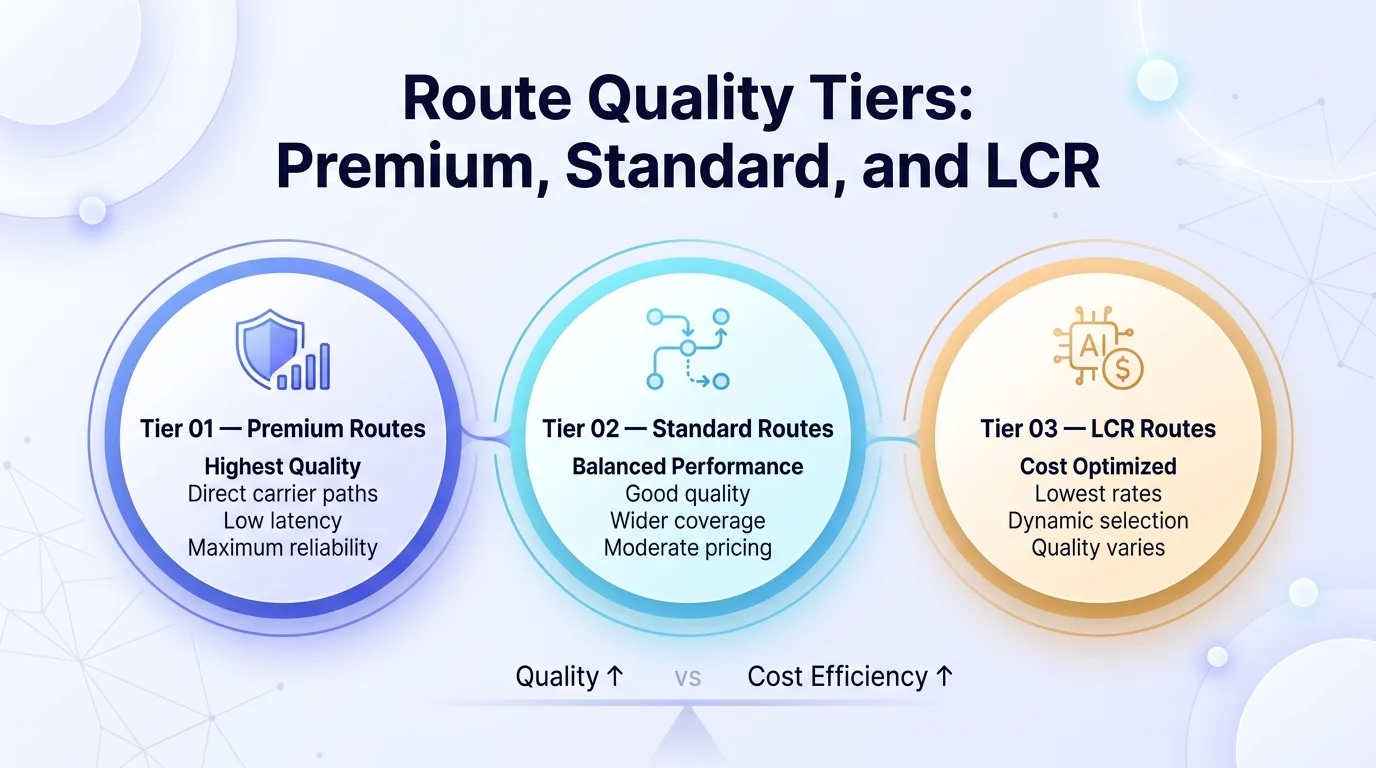
Not all call termination services are equal. The industry organizes routes into quality tiers that reflect both the reliability of the path and the price the buyer pays.
Premium Routes
Premium routes carry a CLI (Calling Line Identification) guarantee — the originating number arrives intact at the called party. Fewer hops minimize PDD (Post Dial Delay) and support high ASR (Answer Seizure Ratio). These are the right choice for enterprise voice and contact centers, where call quality complaints translate directly into churn.
Standard Routes
Standard routes balance quality and cost. CLI delivery is typical but not guaranteed at premium fidelity. ASR and PDD performance is acceptable for most business use cases, making these the workhorse tier for mid-volume resellers.
LCR Routes
LCR routes select the cheapest available path in real time. CLI may not be preserved and quality metrics vary more widely. LCR suits bulk or grey-route tolerant traffic, but not customer-facing voice services where quality matters. For contact center and calling card traffic that requires a consistent mid-tier quality bar, Softtop's CC routes deliver the right balance between cost efficiency and call completion reliability.
5Key Quality Metrics That Affect Your Effective Rate
Quoting wholesale call termination rates in isolation misses half the picture. A low per-minute rate that carries a poor ASR or high PDD can cost more in practice than a slightly more expensive premium route.
ASR (Answer Seizure Ratio)
ASR measures the percentage of call attempts that result in a completed connection. An ASR of 60% on a $0.006/min route means 40% of your call attempts generate signaling costs without producing a billable answered minute — yet your system still consumed resources to attempt them. Most professional-grade wholesale voice routes target ASR above 70% for well-formed destinations.
PDD (Post Dial Delay)
PDD is the time between sending the INVITE and receiving ringback. High PDD (above 6–8 seconds) frustrates callers and can trigger SIP timeouts on poorly configured systems. When comparing VoIP termination rates from multiple suppliers, always request PDD statistics alongside the rate card.
CDR Accuracy
A CDR (Call Detail Record) should reflect every billed second accurately. Reputable carriers provide near-real-time CDR access. Discrepancies between your softswitch CDRs and supplier invoices drive billing disputes — insist on transparent reconciliation, which Softtop's wholesale VoIP platform provides natively before committing volume.
6How to Compare Wholesale Voice Rates Across Suppliers
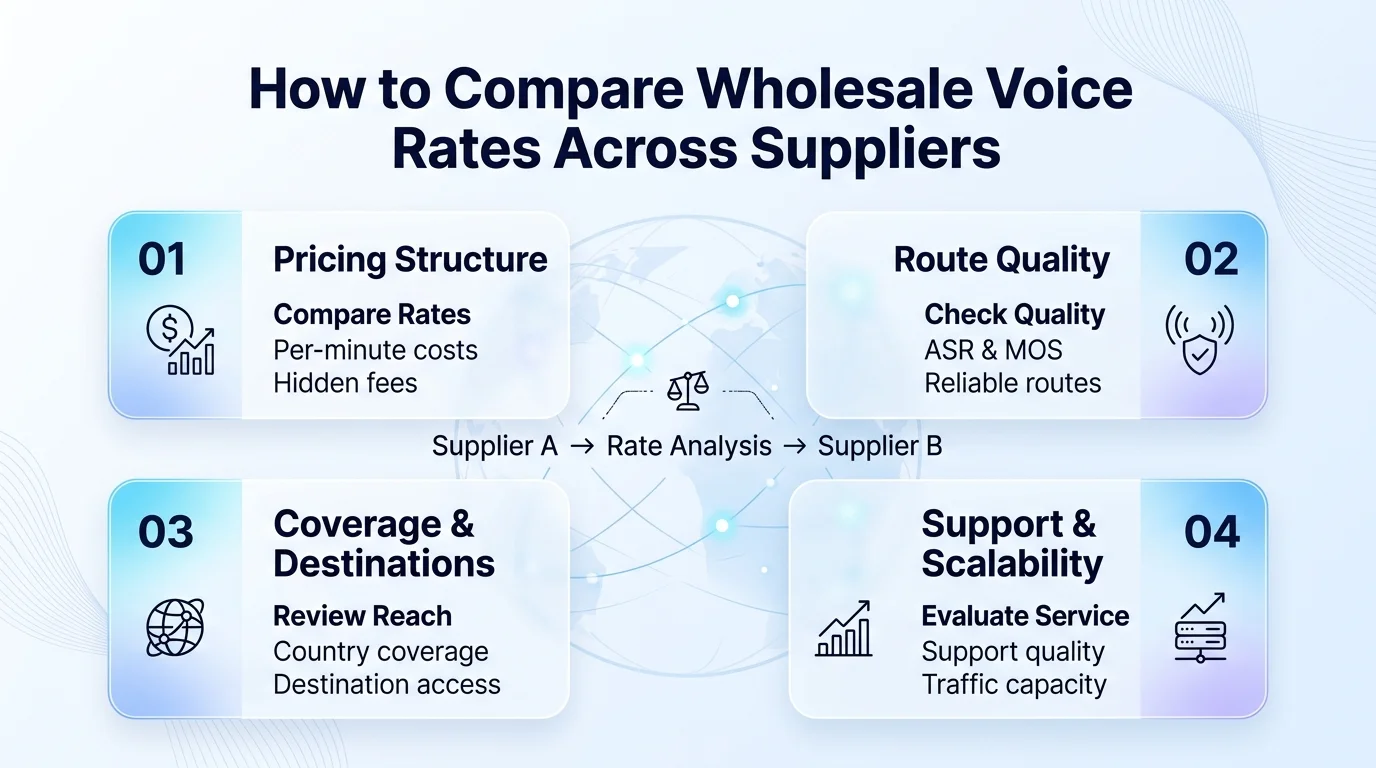
Comparing wholesale voice rates requires more than sorting by the lowest per-minute number:
- 1Normalize billing increments — convert all rates to a 1-second equivalent for fair comparison.
- 2Request live ASR and PDD data for your top-10 destination prefixes.
- 3Check CLI compliance for any route flagged as "CLI guaranteed."
- 4Review minimum volume commitments and rate validity windows — some suppliers lock rates for 30 days; others re-price weekly.
- 5Evaluate geographic coverage — a supplier with strong US rates but thin coverage for Southeast Asia or Latin America will force you into a second vendor relationship.
Softtop aggregates routes across 150+ countries under a single interconnect, reducing the need to manage multiple supplier relationships. All destination prefixes follow the ITU-T E.164 standard — the international numbering framework that governs how every destination prefix is classified and billed.
7International Call Termination Rates: Regional Considerations
International call termination rates introduce regulatory, currency, and interconnect complexity that domestic pricing does not.
Europe
Post-Brexit UK mobile termination caps (0.504p/min as of June 2026, per Ofcom) apply to calls terminating on UK mobile networks. EU rates follow BEREC guidelines, which have compressed intra-EU termination rates significantly over the past decade.
Emerging Markets
High-growth markets in Sub-Saharan Africa, South Asia, and parts of Latin America carry some of the highest per-minute wholesale rates in the world — often $0.05–$0.30/min for mobile — because local mobile operators charge elevated interconnect fees. Carriers operating in these corridors must model call volumes carefully to ensure LCR routing decisions do not sacrifice too much quality for cost.
Number Format Compliance
ITU-T E.164 standardizes international phone number formatting. Routes that do not handle E.164-formatted numbers correctly generate failed calls that look like quality problems but are actually routing configuration issues. Softtop's voice termination routes are built for international scale, with prefix-level routing that handles E.164 normalization automatically before any call is placed.
8Reducing Termination Costs Without Sacrificing Quality
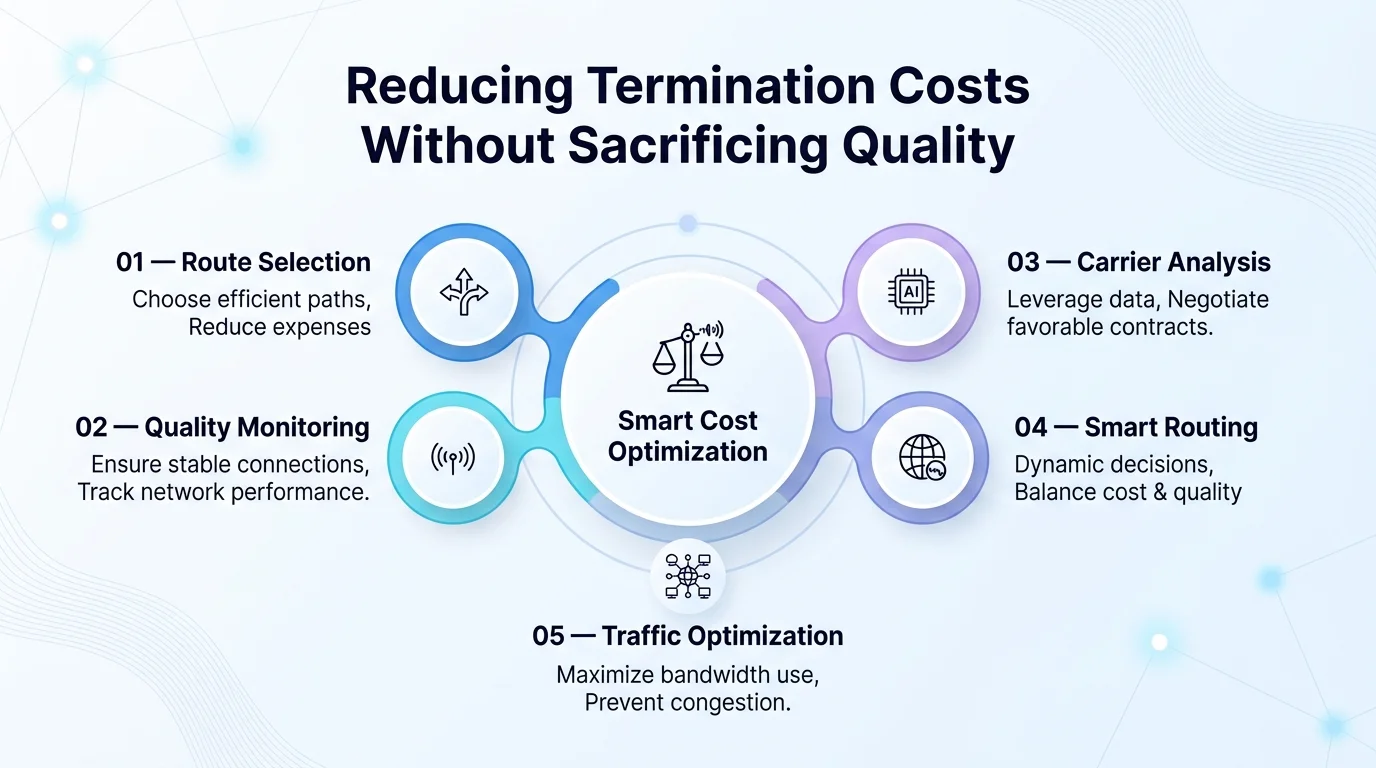
Cost optimization in wholesale call termination does not mean chasing the cheapest rate indiscriminately.
Use tiered routing by traffic type. Route contact center preview-dial traffic via LCR; route inbound enterprise DDI traffic via premium routes. Not all minutes are equal, and your rate strategy should reflect that.
Leverage volume commitments strategically. Most wholesale carriers offer improved per-minute termination rates at committed monthly volume thresholds. If your traffic is predictable, a committed volume deal typically beats spot pricing by 10–20%.
Monitor ASR by route in real time. A route degrading from 75% ASR to 50% mid-month costs you money and quality simultaneously. Automated failover in a well-configured softswitch redirects traffic before degradation compounds.
Audit CDRs monthly. Even with trusted suppliers, billing errors happen. A monthly reconciliation of your CDR data against invoices catches rounding errors, misbilled increments, and miscategorized destination prefixes. To see what competitive carrier-grade rates look like in practice, start a free trial and benchmark your traffic against Softtop's route portfolio.
9Conclusion
Wholesale call termination rates sit at the intersection of technology, regulation, and commercial negotiation. Understanding how per-minute pricing is built — from route quality tiers and billing increments to ASR thresholds and regulatory caps — gives you the leverage to make better supplier decisions and protect your margins.
Whether you are running a reseller operation, managing a contact center voice stack, or building out a wholesale voice carrier business, the same principles apply: normalize your comparisons, monitor quality metrics, and never let a low headline rate substitute for due diligence on route performance. Softtop's carrier-grade infrastructure, covering 150+ countries at 99.9% uptime, is designed for operators who need both competitive rates and the reliability that enterprise traffic demands.
10Frequently Asked Questions
What are wholesale call termination rates?
Wholesale call termination rates are the per-minute fees a carrier charges to complete a voice call on its network on behalf of another operator. These rates are negotiated at volume between carriers and resellers, and are significantly lower than retail VoIP pricing. They vary by destination, route quality tier, and billing increment.
What is a typical wholesale termination rate for US domestic calls?
US domestic wholesale termination typically ranges from $0.005 to $0.010 per minute at the carrier level. Resellers purchasing at these rates generally price their retail product at $0.02–$0.03/min to cover platform, support, and margin. Rates fluctuate based on traffic volume, route quality, and contractual commitments.
What is the difference between CLI and non-CLI routes?
CLI (Calling Line Identification) routes preserve and deliver the originating phone number to the called party. Non-CLI routes strip or alter the caller ID. CLI routes are essential for contact centers, enterprise voice, and any use case where number presentation compliance or brand trust matters. CLI routes typically carry a higher per-minute cost than non-CLI or CC routes.
How do billing increments affect my termination costs?
Billing increments determine the smallest chargeable unit of a call. A 6-second increment rounds every call up to the nearest 6 seconds; a 1-second increment bills exactly what was used. For high volumes of short-duration calls — such as contact center auto-dial traffic — 1-second billing can reduce costs by 5–15% compared to 6-second billing at the same per-minute rate.
What is ASR and why does it matter for termination pricing?
ASR (Answer Seizure Ratio) is the percentage of call attempts that successfully connect. A low ASR means a large share of your call attempts generate signaling and routing cost without producing a billed answered minute. When comparing VoIP termination rates, a cheaper route with 50% ASR can cost more in real terms than a slightly more expensive route with 80% ASR.
Are international call termination rates regulated?
Some markets impose regulatory caps. In the UK, Ofcom updated wholesale call termination caps effective June 2026: fixed-line termination is capped at 0.0377 pence per minute and mobile at 0.504 pence per minute. The EU applies BEREC-influenced caps on intra-EU routes. Outside regulated markets, international rates are set by bilateral commercial agreements between carriers.
How can I reduce my wholesale voice rates without hurting call quality?
Use tiered routing: direct quality-sensitive traffic to premium or standard routes and high-volume, quality-tolerant traffic to LCR routes. Negotiate volume commitments if your traffic is predictable — committed deals typically beat spot rates by 10–20%. Monitor ASR and PDD in real time and automate failover to backup routes when a primary route degrades.