1Introduction
Wholesale VoIP termination is the backbone of modern business telephony — yet most companies continue paying retail rates without realizing a better option exists. Whether you run a call center, a telecom reseller, or an enterprise with high call volumes, understanding how wholesale VoIP termination works can dramatically reduce your monthly communication costs while improving call quality across every destination.
This guide breaks down the mechanics, the terminology, and the key variables that separate a reliable termination provider from one that costs you customers. Softtop delivers voice termination across 150+ countries with 99.99% platform uptime and FAS-free billing, so every cent you spend converts to genuine connected minutes.
Wholesale VoIP termination routes outbound calls through carrier-grade SIP infrastructure at rates of $0.003–$0.01/min — a fraction of retail pricing. Quality is measured by ASR, ACD, and PDD metrics that reveal true route performance. Choosing a Tier-1 provider with FAS-free billing and real-time reporting protects your margins.
2What Is Wholesale VoIP Termination and How Does It Work?
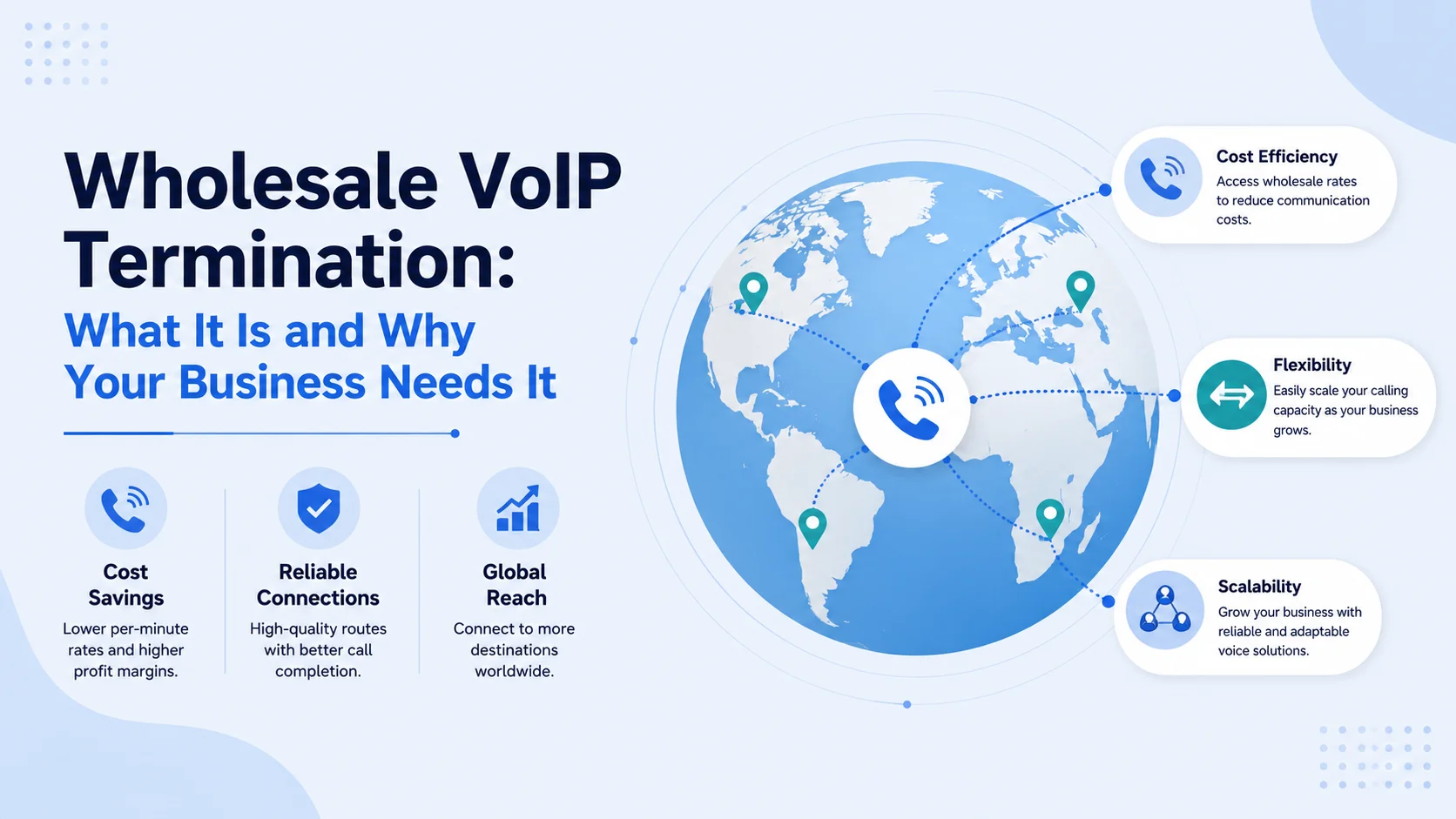
Wholesale VoIP termination is the process of routing voice calls from one carrier's network to the public switched telephone network (PSTN) or another VoIP network to complete the call at the destination. The word "termination" refers to the final leg of a call — where it terminates at the called party's device.
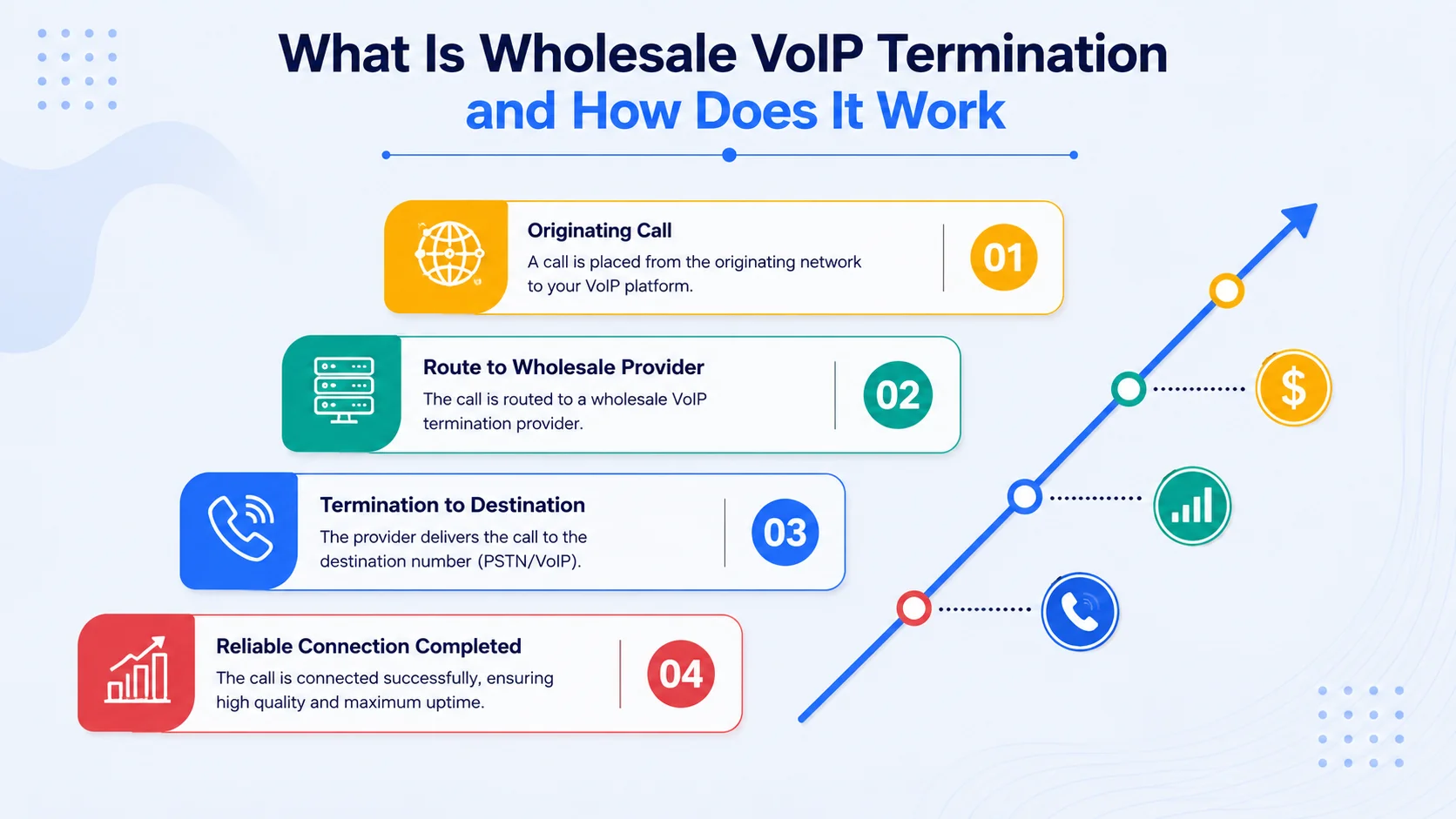
In practice, a business or telecom operator sends SIP (Session Initiation Protocol) traffic to a wholesale termination provider, which then selects the optimal carrier path to complete the call. The provider maintains interconnection agreements with Tier-1 carriers worldwide, giving customers access to routes that would otherwise require direct carrier relationships and significant capital investment.
Unlike retail VoIP, wholesale arrangements are volume-based. Providers charge per-minute rates that start at $0.003 for high-traffic destinations, enabling carriers, resellers, and large enterprises to scale voice operations without the overhead of managing individual carrier contracts. Businesses looking for a complete solution can explore a Wholesale VoIP Solution that covers termination, routing, and billing under one platform.
3Key Quality Metrics Every Wholesale VoIP Termination Buyer Must Track
Not all wholesale VoIP termination routes perform equally. Three metrics define route quality and directly impact your customer experience and profitability.
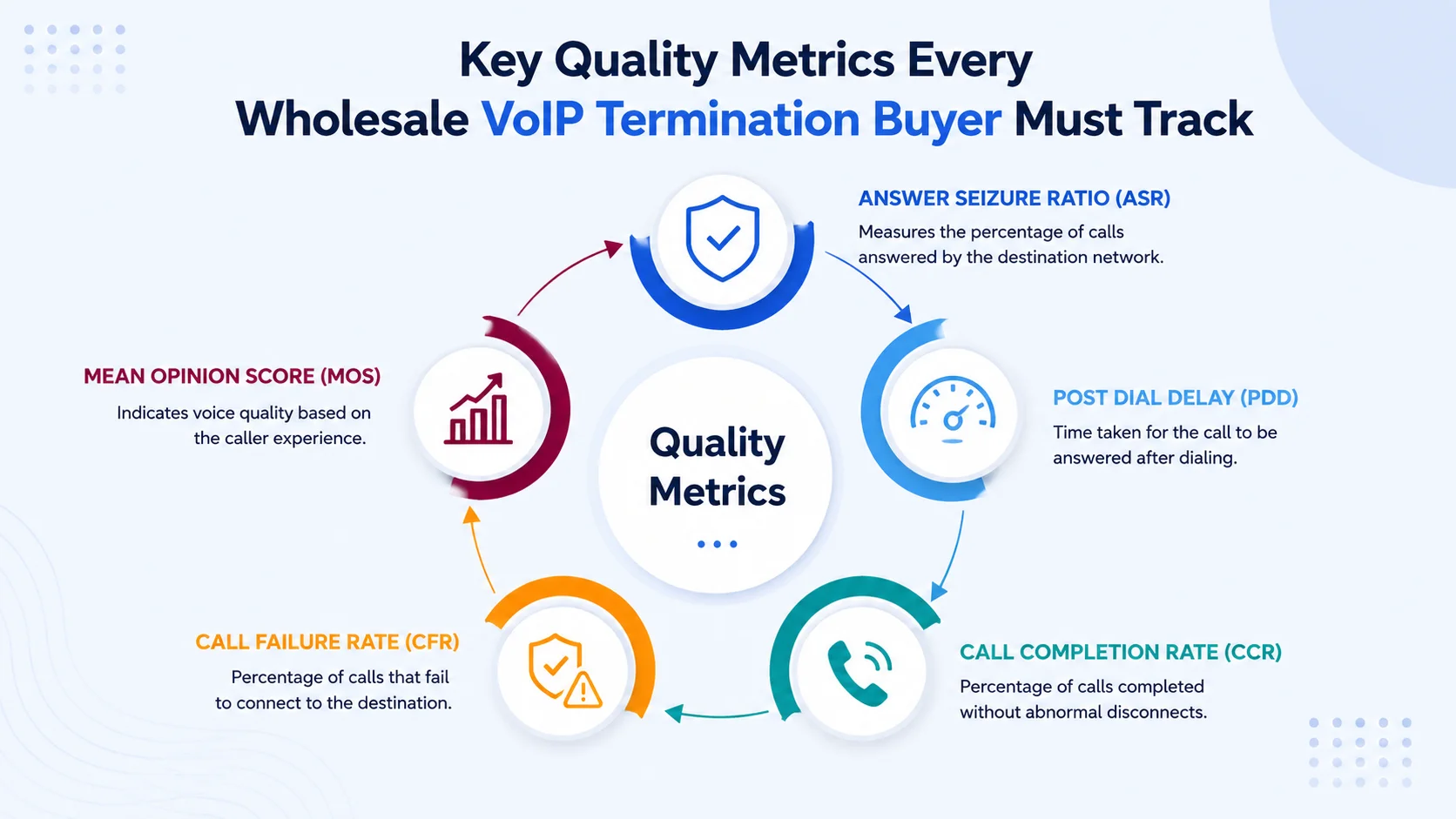
ASR (Answer Seizure Ratio)
ASR measures the percentage of call attempts that connect successfully. Premium CLI routes typically achieve an ASR of 60–80%; anything below 50% suggests poor routing or network congestion on that path.
ACD (Average Call Duration)
ACD indicates whether connected calls are holding. Short ACD values can signal robocall filtering, SPAM labeling, or mismatch between the route type and the use case.
PDD (Post-Dial Delay)
PDD is the time between dialing and hearing a ringback tone. High PDD frustrates callers and signals long transcontinental routing chains. The ITU-T G.107 E-model provides the industry-standard framework for quantifying voice quality across these metrics. A trustworthy termination provider exposes all three in a self-service portal with real-time CDRs so you can audit route performance without waiting for end-of-month reports.
4Route Types in Wholesale VoIP Termination: CLI, Non-CLI, and CC
Wholesale VoIP termination is not one-size-fits-all. Providers offer multiple route types, and selecting the wrong one wastes budget or violates destination carrier rules.
CLI Routes
CLI routes (Caller Line Identification) pass the originating number to the destination network. These are premium routes used for legitimate business calls, contact centers, and enterprise telephony. Explore CLI Routes sourced directly from Tier-1 carriers for superior ASR in markets that enforce calling-party regulations.
Non-CLI Routes
Non-CLI routes strip or replace caller ID. They cost less per minute and are suited to outbound campaigns where caller ID is not a regulatory requirement, though their ASR is typically lower than CLI equivalents.
CC Routes
CC routes (Calling Card routes) are engineered for prepaid calling card traffic. They optimize for high concurrency rather than premium audio quality, making them ideal for high-volume, price-sensitive use cases. CC routes are sourced directly from Tier-1 carriers — not resold capacity — ensuring consistent quality across all three route categories without hidden markups.
5How Least Cost Routing Maximizes Savings on VoIP Termination
Least Cost Routing (LCR) is the automated engine that selects the cheapest available route for each call without sacrificing the quality thresholds you define. For businesses running wholesale VoIP termination at scale, LCR is not optional — it is the mechanism that converts volume into sustainable margin.
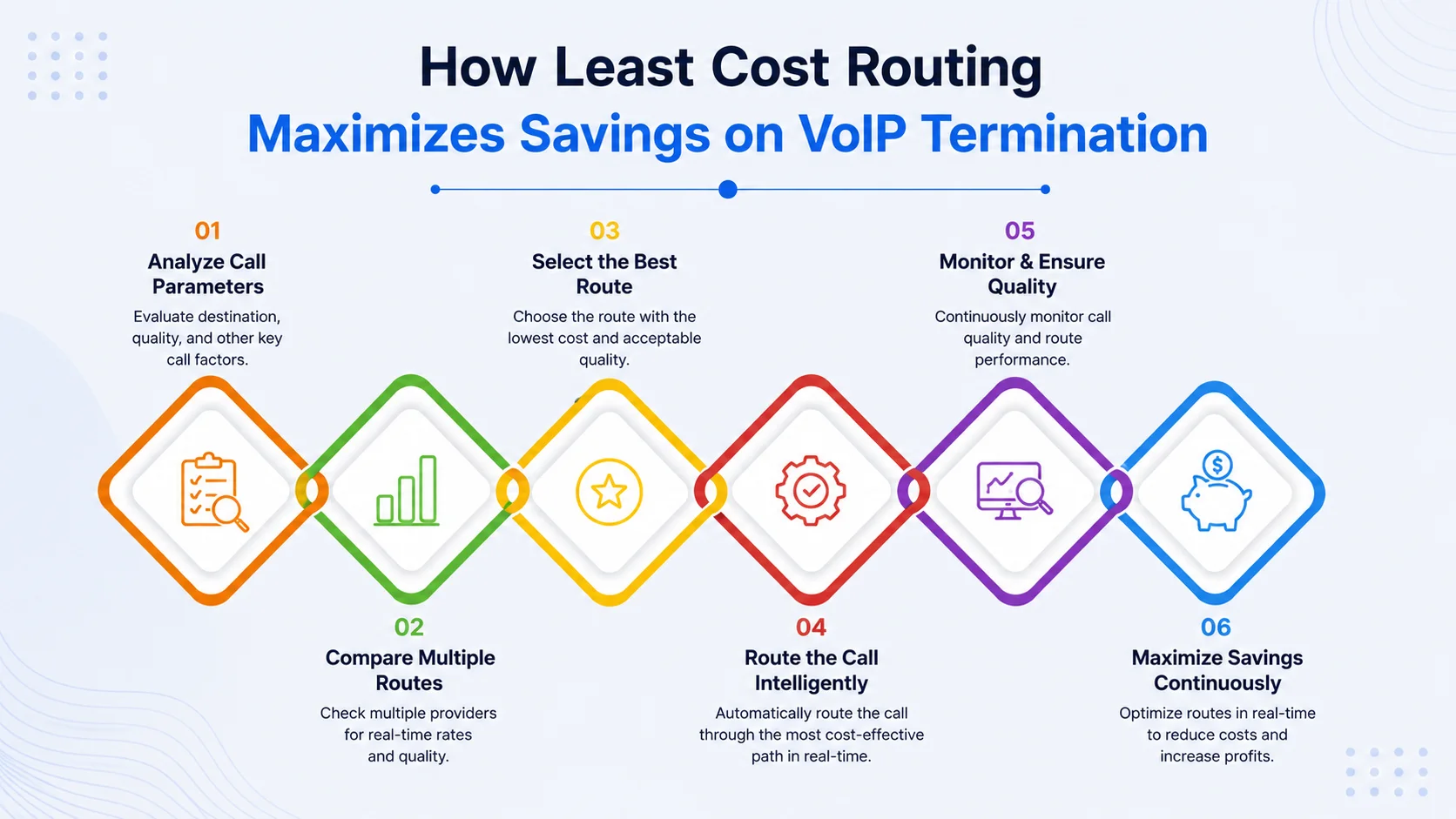
A well-implemented LCR system maintains a real-time routing table updated as carrier rates change. When a call is initiated, the system evaluates all available routes to the destination, ranks them by cost, filters out any that fall below your minimum ASR or ACD thresholds, and selects the winner in milliseconds.
According to the FCC's interconnection framework, carriers are required to complete calls on a non-discriminatory basis, which means LCR savings are achievable without call-quality penalties when routes are properly qualified. Businesses that implement LCR through a wholesale provider typically save 40–70% compared to retail per-minute rates. Softtop's platform applies LCR automatically across its full route portfolio, balancing cost and quality in real time.
6Choosing a Wholesale VoIP Termination Provider: Five Non-Negotiables
Selecting the wrong wholesale VoIP termination provider is expensive. Poor ASR, unexpected billing for unanswered calls, and opaque routing can erase margins within weeks. Here are five criteria that separate reliable providers from those that erode your business.
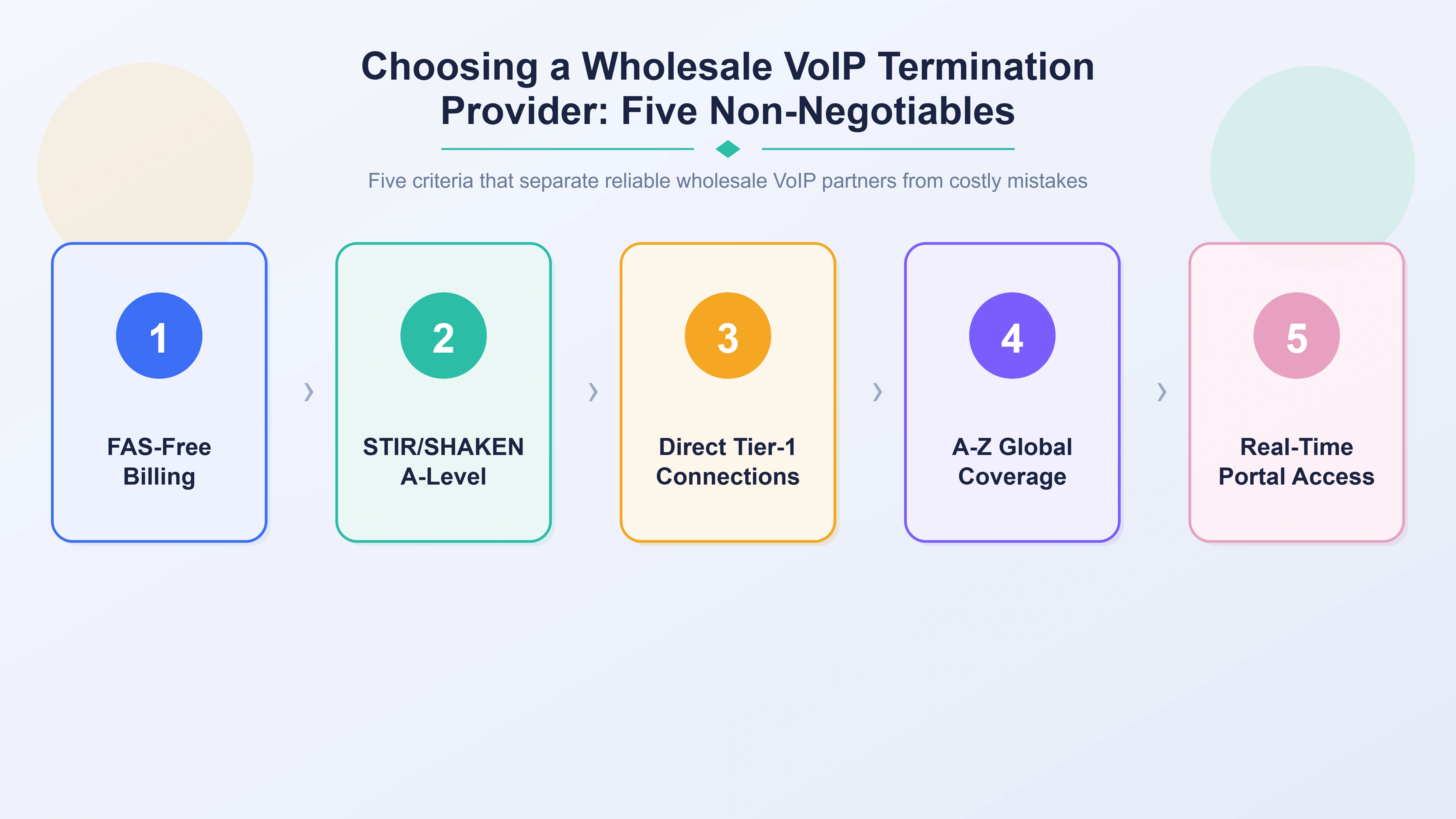
1. FAS-Free Billing
False Answer Supervision is a practice where a carrier bills for a call the moment it begins ringing, even if nobody picks up. FAS-free providers bill only on genuine human answer, which can reduce billing discrepancies by 15–25% on certain routes.
2. STIR/SHAKEN Attestation
Providers with A-level attestation ensure your outbound calls are authenticated, reducing the risk of calls being labeled SPAM by downstream carriers.
3. Direct Tier-1 Connections
Direct connections eliminate intermediary markups and routing hops that degrade quality. Resold capacity introduces additional latency and reduces your ability to troubleshoot call failures.
4. A-Z Global Coverage
Coverage across 150+ countries means you can consolidate termination under a single provider agreement rather than managing multiple regional vendors.
5. Real-Time Portal Access
Live visibility into CDRs, route performance, and spend without depending on provider-generated reports. Softtop's Voice Termination solution meets all five criteria, combining direct carrier relationships with a self-service portal that surfaces route metrics live.
7Conclusion
Wholesale VoIP termination is not a commodity you should buy on price alone. The right provider delivers FAS-free billing, Tier-1 carrier access, transparent quality metrics, and a self-service portal that keeps you in control of every minute. Understanding ASR, ACD, PDD, and route types empowers you to benchmark providers objectively rather than trusting marketing claims.
Softtop's wholesale VoIP termination platform covers 150+ countries, maintains 99.99% uptime backed by a 24/7/365 NOC, and applies Least Cost Routing automatically so your margins grow as your volume scales. Whether you are a telecom reseller building a carrier-grade stack or an enterprise consolidating global voice spend, the fundamentals covered here give you the framework to make a confident purchasing decision.
8Frequently Asked Questions
What is wholesale VoIP termination?
Wholesale VoIP termination is the process of routing outbound voice calls through a carrier-grade SIP network to their final destination — the PSTN or another VoIP endpoint. It is sold in bulk at per-minute rates significantly lower than retail plans, typically between $0.003 and $0.01 per minute.
How is wholesale VoIP termination different from SIP trunking?
SIP trunking connects your PBX or communication platform to the carrier network for both inbound and outbound calls. Wholesale VoIP termination specifically refers to the outbound leg — completing calls to external destinations. Many providers bundle both services, but they solve different parts of the voice infrastructure equation.
What does FAS-free billing mean in VoIP termination?
FAS stands for False Answer Supervision. Some carriers start billing the moment a call begins alerting, even if no one answers. FAS-free billing means charges only apply when a human genuinely answers the call, which ensures you pay only for completed conversations and protects you from inflated invoices.
What ASR should I expect from a premium wholesale route?
Premium CLI routes on reputable wholesale VoIP termination providers typically deliver an ASR of 60–80% for mainstream destinations. Anything below 50% consistently suggests route quality issues. Always request historical ASR data and monitor live CDRs before committing significant traffic volume to any single route.
Do I need STIR/SHAKEN for wholesale VoIP termination?
If you are terminating calls to US numbers, STIR/SHAKEN compliance is essential. A-level attestation signals to downstream carriers that your calls are fully verified, dramatically reducing the chance of SPAM labeling. For international routes outside the US, STIR/SHAKEN is not universally required but is increasingly adopted as a fraud-prevention standard.