1Introduction
Two rate sheets can quote $0.006 per minute to the same destination and still produce a 20% cost gap once the invoice arrives. The headline per-minute figure is only one input in wholesale VoIP pricing — billing increments, FAS practices, minimum commitments, and route quality all move the true landed cost, and providers that look identical on paper often are not.
Most buyers compare wholesale providers by scanning a single column of per-minute rates. That approach misses how differently pricing models are actually structured: per-minute, tiered, and committed-volume agreements shift risk and reward in very different ways, and each has its own set of fees that never appear in the headline number. This guide walks through the mechanics of wholesale VoIP pricing so you can read a rate sheet the way a pricing analyst does, not the way a marketing page presents it.
Wholesale VoIP pricing comes in three main structures — per-minute, tiered, and committed-volume — and each carries different risk and savings profiles. Hidden costs like FAS billing, six-second increments, and minimum commitments can swing effective cost by 10–20% even when the headline rate looks identical. Always compare true cost per connected minute, not the rate sheet number alone.
2Why the Rate Sheet Number Isn't the Real Price
Headline Rate vs. Landed Cost
A rate sheet lists a price per minute by destination, but that figure describes the ceiling, not the bill you will actually pay. The landed cost — what you are charged after billing increments, answer-detection practices, and volume-based discounts or penalties are applied — routinely diverges from the quoted rate by 10% or more, and buyers who never reconcile the two are effectively negotiating blind.
This gap exists because a per-minute rate is a unit price, not a total cost model. Two providers quoting the identical $0.006/min rate to the same country can produce meaningfully different invoices depending on how they round call durations, whether they bill for unanswered attempts, and what commitments trigger rate changes mid-contract.
Why This Matters More at Volume
At low call volumes, small billing mechanics differences are rounding errors. At millions of minutes a month, a 5% gap between quoted and landed cost is real money — often larger than the margin difference between two competing rate sheets. Comparing providers on landed cost rather than headline rate is the single highest-leverage habit a wholesale buyer can build.
3Per-Minute vs. Tiered vs. Committed-Volume: The Three Pricing Structures
Per-Minute (Flat Rate) Pricing
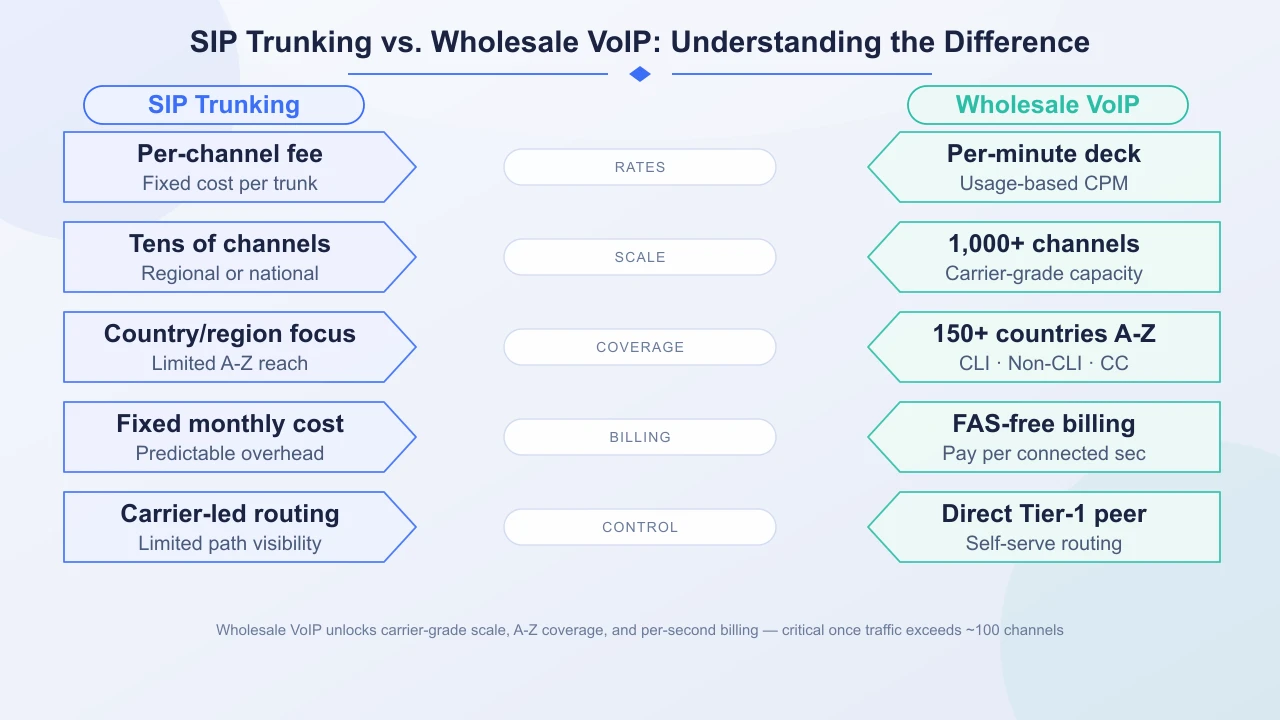
Per-minute pricing charges a single fixed rate per destination regardless of monthly volume. It is the simplest structure to model and compare, and it suits buyers with unpredictable or seasonal traffic who don't want to risk falling short of a commitment. The tradeoff is that per-minute rates sit at the higher end of the market because the provider carries all the volume risk.
Tiered (Volume-Band) Pricing
Tiered pricing sets progressively lower rates as monthly volume crosses defined thresholds — for example, $0.007/min for the first 500,000 minutes, dropping to $0.0055/min beyond that. This rewards growth without requiring a binding commitment, but the discount only applies retroactively or prospectively depending on the contract language, a detail buyers frequently overlook when reading a voice termination agreement for the first time.
Committed-Volume (Take-or-Pay) Pricing
Committed-volume pricing offers the lowest per-minute rate in exchange for a guaranteed monthly minute floor, billed whether or not you use it. This structure delivers the best unit economics for predictable, high-volume traffic, but it converts a variable cost into a fixed obligation — underestimate your volume and you pay for minutes you never sent.
5How Route Quality Changes Your True Cost Per Connected Minute
ASR and PDD Are Cost Variables, Not Just Quality Metrics
A cheap rate on a poor-quality route is not actually cheap. If a route's Answer-Seizure Ratio (ASR) is 40% instead of a healthy 65%, you are paying seizure and signaling costs on far more failed attempts to complete the same number of successful calls — the effective cost per connected minute rises even though the quoted per-minute rate never changes.
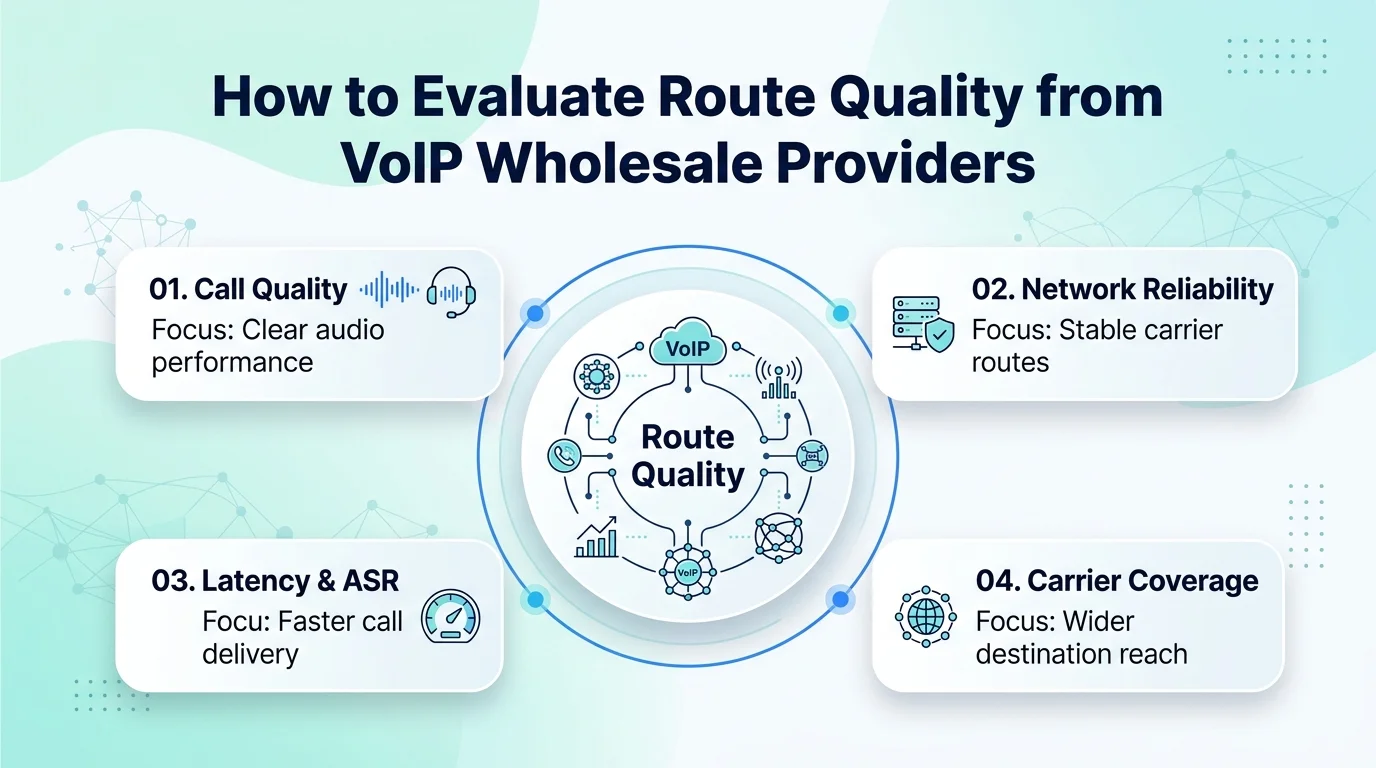
Post-Dial Delay (PDD) has a similar hidden cost: routes with high PDD generate more caller abandonment before the call ever connects, which means you are effectively paying setup and signaling overhead on attempts that produce zero billable, revenue-generating minutes. When comparing two rate sheets, always request 30-day rolling ASR and PDD averages by destination and factor them into the comparison — not just the quoted rate.
6How to Compare Rate Sheets Apples-to-Apples
Building a genuine like-for-like comparison across providers takes a few extra steps beyond lining up per-minute figures, but it is the only way to know which rate sheet actually produces the lower bill for your specific traffic mix.
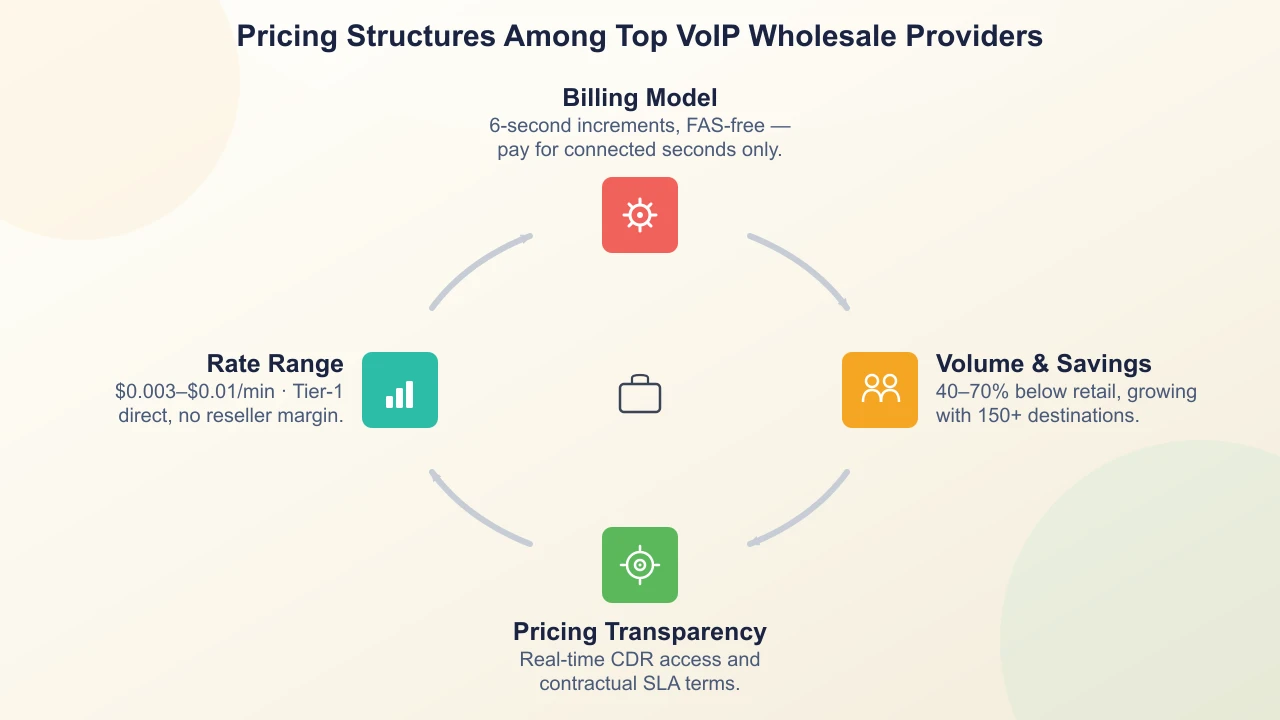
- Normalize the billing increment — recalculate each rate sheet's effective cost assuming your actual average call duration, not a theoretical full minute.
- Confirm FAS policy in writing — ask explicitly whether billing starts on answer supervision or on confirmed human/voicemail pickup.
- Model your real volume against every tier or commitment threshold — a tiered or committed-volume rate only wins if your traffic reliably clears the breakpoint.
- Request destination-level ASR and PDD, then weight the rate by expected connect rate to get a true cost-per-connected-minute figure.
- Read the rate-review and currency clauses — a lower headline rate with a 30-day rate-change notice can turn into a moving target.
Softtop publishes a wholesale termination rates guide with destination-level granularity specifically so operators can run this normalization themselves before signing, rather than discovering the gap between quoted and landed cost after the first invoice.
7Billing Integrity: Verifying the Numbers on Your Invoice
Real-Time CDRs as a Pricing Audit Tool
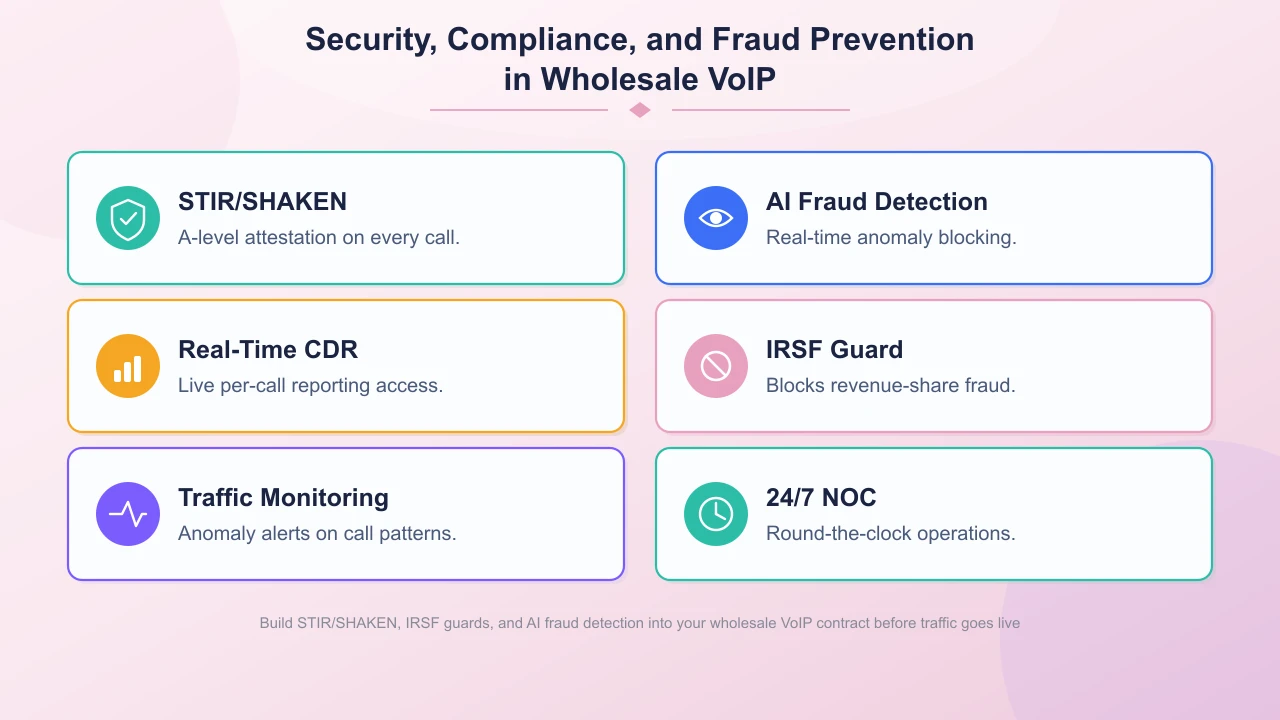
A rate sheet is only a promise; the call detail records (CDRs) are the proof. Real-time CDR access lets a finance or operations team reconcile actual billed duration against expected duration continuously, catching FAS-style discrepancies or increment misapplication within days rather than at month-end, when disputing a full invoice cycle is far more painful.
Why Billing Transparency Is a Pricing Decision, Not Just a Trust Decision
Providers that expose live, itemized CDRs and clearly documented billing rules are effectively letting you audit their pricing continuously. Providers that only issue a monthly summary invoice are asking you to trust that FAS, rounding, and surcharge rules were applied correctly — a meaningfully different risk position when a 10–15% billing gap is possible even under identical quoted rates.
8Conclusion
The cheapest number on a rate sheet is rarely the cheapest bill. Comparing wholesale VoIP providers on cost mechanics — pricing model structure, billing increment, FAS policy, and route quality's effect on cost per connected minute — reveals gaps that a single per-minute column will never show.
Whether you are evaluating per-minute, tiered, or committed-volume pricing, the discipline is the same: normalize every rate sheet to your real traffic mix, confirm billing practices in writing, and verify with live CDR data rather than relying on the invoice alone. That process, not the lowest headline rate, is what actually protects margin at scale.
9Frequently Asked Questions
What's the difference between per-minute, tiered, and committed-volume wholesale VoIP pricing?
Per-minute pricing charges one fixed rate regardless of volume. Tiered pricing lowers the rate automatically as monthly usage crosses defined thresholds. Committed-volume pricing offers the lowest rate in exchange for a guaranteed minimum monthly spend, billed whether or not you use the full commitment.
How much can FAS billing inflate my wholesale VoIP costs?
False Answer Supervision can inflate an invoice by roughly 10–15% because it bills for ringing, IVR intercepts, or setup time as if the call had genuinely connected. FAS-free providers bill only confirmed connected seconds, which is why identical quoted rates can still produce different real-world invoices.
What is a billing increment and why does it matter for cost comparison?
A billing increment (such as 1/1, 6/6, or 60/60) defines the initial billing block and the rounding block for every call thereafter. Coarser increments like 60/60 round short calls up more aggressively, which disproportionately raises cost for traffic with many brief calls, such as IVR-heavy contact center traffic.
How do ASR and PDD affect the real cost of a wholesale route?
A low Answer-Seizure Ratio means you pay signaling and seizure costs on more failed attempts to complete the same number of successful calls, raising the effective cost per connected minute even though the quoted rate stays the same. High Post-Dial Delay similarly increases caller abandonment before a call ever becomes billable.
How do I compare two wholesale VoIP rate sheets fairly?
Normalize both rate sheets to your actual average call duration and traffic mix, confirm each provider's FAS and billing-increment policy in writing, model your real volume against any tiers or commitments, and weight the rate by destination-level ASR so you're comparing cost per connected minute rather than the raw quoted figure.