1Introduction
The global wholesale voice market is projected to exceed $25 billion by 2027, yet most businesses still overpay for call termination by partnering with the wrong wholesale voice providers. Whether you run a contact center, a VoIP reseller, or a telecom startup, choosing a provider with direct Tier-1 carrier connections and transparent billing can reduce per-minute costs by 40–70% compared to retail rates. This guide breaks down what separates the best wholesale voice providers from the rest — rate structures, route quality, fraud compliance, and self-service tools — so you can make a confident, data-backed decision.
Softtop delivers all of this through a carrier-grade platform with 99.99% uptime and global A-Z termination coverage across 150+ countries.
The best wholesale voice providers offer direct Tier-1 connections, FAS-free billing, and 99.99% uptime — Softtop delivers all three. Key metrics to compare: ASR, ACD, PDD, and per-minute rates (look for $0.003–$0.01/min ranges). Route types matter: CLI, Non-CLI, and CC routes each serve different use cases and budgets.
2What Wholesale Voice Providers Actually Sell: Routes and Metrics Explained
Before comparing wholesale voice providers, you need to understand the route types and performance metrics that separate a reliable call from a dropped one.
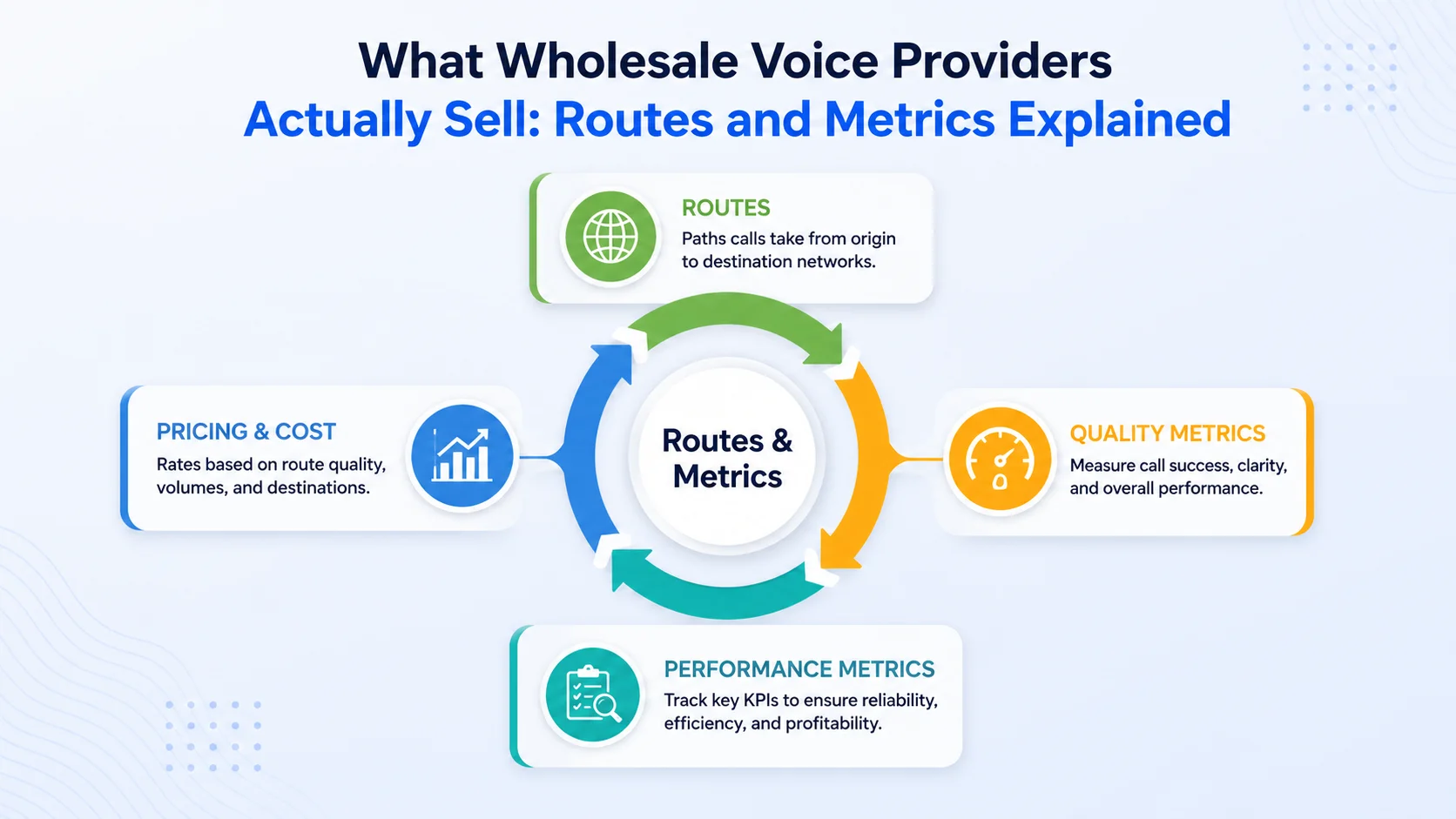
Routes break into three categories: CLI (Calling Line Identification) routes preserve caller ID and deliver the highest answer rates, making them ideal for customer-facing calls; Non-CLI routes strip caller ID in exchange for lower cost-per-minute; and CC (Call Center) routes are built specifically for high-volume outbound dialing campaigns. Softtop's CLI Routes platform supports all three from a single account, eliminating the complexity of managing multiple vendors and separate billing relationships simultaneously.
Performance metrics every buyer must track:
Answer-Seizure Ratio (ASR)
The percentage of call attempts resulting in a connected call. Premium CLI routes should achieve 65–85%.
Average Call Duration (ACD)
Consistently low ACD signals route quality problems or active network fraud.
Post-Dial Delay (PDD)
Anything over six seconds frustrates end-users and increases call abandonment rates. Knowing these metrics before signing any contract means you can hold a wholesale voice provider accountable with real performance data rather than vague SLA language.
3How Wholesale Voice Providers Price Their Rates — and Where Hidden Costs Hide
Wholesale voice pricing looks straightforward — a per-minute rate multiplied by monthly volume — but hidden variables can make a cheap headline rate genuinely expensive in practice.
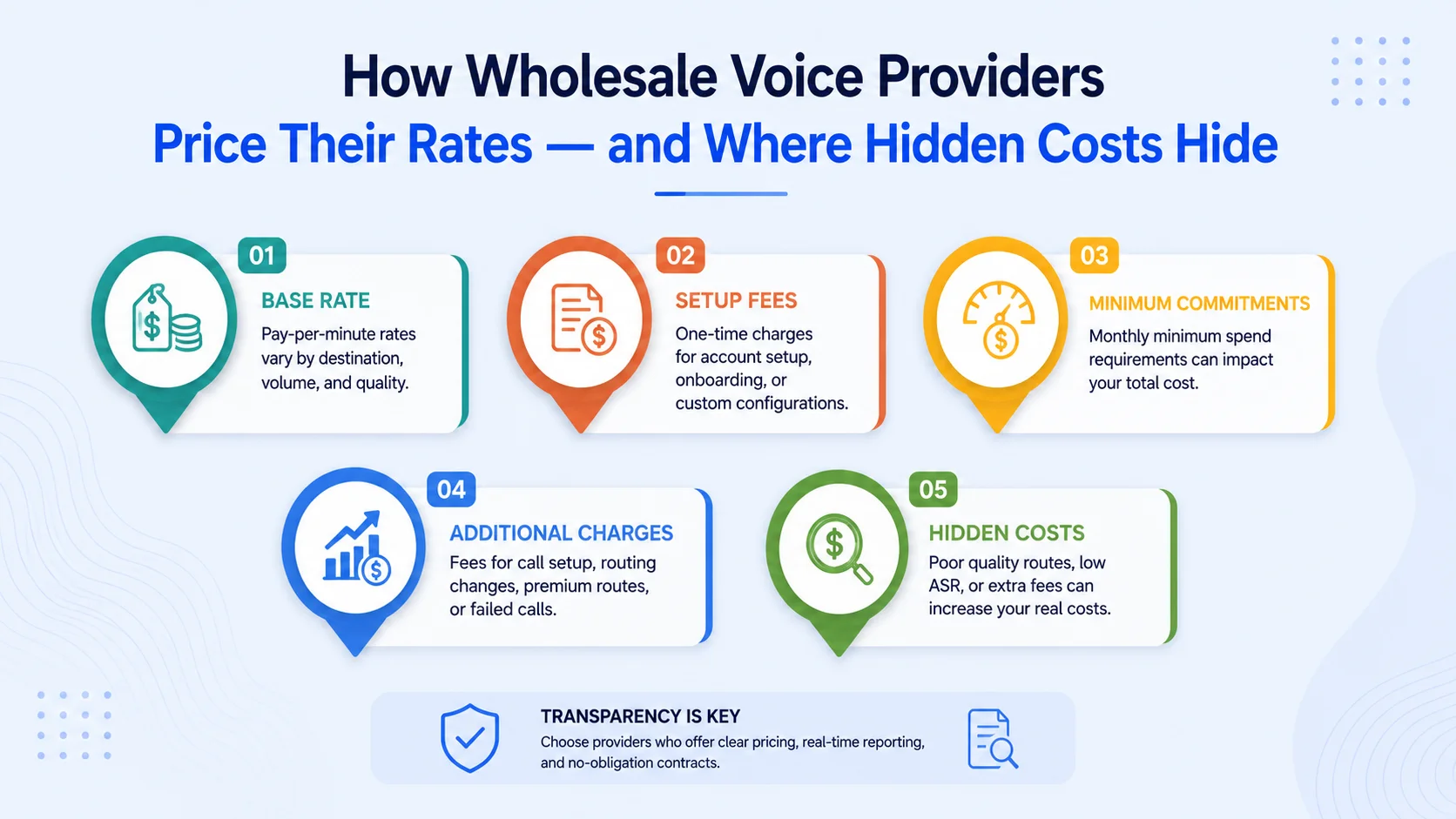
FAS (False Answer Supervision) is the most common billing trap. A provider using FAS starts the billing clock when a remote switch sends a ringing signal, even if no human ever answers. Across high-volume traffic, FAS silently inflates monthly bills by 5–15% with no corresponding call value delivered.
FAS-free billing — starting only on genuine human answer — is a non-negotiable requirement. Softtop applies strictly FAS-free billing across all destinations and route types. Wholesale rates range from $0.003 to $0.01 per minute, a band that saves businesses 40–70% against standard retail VoIP pricing. For a full breakdown of destination-specific rates and volume discounts, the wholesale VoIP termination rates guide is an excellent reference. Rate cards are only a starting point; live CDR access and real-time ASR monitoring let you verify exactly what you are paying for, minute by minute, without waiting for a month-end invoice.
4Why Wholesale Voice Providers Must Pass the STIR/SHAKEN and Fraud Test
Call fraud is the silent budget killer in wholesale voice. The FBI's Internet Crime Complaint Center reports that telecom fraud costs US businesses hundreds of millions annually, and wholesale voice traffic is a primary attack vector because of the speed and volume at which calls move through interconnected networks.
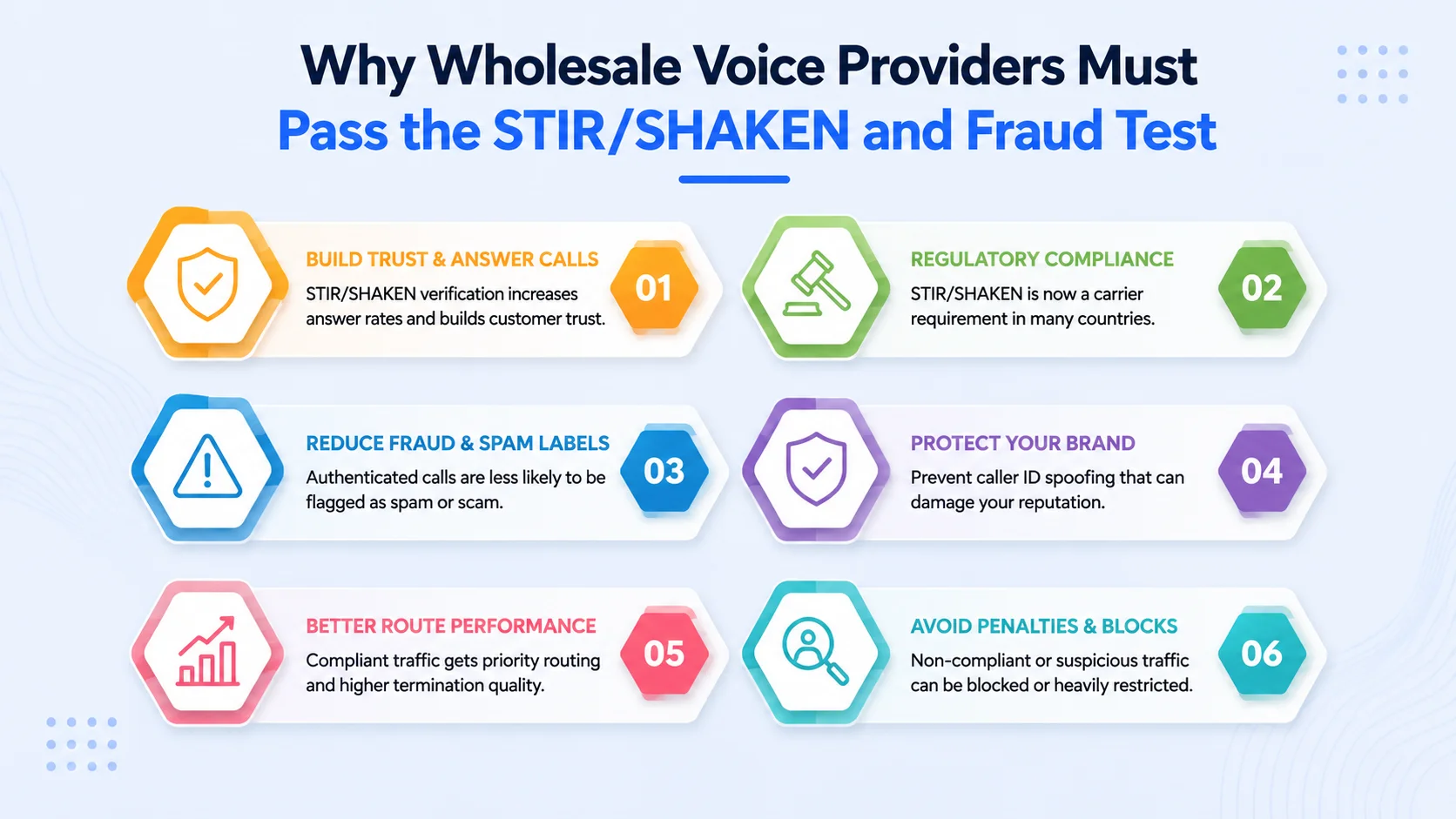
The Federal Communications Commission mandates STIR/SHAKEN call authentication on all US carrier networks — FCC STIR/SHAKEN overview — to combat robocall spoofing at the network level. A wholesale voice provider must carry STIR/SHAKEN A-level attestation, meaning the provider can fully verify originating number ownership and legitimacy. Softtop holds A-level attestation and layers AI-powered fraud detection on top, with custom concurrent call limits you configure per account to automatically cap runaway traffic before it becomes a billing crisis.
Core features to require in any provider's fraud toolkit:
- Real-time anomaly detection on sudden destination-level traffic spikes.
- Configurable concurrent call caps with automatic circuit-break triggers.
- Immediate alerting when traffic patterns deviate from your established baseline.
Without these controls, a single compromised SIP credential can generate thousands of dollars in fraudulent termination minutes before your team detects the problem.
5Key Benefits of Partnering With the Right Wholesale Voice Providers
Choosing a capable wholesale voice provider delivers advantages that extend well beyond a lower per-minute rate. When the provider brings direct Tier-1 connections, transparent billing, and genuine carrier infrastructure, every aspect of your voice operation improves — cost structure, call quality, compliance posture, and long-term scalability.
The primary financial benefit is straightforward: wholesale rates start at $0.003 per minute compared to retail VoIP rates of $0.01–$0.03 per minute, translating to 40–70% in direct cost savings at scale. But the operational benefits compound over time in ways that the headline rate alone does not capture:
- Global A-Z termination through a single interconnect eliminates the cost and complexity of managing multiple regional carriers across 150+ countries.
- FAS-free billing ensures every minute invoiced corresponds to genuine human-answered call time — eliminating the silent 5–15% inflation that FAS-enabled providers routinely add.
- Real-time CDR access gives finance teams immediate visibility into per-call costs without waiting for end-of-month billing summaries.
- Self-service route management lets you adjust routing priorities, concurrent call caps, and destination coverage without support tickets or account manager delays.
- Redundant carrier infrastructure and a 24/7/365 NOC deliver 99.99% platform uptime — fewer than 53 minutes of downtime per year — keeping revenue-generating call flows uninterrupted.
- A-level STIR/SHAKEN attestation improves answer rates on outbound CLI routes by confirming caller identity to destination carriers before the call is delivered.
For resellers and carriers building downstream products on a wholesale voice layer, these benefits translate directly into competitive margin — lower input costs, higher call quality, and the compliance credentials needed to pass regulatory checks without building a separate compliance function.
6Network Reliability: The Infrastructure Behind the Best Wholesale Voice Providers
When your platform carries millions of minutes per month, even a 30-minute outage represents a measurable revenue loss. Wholesale voice providers must demonstrate verifiable uptime backed by genuine engineering commitment, not only marketing promises.
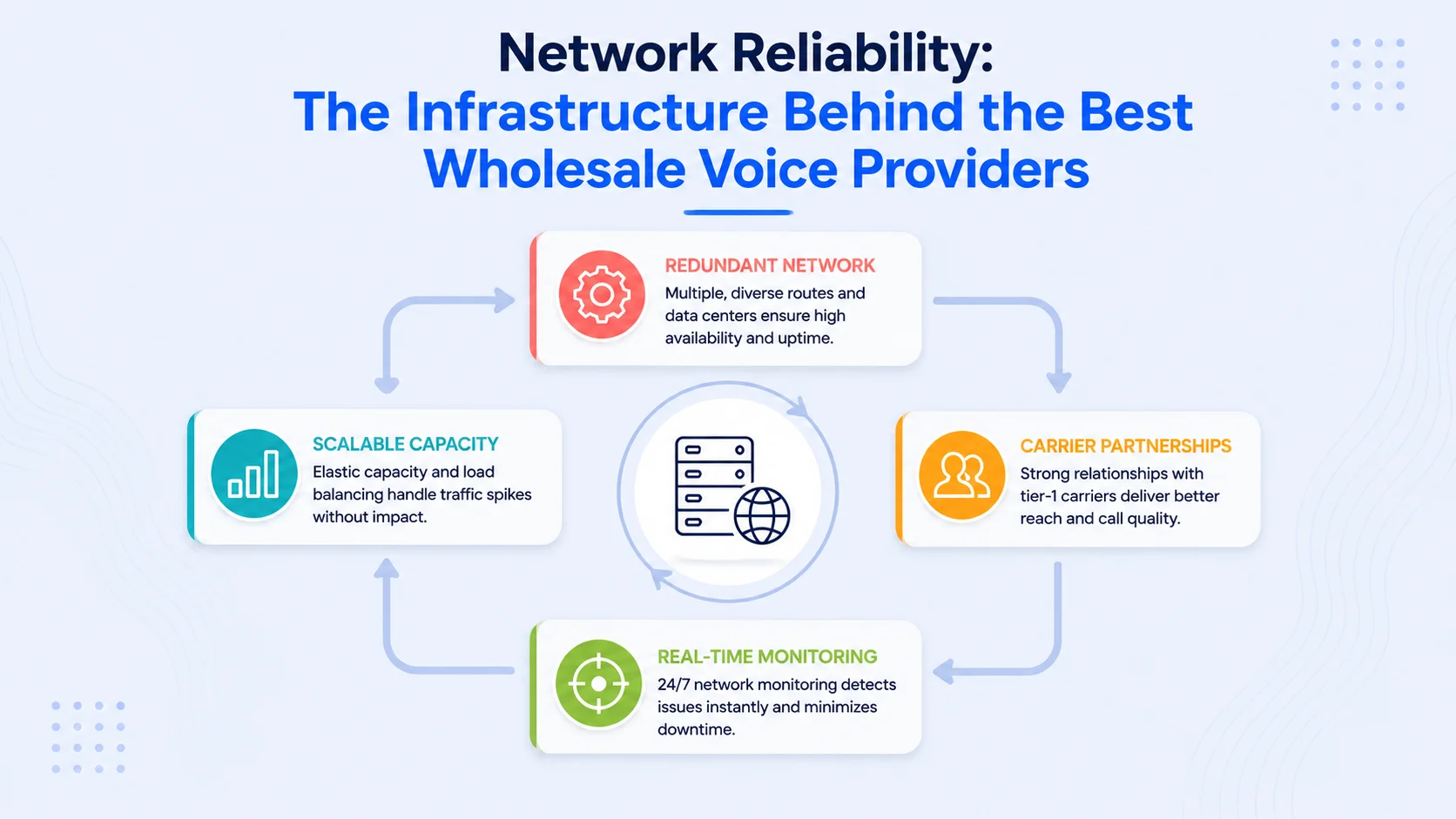
Softtop operates redundant infrastructure with 99.99% platform uptime, supported by a 24/7/365 Network Operations Center. That translates to fewer than 53 minutes of potential downtime per year — a standard that most regional carriers and resellers cannot match consistently. Direct Tier-1 carrier connections mean Softtop controls the routing path end-to-end, cutting failure points and giving the NOC direct escalation access to carrier partners when issues arise.
Infrastructure checklist for evaluating any wholesale voice provider:
- Redundant Points of Presence across multiple geographic regions to prevent single-region failure cascades.
- Direct carrier interconnects rather than sub-reseller hops that add latency and remove accountability.
- Codec diversity: G.711, G.729, G.722, and Opus support ensures compatibility with any SIP endpoint.
- Published SLA with financial penalty clauses, not best-effort language that carries no consequence.
A provider meeting all four criteria can reliably support contact centers, CLECs, and resellers with zero tolerance for unplanned downtime.
7Self-Service, Scalability, and Global Coverage: Comparing Wholesale Voice Providers Long-Term
The best wholesale voice providers give you complete traffic visibility without requiring a support ticket for every data query or route change you need quickly.
Softtop's self-service portal delivers live call detail records (CDRs), real-time ASR monitoring dashboards, and direct route management — all accessible without contacting an account manager. This operational transparency is increasingly the baseline expectation for any serious wholesale voice provider, not a premium tier add-on.
Account scalability determines whether a provider can genuinely grow alongside your business. Softtop's Wholesale Voice solution is purpose-built for resellers and carriers who need white-labeled services, sub-account management, and independent downstream customer control within one unified platform. This architecture scales from a few hundred channels to several thousand without renegotiating contracts or migrating infrastructure.
Global coverage is the final comparison axis. Softtop terminates to 150+ countries via A-Z routes, meaning one interconnect covers the international destinations your customers require. Compare this to providers covering only 50–80 countries, which force secondary vendor relationships — compounding costs, latency, and operational complexity at every stage of growth.
8Conclusion
Choosing among wholesale voice providers is ultimately about how much operational risk you are willing to absorb. A provider cutting corners on FAS billing transparency, skipping STIR/SHAKEN compliance, or overselling network capacity will cost far more than per-minute savings suggest once fraud losses, quality complaints, and support overhead accumulate.
The wholesale voice providers worth building on share four core traits: direct Tier-1 interconnects, FAS-free billing, certified fraud prevention, and transparent self-service reporting. Softtop was built to deliver on all four from day one. With 150+ country coverage, rates starting from $0.003 per minute, 99.99% uptime, and A-level STIR/SHAKEN attestation, it scales from startup call volumes to carrier-grade traffic without requiring a provider change.
9Frequently Asked Questions
What is the difference between wholesale voice providers and retail VoIP providers?
Wholesale voice providers buy termination capacity directly from Tier-1 carriers and resell it at volume rates to businesses, resellers, and carriers. They differ from retail providers in pricing structure, route access — CLI, Non-CLI, CC — and technical control: real-time CDRs, direct SIP interconnects, and configurable routing options that retail plans rarely include.
How much do wholesale voice providers charge per minute?
Rates vary by destination, route type, and committed volume. CLI routes to major markets typically run $0.003–$0.01 per minute wholesale. Non-CLI and CC routes cost less but trade off caller ID and answer rates. Always confirm FAS-free billing upfront, as hidden FAS charges can erase savings across a full month of call traffic.
What is STIR/SHAKEN and why does it matter when choosing wholesale voice providers?
STIR/SHAKEN is a call-authentication framework the FCC mandates for US carriers. It uses digital certificates to verify caller identity at the network level before delivery. Wholesale voice providers with A-level attestation confirm full number ownership, improving answer rates and keeping traffic compliant with US telecommunications regulations.
What ASR should I expect from a quality wholesale voice provider?
ASR measures call attempts that result in a connected answer. A healthy range for CLI routes to Tier-1 destinations is 65–85%. Consistently low ASR signals route congestion, poor carrier quality, or active fraud. Always request 30-day ASR reports by destination before committing to any wholesale voice provider contract.
Do wholesale voice providers require minimum volume commitments?
Volume floors vary — typically 5,000 to 50,000 minutes per month. Some platforms offer scalable entry tiers for businesses ramping up while supporting carrier-grade volumes as traffic grows. Always clarify minimum commitments and short-fall penalties before signing.