1Introduction
A call from an unfamiliar 877 number pops up on your screen — do you answer it, or let it go to voicemail? For millions of people, that decision happens every day, because 877 is one of the most widely used toll-free codes in North America. It's not tied to a city or state, it doesn't cost the caller a cent, and it shows up everywhere from customer service lines to spoofed scam calls.
If you've ever wondered what an 877 area code is, where it "comes from," whether it's safe to answer, or how your business could get one, this guide covers it all — including how 877 differs from other toll-free prefixes and how to set one up.
2What Is the 877 Area Code?
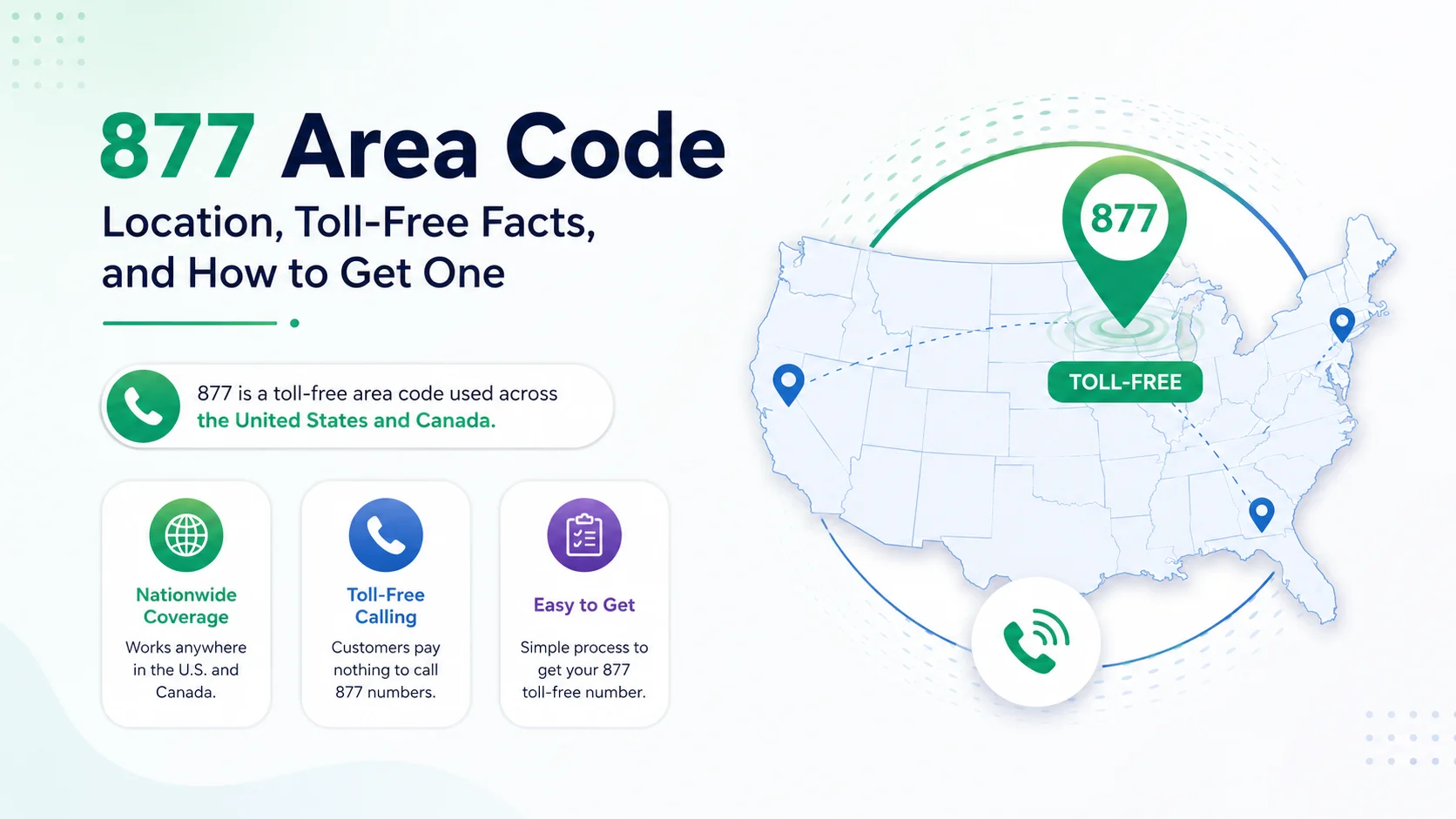
The 877 area code isn't a geographic area code at all — it's a toll-free prefix, part of the same numbering family as 800, 888, 866, 855, 844, and 833. The Federal Communications Commission activated 877 in 1998 after the original pool of 800 numbers started running low, giving businesses a fresh supply of toll-free digits to work with.
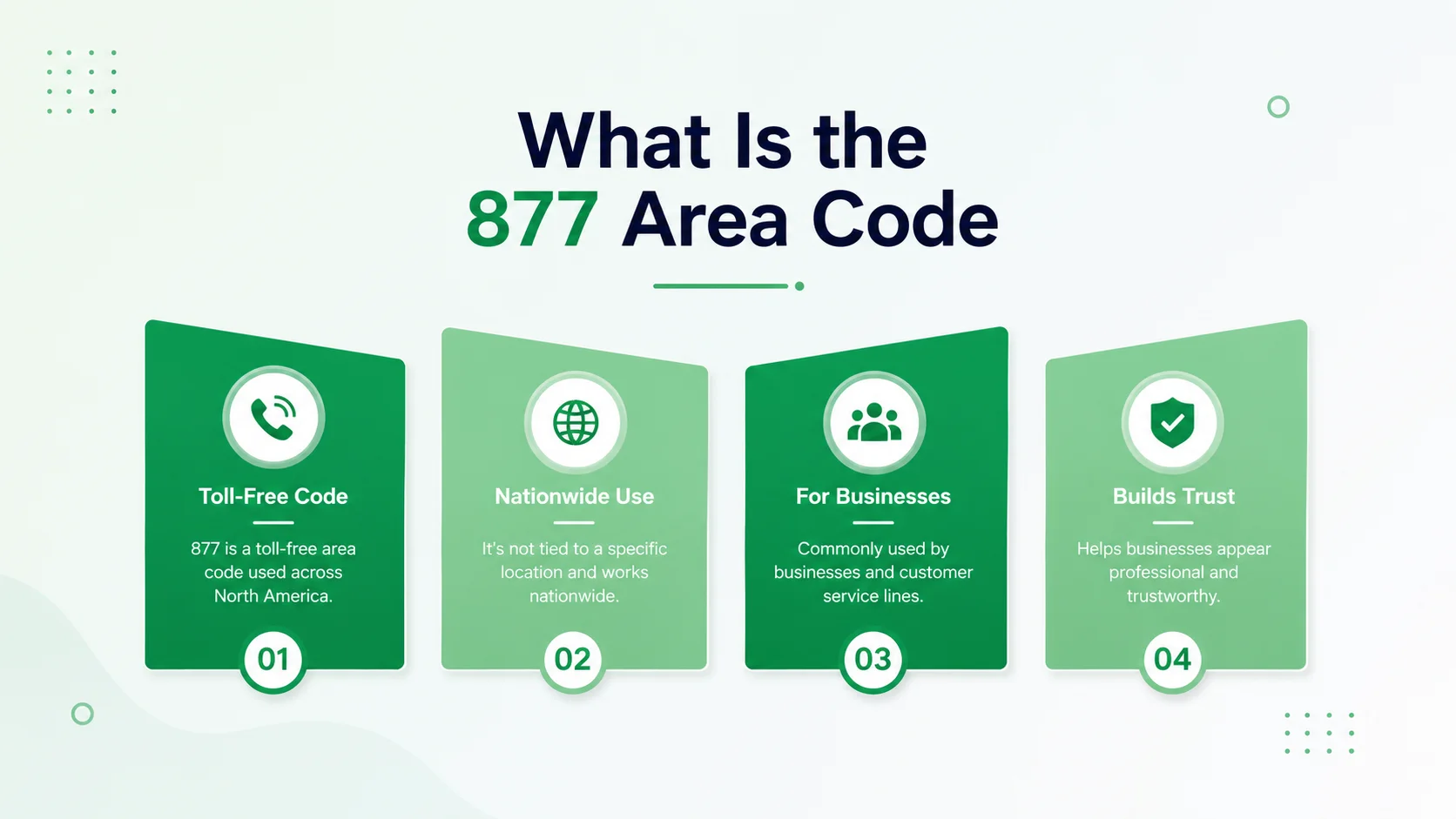
Here's what sets toll-free numbers apart from standard local or long-distance numbers:
- The recipient pays, not the caller: whoever owns the 877 number covers the cost of incoming calls, so dialing one never adds a charge to your phone bill
- They aren't linked to a physical location: a business with an 877 number could be headquartered in Ohio, Manila, or anywhere else within the North American Numbering Plan (NANP)
- They're routable nationwide (and beyond): toll-free numbers can be set up to ring anywhere, forwarded to mobile phones, or distributed across multiple call centers
- They function identically to 800 numbers: there's no technical or quality difference — 877 exists purely to expand the supply of available toll-free digits
3Where Is the 877 Area Code Located?
Short answer: nowhere in particular. Unlike geographic area codes such as 212 (New York) or 305 (Miami), 877 numbers carry no built-in location data. A company using an 877 number could be based in any US state, a Canadian province, or another NANP country. That's part of the appeal for businesses — a single toll-free number can represent a national or even international presence without tying the brand to one region.
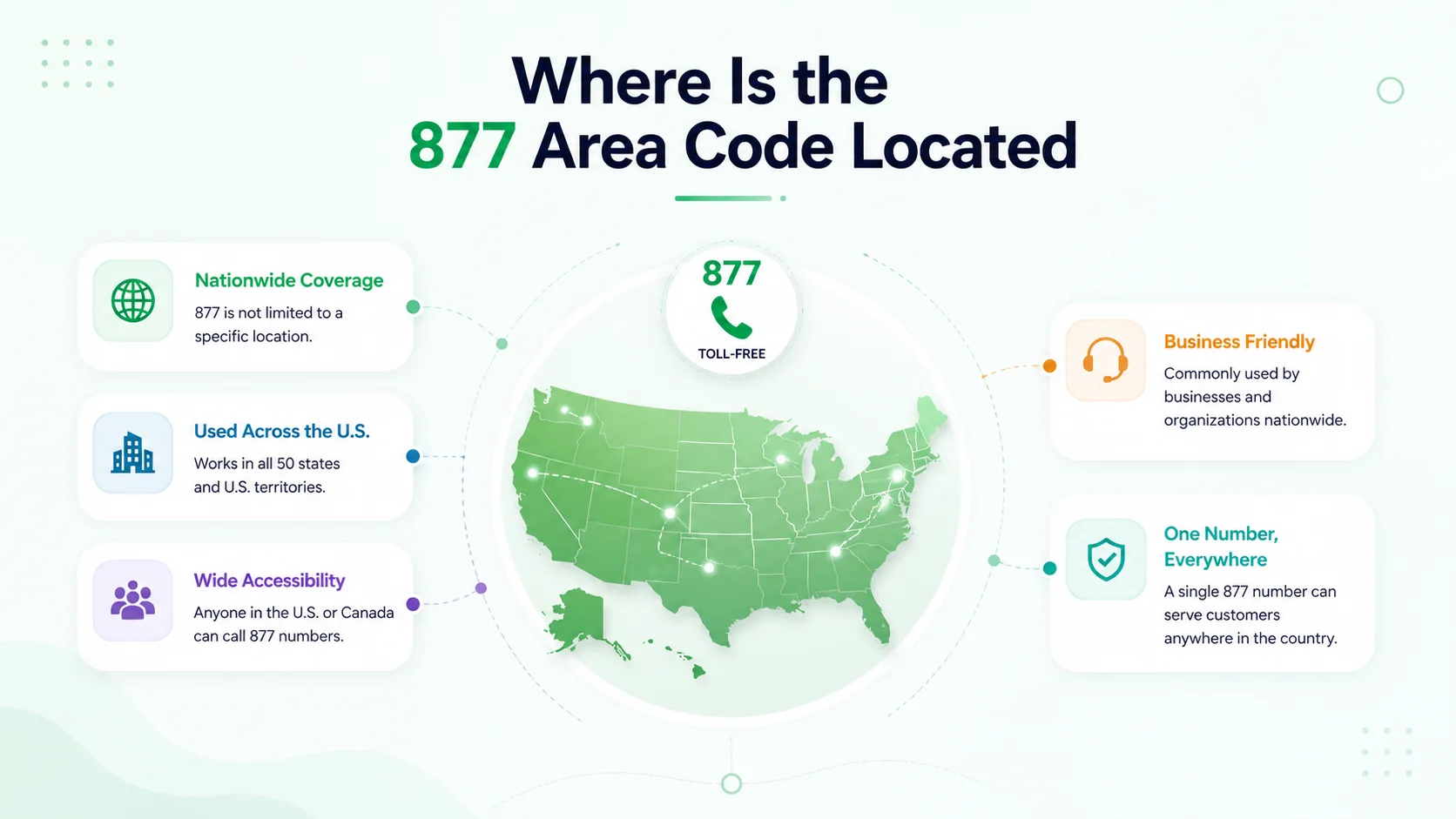
This is also why "reverse lookup" tools can only tell you which carrier issued a specific 877 number and roughly when it was activated — not a physical address.
4877 vs. 800 vs. 888: What's the Difference?
All toll-free prefixes work the same way functionally, but they were rolled out at different times as demand grew:
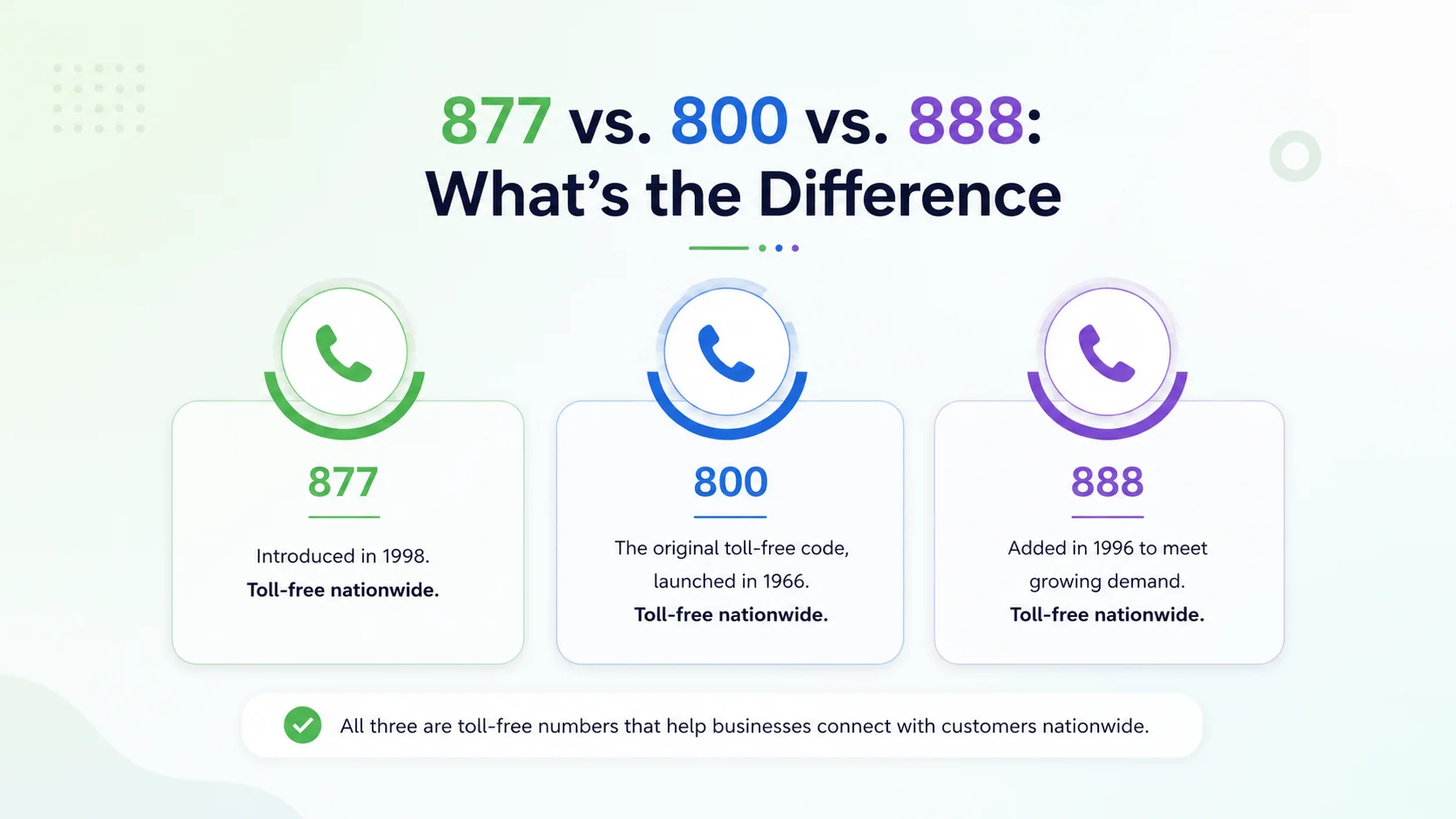
- 800: the original toll-free code, introduced in 1967 — still the most recognized and requested by advertisers
- 888: added in 1996 as the first expansion once 800 numbers grew scarce
- 877: released in 1998 as the second expansion
- 866, 855, 844, 833: added in subsequent years (2000–2017) as toll-free demand kept climbing
The practical difference for a business owner comes down to availability and branding. Because 800 numbers are the oldest and most requested, it's harder to find a short, memorable 800 combination. An 877 number, by contrast, often has more vanity and sequential options still open — similar to the newer 833 area code, which followed the same expansion pattern and is often easier to find a short, brandable combination on.
5Is an 877 Area Code Call Safe, or Is It a Scam?
Most calls from 877 numbers are completely legitimate — banks, airlines, retailers, and customer support lines all rely on toll-free numbers to make it easy (and free) for customers to reach them. That said, 877 is also a frequent target for caller ID spoofing, where scammers fake a trusted-looking number to trick people into answering.
Common scam patterns reported on 877 numbers include:
- Mortgage and loan "relief" calls: the single largest category of 877 spam complaints
- Credit card debt reduction offers that pressure recipients into paying upfront fees
- Fake IRS or government agency calls demanding immediate payment or personal information
- Political robocalls, especially around election season
- Health insurance and Medicare scams, often using prerecorded voice messages
- "One-ring" scams, where the call disconnects after one ring to lure you into calling back a premium-rate number
The core trick behind most of these is spoofing: scammers can display any number they want on caller ID, including a government agency's real toll-free line. In one widely reported case, fraudsters spoofed a legitimate Federal Trade Commission consumer hotline to ask victims for Social Security numbers and banking details.
How to protect yourself:
- Never press a button or "opt out" on a call you didn't expect — it often just confirms your number is active
- If a caller claims to represent your bank, insurer, or a government agency, hang up and call back using the number on your official statement or the agency's verified website
- Look up unfamiliar 877 numbers before calling back, using a reputable reverse-lookup service
- Let unknown calls go to voicemail; legitimate businesses will leave a message
- Report persistent spam or scam numbers to the FTC at reportfraud.ftc.gov
6How to Get an 877 Toll-Free Number for Your Business
Setting up an 877 number is far simpler than most business owners expect. The general process looks like this:
- 1Choose a provider: look for a communications platform that offers toll-free provisioning alongside the rest of your phone system, rather than a standalone number broker
- 2Check availability: search for open 877 combinations, including vanity options that spell out a word or match your brand
- 3Set your routing: decide whether calls should ring a shared inbox, a specific team, an auto-attendant menu, or an AI-powered receptionist
- 4Activate and test: most providers can provision a new toll-free number instantly, with no long-term contract required
- 5Port existing numbers if needed: if you already have a toll-free number elsewhere, ask about porting timelines and fees before you commit to a new provider
Softtop's business phone platform includes toll-free numbers — including 800, 888, and 877 provisioning, alongside local numbers like the 661 area code in California — as part of its unified voice, SMS, and contact center system, so a new toll-free line can be activated and routed to an auto-attendant or AI Receptionist without juggling a separate vendor.
7Benefits of Using an 877 Number for Your Business
A toll-free 877 number isn't just a cost play for callers — it can genuinely shape how customers perceive your business:
- National credibility: a toll-free number signals an established, professional operation rather than a single local office
- No cost barrier for customers: removing the "will this call cost me money" hesitation tends to increase inbound call volume
- Portability: toll-free numbers move with your business if you relocate, switch carriers, or expand to new markets
- Easier tracking: many providers let you assign different toll-free numbers to specific ad campaigns to measure what's driving calls
- Vanity number options: with more digits still available than in the 800 pool, 877 gives you a better shot at a memorable, brandable number
8How to Block or Report Unwanted 877 Calls
If you're on the receiving end of spam rather than shopping for a number, a few steps can cut down on unwanted 877 calls:
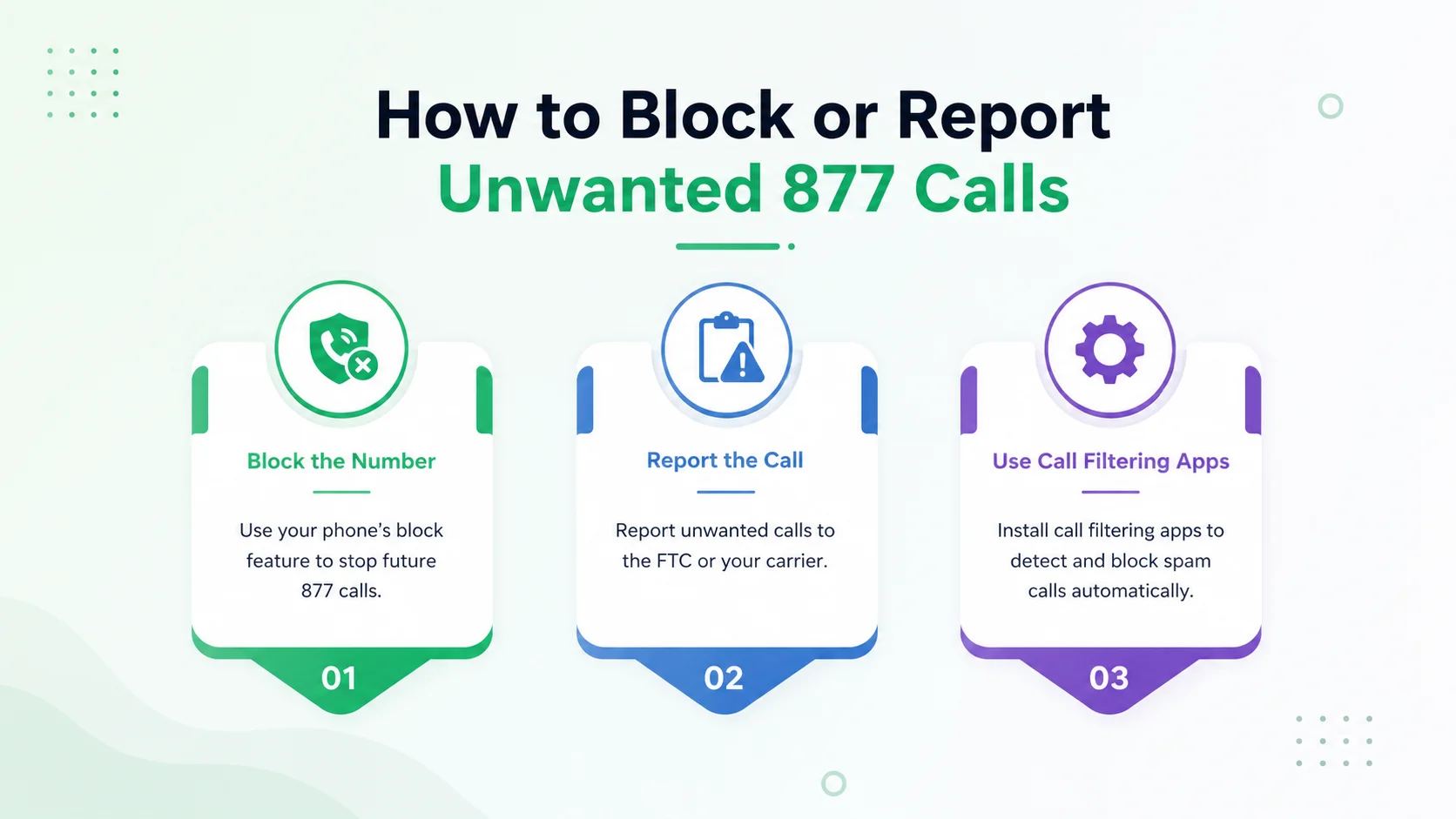
- Enable your carrier's built-in spam-blocking or call-screening feature
- Add persistent numbers to your phone's block list
- Register your number on the National Do Not Call Registry (donotcall.gov) — it won't stop scammers, but it reduces legitimate telemarketing
- Use a call-blocking app that cross-references crowd-sourced spam reports
- Report scam calls to the FCC and FTC so patterns can be tracked and acted on
9Conclusion
The 877 area code is simply one branch of the toll-free family — free for callers, unattached to any physical location, and used by everything from Fortune 500 support lines to small local businesses building a national presence. Most calls you receive from an 877 number are routine customer service or sales outreach, but because the prefix is a favorite target for caller ID spoofing, a healthy dose of caution is worth keeping. If you don't recognize the number, verify before you engage.
On the flip side, if you're a business owner looking to add a professional, no-cost-to-call phone line, an 877 number remains one of the easiest and most affordable ways to do it — and pairing it with modern call routing or an AI receptionist means every inbound call gets handled, not missed.