1Introduction
You've seen it on billboards, customer-service lines, and the back of product packaging: a phone number that starts with 833. Maybe one just lit up your phone screen and left you wondering whether to answer. Is 833 a real area code? Where is it located? Is it safe? And if you run a business, could an 833 number make your company look more established and easier to reach?
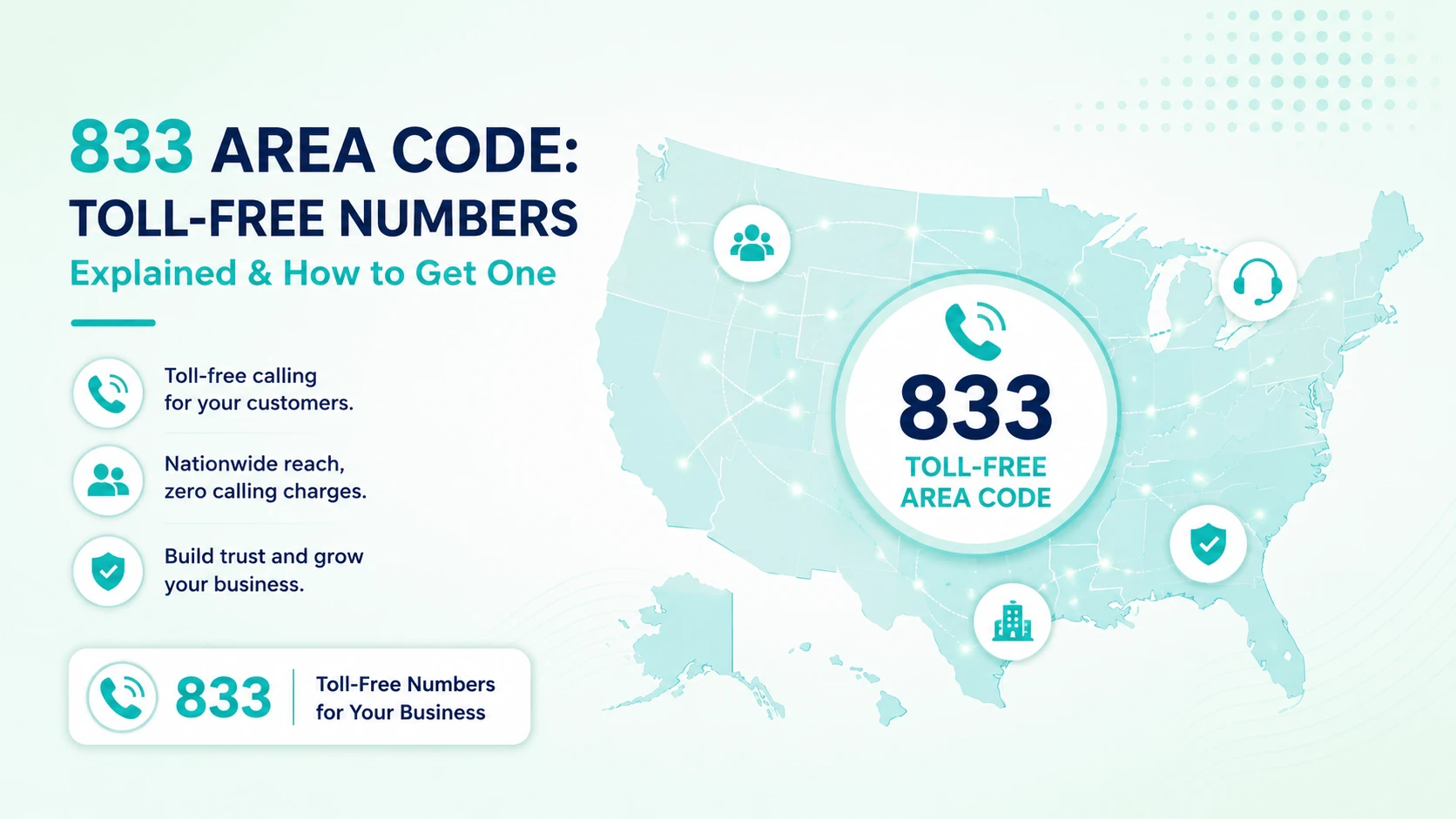
The short answer is that 833 is a toll-free code, not a geographic area code tied to a city or state. It lets customers call you for free while your business covers the cost, and it carries the same nationwide credibility as the classic 1-800 number. This guide breaks down how toll-free numbers work, what they cost, how to spot scam calls, and the simplest way to get an 833 number for your own business, no matter where you're based.
2What Is the 833 Area Code?
The 833 area code is a toll-free prefix in the North American Numbering Plan (NANP). Unlike codes such as 212 (New York) or 415 (San Francisco), 833 is non-geographic, meaning it isn't attached to any particular city, state, or region. A business in Texas, a startup in California, and a nonprofit in Florida could all use 833 numbers — it's simply a toll-free dialing prefix, nothing more mysterious than that.
When someone dials an 833 number, the call is free for the caller. The business or organization that owns the number pays for the incoming calls instead. That's the defining feature of toll-free service, and it's why 833 belongs to the same family as 800, 888, 877, 866, 855, and 844.
3Is 833 Really Toll-Free?
Yes. The 833 code is fully toll-free and works exactly like a 1-800 number. Callers in the United States, Canada, and many Caribbean nations covered by the NANP, including Puerto Rico, Jamaica, and the Bahamas, can reach an 833 number without paying long-distance or per-minute charges.
It's worth clearing up a common myth: none of the toll-free prefixes is "better" or more legitimate than another. An 833 number is administratively identical to an 800 number. The only reason different prefixes exist is supply — as each batch of toll-free numbers ran out, regulators opened a new code to meet demand, and 833 is simply the newest addition.
4A Brief History of Toll-Free Codes
Toll-free service has been around for decades, and 833 is simply the newest member of the family. The timeline looks like this:
- 800 — the original toll-free code, introduced in 1967
- 888 — opened in 1995
- 877 — opened in 1998
- 866 — opened in 2000
- 855 — opened in 2010
- 844 — opened in 2013
- 833 — the most recent, opened on June 3 of its launch year
Because 800 numbers have been in circulation the longest, nearly all of the memorable combinations are taken. The 833 code gives businesses a fresh pool of available numbers, including far more vanity and pattern options than the older prefixes — including the 877 area code — can offer.
That growing pool of options is exactly why area code 833 has become a popular pick for new businesses chasing a specific vanity number.
5Where Is the 833 Area Code Located?
Nowhere specifically, and that's the point. Because 833 is non-geographic, it has no fixed location and no single time zone. A call from an 833 number could originate anywhere in the country. For businesses, this is an advantage: a toll-free number signals a national presence rather than tying your brand to one local market.
6Benefits of an 833 Toll-Free Number for Business
An 833 number does more than let customers call for free. It shapes how people perceive your company. That national-first perception is a big reason an area code 833 number tends to outperform a purely local line in advertising response rates. Key benefits include:
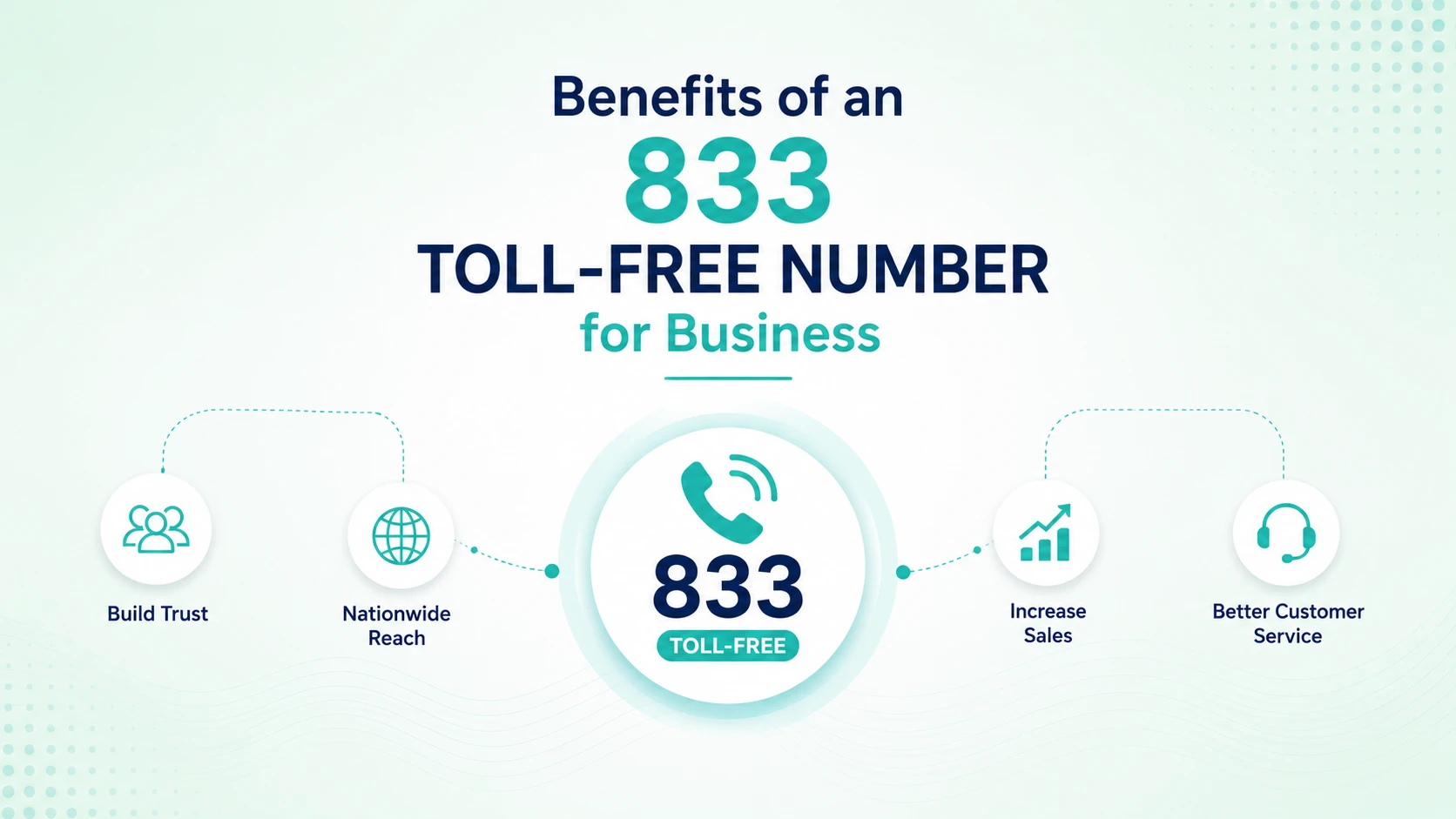
- Professional, national image — a toll-free number makes a small or remote business look established and nationwide.
- Free for your customers — removing the cost of a call encourages more inbound sales and support contacts.
- Memorable vanity options — because 833 is newer, you have a far better chance of landing a number that spells your brand, like 833-NEW-LEADS.
- Portability — toll-free numbers aren't tied to a carrier or location, so you can keep yours as your business grows or relocates.
- Call tracking and analytics — toll-free lines integrate with modern phone platforms for call routing, recording, and performance reporting.
- Trust and recall — customers recognize and remember toll-free numbers, which boosts response rates in advertising.
Once you see what an 833 number does for a brand's credibility, the appeal for growing businesses becomes obvious.
7How Much Does an 833 Number Cost?
Pricing depends on the provider and the features bundled with the number, but most 833 toll-free numbers fall in the range of roughly $10 to $25 per month. Many business phone platforms include a toll-free number within a broader plan or offer it as a low-cost add-on alongside calling minutes, voicemail, call routing, and analytics.
It's important to know that you don't buy a toll-free number outright. Toll-free numbers are managed through a centralized registry, and providers known as Responsible Organizations (RespOrgs) hold the inventory and lease numbers to businesses on a subscription basis, a system the FCC's toll-free number guide explains in more detail. In practice, this just means you get your 833 number through a phone service provider rather than directly from a regulator.
Pricing tracks with every other toll-free prefix, not a premium tier of its own. And no matter which provider you choose, signup won't ask for a location or address, since toll-free numbers carry no regional requirement.
8How to Get an 833 Number
Getting an 833 number is straightforward and usually takes only minutes with the right provider, with no location or address requirement to worry about. The typical process is:
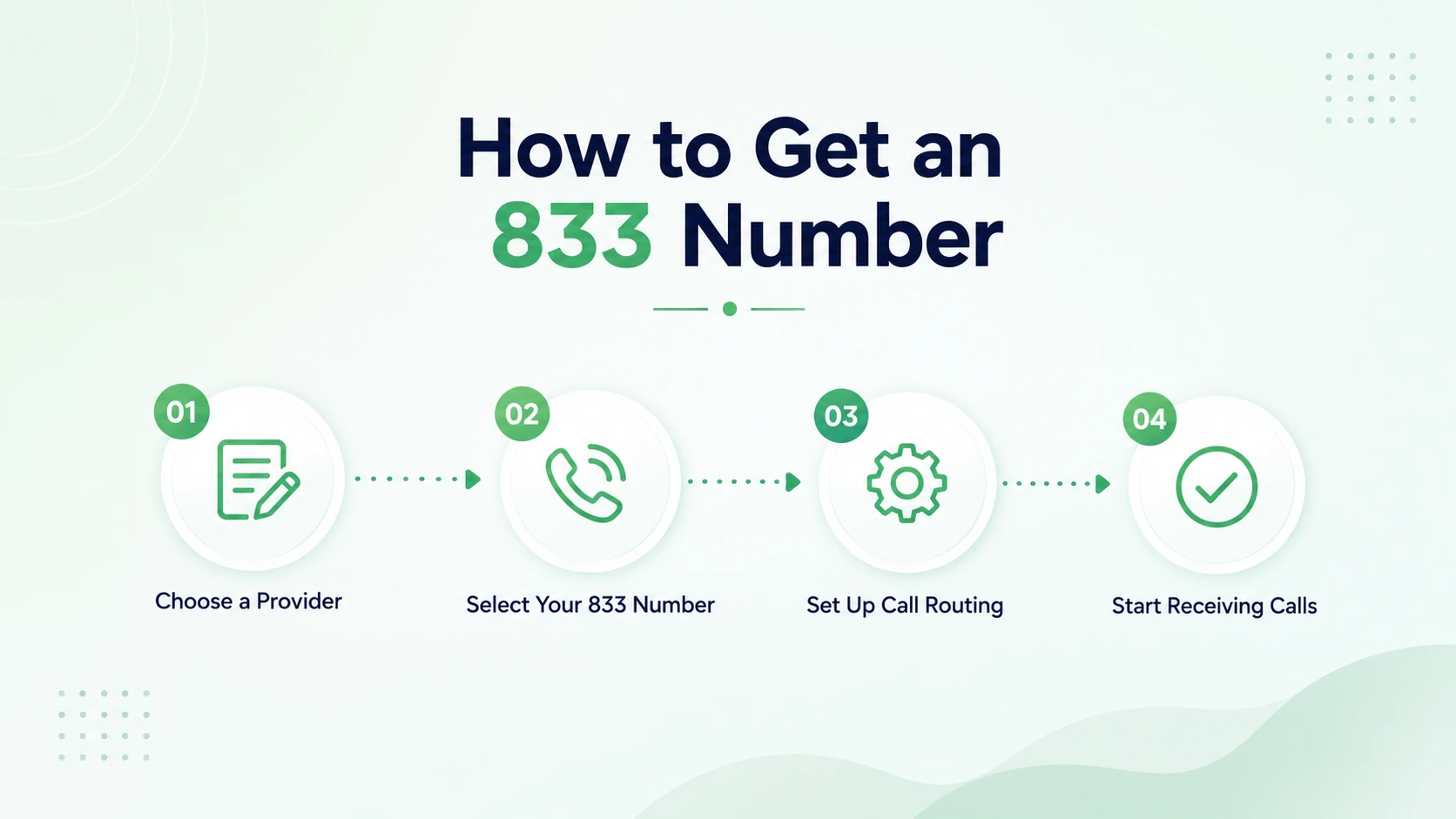
- 1Choose a toll-free provider or business phone platform that offers 833 numbers.
- 2Search the available inventory for a standard or vanity 833 number you like.
- 3Pick a plan that fits your team size, call volume, and feature needs.
- 4Complete a short signup and confirm the number.
- 5Configure call routing, voicemail, greetings, and business hours from your dashboard.
- 6Start taking calls on desktop, mobile, or your existing phones.
This is where the right platform matters. Softtop offers national toll-free numbers, including 833, alongside local numbers across 800+ US area codes, all on one carrier-grade platform that unifies voice, SMS, global numbers, and an AI-powered contact center.
Numbers provision instantly, and calls travel over direct Tier-1 carrier routes. Everything sits under one account, one dashboard, and one bill. With a 99.999% uptime SLA, STIR/SHAKEN attestation on US calls, and a built-in AI Receptionist that can answer every inbound toll-free call, your line is reliable and ready to scale from a single number to a full contact center.
An 833 toll-free number works from anywhere. A solo founder or a distributed support team can project a professional, nationwide image without renting a single square foot of office space.
9Are 833 Numbers Used for Scams?
Like every toll-free prefix, 833 is sometimes misused by scammers who spoof or mass-dial numbers to appear like a legitimate national business. An 833 call is not inherently a scam, but a few habits keep you safe. Because the prefix isn't tied to any single location, scammers count on that ambiguity to make a spoofed call feel harder to question:
- Be wary of unexpected 833 calls that demand payment, gift cards, or personal information.
- Don't trust caller ID alone; numbers can be spoofed.
- Let unknown calls go to voicemail and verify the company through its official website before calling back.
- Report suspected scam calls to the FTC or your carrier's spam-reporting tool.
Reputable businesses that run their toll-free lines on a compliant platform benefit from caller-ID authentication standards like STIR/SHAKEN, which help confirm a call genuinely comes from the displayed number and reduce spoofing — the same protection that keeps a local 717 area code business number in Pennsylvania from being flagged as suspicious. Running an 833 number on a compliant platform makes spoofing far less likely to succeed.
10Conclusion
The 833 area code isn't a place; it's a promise that the call is on the business, not the customer. As the newest toll-free prefix, it carries all the credibility of a classic 1-800 line while offering a fresh supply of memorable and vanity numbers that older codes simply can't match. It's non-geographic, nationwide, and instantly recognizable as a sign that a company is serious about being reachable.
For any business, from a solo founder to a growing support team, an 833 toll-free number is a low-cost way to project a professional, national image and make it effortless for customers to get in touch. With a platform like Softtop, you can claim one from anywhere, route calls intelligently, and back every conversation with carrier-grade reliability and security. Whether you're launching a new venture or upgrading how customers reach you, it's a simple, high-impact upgrade to your brand.