1Introduction
If a call or text from a 385 area code number lands on your phone, it is coming from one of the busiest corners of the Mountain West: the Wasatch Front in north-central Utah. The 385 code blankets Salt Lake City and the dense ring of cities around it, which makes it one of the most recognizable local identifiers in the state. Whether you are a business owner deciding where to plant a local presence, a new resident trying to understand your number, or simply someone screening an unknown caller, knowing what the 385 area code represents helps you act with confidence.
This guide breaks down where the 385 area code is, the cities and counties it serves, its history as an overlay, the time zone it follows, and how scammers misuse local codes — plus how a 385 number can strengthen your reach in the Salt Lake market.
2Where Is the 385 Area Code?
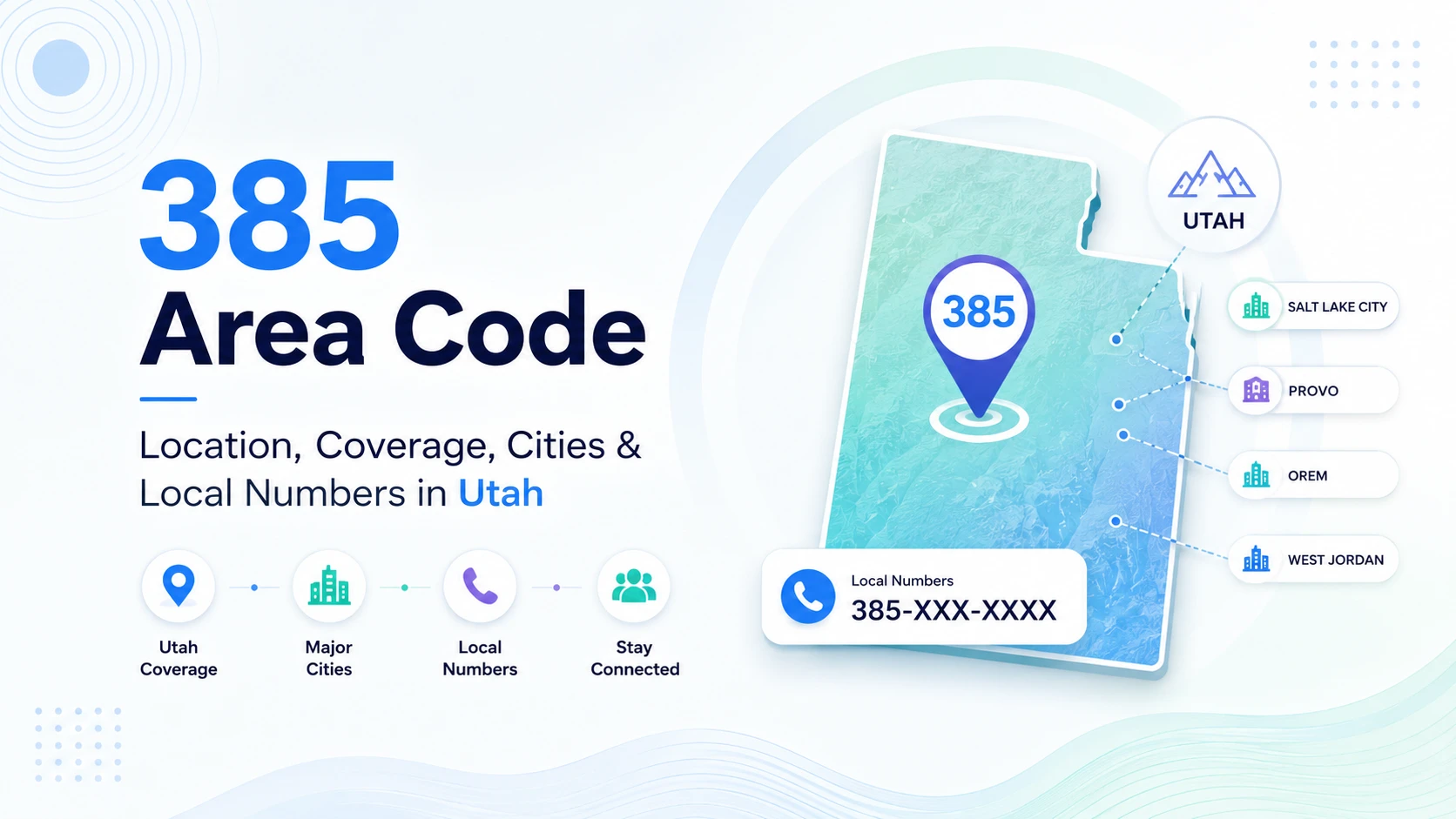
The 385 area code is located in the U.S. state of Utah, specifically across the Wasatch Front — the populous strip of cities running along the western base of the Wasatch Mountains in the north-central part of the state. Its anchor city is Salt Lake City, Utah's capital and largest metro area.
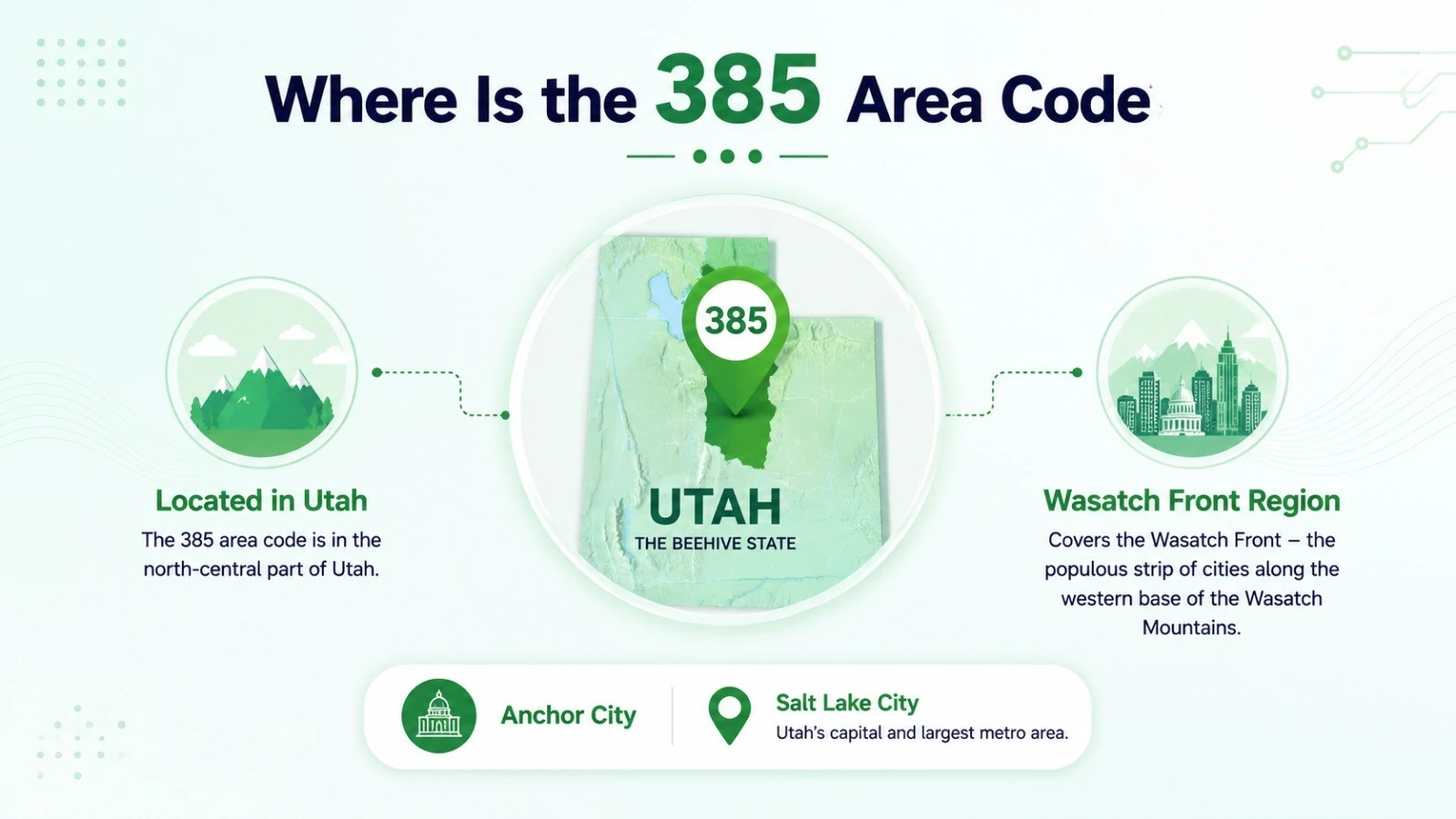
Rather than covering its own separate region, 385 shares the exact same geography as the older 801 area code. The two codes sit on top of each other, so a 385 number and an 801 number can be neighbors on the same street. Together they serve a five-county footprint that includes the economic heart of Utah, from downtown Salt Lake City through the suburbs of Davis, Utah, and Weber counties.
In short: when you see 385, think Salt Lake City and its surrounding metropolitan corridor.
3A Quick History of the 385 Area Code
Utah originally operated under a single area code — 801, one of the original North American area codes established back in 1947. For decades, that one code was enough to cover the entire state, and later the Wasatch Front specifically.
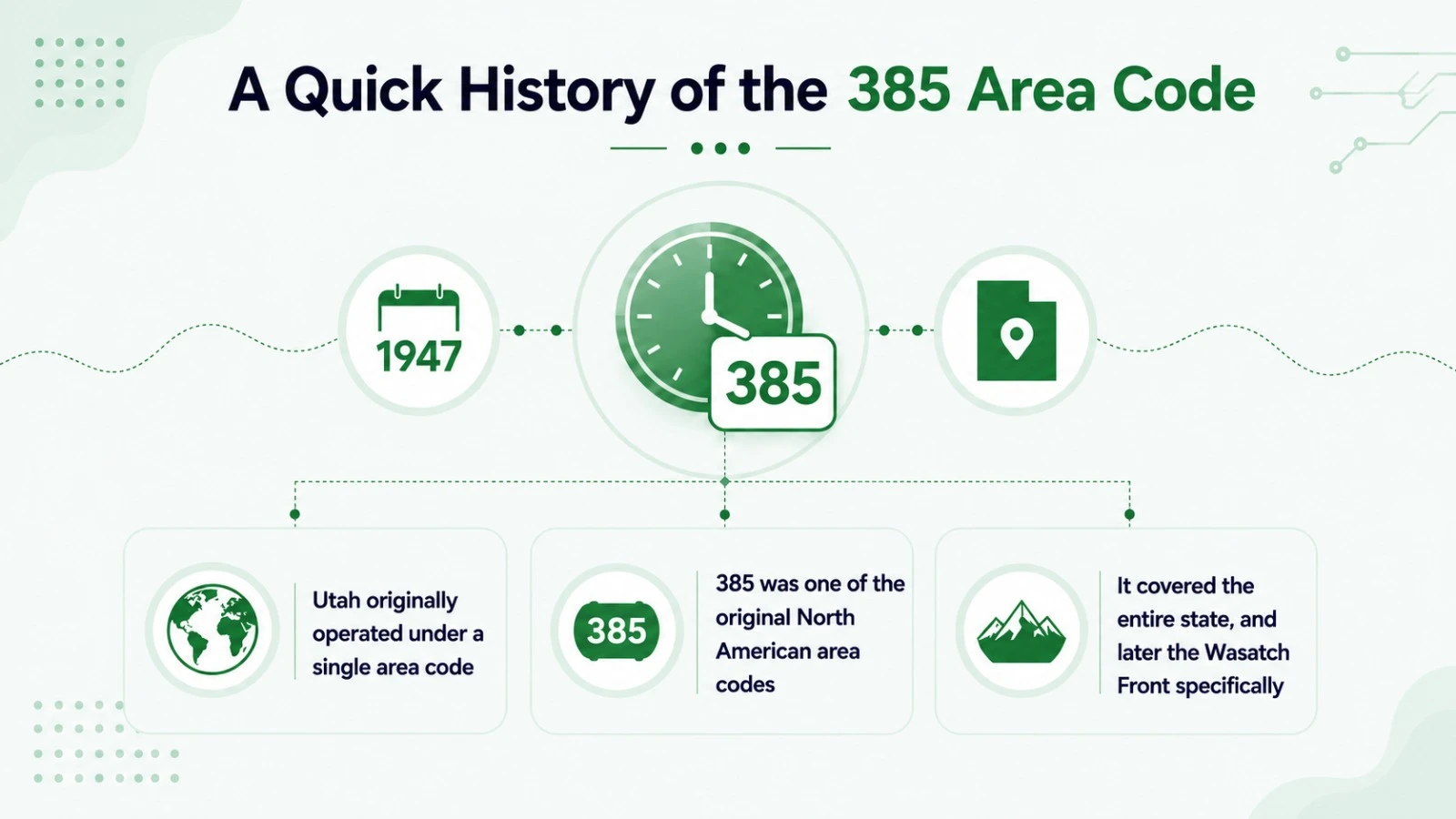
By the mid-2000s, however, explosive population growth and the rise of mobile phones, fax lines, and dedicated data numbers drained the supply of available 801 numbers. Regulators faced a choice: split the region into two separate zones, or overlay a second code on top of the existing one.
They chose the overlay. Area code 385 was assigned to the same numbering plan area in 2008, and it officially entered service on June 1, 2008. A year-long permissive dialing period followed, during which residents could still complete calls using seven or ten digits. On June 1, 2009, ten-digit dialing became mandatory across the Wasatch Front. The overlay approach meant nobody had to give up an existing 801 number — new lines simply began drawing from the 385 inventory, the same single-code-to-overlay path New Mexico later followed with its own 505 area code.
4Cities and Counties Covered by the 385 Area Code
Because 385 overlays 801, it reaches every community those codes serve. The numbering plan area covers five counties along the Wasatch Front:
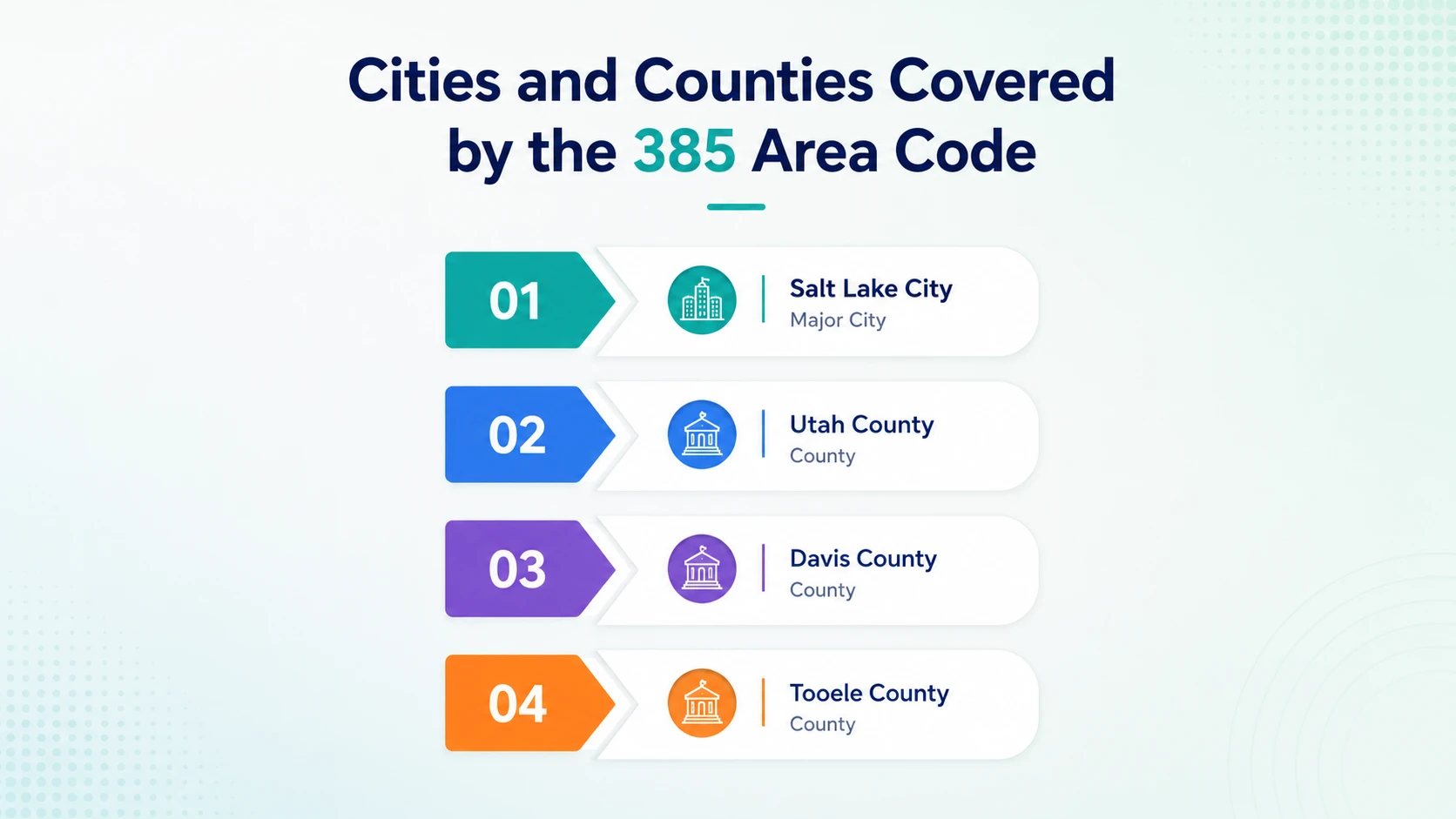
- Salt Lake County
- Utah County
- Davis County
- Weber County
- Morgan County
Within those counties, the 385 area code serves a long list of cities and towns, including:
- Salt Lake City — the state capital and metro anchor
- West Valley City — Utah's second-largest city
- Provo and Orem — the Utah County tech and university hub
- West Jordan, South Jordan, and Sandy — fast-growing southern suburbs
- Ogden and Layton — the northern Weber and Davis County corridor
- Lehi and American Fork — the "Silicon Slopes" tech belt
- Bountiful, Murray, Taylorsville, and Spanish Fork — established residential communities
Smaller communities such as Alta, Morgan, and the canyon towns along the front also fall inside the 385 footprint. In practical terms, if a place is part of greater Salt Lake City, a 385 number fits there.
5385 Area Code Time Zone
The 385 area code sits in the Mountain Time Zone (MT). That means numbers in this region follow Mountain Standard Time (MST) at UTC−7 during the standard-time months of the year, and Mountain Daylight Time (MDT) at UTC−6 when daylight saving time is in effect.
For anyone scheduling calls into Salt Lake City, that places the region one hour behind Central Time and two hours behind the East Coast. If you are dialing a 385 number from New York, a 9 a.m. Eastern call reaches Utah at 7 a.m. local — worth remembering before you ring early, per the standard time-zone references published by the Area code 385 on Wikipedia.
6Why a 385 Number Matters for Your Business
A local number is more than a string of digits; it is a signal of presence and trust. People are far more likely to answer a call that looks local than one from an unfamiliar or out-of-state code. For companies selling into the Salt Lake market, a 385 area code phone number delivers several concrete advantages:
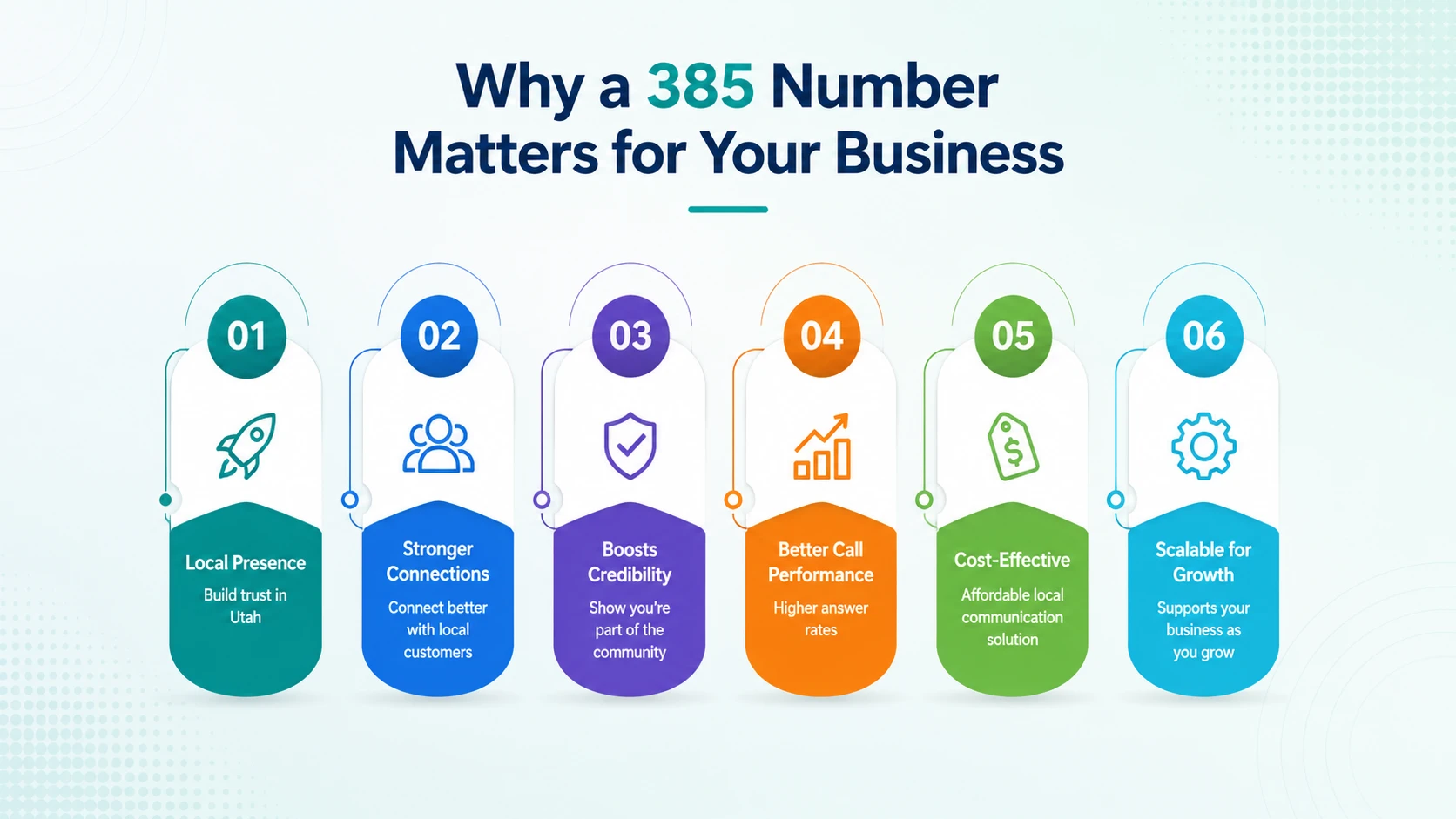
- Higher answer rates. Wasatch Front customers recognize 385 and 801 as home, so your calls feel familiar rather than intrusive.
- Local credibility. A 385 number positions even a remote or national business as a genuine member of the Utah community.
- Market testing without an office. You can establish a Salt Lake presence and route those calls anywhere — no physical branch required.
- Consistent branding. Pairing a memorable local number with SMS and voice keeps every customer touchpoint on one identity.
For sales teams, support desks, real estate agents, and service providers chasing the booming Silicon Slopes economy, a 385 number is an inexpensive but powerful way to compete with established local players.
7How to Get a 385 Area Code Phone Number
You no longer need a landline contract or a Utah office to own a 385 number. With a cloud communications platform like Softtop, you can provision a local 385 line and start taking calls and texts the same day. Softtop carries inventory across 800-plus U.S. area codes, including local DIDs for any Utah market, and provisions them instantly.
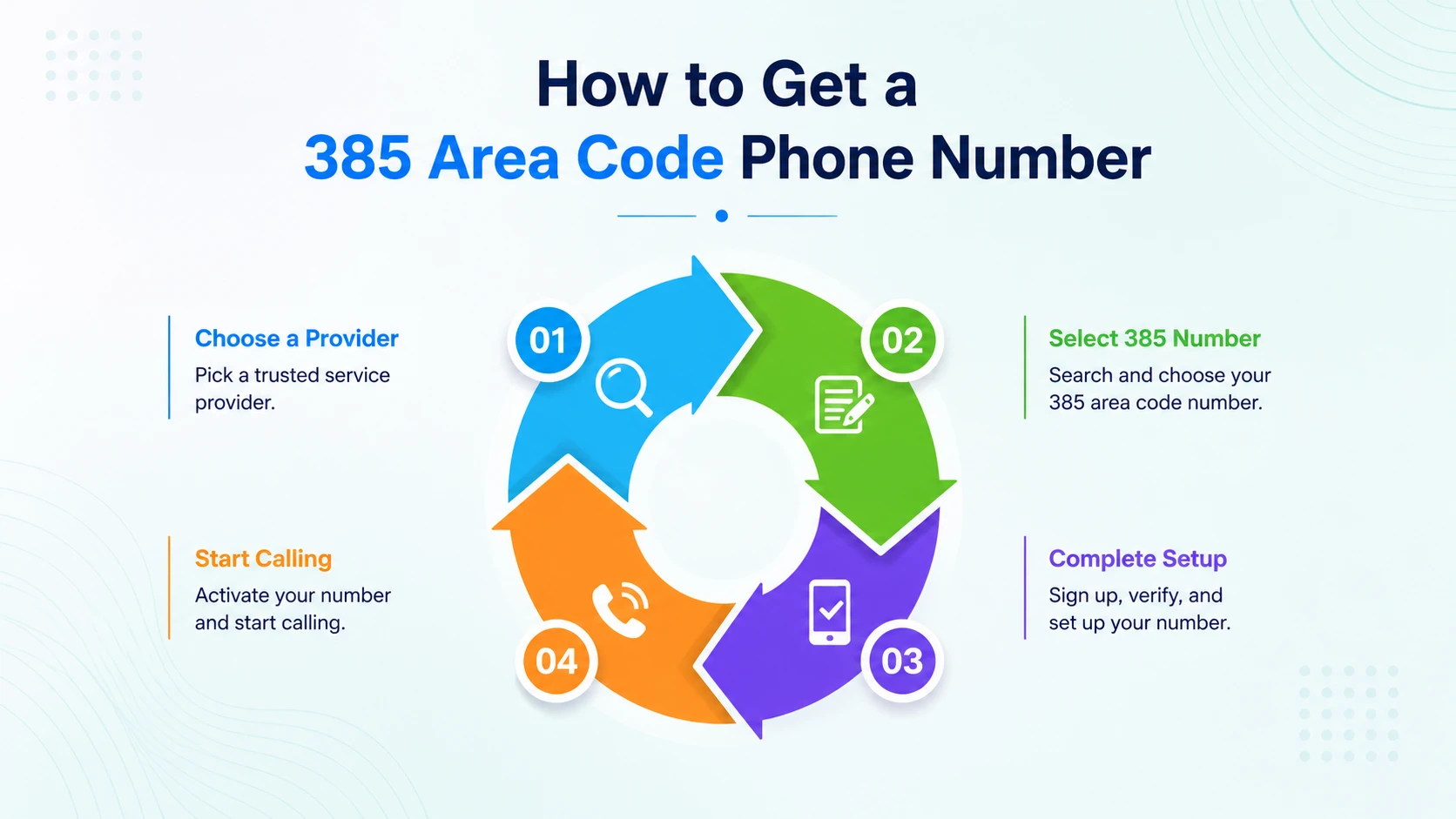
- 1Choose your number. Search Softtop's inventory for an available 385 line, hold it before purchase, or order in bulk if you need many at once.
- 2Activate the line. Numbers provision instantly, so your 385 presence is live without waiting on a carrier.
- 3Route calls anywhere. Forward to a mobile, a desk phone, a softphone, or a full team — calls land wherever your people are.
- 4Add voice, SMS, and AI. Layer on business SMS and MMS, an AI Receptionist that answers every call, call recording, and smart routing on the same platform.
Because Softtop runs everything — voice, SIP trunking, SMS, global numbers, and a cloud contact center — on one Tier-1 platform with one bill and one SLA, you get a local Utah footprint backed by carrier-grade reliability and 24/7 human support. The same dashboard can just as easily provision a 630 area code number for DuPage County, Illinois, if you ever expand beyond Salt Lake City.
8Are 385 Area Code Calls Safe?
The 385 area code itself is completely legitimate — it is simply Utah's overlay code, not a marker of fraud. That said, scammers everywhere exploit "neighbor spoofing," a tactic where they fake a local area code so their call looks like it is coming from nearby. A spoofed 385 number can appear on your screen even when the caller is anywhere in the world.
A few sensible habits keep you protected:
- Let unknown 385 calls go to voicemail. Legitimate callers will leave a message.
- Never share personal or financial details with an unsolicited caller, regardless of the area code.
- Verify independently. If a "bank" or "agency" calls, hang up and dial the official number yourself.
- Block and report repeat offenders through your carrier or phone settings.
Business owners can also reduce the odds of their own numbers being flagged or spoofed by using a provider with STIR/SHAKEN attestation and built-in fraud protection — both standard on Softtop's network for U.S. calls.
9Conclusion
The 385 area code is the modern face of the Salt Lake City region. Introduced in 2008 as an overlay on the long-standing 801 code, it shares the same five-county Wasatch Front territory — covering Salt Lake City, West Valley City, Provo, Orem, Ogden, and dozens of surrounding communities — all within the Mountain Time Zone. For residents, it is simply the number on their phone. For businesses, it is a doorway into one of the fastest-growing economies in the country.
Whether you want to build local trust in Utah, expand into the Silicon Slopes corridor, or simply understand the calls reaching your phone, the 385 area code is worth knowing well. And when you are ready to claim a local number of your own, Softtop makes it possible to get a working 385 line — complete with voice, SMS, and AI tools — in a matter of minutes.