1Introduction
If you've ever received a call from a 717 number — or you're looking to establish a local presence in south central Pennsylvania — this guide covers everything you need to know. The 717 area code serves one of the most historically rich and economically vibrant regions in the Keystone State: home to the state capital, Pennsylvania Dutch Country, Civil War heritage sites, and millions of residents and businesses.
Whether you need to identify a 717 caller, understand the geography behind the code, protect yourself from spoofed scam calls, or set up a local business number for the region, you'll find clear, actionable answers here. From its 1947 origins to the modern 223 overlay, we break down every aspect of the 717 area code so you're always a step ahead.
2What Is the 717 Area Code?
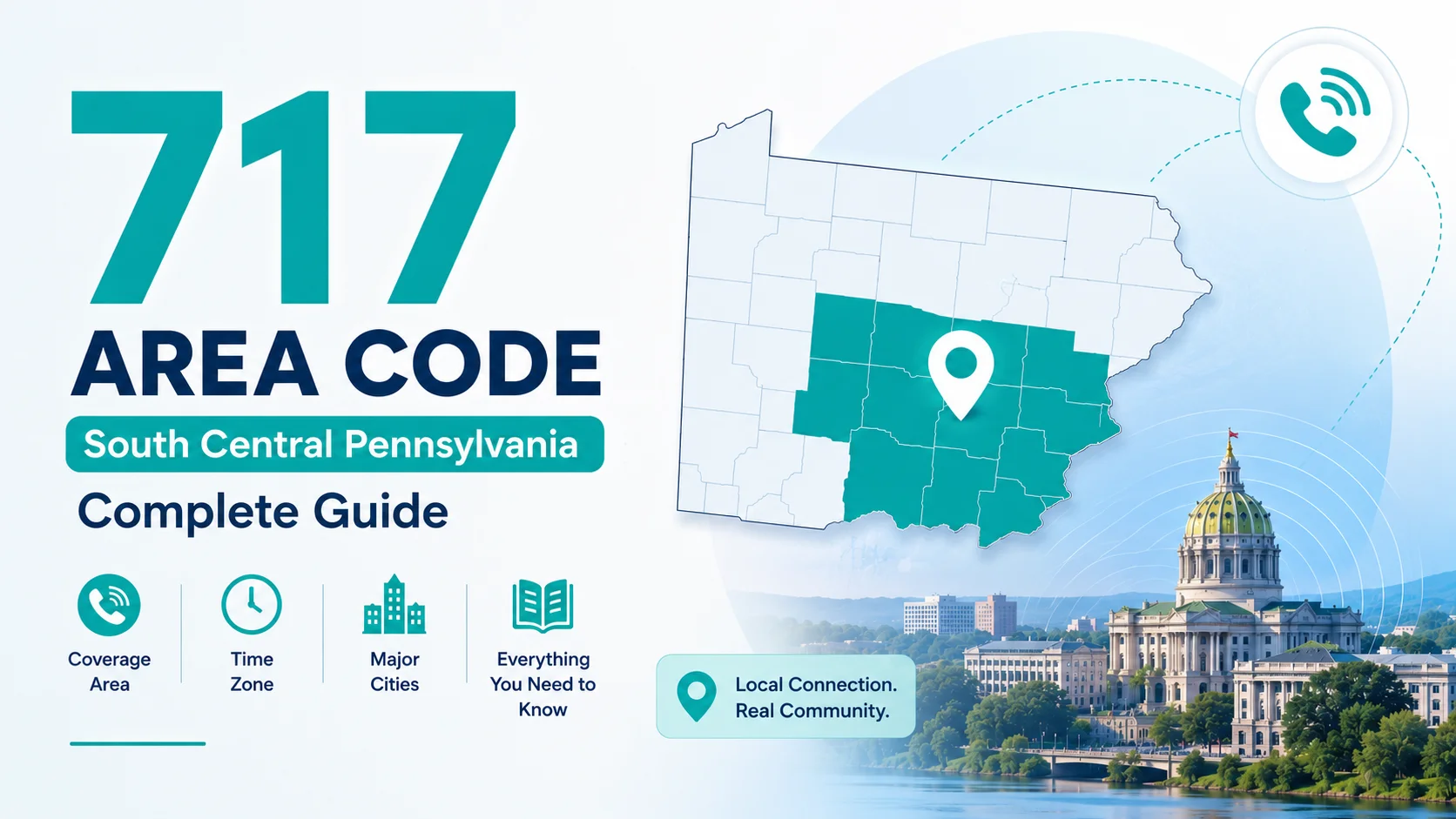
The 717 area code is the primary telephone area code for south central Pennsylvania. It covers a broad stretch of the state — from the Susquehanna Valley through the rolling farmlands of Pennsylvania Dutch Country, across the Cumberland Valley, and down to the Maryland state line.
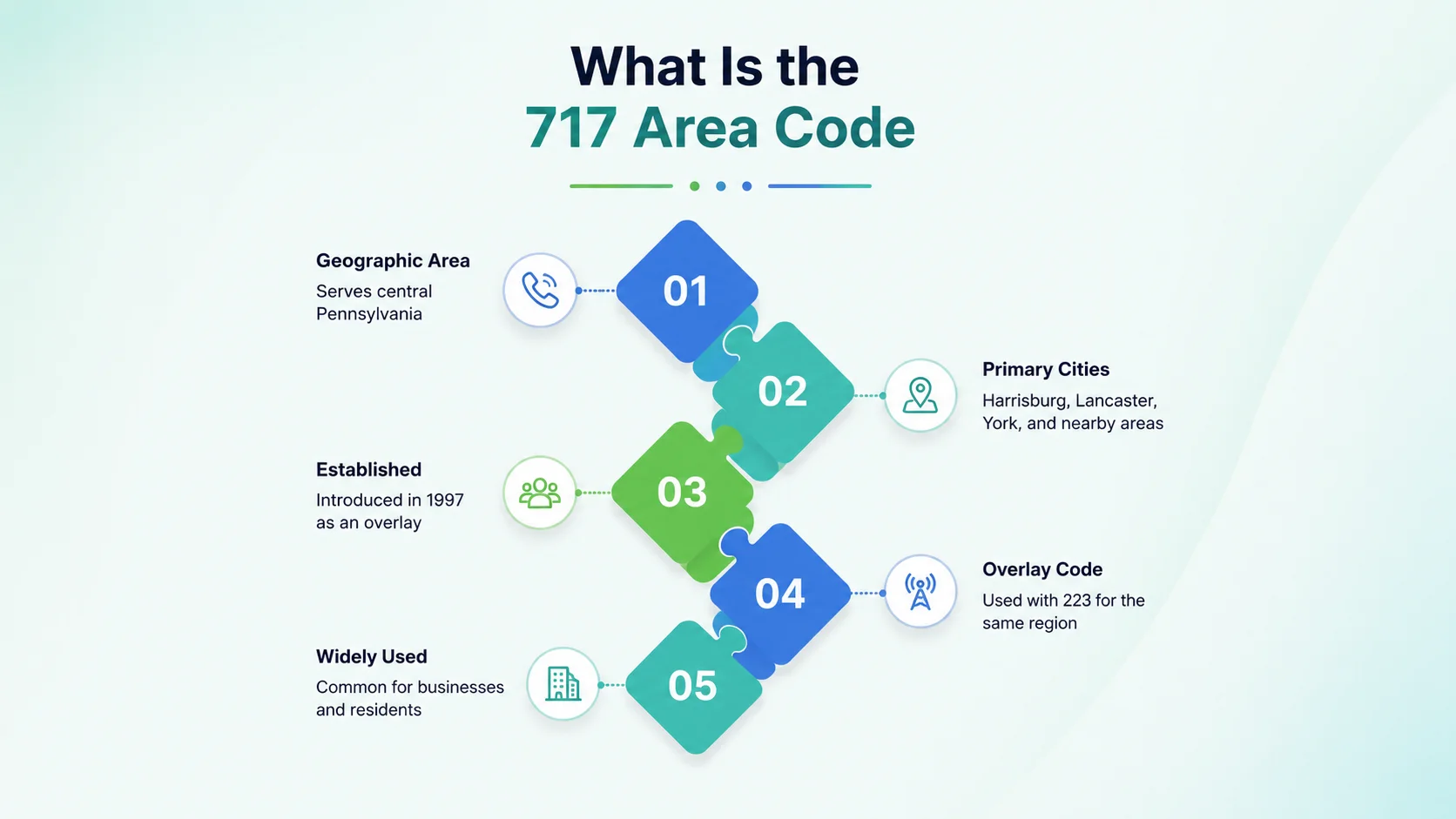
This region is anchored by three major urban centers: Harrisburg (the state capital), Lancaster (a thriving arts and commerce hub), and York (a growing manufacturing and healthcare center). Together, these cities and their surrounding counties form one of the most economically connected corridors in the Mid-Atlantic United States.
The 717 numbering plan area (NPA) falls entirely within the Eastern Time Zone (UTC−5 in winter, UTC−4 during daylight saving time). Whether you're calling from the West Coast, internationally, or the other side of the state, keep Eastern Time in mind when scheduling business calls or outreach campaigns into the region.
3History of the 717 Area Code
Area code 717 has deep roots in American telecommunications. It was established in 1947 as one of the original 86 North American Numbering Plan (NANP) area codes — among the very first assigned when AT&T rolled out the modern telephone numbering system.
Originally, 717 covered nearly all of Pennsylvania outside of Philadelphia and its suburbs (which received 215). As Pennsylvania's population expanded over the following decades, the state was progressively subdivided: codes 412 (Pittsburgh), 814 (western PA), and 570 (northeast PA) were carved out, eventually concentrating 717 on south central Pennsylvania.
By the late 1990s and early 2000s, even this trimmed footprint was running low on available numbers. Demand from mobile phones, fax lines, pagers, and internet connections had consumed number inventory at an accelerating pace. The solution — introduced in 2013 — was the 223 area code overlay, which paired a new code with the same geographic region rather than splitting it further, similar to how Ohio handled growth around the 513 area code. Today, 717 remains the dominant and most recognized code for south central Pennsylvania, while 223 quietly supplements it with additional capacity.
4Cities and Counties Covered by the 717 Area Code
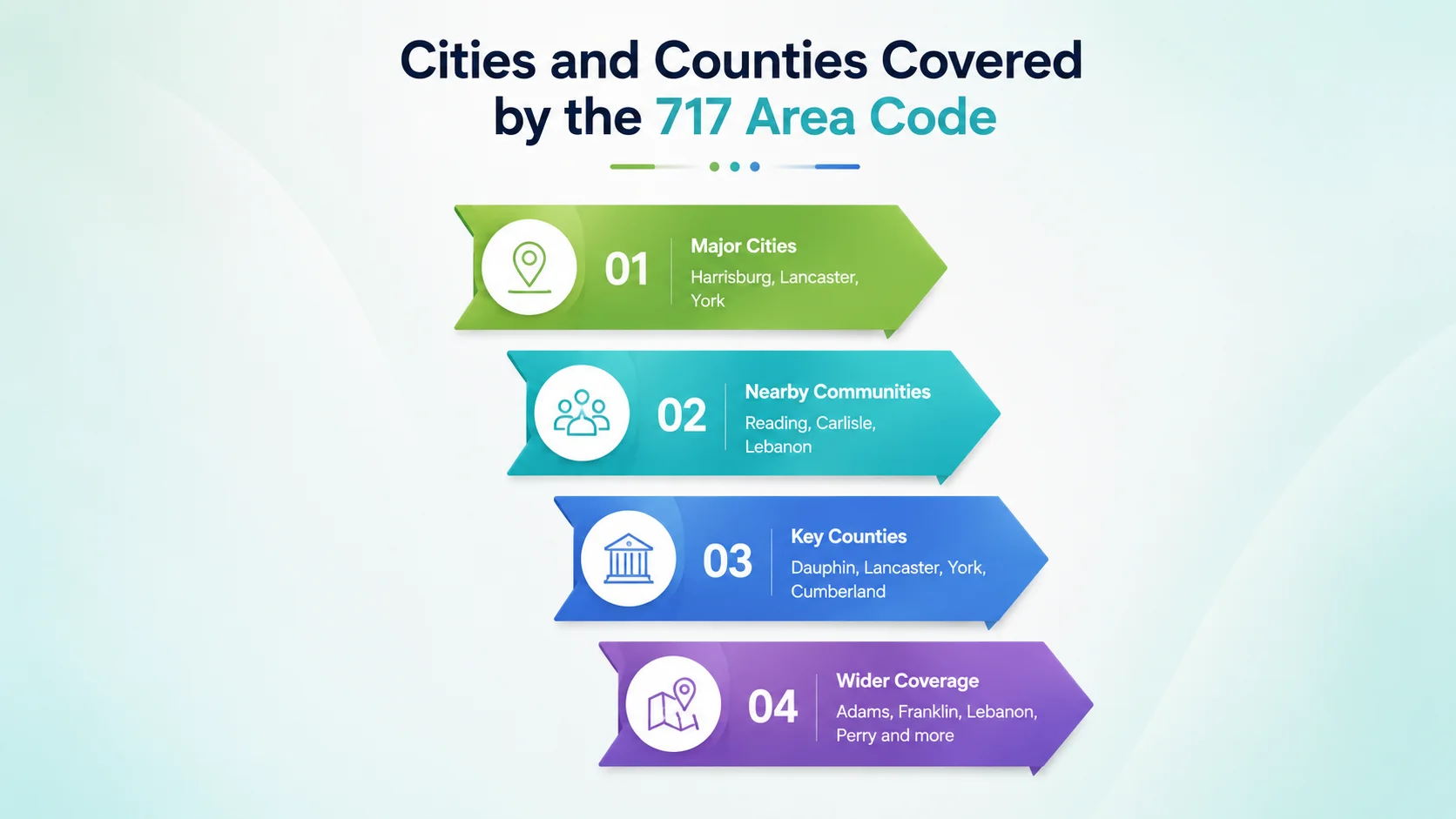
The 717 area code spans 14 counties in south central Pennsylvania, touching everything from suburban commuter belts to remote rural townships. Here are the most notable cities and communities served:
- Harrisburg — Pennsylvania's state capital and regional commercial hub
- Lancaster — Heart of Pennsylvania Dutch Country and a vibrant arts destination
- York — Manufacturing center and rapidly growing healthcare corridor
- Chambersburg — Franklin County seat and gateway to the Cumberland Valley
- Lebanon — Central point of the Lebanon Valley agricultural region
- Carlisle — Home to Dickinson College and the U.S. Army War College
- Hanover — A bustling borough close to the Maryland border
- Hershey — Famous for its chocolate heritage and Penn State Health Medical Center
- Gettysburg — Site of the pivotal 1863 Civil War battle and a major tourist destination
Counties within the 717 NPA include Dauphin, Lancaster, York, Cumberland, Franklin, Lebanon, Adams, Perry, Juniata, Mifflin, Snyder, and additional surrounding counties. This geographic breadth means that a 717 number is instantly recognized by millions of Pennsylvanians as a local call — a built-in trust signal that businesses calling into or within the region benefit from enormously.
5The 223 Area Code Overlay Explained
When area code 717 began running out of available numbers, Pennsylvania regulators introduced area code 223 in 2013 as an overlay. Unlike a split — where a new code takes over part of an existing region — an overlay shares the exact same geographic territory. Both 717 and 223 cover the same counties, cities, and communities in south central Pennsylvania.
What the overlay means for everyday callers:
- 10-digit dialing is mandatory for all local calls in the 717/223 region — even calling your next-door neighbor requires the full area code + seven-digit number
- Newly assigned phone numbers in the region may carry either the 717 or the 223 code
- Both area codes share the same time zone, billing rules, and dialing conventions
For businesses, this means clients and partners in the region may carry 223 numbers rather than 717. Treat both codes with equal legitimacy — they represent the same community, the same customers, and the same local trust.
6Identifying and Avoiding 717 Area Code Scam Calls
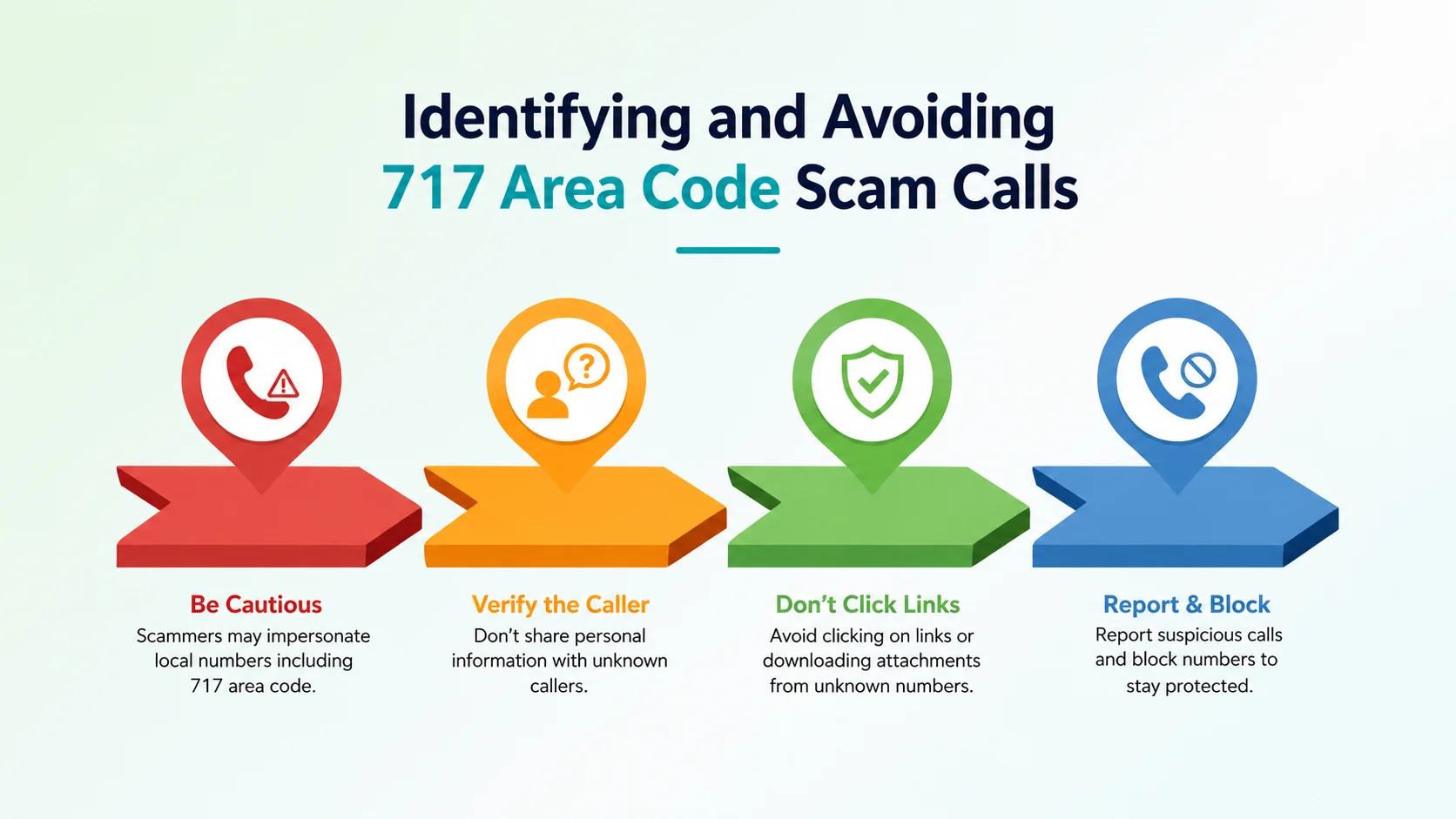
Like virtually every active area code in the United States, 717 numbers are regularly spoofed by fraudsters. Caller ID spoofing allows bad actors to mask their true number and display a familiar-looking local code, making recipients far more likely to answer.
Common scam types reported from spoofed 717 numbers:
- Medicare and Medicaid fraud calls — consistently the most reported category
- Home improvement scams — fake contractors targeting homeowners
- Auto warranty robocalls
- Solar panel and health insurance pitches
- Fake utility company impersonation calls
How to protect yourself:
- If you're not expecting a call, let unknown 717 numbers go to voicemail — legitimate callers leave messages
- Never share personal information, Social Security numbers, or payment details over an unsolicited inbound call
- Hang up and call the purported organization back directly using a number from their official website
- Report suspicious calls to the FTC or the Pennsylvania Attorney General's office
- Look for VoIP providers and carriers that support STIR/SHAKEN attestation — the FCC-mandated framework that cryptographically verifies a caller's identity and flags spoofed numbers to recipients
You can file a report directly with the FTC's fraud reporting site. Spoofing is never the fault of legitimate 717 businesses. The best defense for organizations is to ensure their own outbound calls carry full STIR/SHAKEN A-attestation, building caller trust over time.
7How to Get a 717 Area Code Phone Number for Your Business
You don't need a physical office in Harrisburg or Lancaster to use a 717 number. Modern VoIP and cloud phone platforms allow any business — regardless of location — to provision a south central Pennsylvania number and use it as a professional local line.
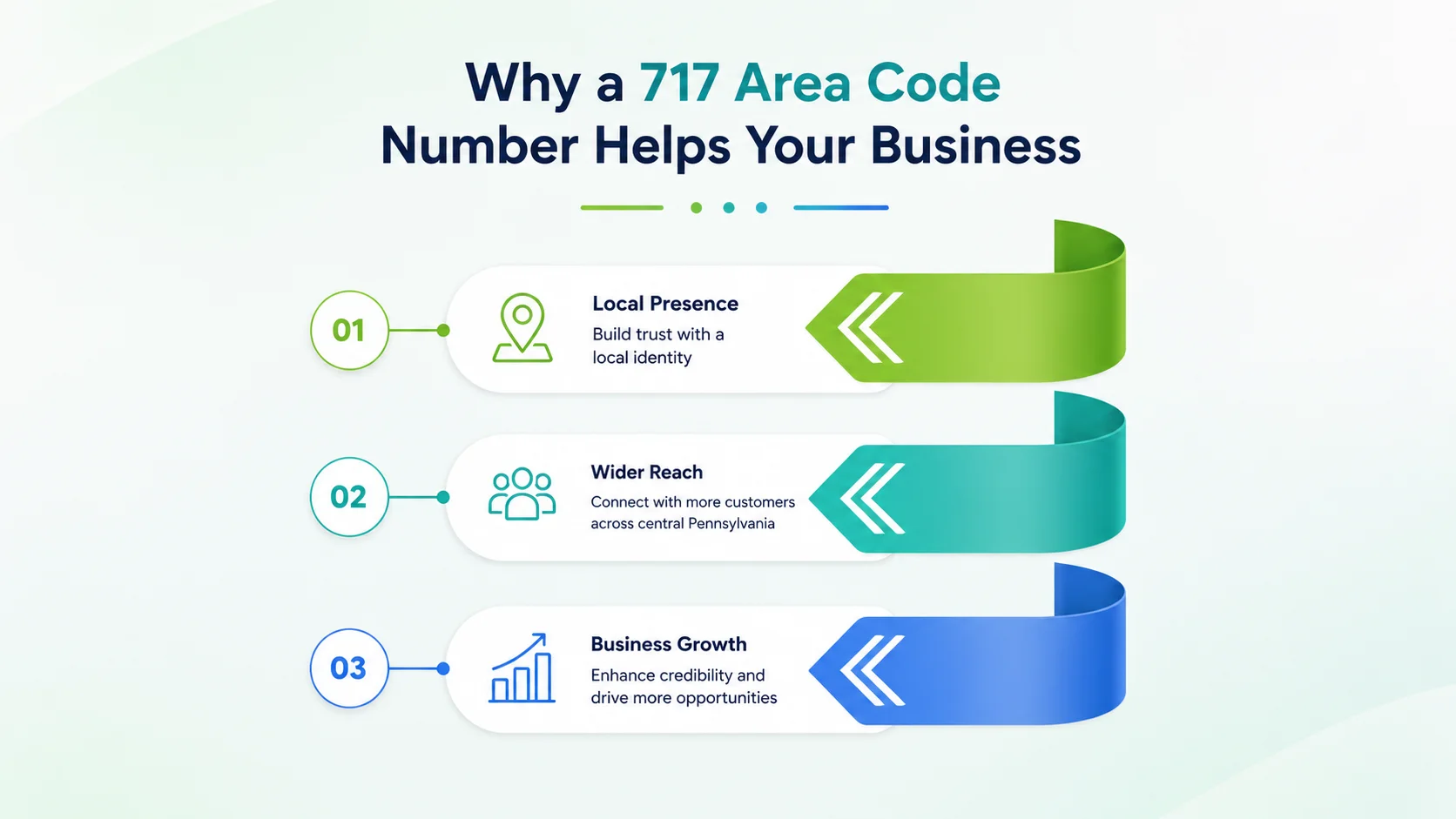
Why a 717 area code number helps your business:
- Builds immediate credibility with Pennsylvania customers who recognize it as local
- Lifts call answer rates — people are significantly more likely to pick up local-looking numbers
- Strengthens local SEO when listed consistently on Google Business Profile, Bing Places, and regional directories
- Enables cost-effective inbound and outbound calling across the entire 717/223 region
What to look for in a 717 number provider:
- Instant provisioning — you should be live in minutes, not days
- Full VoIP feature set — call forwarding, voicemail-to-email, auto-attendant, IVR, and call recording as standard
- STIR/SHAKEN attestation — ensures your outbound calls pass modern spam filters and reach recipients' screens
- Scalability — ability to add extensions, ring groups, or a full contact center as your team grows
- Compliance-ready infrastructure — critical for outbound campaigns targeting Pennsylvania residents under FCC and TCPA rules
Softtop offers an enterprise-grade cloud phone system with 800+ US area codes in inventory — including 717 and the 562 area code in Southern California — with instant number activation, unlimited US and Canada calling, an AI Receptionist on every line, and a guaranteed 99.999% uptime SLA. STIR/SHAKEN attestation is built in at the carrier layer, and the platform scales from a single seat to thousands of agents. Start with a 14-day free trial — no credit card required.
8Conclusion
The 717 area code is far more than a string of digits — it's the telephone identity of a region spanning Pennsylvania's state capital, Civil War battlefields, Dutch Country farmlands, and some of the Mid-Atlantic's most active business communities. Whether you're trying to identify an incoming call, understand how the 223 overlay affects local dialing, guard against spoofed scammers, or build a credible local presence in south central Pennsylvania, knowing how 717 works puts you in a position of confidence.
For any business ready to establish a trusted, STIR/SHAKEN-attested 717 number on a reliable, all-in-one platform, explore Softtop's cloud phone system — instant provisioning, full VoIP features, and carrier-grade infrastructure, all on one bill.