1Introduction
If you've received a call from a 925 number, or you're weighing whether one makes sense for your business, you're looking at one of California's busiest inland telephone codes. The 925 area code covers a stretch of the East Bay that runs from national research labs to Fortune 500 corporate campuses, and it's been in service since the late 1990s.
This guide breaks down exactly where the 925 area code sits on the map, which cities and counties it serves, what time zone it follows, why so many businesses request one, and how to spot the scam calls that sometimes ride along with it.
2What Is the 925 Area Code?
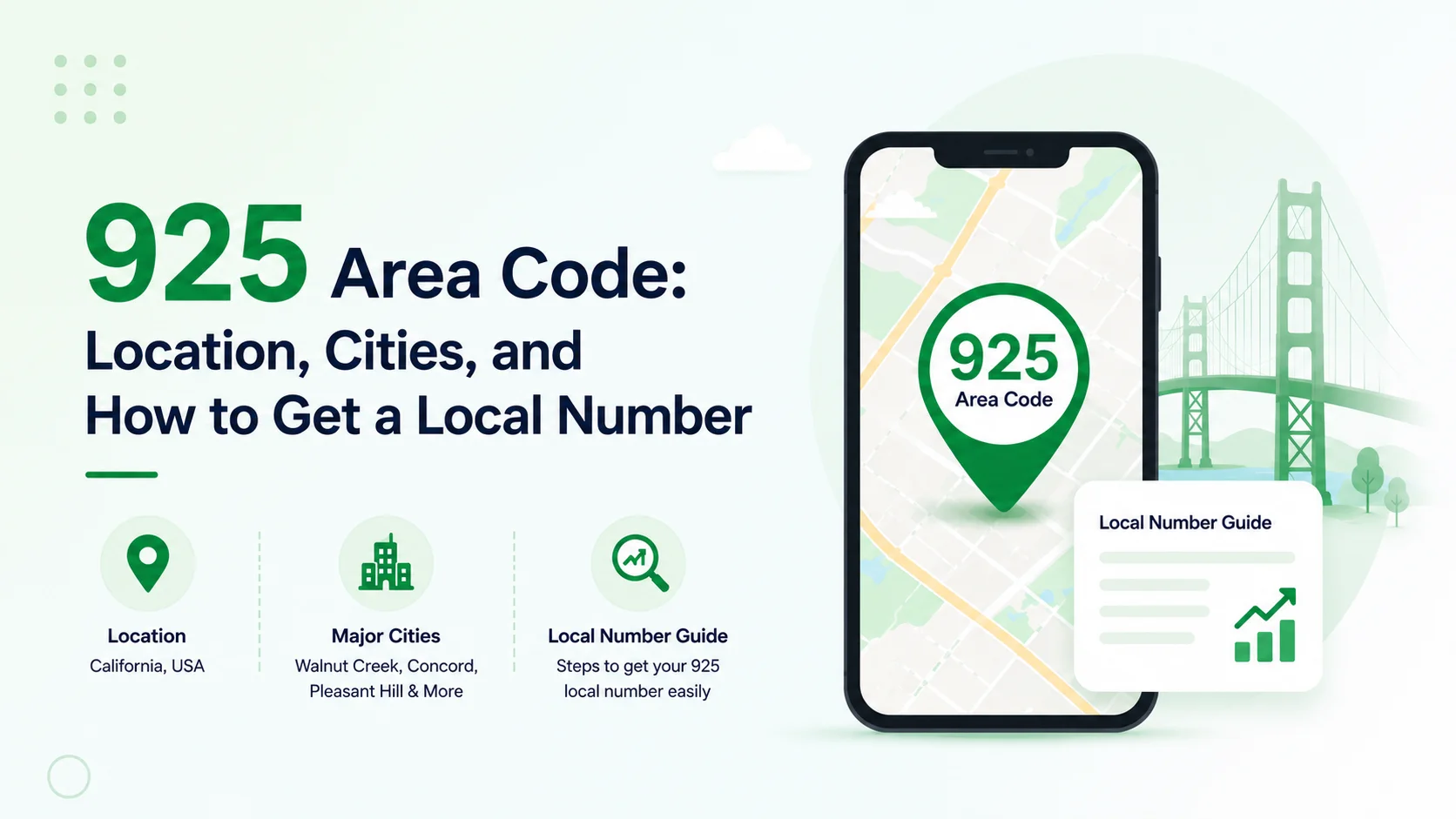
The 925 area code is a California telephone prefix assigned to the inland portion of the San Francisco Bay Area's East Bay region. It covers most of Contra Costa County and the Tri-Valley section of southeastern Alameda County, and it belongs to the North American Numbering Plan that governs phone numbering across the United States, Canada, and several Caribbean nations.
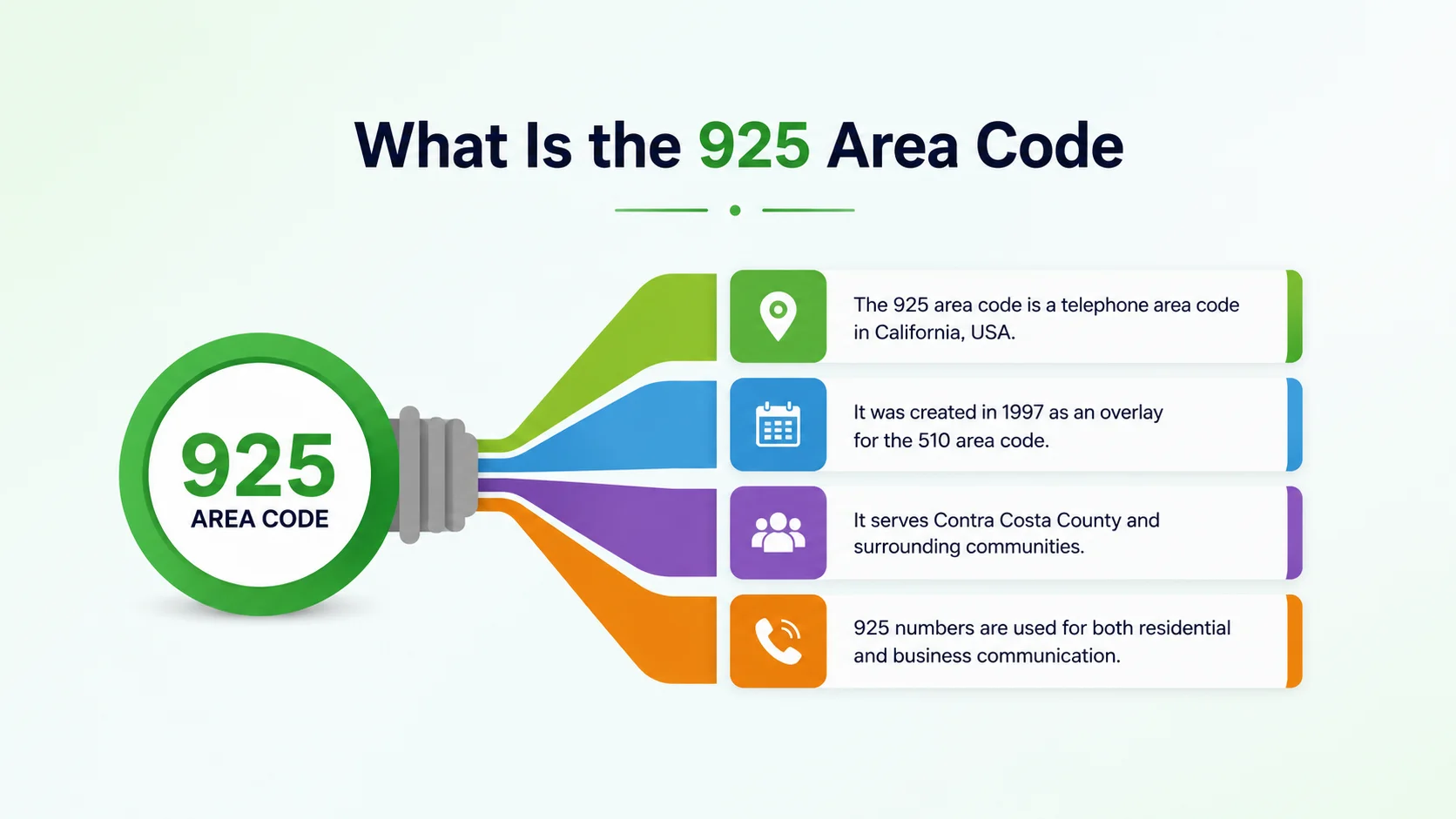
Area code 925 went into service on March 14, 1998, created when regulators split the original 510 area code along the natural boundary of the Berkeley Hills. The coastal cities — Oakland, Berkeley, and Fremont — kept the 510 area code, an area now also served by the newer 341 area code overlay, while the inland suburbs and business corridors east of the ridge, which were quickly running out of available numbers, moved to 925. Before that split, the entire region had been served by 415, one of California's original three area codes.
3Cities and Communities Covered by the 925 Area Code
The 925 area code spans more than two dozen cities and unincorporated communities across two counties, with a combined population well over a million residents. Coverage includes:
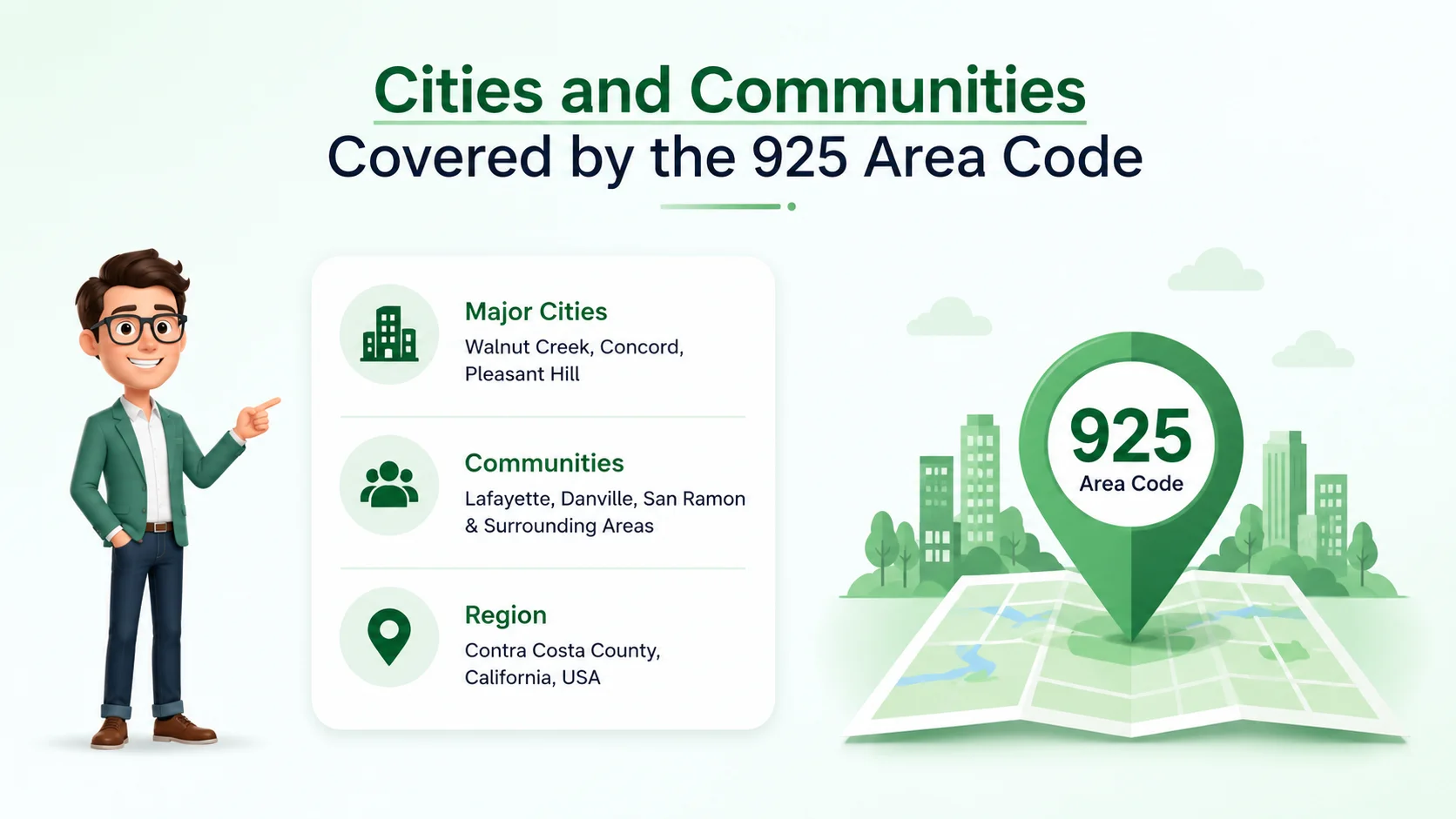
- Concord: the largest city in Contra Costa County, anchoring the Diablo Valley
- Walnut Creek: a regional hub for financial services and healthcare
- Antioch, Pittsburg, Oakley, and Brentwood: fast-growing delta cities in northern Contra Costa County
- Livermore: home to two national research laboratories and a growing tech and biotech presence
- Pleasanton, San Ramon, and Dublin: the Tri-Valley's corporate campus corridor, home to numerous large employers
- Danville, Lafayette, Moraga, and Orinda: affluent Diablo Valley suburbs known for their schools
- Martinez: the Contra Costa County seat
Because the area code lines up with county and city boundaries rather than an overlay, a 925 number is a reliable signal that a caller or business is physically rooted in this part of the East Bay.
4925 Area Code Time Zone and Dialing Rules
Like the rest of California, the 925 area code operates in the Pacific Time Zone. That means Pacific Standard Time (UTC−8) from November through March, and Pacific Daylight Time (UTC−7) the rest of the year — a three-hour gap behind New York, Boston, or Miami that East Coast-facing teams need to plan around when scheduling calls.
Dialing within the 925 area code has changed in one important way. For years, seven-digit local dialing was allowed, but that ended in October 2021 when regulators mandated 10-digit dialing nationwide to accommodate 988, the new three-digit code for the National Suicide Prevention Lifeline. Every call within the 925 region now requires the full area code, and the North American Numbering Plan Administrator maintains the official record of these numbering rule changes for every area code in the country, including the exact date each region moved to mandatory 10-digit dialing. International callers should dial +1 (925) followed by the seven-digit number, and businesses publishing a 925 number on invoices, websites, or caller ID should always format it in full to avoid confusing callers who are used to the older seven-digit habit.
5Why Businesses Choose a 925 Area Code Number
A 925 number is more than a prefix for companies trying to reach East Bay customers — it's a trust signal. Calls from local, recognizable area codes are answered more consistently than calls from unfamiliar or out-of-area numbers, which matters in a region dense with corporate campuses and professional buyers who screen unknown calls by default.
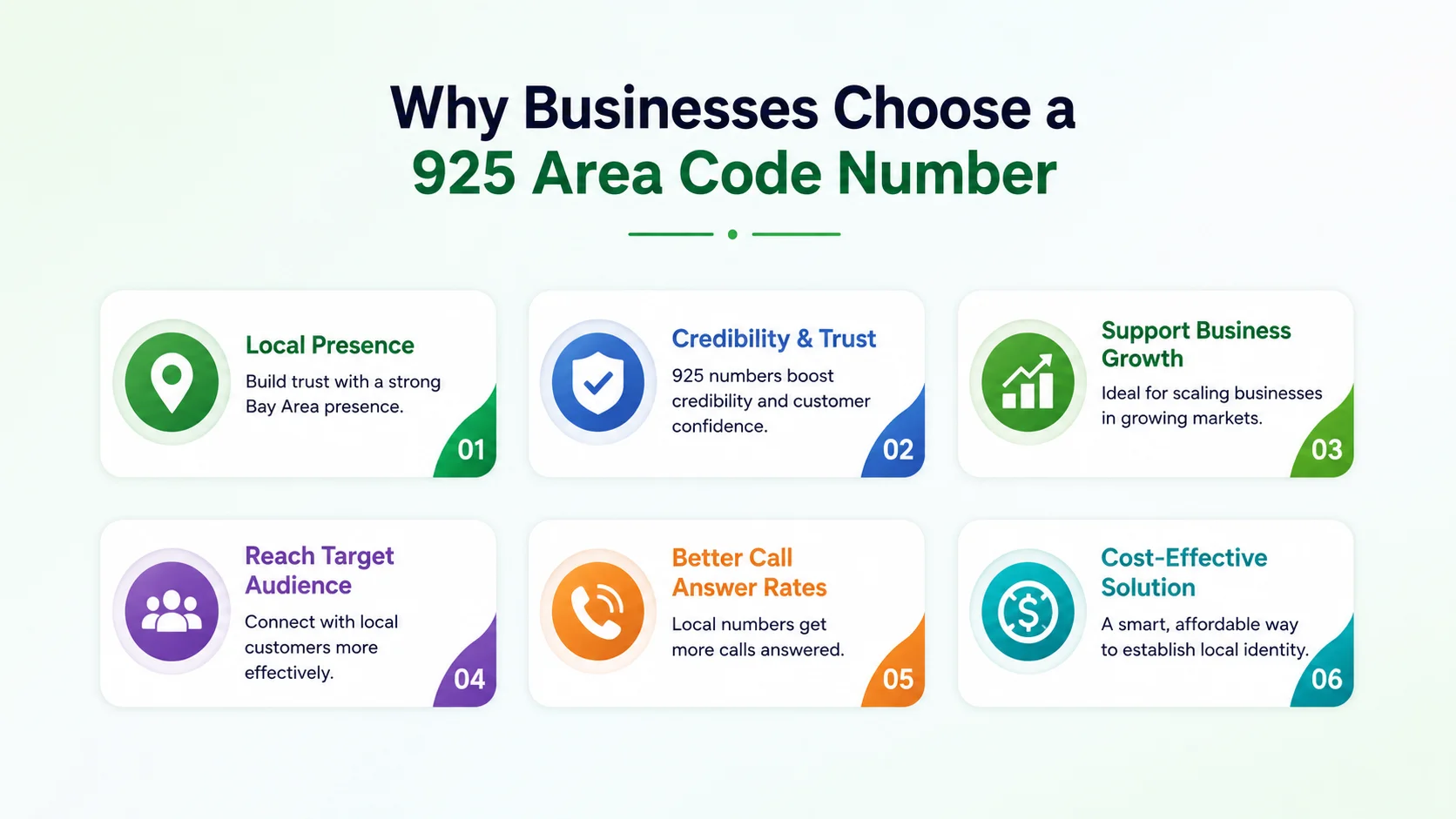
Cloud-based phone systems have made getting a 925 number far simpler than it used to be. A distributed sales or support team can present a consistent East Bay caller ID on every outbound call, answer inbound inquiries from any device, and route calls intelligently without leasing a single square foot of Contra Costa office space. That same infrastructure typically bundles in call recording, an auto-attendant, and CRM-connected call logging, so the number does more than just ring — it feeds directly into how a team tracks and follows up on every conversation. Businesses expanding into other California markets often pair a 925 number with coverage in neighboring regions, such as the 707 area code covering the North Bay and wine country, to build a broader local footprint across the state.
6How to Get a 925 Area Code Phone Number
There are three common paths to acquiring a 925 number:
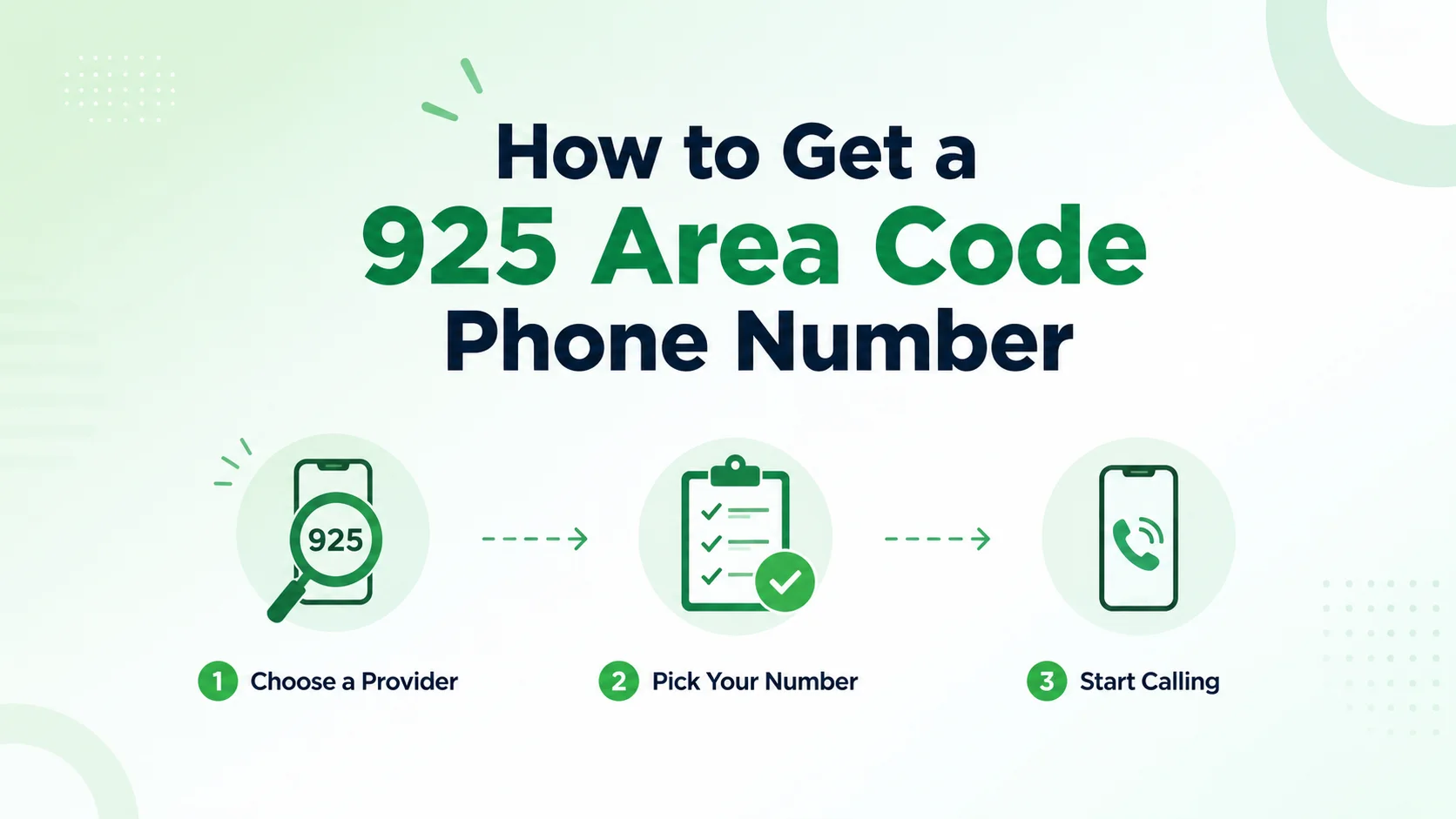
- Traditional carrier: AT&T, Verizon, and T-Mobile issue 925 numbers to customers physically located within the service territory — the standard route for a landline or mobile plan
- Cloud VoIP platform: a hosted business phone provider can issue a 925 number and route it to any desktop, mobile device, or softphone within minutes, regardless of where the team is actually based
- Number porting: if a business already has a number under a different area code, most VoIP providers can port it to a 925 prefix while preserving call history and existing contacts
When comparing options, look past the number itself to the platform behind it: uptime guarantees, porting turnaround, and whether call recording, auto-attendants, and CRM integrations come standard or cost extra as the team grows. It's also worth confirming how many 925 numbers a plan allows, since a growing team may eventually need separate lines for sales, support, and billing rather than routing every call through a single extension.
7How to Spot and Avoid 925 Area Code Scam Calls
The same local trust that makes 925 numbers valuable for legitimate businesses also makes them attractive to scammers, who spoof the prefix to make robocalls look like they're coming from a neighbor or a local office. Reported 925-area scam categories commonly include fake auto warranty offers, unsolicited home improvement pitches, mortgage and solar sales calls, and impersonation of government agencies or debt collectors demanding immediate payment.
A few habits go a long way toward staying safe:
- Let unrecognized numbers go to voicemail; legitimate callers leave a message
- Never provide payment by gift card, wire transfer, or cryptocurrency over the phone
- Run an unfamiliar 925 number through a reverse lookup service before calling back
- Enable your carrier's free call-screening or spam-labeling feature
- Report confirmed scam calls to the FTC or FCC
- Treat any request for a Social Security number, bank details, or upfront fees over the phone as a red flag, regardless of how official the caller sounds
8Conclusion
The 925 area code has served California's inland East Bay since 1998, covering everything from the national labs in Livermore to the corporate campuses of San Ramon and the financial district of Walnut Creek. It runs on Pacific Time, requires 10-digit dialing, and remains one of the more geographically consistent codes in the state, mapped cleanly to Contra Costa County and the Tri-Valley.
For residents, it's simply how the region dials. For businesses, a 925 number can be a genuine asset — a way to build local credibility and get calls answered in one of the Bay Area's most active commercial corridors, without the overhead of a physical office. It's also worth remembering that the same local trust a 925 number earns is exactly what scammers try to borrow when they spoof the prefix, so a healthy dose of skepticism toward unexpected calls remains good practice no matter which side of the line you're on.
Whatever brought you here, you now have a clear picture of what this area code covers, how it works, and what to watch out for.