1Introduction
A call from the 626 area code usually means someone from the San Gabriel Valley is trying to reach you. This three-digit prefix covers one of the busiest business corridors east of downtown Los Angeles, and it shows up constantly on caller ID across Southern California.
This guide answers the questions people search most: what the 626 area code is, where it's located, which cities it covers, and how it fits into California's numbering history. You'll also find practical steps for getting a local number if you run a business in the region.
2What Is the 626 Area Code?
This is a geographic telephone prefix assigned under the North American Numbering Plan (NANP). It identifies calls originating from a specific region rather than a single city, which is why understanding what the 626 area code is matters before you decide whether to answer or call back an unfamiliar number.
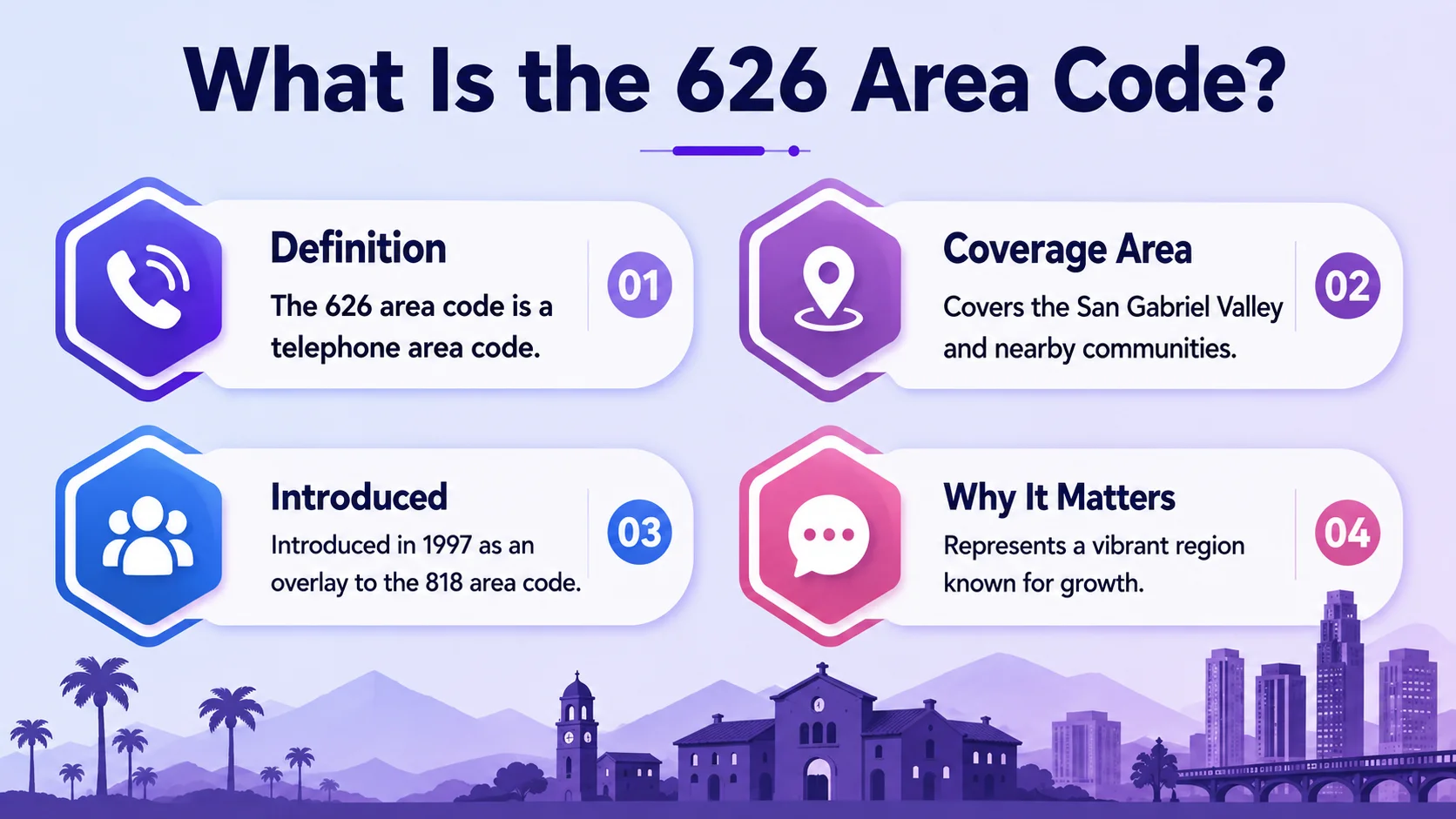
Unlike toll-free prefixes such as 800 or 833, this code is tied to a real, fixed geography. Every number starting with 626 traces back to Los Angeles County, and the prefix has never been reassigned to a different part of the state since it launched.
3Where Is the 626 Area Code Located?
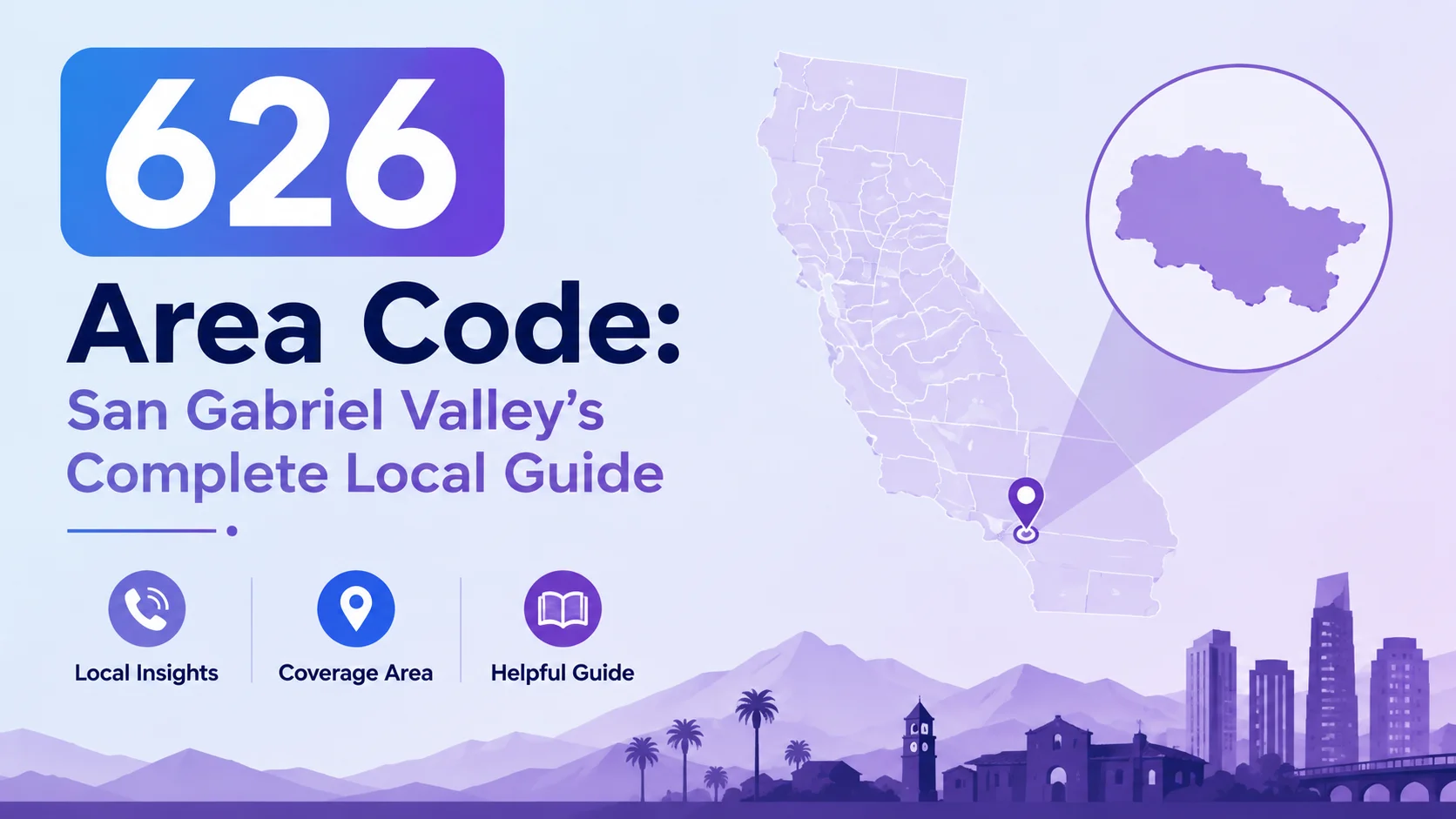
So where is the 626 area code exactly? It covers the San Gabriel Valley, a region stretching east from Los Angeles toward the San Gabriel Mountains. The territory sits entirely within Los Angeles County and borders the 213, 323, 818 area code, and 909 numbering regions.
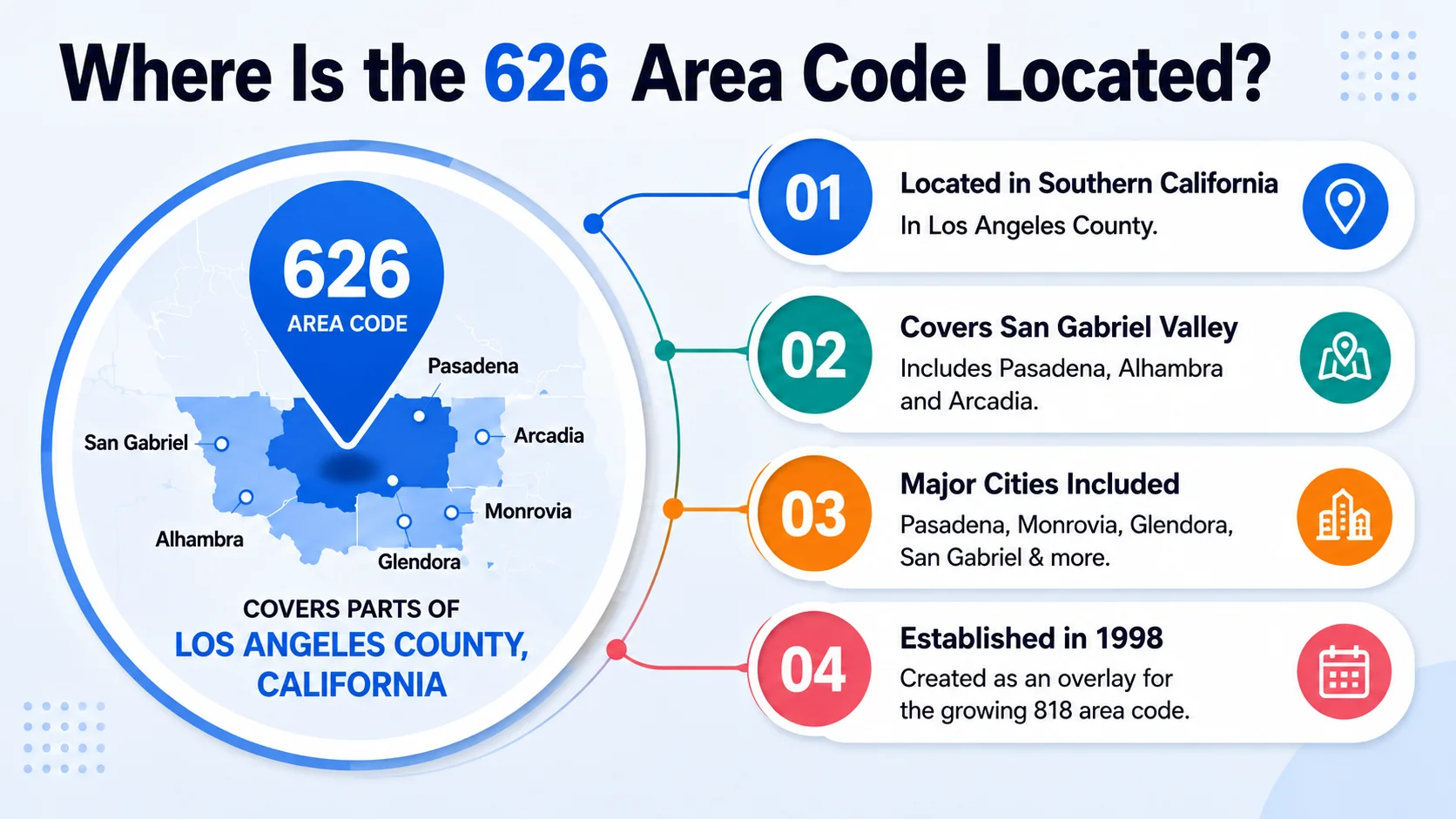
Cities and communities served by area code 626 include:
- Pasadena: home to the Rose Bowl and a major regional business hub
- Alhambra: a dense residential and commercial city bordering East LA
- Arcadia: known for the Santa Anita Park racetrack
- West Covina and Baldwin Park: mid-sized suburban business centers
- El Monte and South El Monte: industrial and logistics hubs
- Monrovia, Duarte, and Sierra Madre: foothill communities near the mountains
- San Marino and San Gabriel: smaller residential cities with strong local economies
This numbering region spans roughly 30 cities and unincorporated communities, making it one of the more densely populated areas in California's phone system. Few outsiders realize just how much economic activity — from biotech firms near Caltech to import-export warehouses in El Monte — runs through this single prefix every day.
4A Brief History of the 626 Area Code
This prefix went into service on June 14, 1997, becoming the sixteenth area code assigned within California. It was carved out of the original 818 area code, which itself split from 213 in 1984 as the Los Angeles region's population and phone demand grew far beyond what one prefix could support.
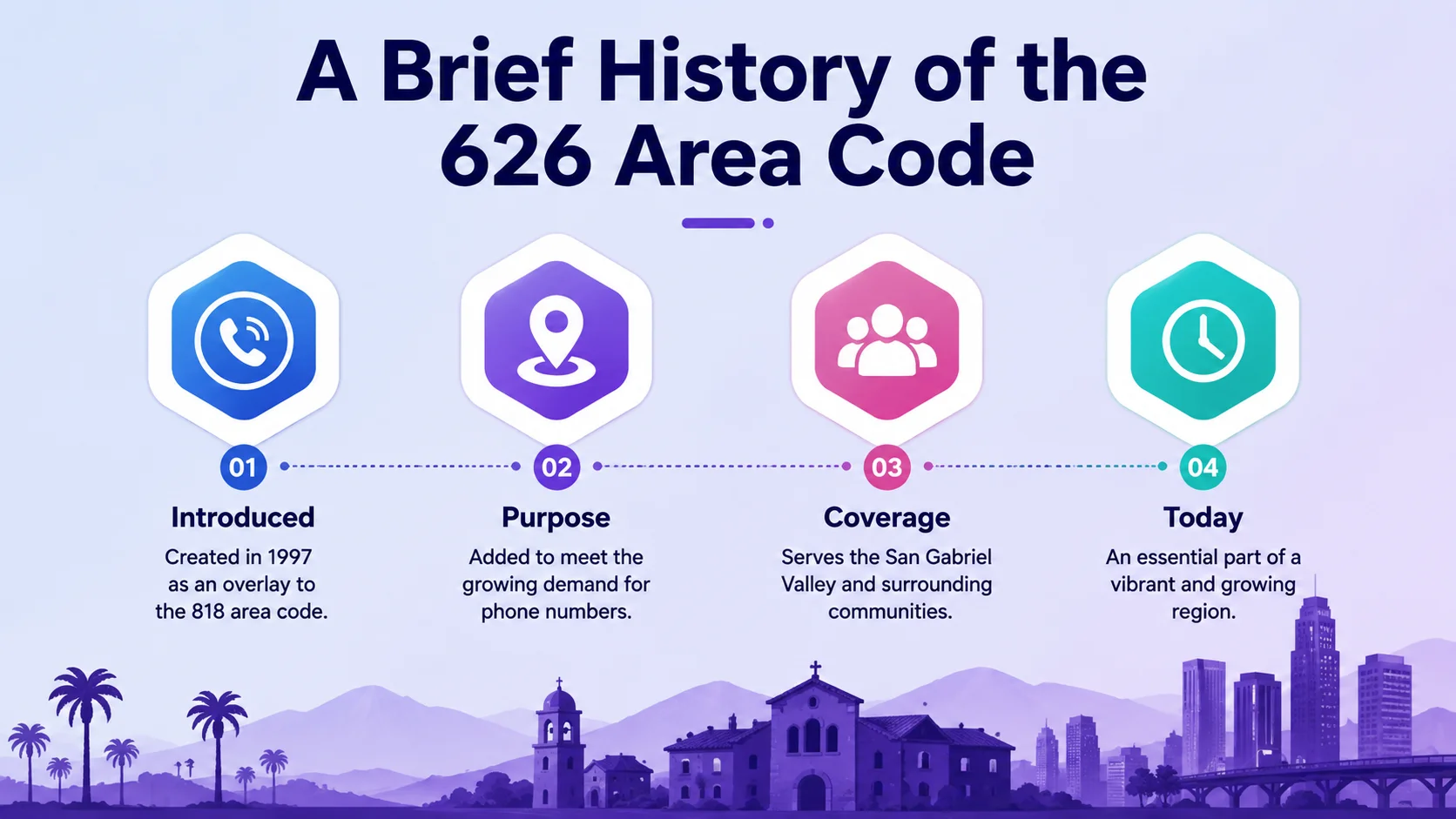
By the mid-1990s, 818 covered too much territory to sustain new number growth in the eastern San Gabriel Valley. Regulators split the region, keeping 818 for the San Fernando Valley and assigning the new code to Pasadena, Alhambra, and the surrounding communities. That boundary has remained unchanged for more than two decades, which is unusually stable for a fast-growing corner of Los Angeles County.
5The 840 Overlay and 10-Digit Dialing
Just like the region outgrew 818 in the 1990s, the San Gabriel Valley eventually outgrew its own number supply again. In 2021, California regulators approved 840 as an overlay covering the identical geographic footprint, rather than splitting the territory a second time.
Because 626 and 840 now share the same region, every call within the area requires 10-digit dialing, even between two neighbors with the same prefix. Existing numbers were not changed or reassigned; the overlay only applies to newly issued lines — the same approach Colorado took when it layered overlays onto the 303 area code instead of splitting it again.
6What Time Zone Does the 626 Area Code Use?
Every community here operates on Pacific Time. That means Pacific Standard Time (UTC−8) in the winter and Pacific Daylight Time (UTC−7) from March through early November, the same clock used across the rest of California.
Businesses coordinating with the San Gabriel Valley from the East Coast should plan for a three-hour gap during standard time, which narrows slightly during the daylight saving overlap period each spring and fall.
7Is the 626 Area Code a Scam? What to Watch For
The 626 area code itself is completely legitimate — it simply identifies calls from a real, populous part of Los Angeles County. But its familiarity is exactly why scammers exploit it. Caller ID spoofing lets a fraudulent caller display a local number so residents are more likely to pick up.
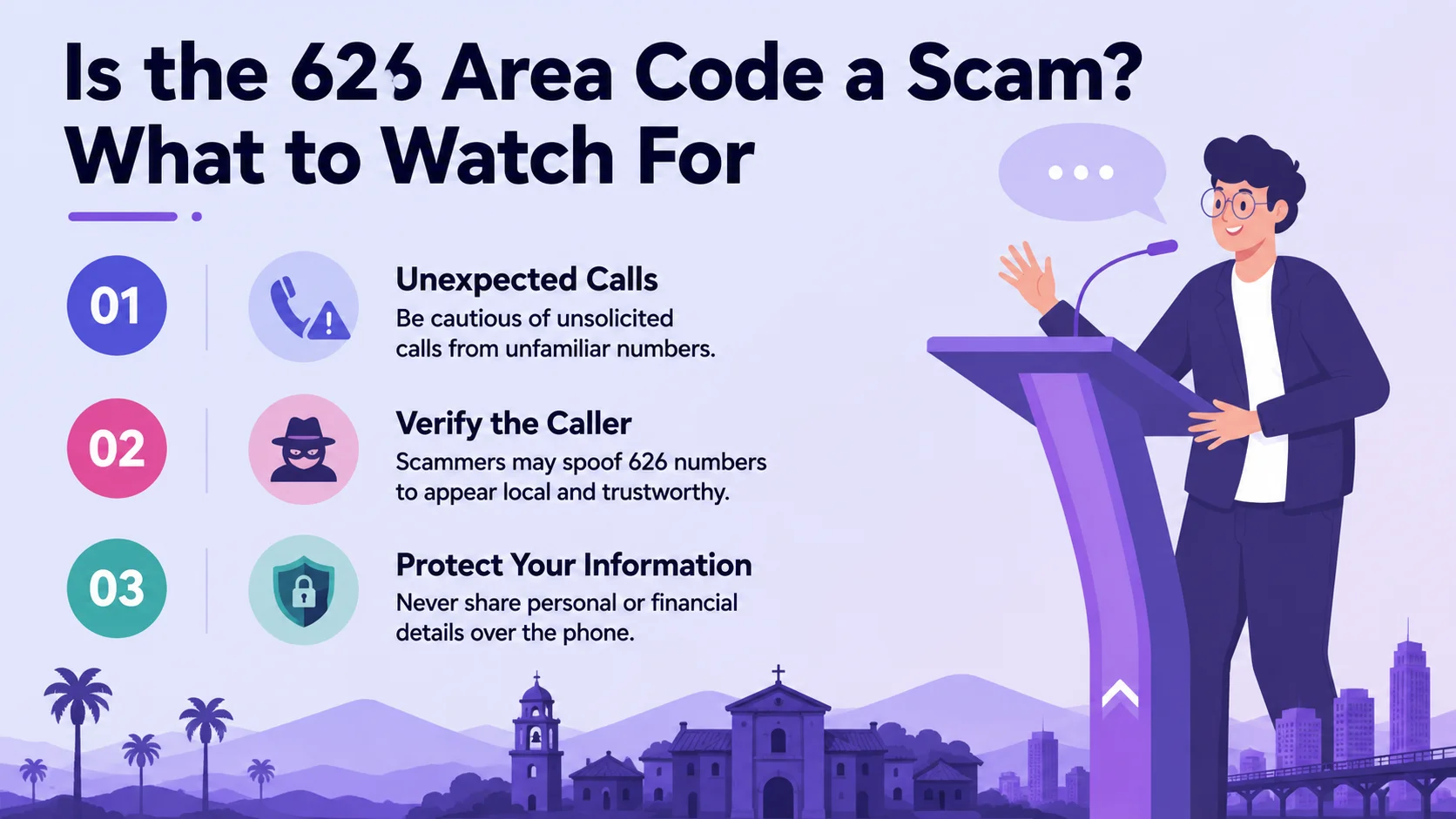
Common scam patterns tied to this prefix include fake Social Security Administration threats demanding immediate payment, robocalls claiming a vehicle warranty is about to expire, and wrong-number text messages designed to move victims into a WhatsApp conversation before running a longer con.
If you receive a suspicious call, avoid sharing personal or financial details and verify the caller independently before acting on anything they say. The Federal Communications Commission publishes ongoing guidance on caller ID spoofing that explains how these scams work and how to report them.
8Why Businesses Choose Local Phone Numbers
Businesses in the San Gabriel Valley, and companies hoping to reach customers there, often prioritize a local area code over a generic toll-free or out-of-state number. Research consistently shows people answer and return calls more readily when the caller ID looks familiar, and a matching prefix signals that a company understands the local market.
Local phone numbers also build a foundation of customer trust that toll-free lines rarely achieve on their own. Virtual phone numbers make this kind of local presence achievable without leasing office space in Pasadena or Alhambra — a cloud phone system lets a fully remote team answer calls, send texts, and route voicemail through a single dashboard while displaying a number that looks completely local.
A few tips help narrow down the right choice: confirm the provider actually holds inventory in the target prefix rather than reselling from a third party, check whether number porting is included at no extra cost, and look for built-in call recording or an AI receptionist if the line will handle real customer volume. Softtop is one example of a provider that issues local business numbers in this region, alongside call routing, an AI receptionist, and CRM integrations built for teams that never set foot in the area they serve.
9How to Get a 626 Area Code Phone Number
Getting a number here no longer requires a physical office in the San Gabriel Valley. Cloud-based providers like Softtop can provision a local number in minutes, with calls routed to a desk phone, mobile app, or shared team inbox anywhere in the world.
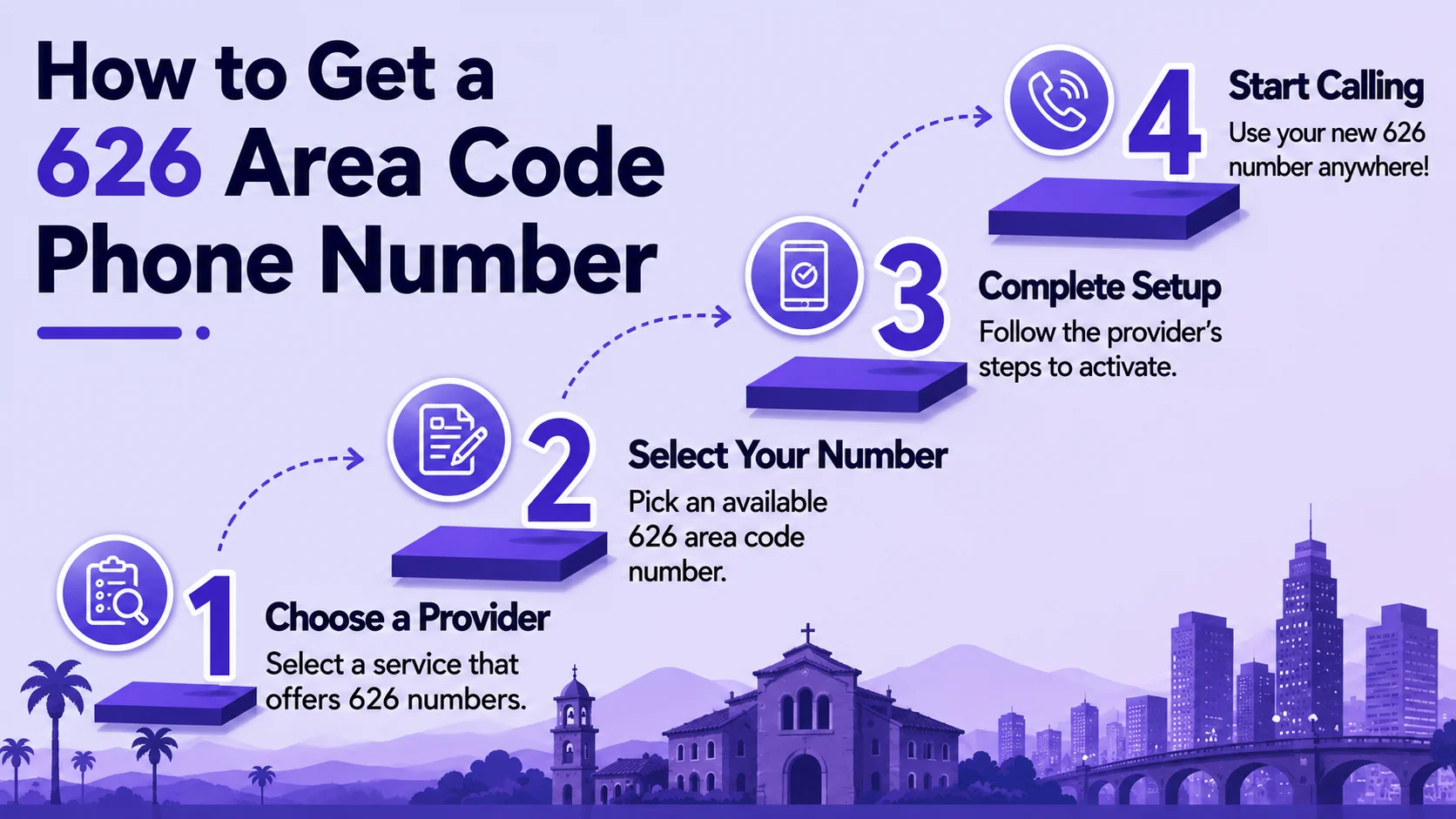
The process typically involves choosing a provider with real inventory in this prefix, selecting an available number, assigning it to a team or an AI receptionist, and going live immediately. Businesses switching from another provider can usually port an existing number over within five to ten business days with no port-out fees.
10Conclusion
The 626 area code has anchored the San Gabriel Valley's identity since 1997, growing from a single split off the original 818 prefix into one of California's most recognizable regional codes. It now shares its territory with the newer 840 overlay, requires 10-digit dialing for every call, and runs entirely on Pacific Time. Scammers borrow its familiarity through caller ID spoofing, but area code 626 itself remains exactly what it has always been: a legitimate marker of a real Los Angeles County community.
For businesses, claiming a local number is one of the simplest ways to build genuine credibility in a market of more than a million residents. A cloud phone platform removes the old barriers of leasing office space or running physical lines, letting any team look and sound local from day one. Whether you're verifying an unexpected call or planning your next regional expansion, the 626 area code offers a straightforward path forward.