1Introduction
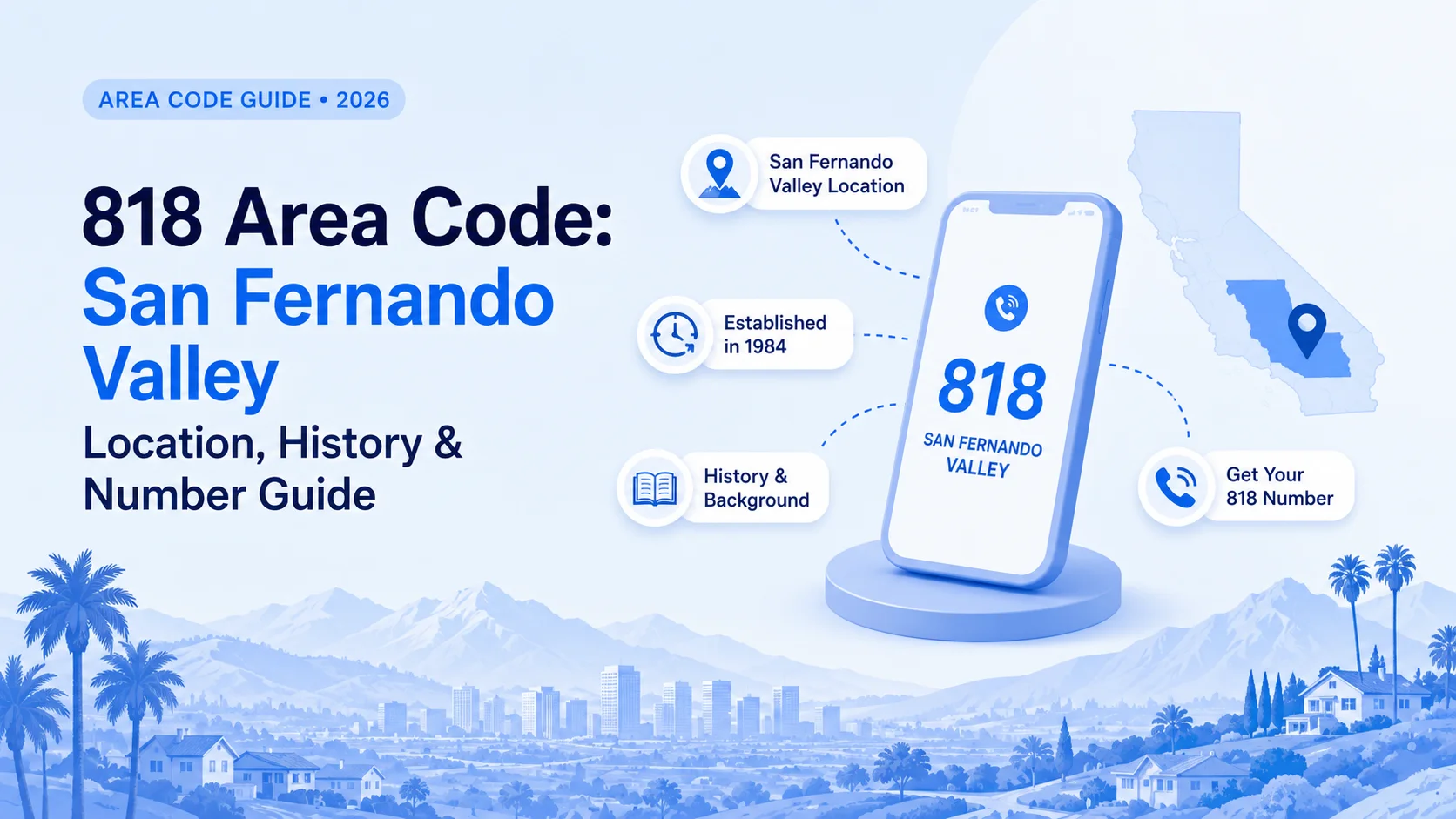
Few three-digit prefixes carry as much California identity as the 818 area code. Stamped on the phone lines of Burbank soundstages, Glendale storefronts, and North Hollywood apartments alike, 818 has been the dial tone of the San Fernando Valley since the mid-1980s. If a call, text, or business listing shows this prefix, it's rooted in one of Los Angeles County's largest and most economically diverse regions.
This guide covers everything worth knowing about the 818 area code: where it sits on the map, how it came to exist, how it relates to the newer 747 overlay, the correct way to dial it, and what it takes to claim an 818 number for your own business — even if you're nowhere near California.
2What Is the 818 Area Code?
The 818 area code is a North American Numbering Plan (NANP) code assigned to the San Fernando Valley and a handful of adjoining communities within Los Angeles County, California. It sits entirely inside the Pacific Time Zone, observing PST (UTC−8) in winter and PDT (UTC−7) during daylight saving months.
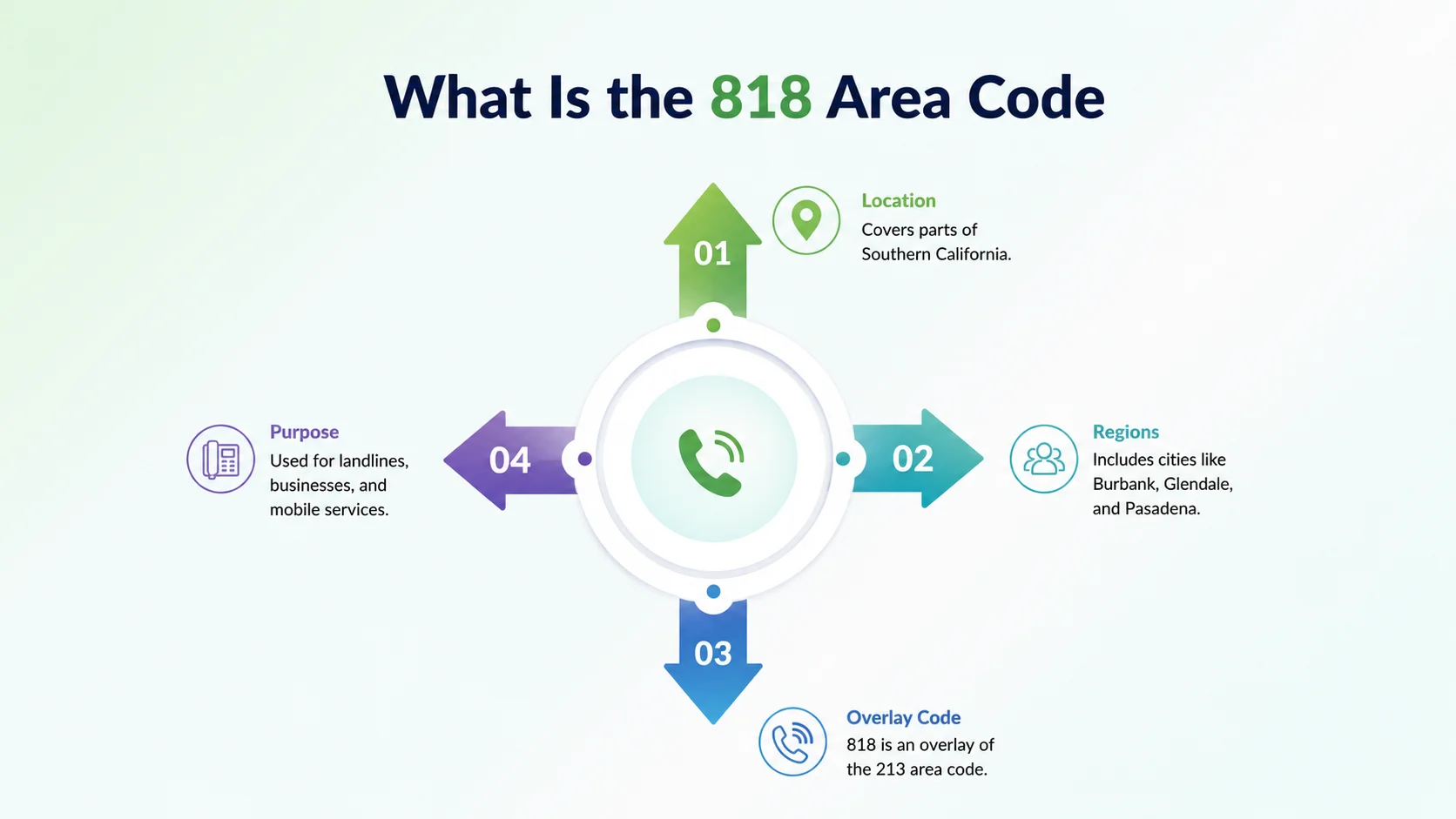
The 818 footprint covers roughly 500 square miles and serves a population well over a million. Mobile number portability means an 818 number today could belong to a cell phone, a VoIP line, or a traditional business phone system.
3Where Is the 818 Area Code Located?
The 818 area code location spans the northern half of the greater Los Angeles metro area, bounded by the Santa Susana and San Gabriel Mountains to the north and the Hollywood Hills to the south. It does not reach Downtown LA, Santa Clarita, or Pasadena — those fall under 213/323, 661, and 626 respectively.
Cities and communities commonly associated with the 818 area code include:
- Burbank — home to major film and TV studio lots
- Glendale — one of LA County's largest commercial hubs
- North Hollywood — arts district and entertainment corridor
- Van Nuys — the Valley's civic and transit center
- Sherman Oaks and Encino — retail and professional-services corridors along Ventura Boulevard
- Woodland Hills, Tarzana, Reseda, Canoga Park, Northridge, Chatsworth — western and central Valley communities
- Studio City and Universal City — media and production hubs
- San Fernando, Calabasas, Agoura Hills, Westlake Village, and La Canada Flintridge — surrounding cities and unincorporated areas
4A Brief History of the 818 Area Code
Understanding the backstory explains why the Valley now shares its numbering territory with a second code:
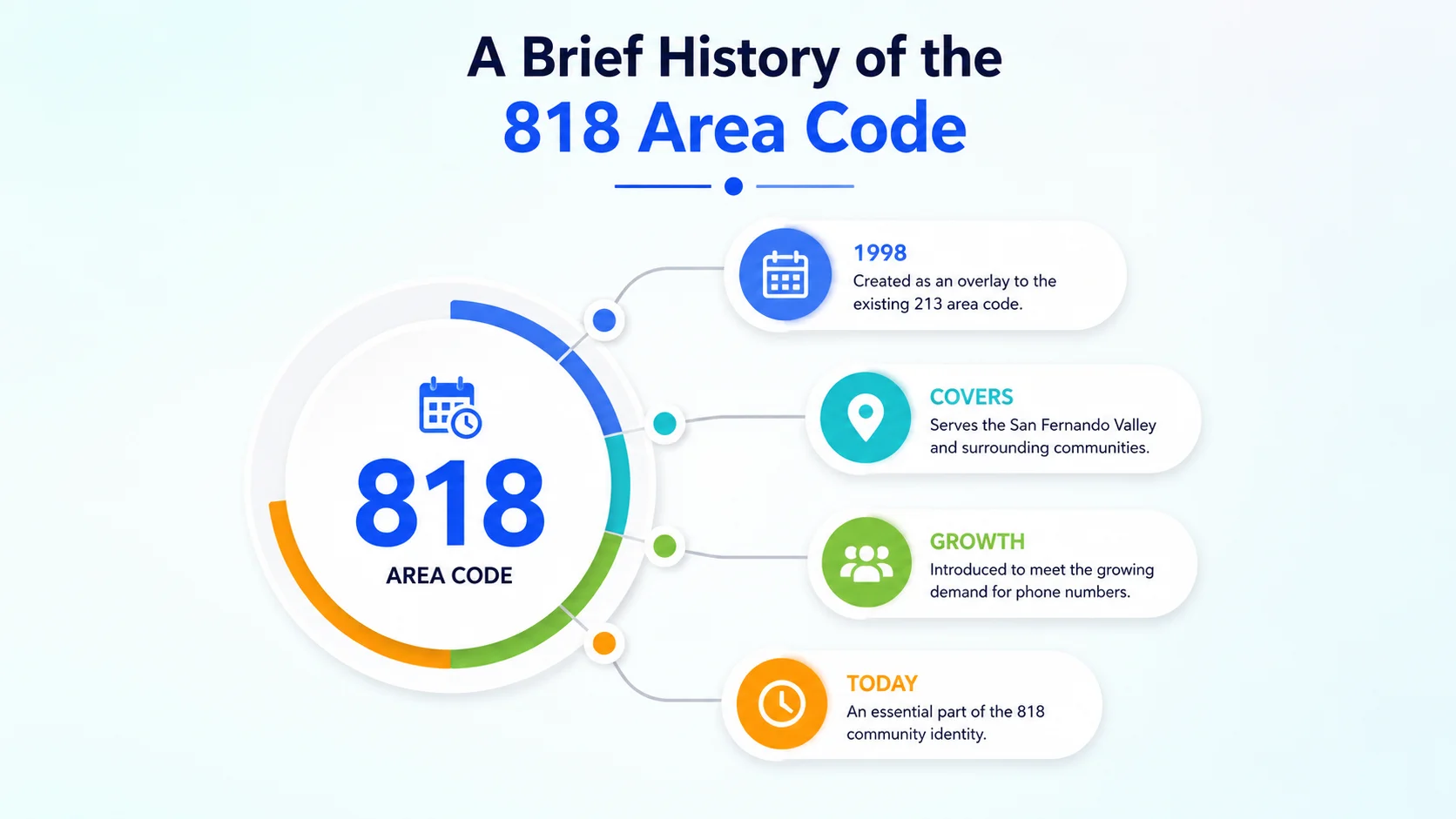
- 1947: California's original numbering plan assigns nearly all of Los Angeles County to a single code, 213
- 1984: Growing phone demand strains 213's supply, so regulators split the San Fernando Valley into a new code, 818
- 1997: The San Gabriel Valley, previously part of 818's territory, splits away to form 626, narrowing 818 to its current footprint
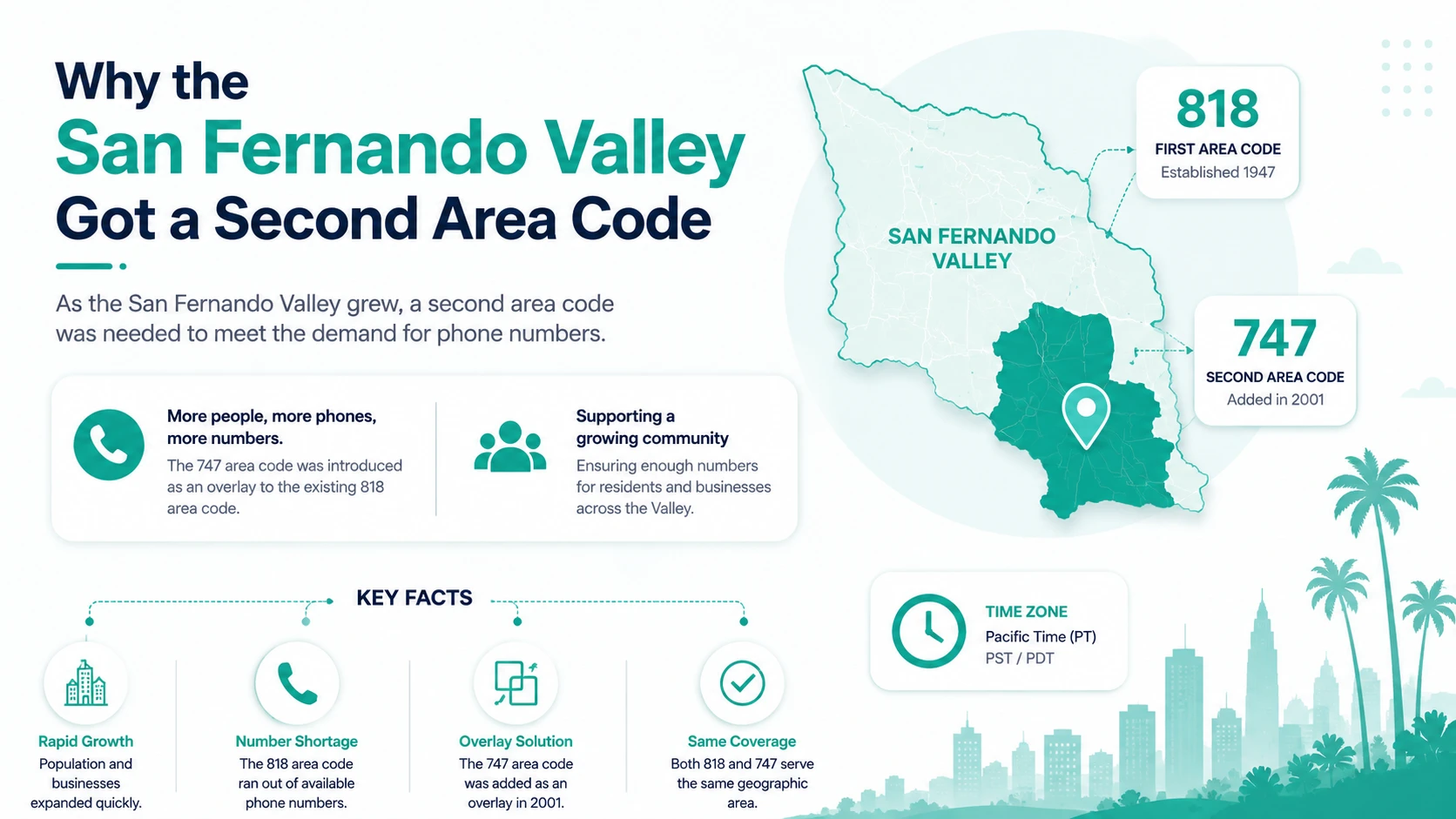
- 2009: With landlines, mobiles, and VoIP numbers all drawing from the same pool, regulators add 747 as an overlay rather than splitting the Valley again
That last decision is why every call in the region — even next-door neighbors — now requires 10-digit dialing, the same overlay arrangement covered in our 747 area code guide.
5818 vs. 747: What's the Difference?
Because 747 was added as an overlay rather than a geographic split, it shares the exact same service area as 818. There's no functional difference between the two for callers — both ring through normally and can be assigned to landlines, mobiles, or VoIP numbers.
- Existing 818 numbers were never reassigned or renumbered when 747 launched
- New numbers issued in the Valley today may come from either the 818 or 747 pool, depending on availability
- Because it's the older code, an 818 number is sometimes viewed as slightly more established — though that's a matter of perception, not function
6How to Dial an 818 Number
Because 818 and 747 overlap the same geography, the Area code 818 on Wikipedia requires 10-digit dialing for every call placed within the area — local calls included.
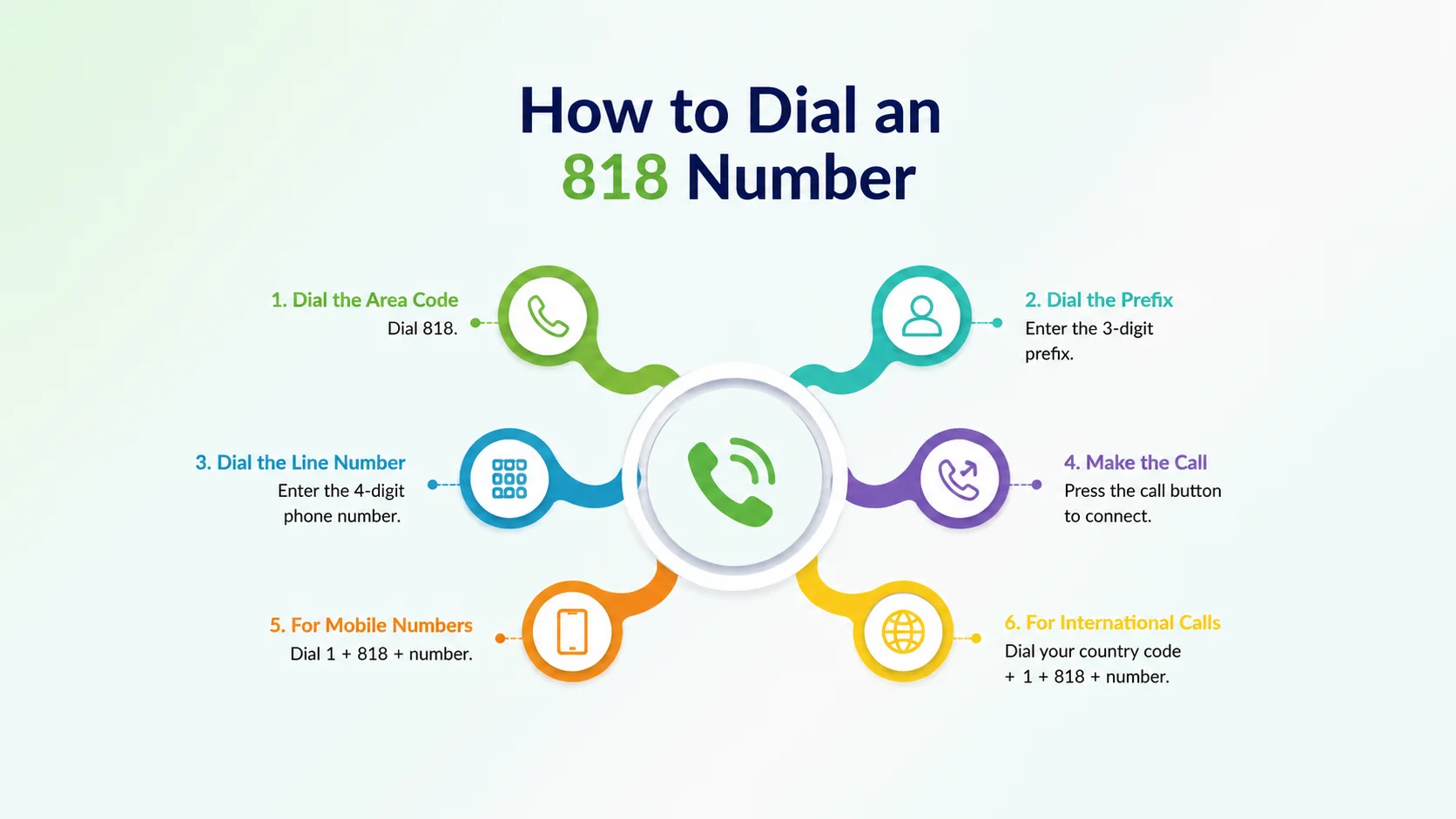
- Local and domestic calls: Dial the full 10 digits — 818-XXX-XXXX. Seven-digit dialing no longer works, even between two 818 numbers
- Calling from outside the US: Dial your country's exit code, then the US country code (+1), then the 10-digit number — for example, from the UK, 00-1-818-XXX-XXXX
- Calling internationally from an 818 number: Dial 011, then the destination country code, then the local number
7Why Businesses Choose an 818 Area Code Number
A local number does more than route calls — it signals where a business belongs. Companies serving the Valley, or wanting a foothold in it, often pick an 818 number for a few concrete reasons:
- Local answer rates: Valley residents and businesses are more likely to pick up a call from a familiar area code than an unfamiliar toll-free or out-of-state number
- Industry proximity: Burbank and the surrounding studios anchor a large share of the entertainment industry's production and post-production work, so an 818 number can carry weight with agencies, vendors, and production offices
- Everyday commerce: Healthcare providers, real estate agents, retailers, and service businesses across Glendale, Van Nuys, and the wider Valley use 818 numbers simply because that's where their customers are
- Expansion without an office: Businesses based elsewhere can establish a credible San Fernando Valley presence using a virtual 818 number, without leasing physical space in the region
The same expansion playbook works in reverse: a Valley business can just as easily pick up a 562 area code number to build a presence in Long Beach and southeastern LA County.
8How to Get an 818 Area Code Number
Getting an 818 number no longer requires a physical line installed by a local carrier. Most businesses today provision one through a cloud-based business phone platform:
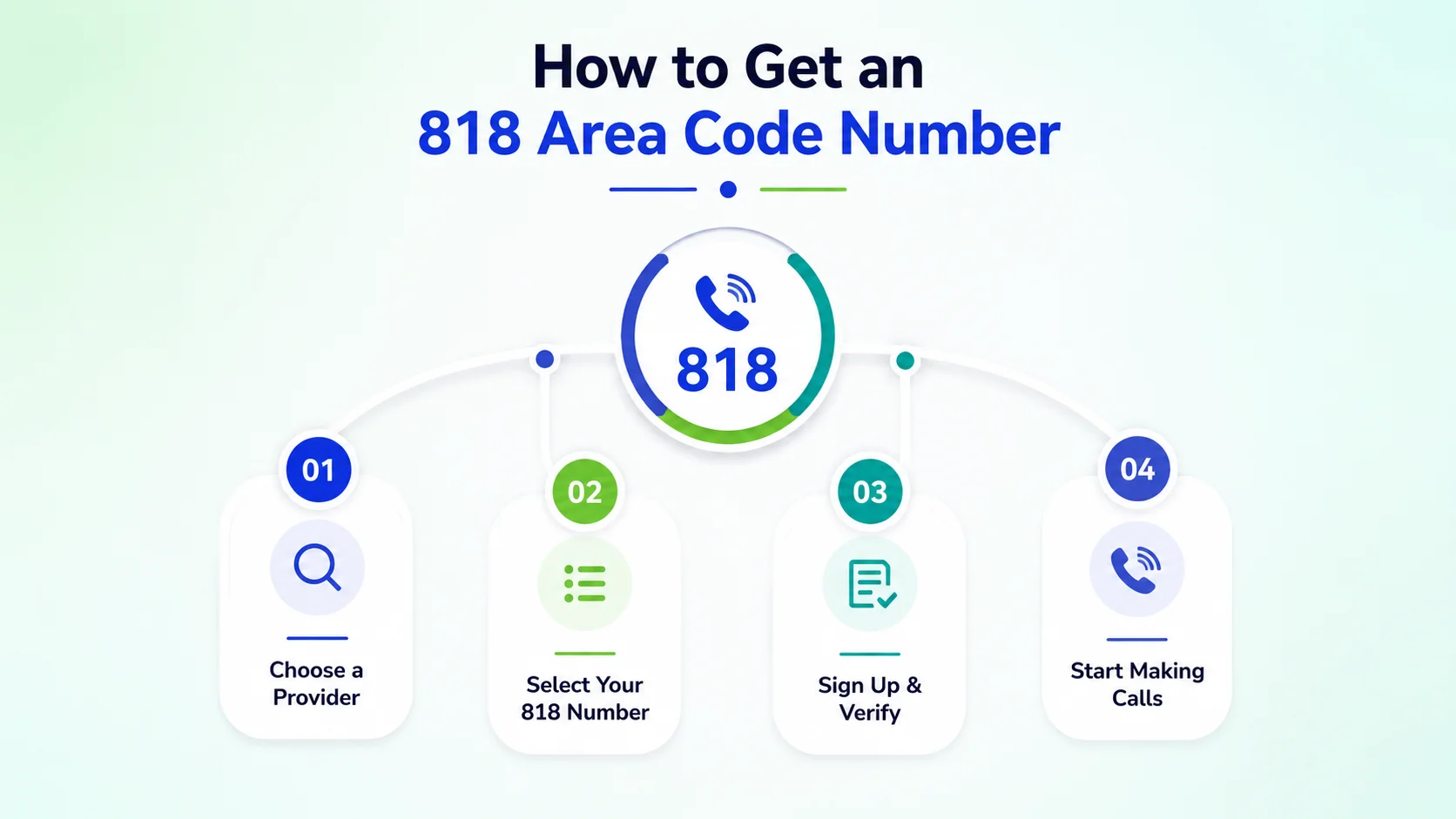
- 1Choose a provider — a cloud communications platform can issue an 818 number regardless of where your team is based
- 2Search available numbers — look for a standard line or a memorable vanity-style sequence
- 3Set up call routing — route calls to a desk phone, mobile device, or an auto-attendant
- 4Turn on the features you need — voicemail transcription, call recording, SMS, and after-hours AI answering
- 5Port an existing number if you have one — reputable providers transfer it without downtime
Softtop's Business Phone plans include local numbers across every US area code — 818 included — provisioned instantly with no hardware required. Every line also comes with an AI Receptionist that answers in under a second, so a Valley-based line never goes to voicemail during a busy call spike. Businesses switching providers can port an existing 818 number in 5–10 business days with zero port-out fees.
9Avoiding Scams Tied to the 818 Area Code
The recognizability that makes 818 valuable for legitimate businesses also makes it attractive to scammers using caller ID spoofing — a fake local number designed to increase the odds a call gets answered. Common patterns include government or agency impersonation, fake utility shutoff threats, and prize or debt-collection pressure tactics.
To protect yourself: never share payment or personal information with an unexpected caller — hang up and call the organization back on a verified number. Use a phone platform with built-in spam and spoofing detection, ask your provider whether your line carries STIR/SHAKEN attestation, and report suspected spoofed calls to the Federal Trade Commission.
10Conclusion
The 818 area code has represented the San Fernando Valley since 1984 — a region that spans entertainment studios, dense residential neighborhoods, and a wide mix of local businesses. Its 1997 boundary change and the 2009 addition of the 747 overlay didn't diminish its identity; if anything, 818 remains the more established of the two codes serving the Valley today.
Whether you're trying to identify an incoming call, planning a move to the area, or building a local presence for your business, understanding how 818 works — its coverage, its history, and its dialing rules — makes it easier to use with confidence. And for businesses that want that local footprint without opening a physical Valley office, a virtual 818 number paired with modern call routing and AI-assisted answering makes the process straightforward.