1Introduction
Not all area codes are the same. Some cover entire states. Others belong to just one city. The 210 area code fits the second group. It is the original phone prefix for San Antonio, Texas, one of the largest and fastest-growing cities in the United States.
Maybe you got a call from a 210 number and want to know where it came from. Maybe you're researching the area's telecom history. Or maybe you want a local 210 phone number to help your business connect with San Antonio customers. This guide covers everything you need to know.
You'll learn where the 210 area code reaches, how neighbor-spoofing scams work, and how to get your own local number. By the end, you'll have a clear picture of what 210 means — and how to make it work for you.
2What Is the 210 Area Code?
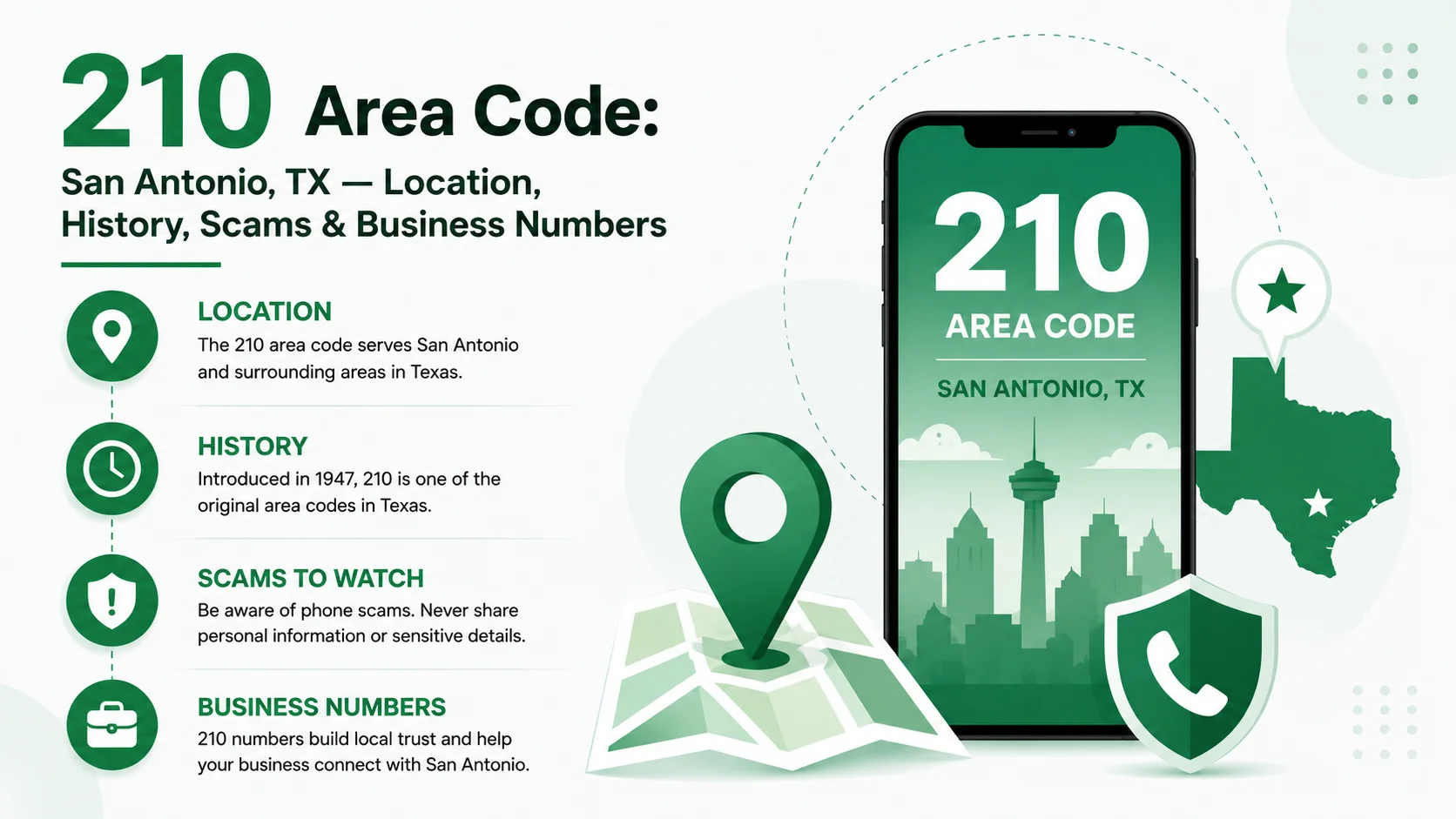
The 210 area code is a geographic telephone prefix for San Antonio, Texas and its surrounding metro area, under the North American Numbering Plan (NANP). Unlike toll-free prefixes such as 800 or 833, the 210 area code is tied to a location. It shows that the number comes from, or is registered to, the greater San Antonio region in south-central Texas.
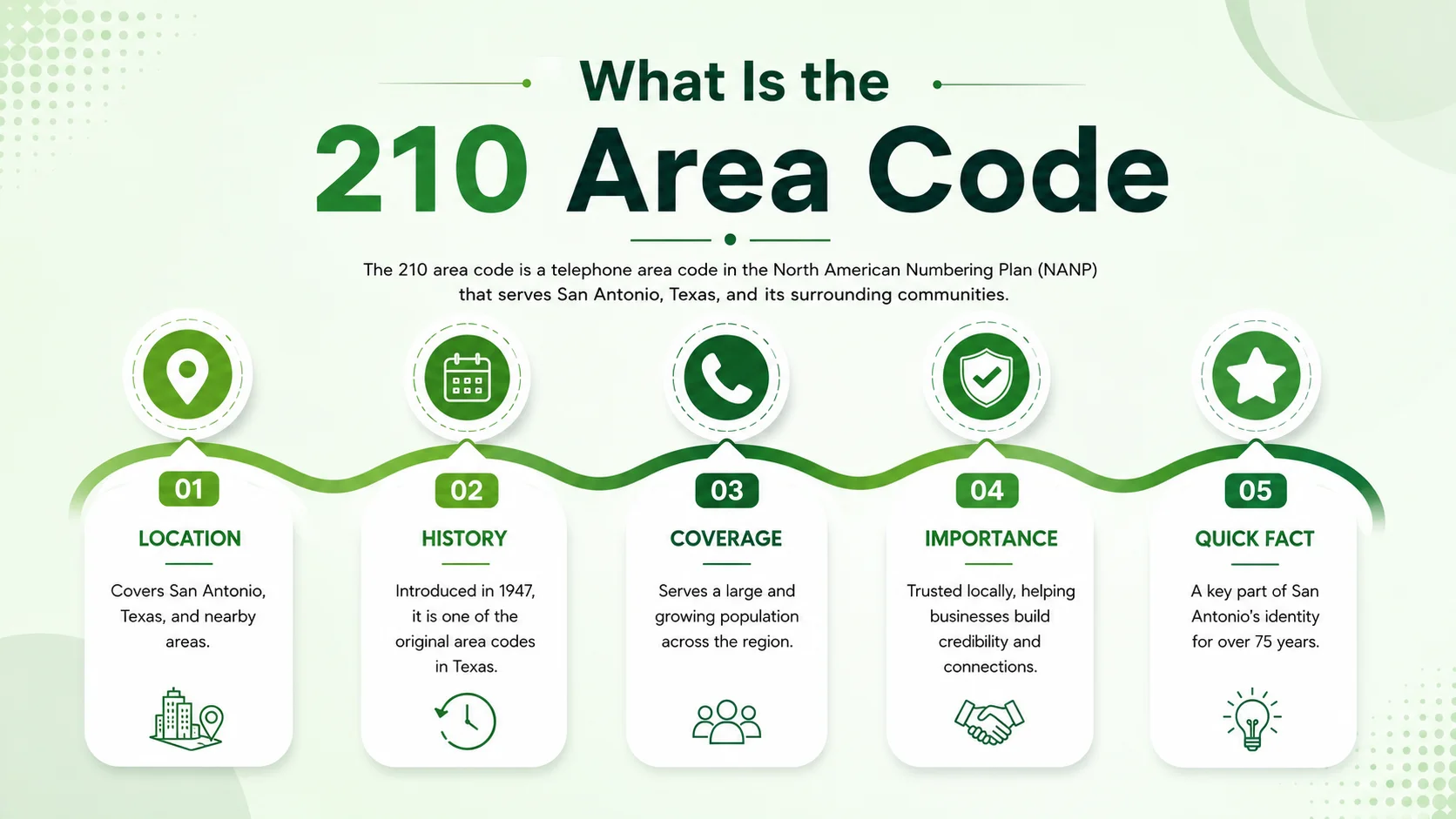
When a 210 number calls you, you can usually assume the call connects to San Antonio in some way. But VoIP and virtual number technology now let businesses located anywhere operate a 210 number and appear local in the region.
Quick facts about the 210 area code:
- State: Texas
- Primary city: San Antonio
- County: Bexar County (primary), with portions of Atascosa, Comal, Guadalupe, Medina, and Wilson counties
- Time zone: Central Time (CT) — UTC−6 in winter, UTC−5 in summer
- Overlay code: 726 (added to address number exhaustion)
- NANP region: United States
3Where Is the 210 Area Code Located? Cities & Counties
The 210 area code covers San Antonio and the dense suburbs that make up the Bexar County metro. San Antonio is the seventh-largest city in the United States by population. That makes 210 one of the most significant local area codes in the country.
Beyond the city limits, 210 also serves communities in five nearby counties. This includes parts of Comal County to the north, near the New Braunfels fringe, and Guadalupe County to the northeast. Over time, the less-populated outer reaches of the original 210 footprint were carved off and reassigned to area code 830. That code now wraps around 210 and handles the wider Hill Country and South Texas corridor.
Key cities and communities served by 210:
- San Antonio (the primary hub)
- Converse
- Leon Valley
- Kirby
- Live Oak
- Universal City
- Windcrest
- Schertz (portions)
If you're calling or getting a call from any of these communities, you're inside 210 territory.
4A Brief History of the 210 Area Code
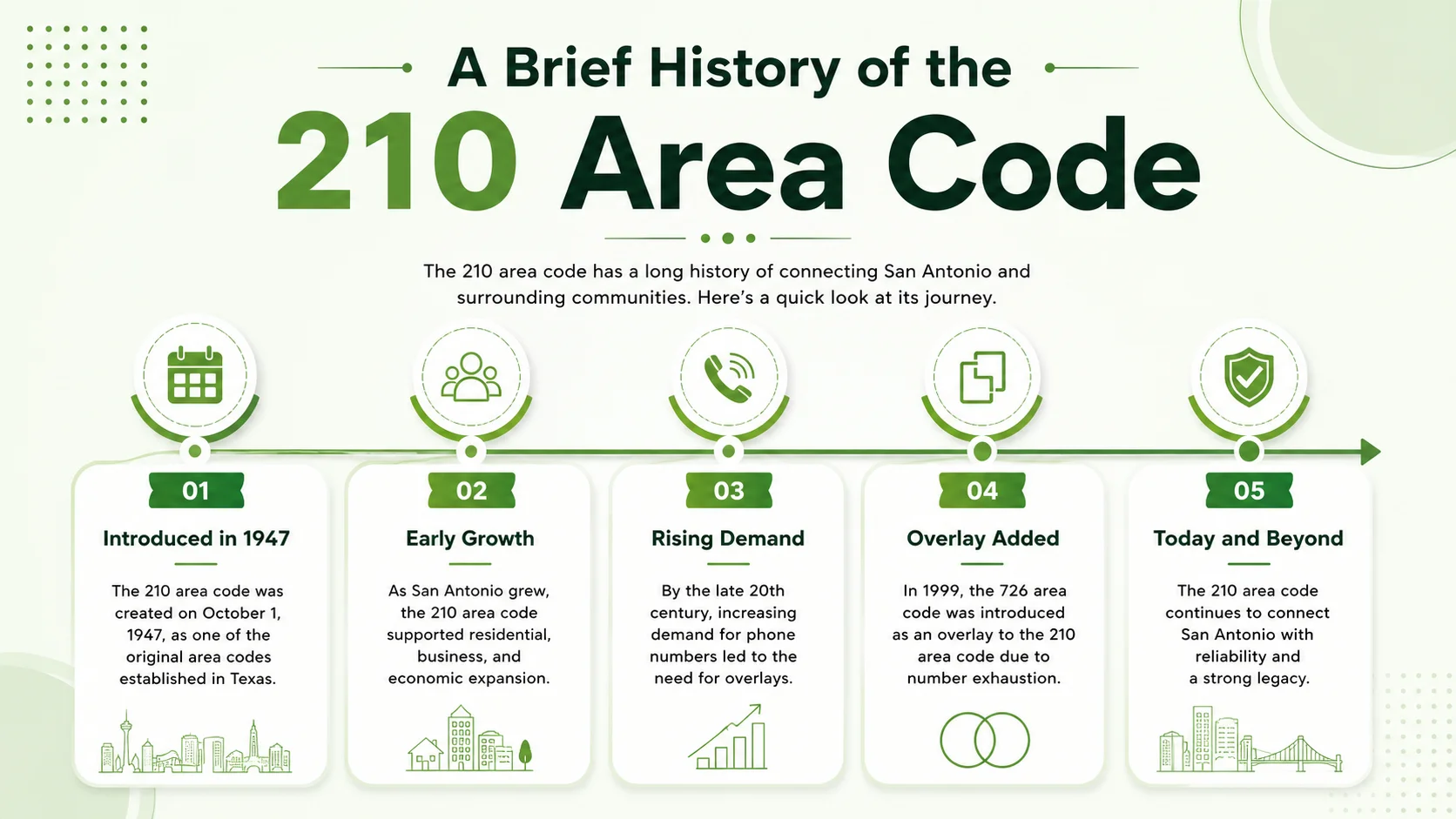
The 210 area code has roots in one of the biggest phone system changes in Texas history. Before 1992, San Antonio shared the sprawling 512 area code with Austin and a wide swath of central Texas. As the region's population and phone usage grew, regulators split 512 to give San Antonio its own dedicated prefix.
Area code 210 officially launched on November 1, 1992. It quickly became the phone identity of a city already proud of its culture, cuisine, and community. It stayed San Antonio's only prefix for over two decades — a remarkable run for one of the country's most populous metros.
By the mid-2010s, San Antonio's continued growth demanded more numbers than 210 had left. Rather than splitting the area code geographically, regulators chose an overlay approach instead.
5The 726 Overlay: What It Means for 210 Callers
When an area code runs low on number combinations, regulators have two options. They can split the region geographically, or overlay it with a new prefix that covers the same footprint. San Antonio chose the overlay route: area code 726 was introduced in 2017 to share coverage with 210 across the same territory.
For callers and businesses, the overlay means two things. First, new San Antonio subscribers may get a 726 number instead of a 210 number — both are equally local. Second, 10-digit dialing became mandatory across the 210/726 region. Even calls between two neighbors must now include the full area code. If your business phone system still defaults to 7-digit local dialing in San Antonio, it needs to be updated.
6Is the 210 Area Code a Scam? What to Watch For
The 210 area code is entirely legitimate. It serves millions of real residential and business subscribers across San Antonio. But it has also drawn heavy attention from phone fraudsters — particularly through a tactic called neighbor spoofing.
Neighbor spoofing is when a scammer disguises their caller ID to display a number that shares your area code, and sometimes even your exchange, the first six digits. The goal is simple: local-looking calls get answered. According to data from call-intelligence firm Hiya, the 210 area code has ranked among the top five most-spoofed area codes in the United States. That makes San Antonio residents especially vulnerable.
Common scam patterns using 210 numbers:
- Health insurance robocalls — the most frequently reported scam type linked to 210, often impersonating major insurers
- Medicare/Medicaid fraud — callers claiming you qualify for benefits or need to update your information immediately
- Auto warranty scams — high-pressure pitches for extended car warranties
- Property cash-offer spam — aggressive SMS and voice blasts urging homeowners to sell quickly
- IRS impersonation — threats of arrest or fines to pressure payments via gift card or wire transfer
How to protect yourself from 210 scam calls:
- 1Let unknown numbers go to voicemail — legitimate callers leave messages; scammers rarely do.
- 2Never provide personal or financial information to an unsolicited caller, even if the number looks local.
- 3Search the number online before calling back; scam databases often surface known fraud numbers within hours.
- 4Use carrier-level call filtering (AT&T ActiveArmor, T-Mobile Scam Shield) or third-party apps to flag suspicious numbers.
- 5Report suspicious 210 calls to the FTC at reportfraud.ftc.gov and to your carrier.
7Why Businesses Choose a 210 Local Phone Number
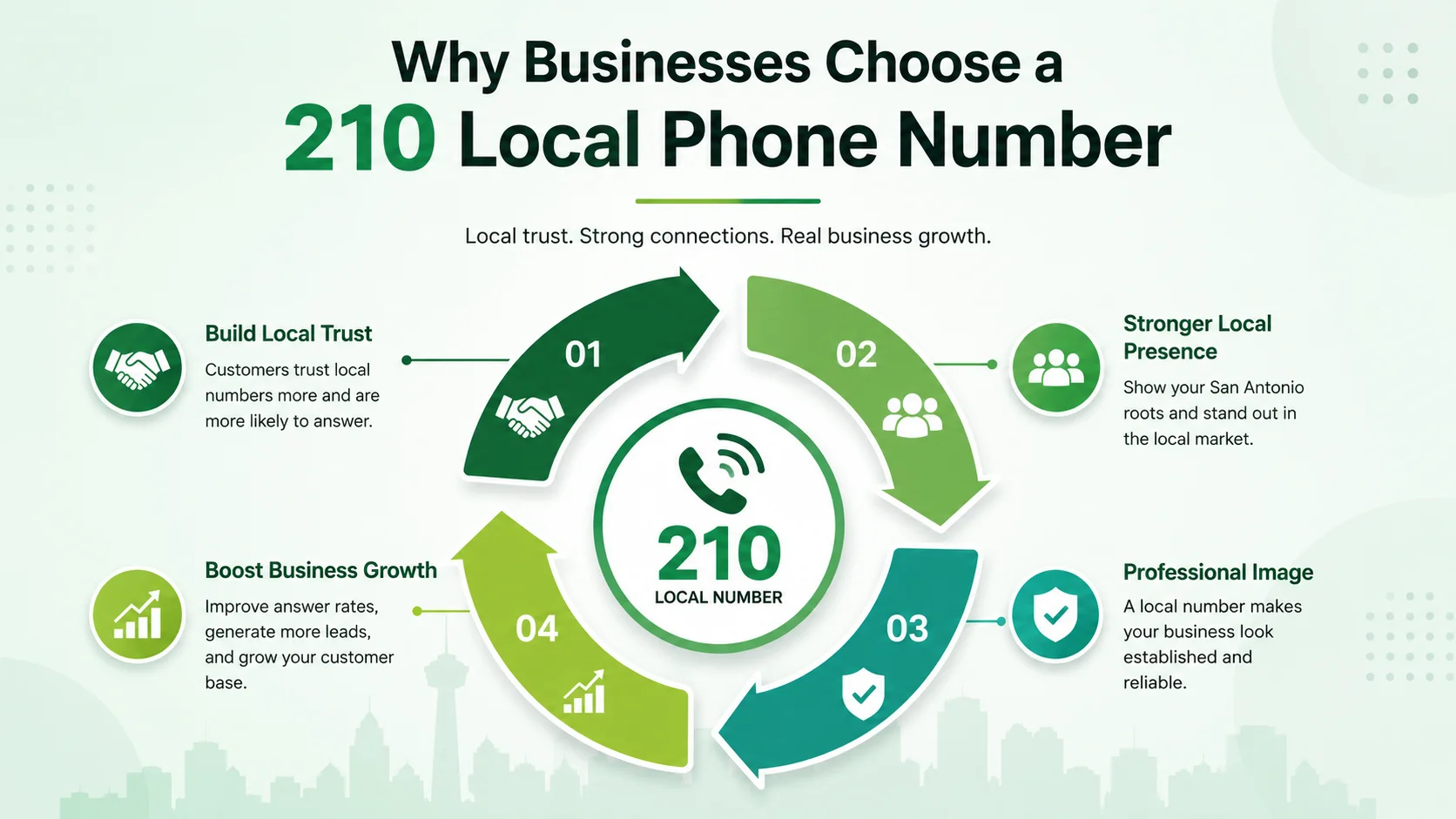
For any company targeting customers in San Antonio and surrounding Bexar County, a business phone with a 210 local number offers real advantages over toll-free or out-of-state alternatives.
Studies consistently show that local numbers get much higher answer rates than unfamiliar area codes or toll-free prefixes. San Antonio residents are more likely to pick up when they recognize a 210 number as part of their community. That one factor can significantly improve lead conversion and customer satisfaction.
Businesses expanding across multiple Texas markets often pair a San Antonio line with a 713 area code number to reach Houston too, covering two of the state's largest metros from a single cloud platform.
Key business benefits of a 210 area code number:
- Local trust signal: A 210 number tells San Antonio customers you're part of their market, not a distant call center.
- Higher answer rates: Local area code calls are answered more often than toll-free or out-of-state numbers, particularly on mobile devices.
- No geographic limitations: With VoIP, your team can answer 210 calls from anywhere — a remote office, a home desk, or a mobile app — without appearing non-local.
- Cost-effective reach: A single cloud-hosted 210 number can serve an entire distributed team without physical infrastructure in Texas.
- CRM and analytics integration: Modern VoIP platforms log every 210 call, attach it to contact records, and surface metrics like call duration, response time, and conversion rates.
- Scalability: Need multiple 210 numbers for different departments, campaigns, or agents? Virtual number provisioning lets you spin them up instantly.
- Competitive differentiation: In crowded local markets, a recognizable 210 presence distinguishes you from competitors using generic 800 numbers.
8How to Get a 210 Area Code Number for Your Business
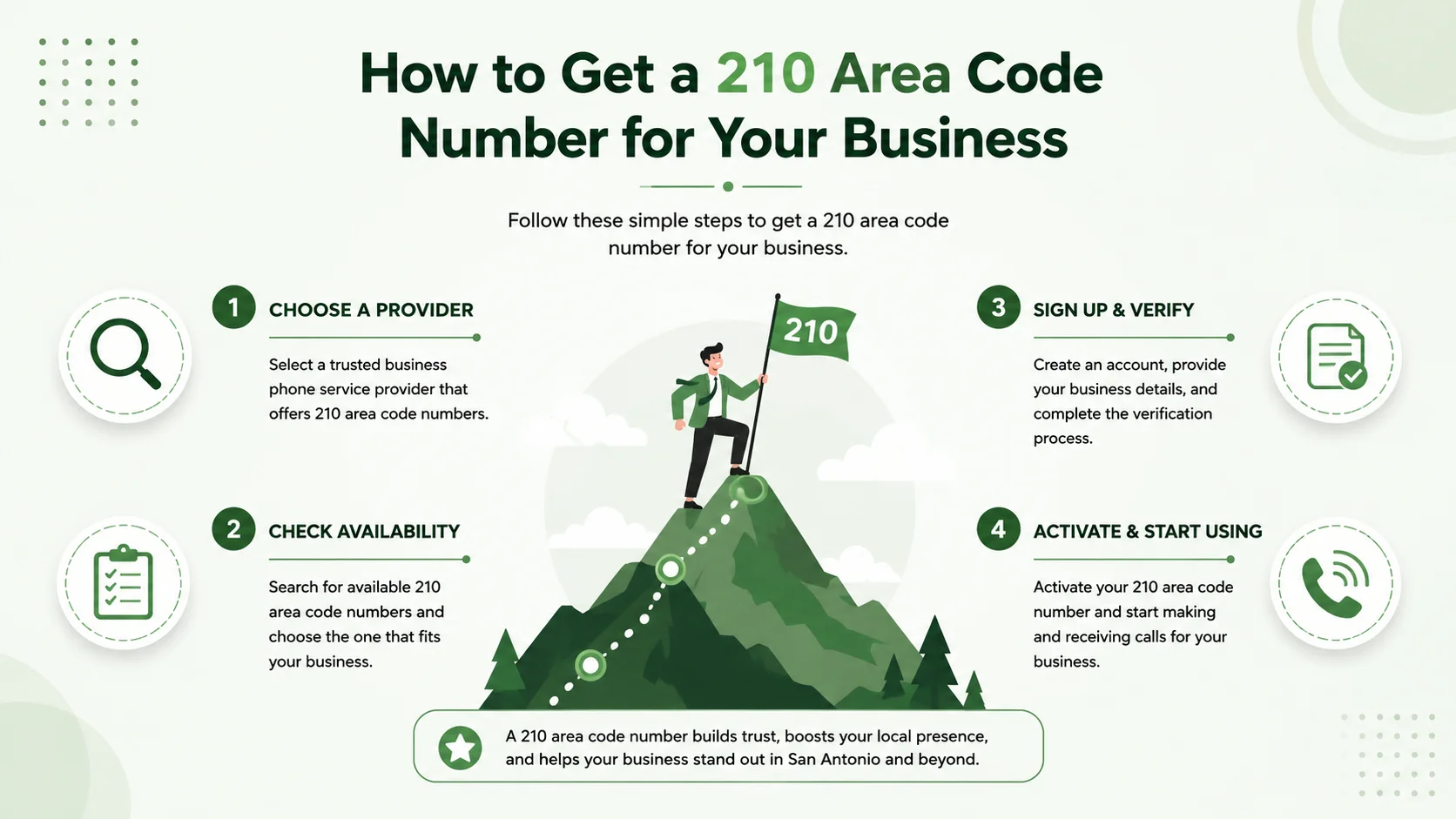
Getting a 210 local phone number is easy with a modern VoIP or cloud communications provider. Here's how the process works:
- 1Choose a provider that offers NANP local number provisioning in Texas, with 210 inventory available. Prioritize platforms that bundle calling with features like IVR, SMS, call recording, and CRM integrations.
- 2Search available numbers. Most providers offer a real-time lookup tool. You can filter by area code (210) and, in some cases, search for memorable digit patterns.
- 3Select a plan. Local number plans typically include unlimited or bundled inbound/outbound minutes, plus communication features.
- 4Configure your routing. Point your 210 number to a ring group, IVR menu, individual extension, or call queue — configurable from a web dashboard with no hardware required.
- 5Activate and go live. Provisioning is instant with most cloud providers. Your 210 number is active within minutes of completing setup.
Some businesses want voice, SMS, and unified contact center capabilities all under one roof — including local numbers for San Antonio and coverage across 150+ countries. Choosing a full-stack telecom provider makes billing and management much simpler.
9Conclusion
The 210 area code is San Antonio through and through — a local prefix that carries the identity of one of America's most vibrant cities. For residents, understanding 210 helps you tell legitimate local calls apart from the neighbor-spoofing scams that plague the region. For businesses, a 210 number is one of the most effective tools for building instant trust with San Antonio customers, no matter where your team is physically located.
Whether you're verifying an incoming call, researching Texas area codes, or ready to establish a local San Antonio presence, the 210 area code is your starting point. Getting one takes minutes — and the credibility it delivers lasts for as long as you use it.
10Frequently Asked Questions
What city does the 210 area code belong to?
The 210 area code primarily serves San Antonio, Texas — the seventh-largest city in the United States. It covers Bexar County and portions of the surrounding counties including Atascosa, Comal, Guadalupe, Medina, and Wilson.
Is the 210 area code a scam?
No — 210 is a legitimate geographic area code for San Antonio. However, scammers frequently use neighbor spoofing to fake 210 caller IDs. If you receive an unexpected call from a 210 number requesting money or personal information, verify the caller's identity independently before responding.
What is the 726 area code, and how does it relate to 210?
Area code 726 is an overlay code introduced in 2017 to serve the same geographic area as 210. Both cover San Antonio and the surrounding region. Because they share the same footprint, 10-digit dialing is required for all local calls in the area.
Can a business outside Texas get a 210 area code number?
Yes. VoIP and cloud phone providers allow businesses anywhere to register a 210 local number. Your team can answer calls from any device or location while appearing local to San Antonio customers.
When did the 210 area code start?
Area code 210 launched on November 1, 1992, when the original 512 area code — which covered both Austin and San Antonio — was split to give San Antonio its own dedicated prefix.
Softtop provisions local 210 numbers instantly with full VoIP features — IVR, call recording, SMS, and CRM integration. Explore local number plans to put your business on the San Antonio map today.