1Introduction
Two providers can quote the same $0.006/min headline rate and still bill you completely different amounts for the same call. The gap rarely comes from the rate itself — it comes from the billing mechanics underneath it: the increment a call is rounded to, whether your minutes are prepaid or postpaid, and how a committed-volume plan handles overage.
This guide breaks down exactly how wholesale minute billing works: per-second versus 6-second versus full-minute rounding, prepaid and postpaid bundle structures, committed-minute packages with overage terms, and the formula for calculating your true effective cost per minute across any of them. Softtop bills wholesale traffic in 1-second increments with no minimum call duration, so we have a direct interest in buyers understanding exactly what a rate sheet is not telling them.
The advertised per-minute rate is only half the story. Billing increment (1-second, 6-second, or per-minute rounding), prepaid vs. postpaid terms, and committed-plan overage rates can each swing your real cost by 10–30%. Always calculate effective cost-per-minute against your actual call-length distribution, not the rate sheet number.
2Billing Increments: Per-Second vs. 6-Second vs. Full-Minute Rounding
Every wholesale voice contract specifies a billing increment — the unit of time a call is rounded up to before the rate is applied. This single line item, often buried in a rate deck footnote, can matter more than the headline rate itself.
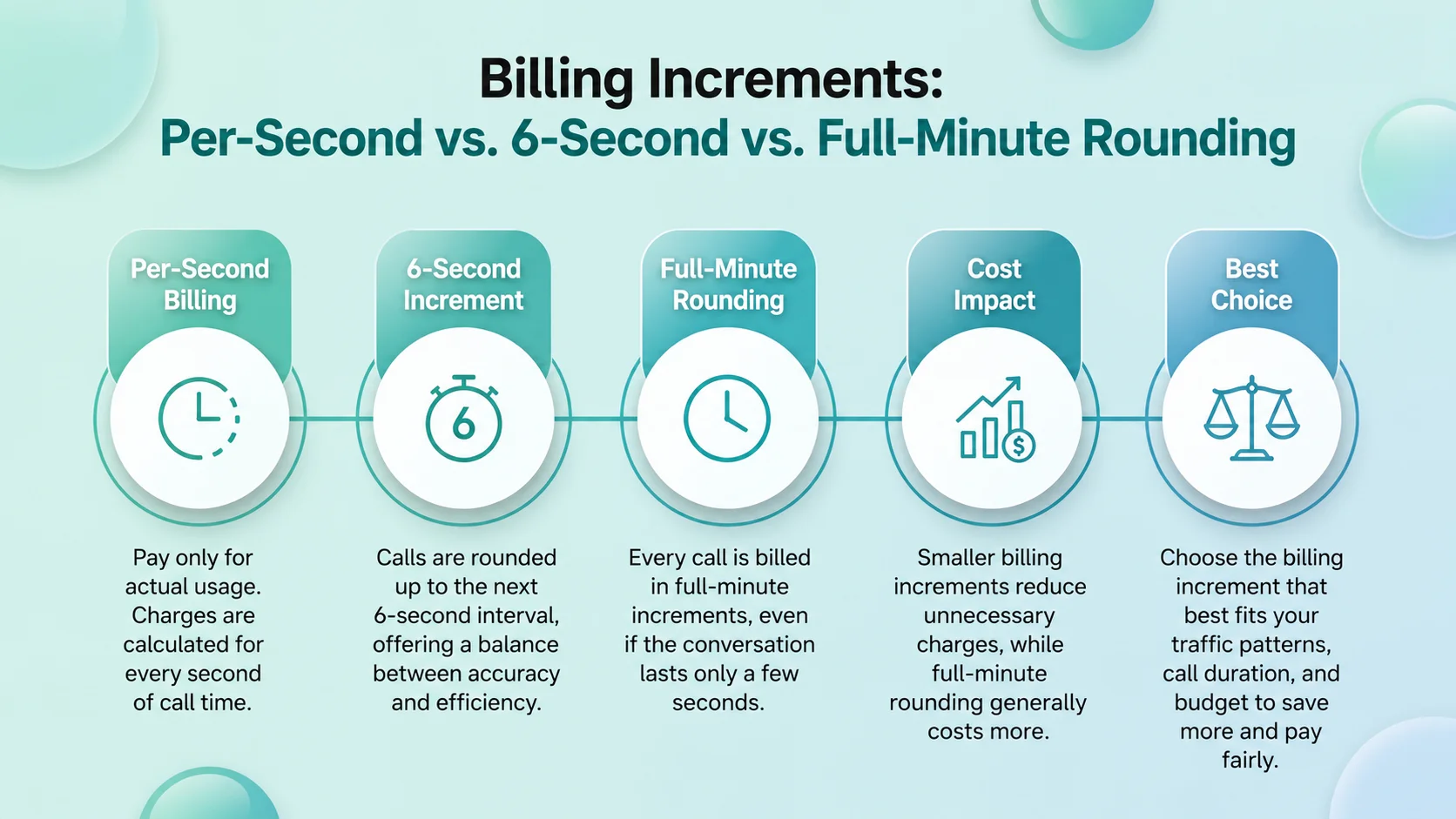
- 1/1 billing (per-second, no minimum) — every second is billed as used, from the first second of the call. A 17-second call bills as 17 seconds. This is the most precise and buyer-friendly model.
- 6/6 billing — calls are billed in 6-second blocks, rounded up. A 17-second call rounds up to 18 seconds. The distortion is small but compounds across millions of short calls.
- 1/60 or 60/60 billing (full-minute rounding) — any call under a minute is billed as a full minute, and calls are billed in whole-minute blocks afterward. A 17-second call bills as 60 seconds — more than 3x the actual usage.
Rounding overhead hits hardest on traffic with short average call durations — IVR verification, OTP delivery, click-to-call, and cold outbound dialing, where a large share of calls last under 20 seconds. A contact center running high call volumes with short handle times can pay a meaningfully higher effective rate under 60/60 billing than under 1/1 billing, even at an identical quoted per-minute price.
"Billed in minute increments" and "billed per minute, 1-second granularity" sound similar but describe opposite models. Ask a provider to state their billing increment explicitly — 1/1, 6/6, or 60/60 — before comparing quoted rates.
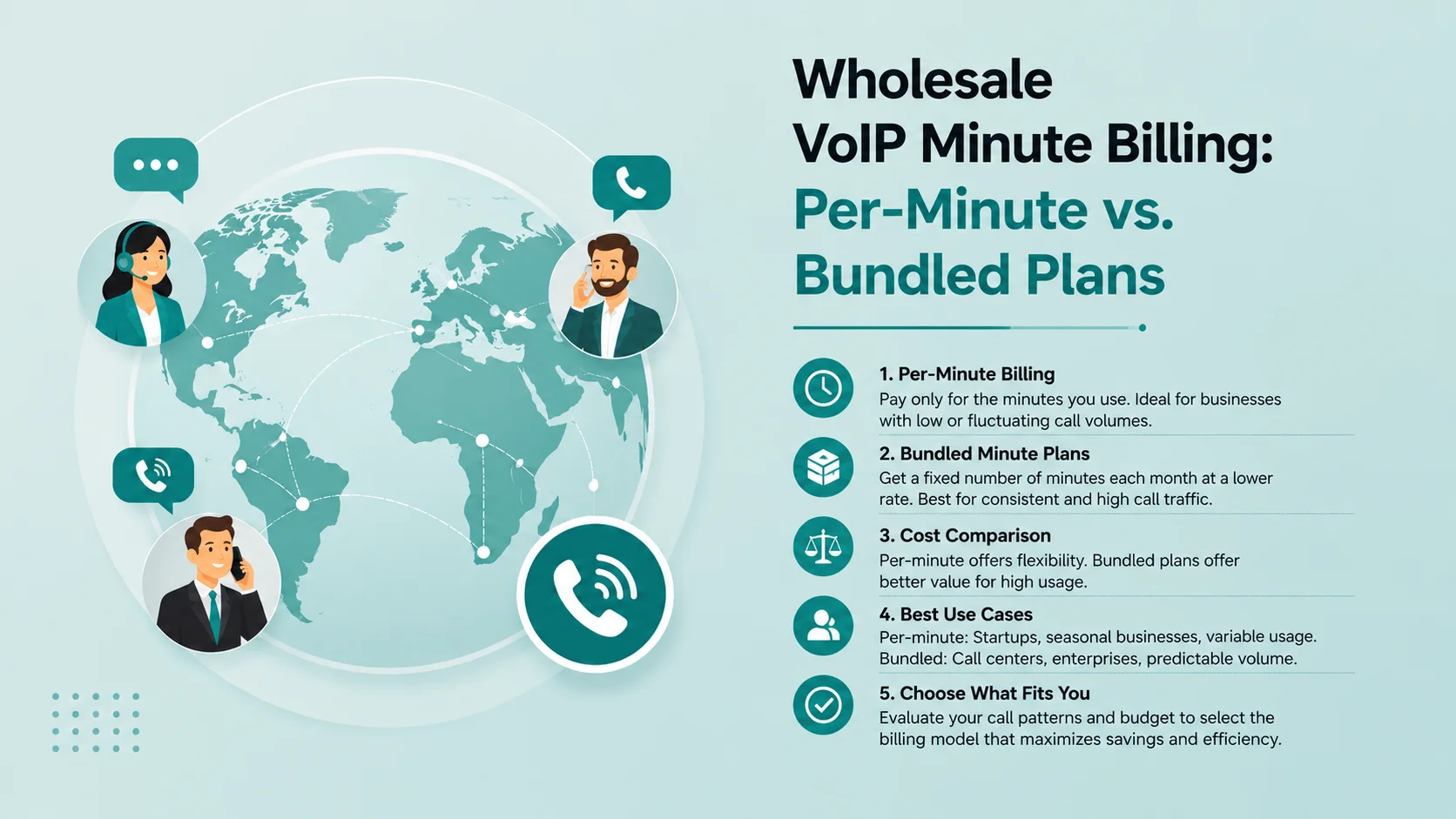
3Prepaid vs. Postpaid Minute Bundles
Beyond the increment, wholesale minutes are sold under one of two settlement models, each with different cash-flow and risk implications.
Prepaid Minute Bundles
You load a balance or purchase a fixed bundle of minutes upfront, and usage draws down against it in real time. Calls stop routing once the balance hits zero, unless auto-recharge is enabled. Prepaid suits newer accounts, variable or unpredictable traffic, and any business that wants to cap exposure without a credit relationship.
Postpaid Minute Bundles
You are extended a credit line and billed in arrears — typically monthly — against actual usage or a committed allowance. Postpaid suits established accounts with steady volume, since it removes the operational overhead of monitoring balance depletion mid-month, but it depends on the provider's credit terms and requires trust in the accuracy of your own invoice reconciliation.
Neither model is inherently cheaper — the settlement structure affects cash flow and risk exposure, not the underlying per-minute economics. What does affect economics is the plan structure layered on top: pure pay-as-you-go versus a committed-volume package.
4Committed-Volume Minute Packages and Overage Terms
High-volume buyers are often offered a committed-minute package: a fixed monthly minute allowance at a discounted blended rate, in exchange for a volume commitment. These plans reward predictable traffic but penalize both under- and over-use.
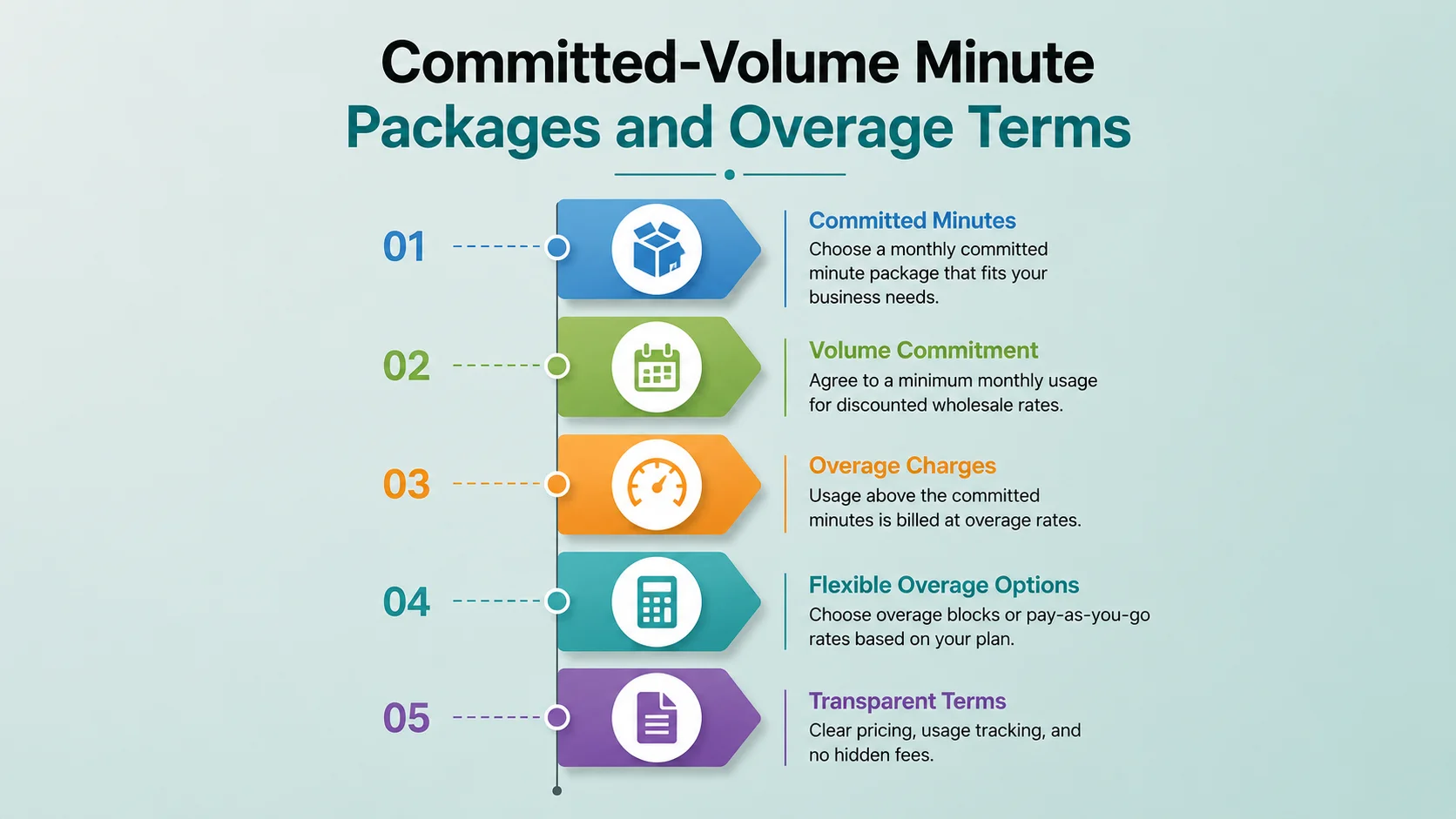
- Base allowance — a fixed number of minutes included in the monthly fee, priced lower per minute than pay-as-you-go because the provider can plan capacity around a guaranteed volume.
- Overage rate — the per-minute charge once you exceed the base allowance, frequently priced higher than the blended rate and sometimes higher than standard pay-as-you-go pricing. A plan built for 2M minutes that regularly sees 2.4M minutes of traffic can cost more overall than a plan with no commitment at all.
- Unused-minute treatment — some packages let unused minutes roll over one billing cycle; most forfeit them (a use-it-or-lose-it model), which quietly inflates your effective rate in any month you fall short of the committed volume.
- True-up and step-down clauses — annual contracts often include a true-up if you exceed volume repeatedly, or a step-down to a lower tier if you consistently underuse it — read both directions before signing a 12-month term.
Committed plans make the most sense when your monthly volume is stable and predictable within a narrow band. If your traffic swings by more than 20–30% month to month, the overage and forfeiture terms can erase the discount the base rate appeared to offer.
5How to Calculate Your True Effective Cost Per Minute
The only number that matters for comparing providers is effective cost per minute — total dollars billed divided by total minutes of actual talk time, using your own traffic pattern rather than a vendor's example.
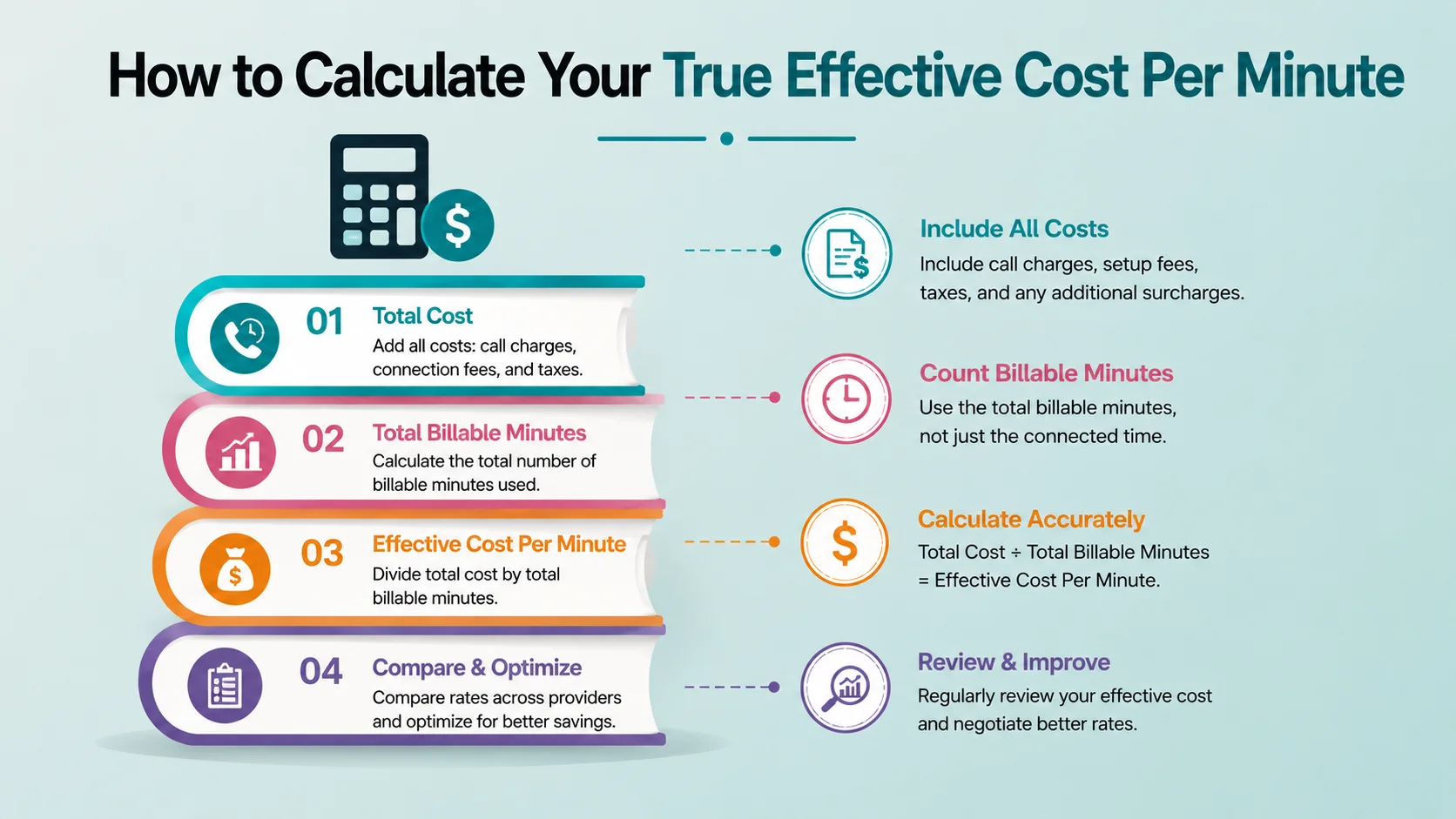
A simple three-step method:
- 1Pull a representative sample of your recent call detail records — ideally a full month, including your actual distribution of call lengths, not just an average handle time.
- 2Re-bill that exact call log under each candidate provider's stated increment, rate, and plan structure (pay-as-you-go, prepaid bundle, or committed package with its overage rate).
- 3Divide the resulting total charge by the total actual talk-time minutes in the sample. That number — not the quoted per-minute rate — is your effective cost per minute for that provider.
Running this calculation against two or three candidate rate decks routinely reorders which provider looks cheapest — a headline-low rate on 60/60 billing frequently loses to a higher headline rate on 1/1 billing once real call-length distribution is applied. Softtop's wholesale VoIP plans bill in 1-second increments with no rounding penalty, which is why the quoted rate and the effective rate stay close together.
1,000 calls averaging 25 seconds each = 25,000 seconds of actual usage (≈417 minutes). Under 1/1 billing at $0.006/min, that's ≈$2.50. Under 60/60 billing at the same $0.006/min, all 1,000 calls round up to a full minute each — 1,000 billable minutes, or $6.00. Same rate, 2.4x the bill.
6Conclusion
The per-minute rate on a wholesale rate sheet is a starting point, not the answer. Billing increment, prepaid versus postpaid terms, and the fine print on committed-volume overage and forfeiture clauses all move your real cost — sometimes by a wider margin than the rate itself.
Before signing with any provider, re-bill a real sample of your own call records under their stated structure and compare the effective cost per minute, not the quoted one. Softtop bills wholesale minutes in transparent 1-second increments with no hidden rounding, so the number on the rate deck is the number you actually pay.
7Frequently Asked Questions
What is a billing increment in wholesale VoIP?
It is the unit of time a call is rounded to before the per-minute rate is applied — commonly 1-second (1/1), 6-second (6/6), or full-minute (60/60) blocks. It determines how much of a short call gets billed as usage you did not actually generate.
Is 6-second billing better than per-minute billing?
Yes, for buyers with variable or short call durations. 6-second billing rounds far less aggressively than full-minute billing, so it typically produces a lower effective cost per minute for traffic like IVR calls, OTPs, or short outbound attempts.
What is the difference between prepaid and postpaid wholesale minutes?
Prepaid requires a funded balance that draws down as you use minutes, stopping traffic if it reaches zero. Postpaid extends credit and bills usage in arrears, usually monthly. The choice affects cash flow and risk exposure, not the underlying per-minute rate.
How does overage pricing work on a committed-minute plan?
You pay a discounted blended rate for a fixed monthly minute allowance. Minutes used beyond that allowance are billed at an overage rate, which is often higher than both the plan's blended rate and standard pay-as-you-go pricing — so consistent over-commitment can cost more than no plan at all.
Do unused committed minutes roll over?
It depends on the contract. Some providers allow a one-cycle rollover of unused minutes; most operate on a use-it-or-lose-it basis, which effectively raises your cost per minute in any month you fall short of the committed volume.
How do I calculate my true effective cost per minute?
Take a real sample of your call detail records, re-bill it under each provider's stated increment and plan terms, then divide the total charge by your total actual talk-time minutes. That result — not the quoted rate — is the number to compare across providers.